


How to Cut Plywood Without Splintering: Blade and Technique Guide
Splintering on plywood cuts, called tearout, happens when the saw blade exits the veneer face, lifting fibres instead of cutting them cleanly. It is one of the most common problems woodworkers face, and one of the most preventable.
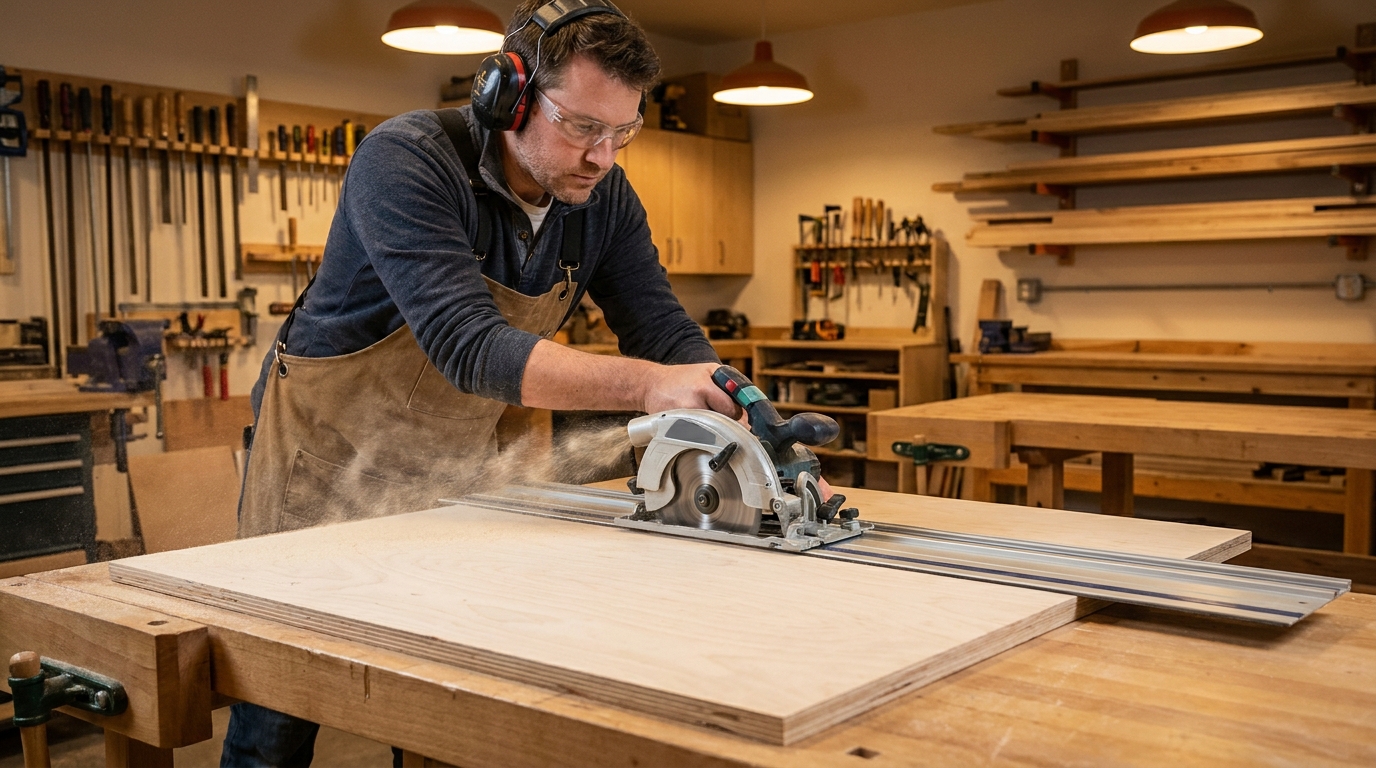
The fix is not a single trick. It is the combination of the right blade, the right cut direction, and a simple scoring step that takes 30 seconds. This guide covers all three, for every common cutting tool.

Why Plywood Splinters When Cut
Understanding the cause makes the fix obvious.
Plywood is cross-laminated veneer, alternating layers with grain running perpendicular to each layer above and below. When a saw blade exits through the top face veneer, the teeth lift the veneer fibres upward before cutting them. This is tearout, visible as splintering on the cut edge.
Three factors control how much tearout occurs:
- Blade tooth count: more teeth per inch means smaller chip load per tooth and a cleaner cut
- Tooth geometry: alternating top bevel (ATB) teeth slice fibres; flat-top (raker) teeth scrape them
- Cut face direction: the face toward the blade exits last; tearout occurs on the exit face, not the entry face
This means the same cut can be clean on one face and splintered on the other, depending on which face is up relative to the blade.
The Universal Rule: Which Face Up?
Every cutting tool has a blade that enters from one side and exits from the other. Tearout occurs on the exit side.
| Tool | Blade exits from | Face that tears | Solution |
|---|---|---|---|
| Circular saw (blade below) | Top | Face-down tears | Place finish face DOWN |
| Table saw (blade below) | Top | Face-up tears | Place finish face UP |
| Jigsaw (blade cuts on upstroke) | Top | Face-up tears | Place finish face DOWN |
| Track saw | Same as circular saw | Face-down tears | Place finish face DOWN |
| Miter saw | Top | Face-up tears | Place finish face UP |
The rule: identify which side the blade exits, and orient the finish face to the entry side.
Method 1: Scoring Before Cutting (Most Effective)
Scoring severs the face veneer fibres before the saw blade reaches them, eliminating tearout at the source.
What you need: utility knife or marking knife, straightedge
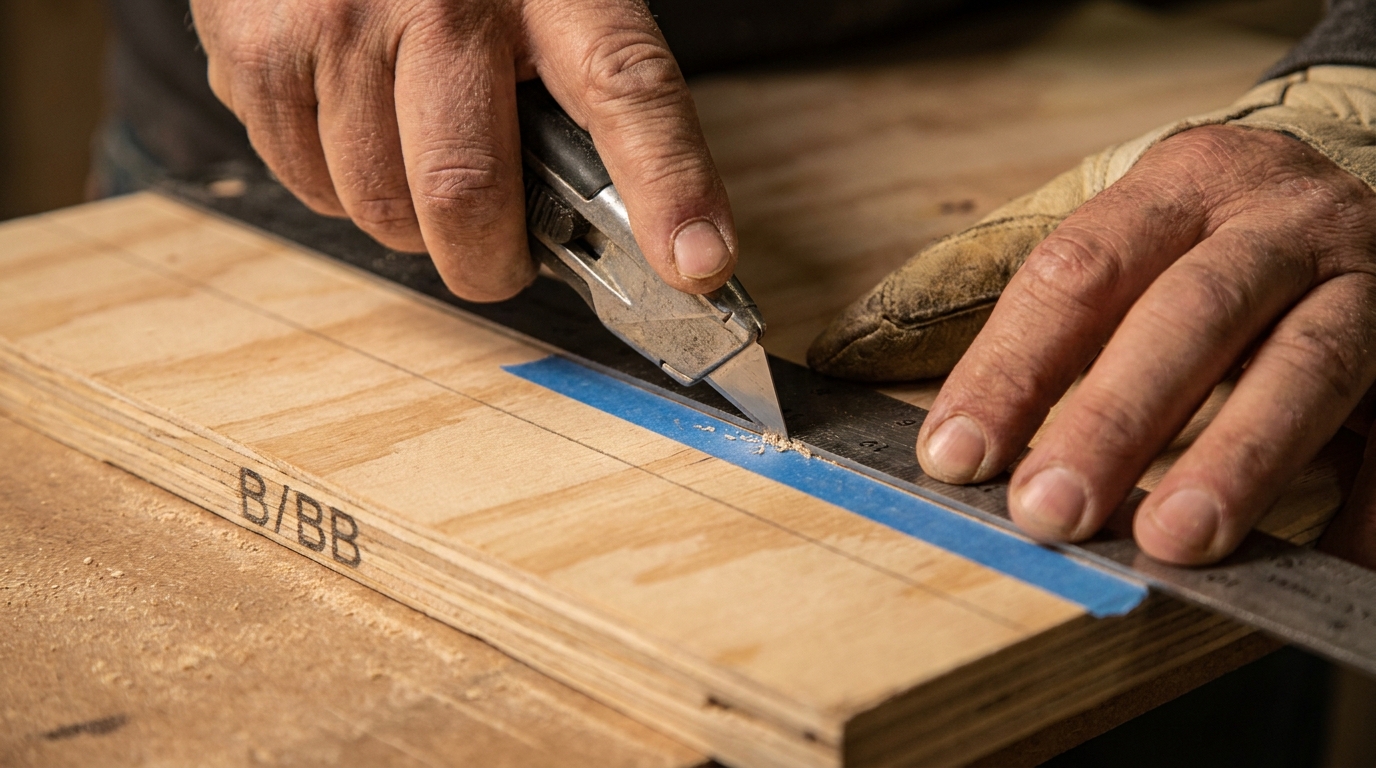
Steps:
- Mark your cut line clearly on the finish face
- Set a straightedge or clamped guide along the cut line
- Score along the line with a utility knife, one firm pass, cutting approximately 0.5 to 1mm deep into the face veneer
- Make your saw cut with the blade positioned so the kerf falls just inside the waste side of the score line
- The score line prevents the veneer fibres from tearing because they are already severed
This works with any tool and any blade. It adds 60 seconds to a cut and virtually eliminates tearout on the scored face.
Method 2: Masking Tape
Apply a strip of quality masking tape (not low-tack painter’s tape; use 3M 2080 or equivalent) along the cut line on the exit face. Mark the cut line on the tape, make the cut, then peel the tape away.
The tape holds down the veneer fibres during the cut, reducing tearout significantly. It is faster than scoring for production work and for tools where scoring is impractical such as jigsaw curves.
Limitation: works well for moderate tearout situations. Less effective than scoring on very thin veneers or with blunt blades.
Blade Selection: The Most Important Variable
A blunt blade or wrong tooth geometry causes more tearout than technique. Get the blade right first.
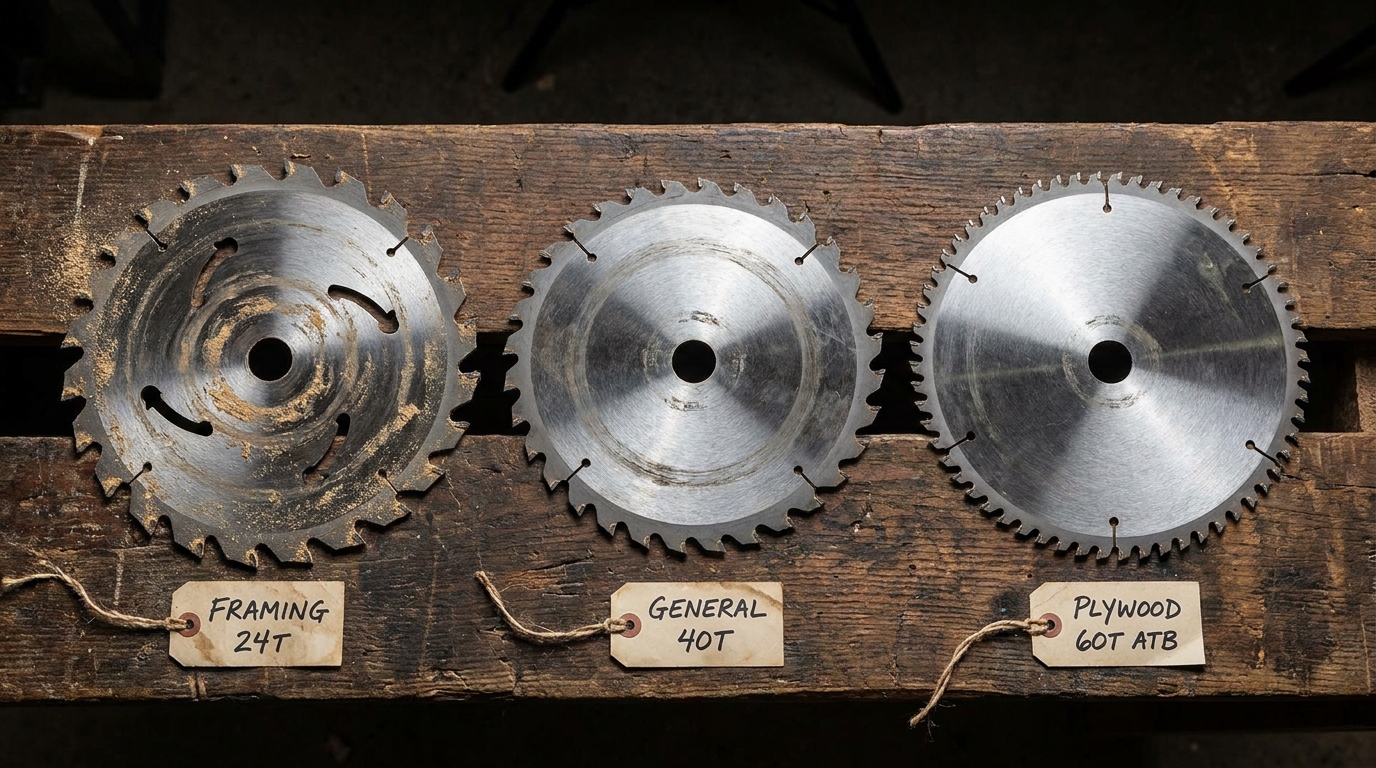
For Circular Saw
| Blade type | Tooth count (7-1/4″) | Result on plywood |
|---|---|---|
| Framing/construction blade | 24T | Heavy tearout, wrong blade for plywood |
| General purpose | 40T | Acceptable for construction grades |
| Plywood/fine finish blade | 60T ATB | Clean cut on B/BB grade plywood |
| Ultra-fine finish blade | 80T ATB | Near-zero tearout on face veneer |
Recommendation for birch plywood B/BB grade: 60T or 80T ATB (Alternating Top Bevel) blade. The ATB geometry slices veneer fibres rather than scraping them.
Blade brands that perform consistently: Freud LU79R (60T), Diablo D0760A (60T), DeWalt DW3106P5 (60T).
For Table Saw
A 60T ATB or 80T ATB blade on a table saw gives clean results on B/BB birch when the fence is set accurately. Add a zero-clearance insert, a throat plate with minimum gap around the blade. This supports the veneer at the cut point and prevents veneer from deflecting into the blade slot, which causes tearout on the underside.
Zero-clearance insert: make one from 6mm MDF, lower the blade below the table, place the MDF sheet, clamp it, then raise the spinning blade through the MDF to create a kerf exactly the width of the blade. This is the single most effective table saw upgrade for clean plywood cuts.
For Jigsaw
Jigsaws are the most prone to tearout because the blade cuts on the upstroke. The exit face is the top face, which is typically the face the user can see.
Blade selection for jigsaw:
- Use a downcut (reverse) blade, teeth are oriented to cut on the downstroke, eliminating upstroke tearout on the top face. Bosch T101AO is a standard reference for reverse-cut jigsaw blades.
- Alternatively, place the finish face DOWN and use a standard upcut blade.
Speed and pressure: slow the stroke speed, reduce downward pressure. High speed and pressure cause blade deflection, the blade bends away from the cut line, producing both a wandering cut and increased tearout.
For Track Saw (Plunge Saw)
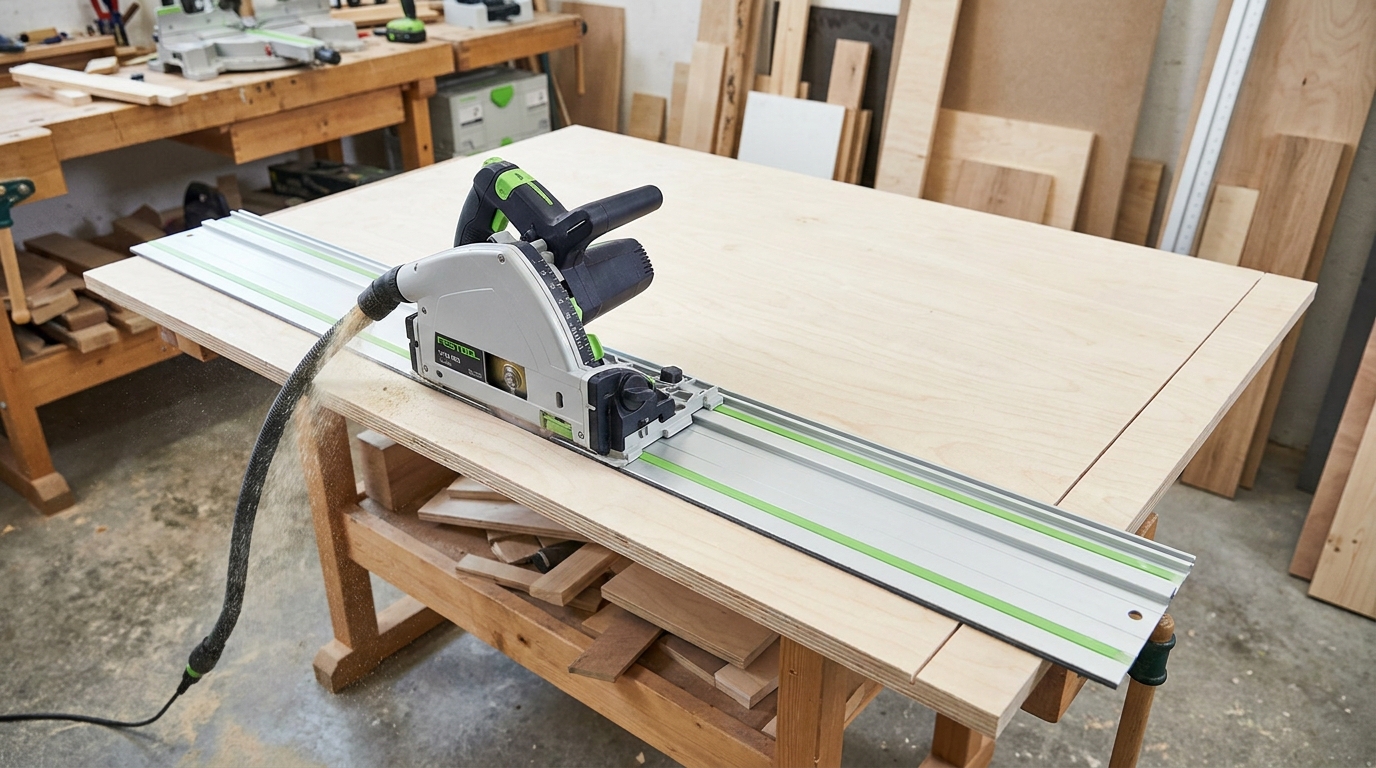
Track saws (Festool TS 55, Makita SP6000, Mafell) produce the cleanest plywood cuts of any portable tool. The scoring blade, a small blade ahead of the main blade, pre-scores the veneer before the main blade cuts, eliminating tearout without any manual scoring step.
If high-volume plywood work is regular, a track saw pays for itself in finish quality and time saved on remediation.
Cutting Birch Plywood Specifically
Birch plywood, particularly B/BB and BB/BB grade face veneer, has a very thin face veneer (typically 0.6 to 1.0mm for commercial birch). This makes it more susceptible to tearout than species with thicker faces.
Specific recommendations for cutting birch B/BB:
- Score the cut line — mandatory on B/BB face veneer for any cut that will be visible in the finished piece
- 60T minimum blade on circular or table saw — 40T is not adequate for clean B/BB cuts
- Support the panel fully — unsupported panel edges vibrate during cutting and increase tearout. Use a full sheet of foam insulation or a sacrificial sheet under the panel when cutting on the floor
- Cut with the good face DOWN on circular saw — the blade exits from the top on a circular saw; the bottom face is the clean face
For a full guide to working with and finishing birch plywood: How to Finish Birch Plywood: Staining, Painting and Sealing.
Cutting Plywood Straight: The Guide Rail Problem
Clean cuts require straight cuts. Freehand circular saw cuts on plywood are almost never straight enough for furniture work. The saw wanders, producing a slightly bowed cut that requires remediation.
Solutions:
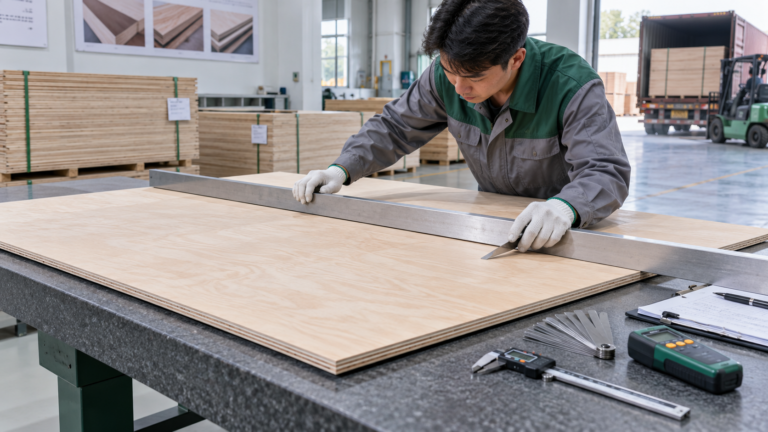
- Clamped straightedge guide: clamp a known-straight board or metal ruler parallel to the cut line, offset by the distance from the blade to the saw’s base plate edge. Run the base plate against the guide. This is the standard method for on-site and workshop cutting.
- Track saw: eliminates the guide-positioning step. The track is placed directly on the cut line, not offset, and the saw runs in the track channel. Fastest and most accurate.
- Table saw with fence: most accurate for ripping (long cuts parallel to the sheet edge). Less practical for crosscuts on full 4×8 sheets without a sliding table or panel sled.
- Circular saw with factory-edge guide: some saws include a rip fence attachment for parallel cuts near the sheet edge. Adequate for rip cuts within 300mm of the edge.
Cutting Plywood: Tool-by-Tool Summary
Circular Saw
- Blade: 60T to 80T ATB
- Face orientation: finish face DOWN
- Score first: yes, for B/BB face veneer
- Guide: clamped straightedge mandatory for furniture-quality cuts
- Depth setting: set blade to cut approximately 6mm below the panel
Table Saw
- Blade: 60T ATB, zero-clearance insert
- Face orientation: finish face UP
- Feed rate: slow, consistent, do not rush
- Panel support: use a roller stand or outfeed support for full sheets
Jigsaw
- Blade: reverse/downcut blade (Bosch T101AO) OR finish face DOWN
- Speed: medium, high speed increases vibration and tearout
- Masking tape: apply to top face exit side
- Application: curves and irregular cuts, not suitable for long straight cuts without a guide
Track Saw
- Blade: 60T ATB standard
- Face orientation: finish face UP (scoring blade handles tearout automatically)
- Guide placement: directly on the cut line, no offset calculation needed
- Best for: sheet goods cutting, production work, site work
Miter Saw / Compound Miter Saw
- Blade: 80T ATB for plywood crosscuts
- Face orientation: finish face UP
- Application: crosscuts on narrower pieces, not practical for full sheets
- Tearout control: slow, controlled downstroke; let blade come to full stop before raising
Common Mistakes
1. Using a framing blade on plywood. A 24T construction blade produces severe tearout on any plywood face veneer. The correct blade for clean plywood cuts is 60T minimum. The blade cost ($30 to $60) is insignificant relative to the panel cost and finishing time.
2. Cutting at high blade speed with a jigsaw. Faster stroke speed on a jigsaw increases blade deflection and vibration, the opposite of a cleaner cut. Medium speed with light pressure and a sharp reverse blade produces better results.
3. Not supporting the cut-off piece. When the cut-off piece is not supported, it sags and pinches the blade as the cut completes, causing blade binding, kickback, and tearout on the final millimetres of the cut. Use a sawhorse, foam sheet, or helper to support both sides.
4. Skipping the score on thin-veneer panels. On B/BB birch with 0.6mm face veneer, even a 60T blade will produce minor tearout without scoring. The 60-second scoring step is not optional for furniture-grade cuts.
FAQ
What is the best blade for cutting plywood without splintering?
A 60T or 80T ATB (Alternating Top Bevel) blade for circular or table saw. The ATB geometry slices veneer fibres cleanly. For jigsaws, a reverse-cut (downcut) blade such as Bosch T101AO eliminates upstroke tearout on the top face.
Why does my plywood splinter even with a fine blade?
Most likely causes: blade is dull (replace or sharpen), cut speed too fast, or the finish face is oriented toward the blade exit direction. Check face orientation first, then blade sharpness.
Does masking tape actually prevent splintering?
Yes, for moderate tearout situations. High-quality masking tape (3M 2080 or equivalent) holds down veneer fibres during the cut. Scoring with a utility knife is more effective for thin-veneer panels like B/BB birch.
Which face of plywood goes up when cutting with a circular saw?
The face you want to keep clean goes DOWN when cutting with a circular saw. The circular saw blade exits from the top, so tearout occurs on the top face. The bottom face (entry side) cuts cleanly.
How do I cut plywood without a table saw?
A circular saw with a clamped straightedge guide produces table-saw quality straight cuts. Set a 60T blade, clamp a known-straight guide board parallel to your cut line (offset by the distance from blade to base plate edge), and run the saw along the guide. Score the cut line first for B/BB face veneer.
Can you cut plywood with a hand saw?
Yes, for short cuts and curved shapes where power tools are impractical. Use a fine-tooth crosscut hand saw (at least 10 to 12 TPI). Masking tape on the cut line reduces tearout significantly.
Order Specification for Precision Plywood Panels
Species:         Birch face/back (B/BB grade)
Core:            Combi core or all-birch
Thickness:       18mm (plus or minus 0.5mm)
Sheet size:      1220x2440mm
Glue:            MR (EN 314-2 Class 1) dry interior
                 WBP (EN 314-2 Class 3) kitchen / bathroom
Emission:        E1
Surface:         Sanded both faces, calibrated thickness
Kosmex produces birch-faced plywood with calibrated thickness tolerance (plus or minus 0.5mm) and sanded B/BB face. For specifications and FOB pricing: anna@kosmexgroup.com
Bình luận