


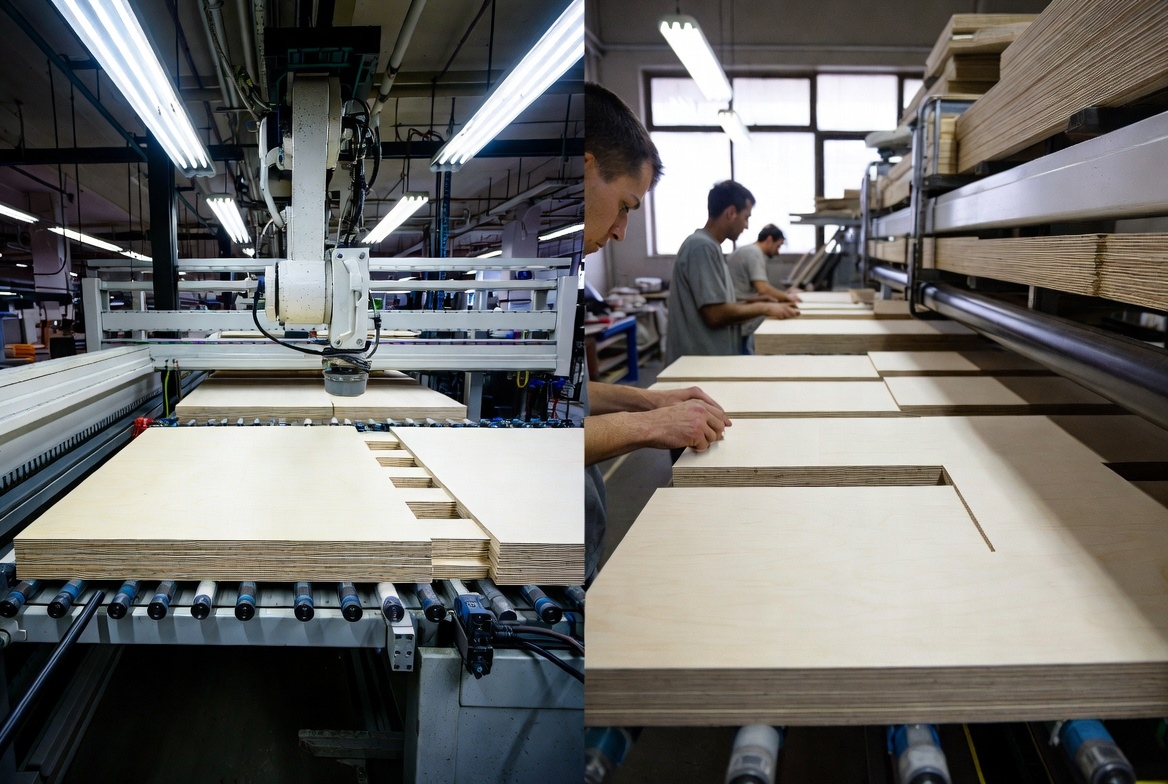
Flatness control is a process capability
A flat panel at one moment is not enough. A capable process repeatedly produces panels that remain within an agreed bow, cup and twist limit after conditioning and normal logistics. That requires controlled inputs, stable production, measurable inspection and protection after release.
The factory should define the product: thickness, sheet size, face and back, core species, veneer schedule, glue, sanding and finish. If the construction changes without review, the previous flatness evidence may no longer apply. Buyers evaluating suppliers can use Kosmex’s broader Vietnam plywood factory audit guide alongside the process below.
For 6mm, 8mm and 9mm products, the margin for handling and moisture variation can be smaller than for heavy panels. The correct response is not an absolute “no bending” promise. It is a controlled method that distinguishes unwanted permanent warp from normal elastic deflection under load.

1. Log and veneer preparation
Panel consistency begins with raw material. Species, log diameter, growth conditions, peeling quality and veneer thickness influence density, stress and surface quality. Factories should identify the intended species mix and avoid unapproved substitutions.
Peeling must produce veneer within the required thickness range with manageable lathe checks and damage. Torn grain, variable thickness and excessive waviness create poor contact in the lay-up. Clipping removes unusable zones and prepares sizes for faces, crossbands and cores.
Buyers do not need to prescribe every machine setting. They should verify that the mill measures veneer thickness, grades visible defects and separates material by intended position. Kosmex’s plywood making process provides a complete production overview.

2. Veneer drying and moisture matching
Veneer moisture is one of the most important flatness inputs. Veneers that are too wet can bond poorly or lose moisture unevenly after pressing. Veneers that are excessively dry may become brittle and can absorb water from adhesive rapidly. Wide variation within one lay-up can create an internal gradient.
A credible control plan includes a target range, an appropriate measurement method, sampling by dryer batch or stack, separation of outliers and a response when results exceed limits. Meter type, species correction, veneer temperature and measurement location affect readings. Calibration checks must be recorded.
Matching matters as much as the average. A batch average can look acceptable while individual sheets vary widely. For warp resistance, the factory should prevent one face or one group of plies from carrying a systematically different moisture condition.
3. Veneer grading and stress distribution
Veneers differ in grain, density, repairs and residual stress. Grading assigns suitable material to face, back, crossband and inner core positions. Symmetrical placement helps forces oppose one another rather than accumulate on one side.
Core composers can improve joint consistency when they are correctly set and maintained. Hand joining can also work, but depends more heavily on operator technique. The useful comparison is evidence of gap control, overlap control and joint stability, not a simple machine-good, hand-bad label. See core joint by composer machine vs hand.
Core gaps can create local weakness or surface depressions. Overlaps can create ridges and thickness variation. Both can interfere with later sanding and lamination. Buyers should define permitted core defects by size, frequency and location, as explained in plywood core gap and overlap control.
4. Balanced lay-up for 6mm, 8mm and 9mm panels
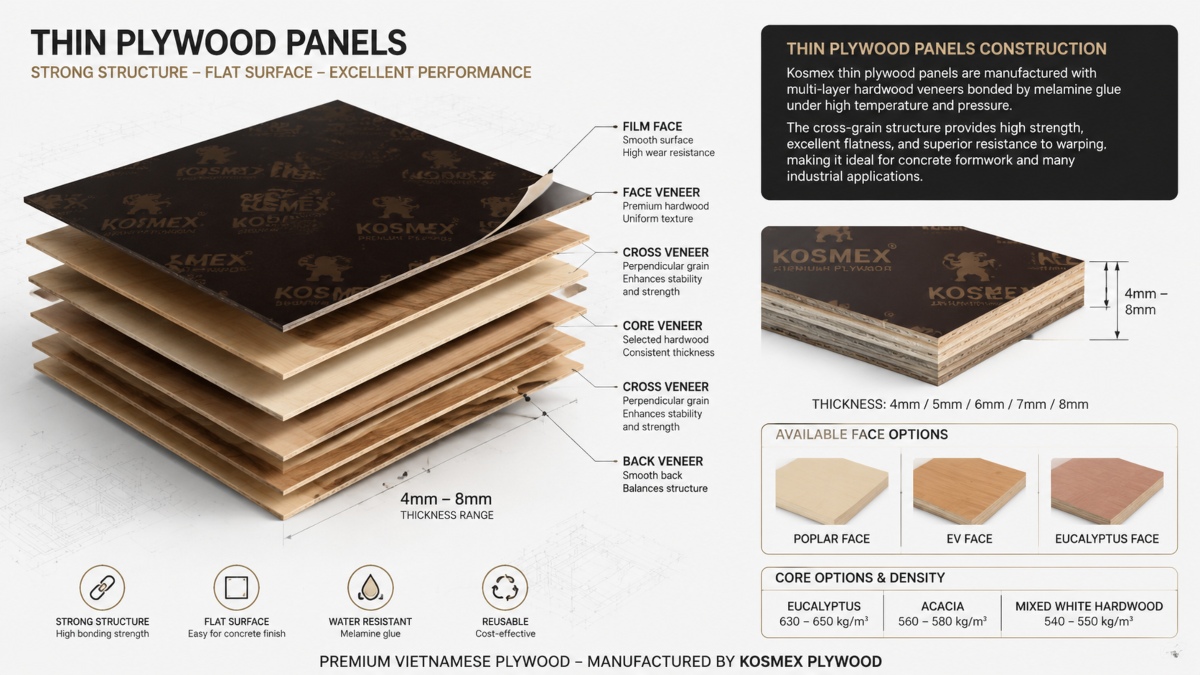
Balanced lay-up means the construction on one side of the centreline is compatible with the construction on the other. Grain directions alternate, and corresponding veneers should be reasonably matched for species, thickness, grade and moisture. The face and back may have different appearance grades, but their mechanical and moisture effects still need consideration.
| Control question | Why it matters | Evidence to request |
|---|---|---|
| What is the approved veneer schedule? | Nominal thickness alone does not reveal symmetry | Construction sheet or lay-up diagram |
| Are face and back compatible? | Asymmetry can pull the panel after conditioning | Face and back species, thickness, finish plan |
| How are repairs positioned? | Concentrated repairs can create local variation | Grade rules and sample photos |
| How are product changes approved? | A substitute veneer or glue can change behaviour | Change-control record and renewed sample approval |
An odd number of plies is common because it supports symmetry, but ply count by itself does not prove balance. Veneer thickness and material pairing are also important.
5. Glue spread and assembly control
Adhesive contributes moisture, bond strength and curing stress. The correct spread depends on glue formulation, veneer surface, species, temperature and process. Too little can create dry bonds. Excessive or uneven spread can extend pressing demands and increase variability.
Factories should control mix ratio where relevant, viscosity or other working properties, spread rate, open and closed assembly time, batch identity and expiry. Application equipment must distribute glue consistently across the sheet. Operators need a defined response to line stops or delays.
The bond should match the service condition. Interior furniture, humid interiors and exterior use require different decisions. Buyers should state the applicable bond or test requirement instead of using “waterproof” as a complete specification. Kosmex compares common systems in phenolic vs melamine glue in plywood.
6. Pre-pressing and hot pressing
Pre-pressing consolidates the loose assembly and helps stabilise it for hot pressing. Hot pressing then applies controlled pressure and heat for adhesive cure. The schedule must suit thickness, species, glue, veneer moisture and press equipment.
Critical records can include press load or pressure, platen temperature, time, product code and shift. Factories also need maintenance and checks for platen condition, temperature distribution and hydraulic performance. A nominal set point without verification is weak evidence.
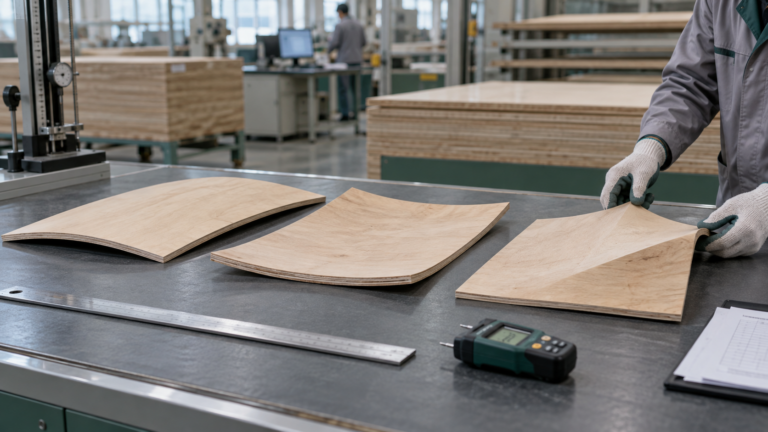
Pressing can make a stressed assembly appear flat while it is hot and restrained. The real test comes after release, cooling and moisture equalisation. This is why a factory cannot inspect only at the press exit.
7. Cooling and post-press conditioning
Panels leaving a hot press contain temperature and moisture gradients. Stacking, spacing and time influence how those gradients equalise. If one side cools or dries differently, curvature may develop later.
The conditioning plan should define where bundles wait, how they are supported, whether sheets are stacked hot, how air circulates and when panels may proceed to sanding and inspection. The appropriate method depends on the product and factory environment. Buyers should look for a repeatable rule rather than an informal wait period.
8. Trimming, sanding and surface finishing
Trimming establishes dimensions and provides an opportunity to check edge quality and core construction. Sanding calibrates thickness and prepares the surface. Uneven sanding can disturb balance or leave thickness bands. Calibration records, abrasive condition and multi-point measurements help control this risk.
If panels receive engineered veneer, UV coating, paper, film or laminate, the complete face and back treatment needs a balance review. Cure temperature, adhesive water and press pressure may change flatness. A good substrate can still move after an asymmetric secondary process.
9. Final flatness inspection
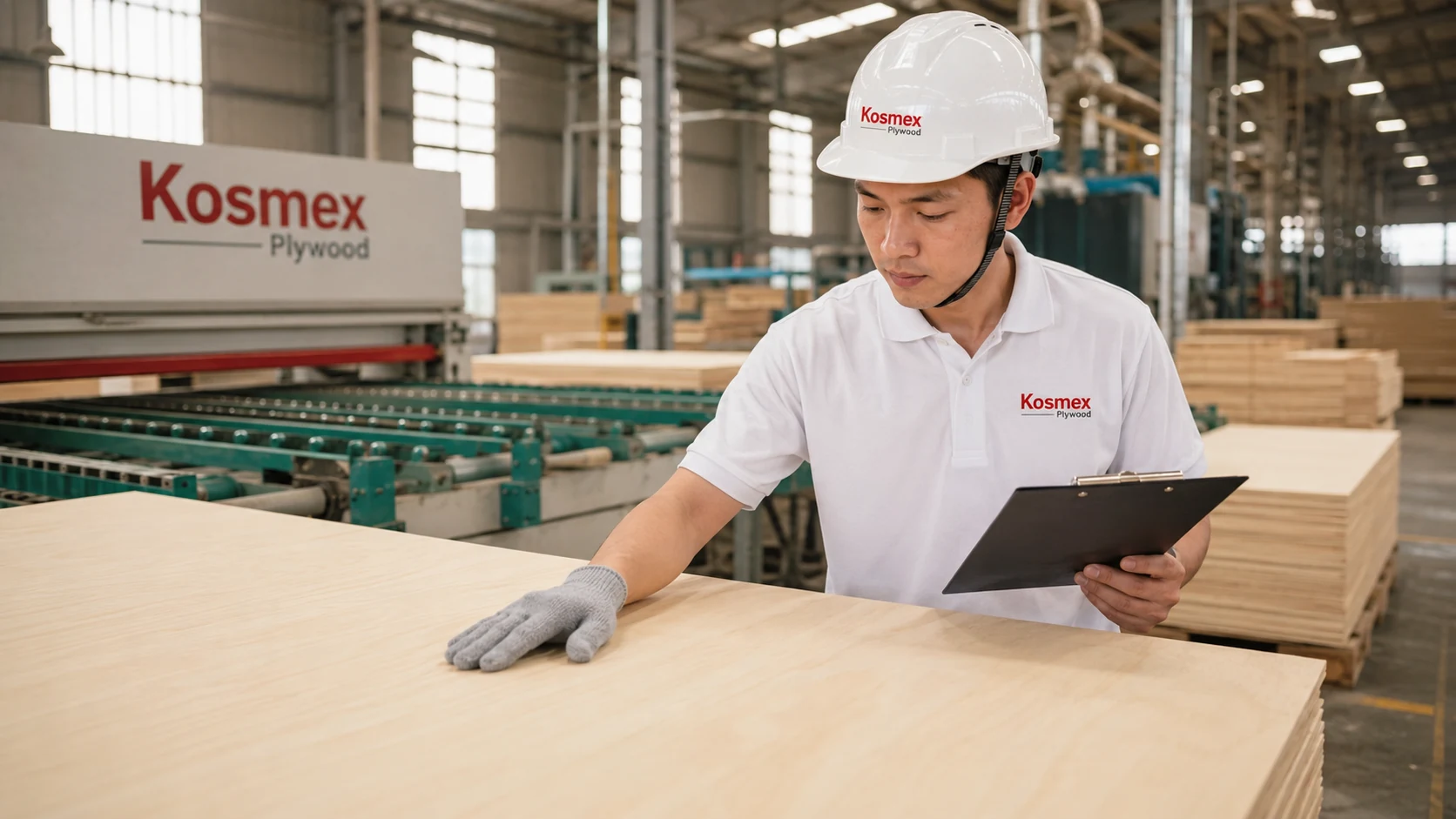
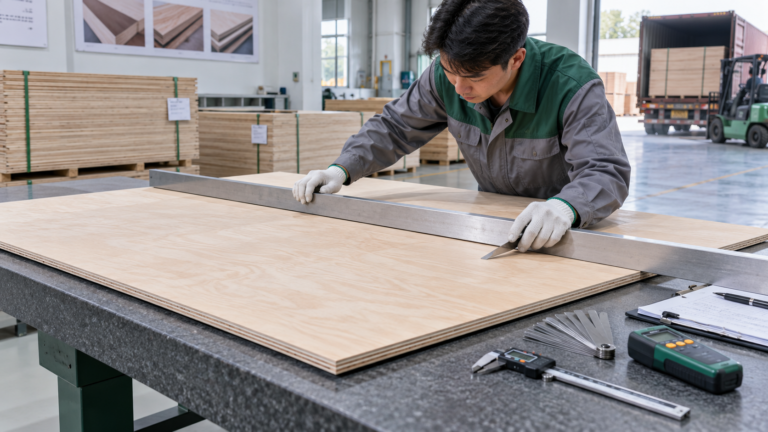
The approved method should define conditioning, support, panel orientation, measuring device, locations and acceptance limits. Bow, cup and twist should be recorded separately. A straightedge and calibrated gap tool can be used for certain agreed methods, while larger inspection setups may use a flat table, reference frame or measurement system.
Moisture mapping, thickness, dimensions and diagonals provide context. A twisted sheet with a large moisture difference between faces tells a different story from one with uniform moisture and a local core ridge. Sample identity links the result to production and packing.
There is no value in copying a tolerance from an unrelated product. Agree the limit for the sheet size, thickness, construction and end use. Kosmex gives the complete sequence in how to inspect plywood flatness before shipment.
10. Packing preserves the result
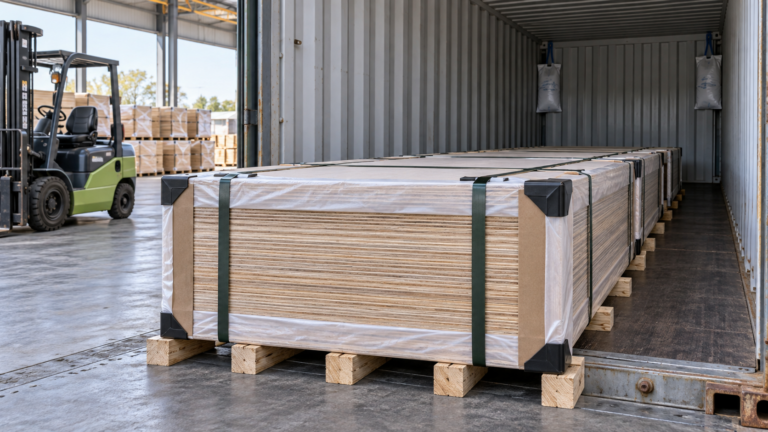
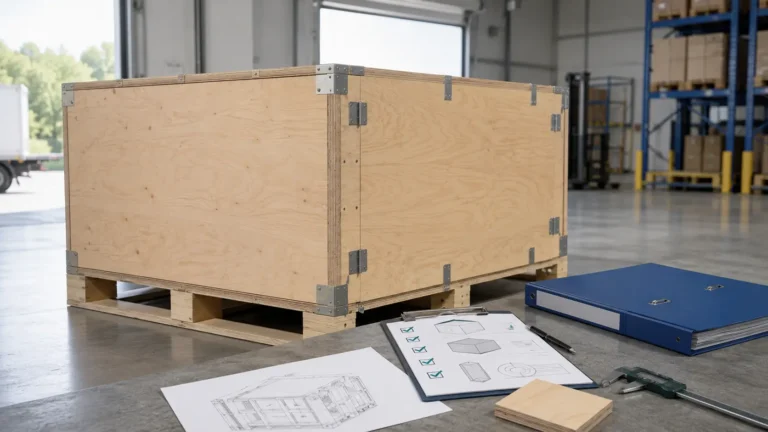
Released panels need flat, level support. Bearers should be aligned vertically through stacked bundles, with spacing appropriate to the sheet and route. Edges need protection, and straps should distribute pressure without crushing corners or forcing the stack over unsupported zones.
Wrapping must protect from rain and contamination while avoiding trapped moisture. Container selection, floor condition, leaks, odour, loading pattern and condensation risk should be checked and photographed. Export records should show the final bundle before doors close.

Factory evidence buyers should request
- approved product construction and revision;
- veneer moisture target, sampling and recent records;
- face, back and core grading rules;
- glue batch, spread and assembly controls;
- press parameters linked to the product and lot;
- conditioning rule and release timing;
- thickness, moisture and flatness report with sample IDs;
- measurement equipment and calibration status;
- nonconformity and corrective-action records;
- bundle, pallet and container loading photos.
The document list should be agreed before production. Kosmex’s guide to supplier documents helps importers separate routine records from destination-specific declarations.
How Kosmex positions flatness
Kosmex can design 6mm, 8mm and 9mm plywood to resist bowing, cupping and twisting under specified production, storage and service conditions. The commercial commitment should be an agreed construction plus measurable acceptance criteria, not an undefined guarantee that wood will never move.
For supplier approval, trace the chain from veneer moisture to loading. Ask where data are recorded, who releases the lot and what happens when a result fails. That is the difference between a flat sample and a repeatable flatness-control system.
Frequently asked questions
Which factory step has the greatest effect on plywood flatness?
There is no single step. Veneer moisture matching, balanced lay-up, glue and press control, conditioning and supported packing work together. A failure in one stage can appear only later.
Does hot pressing make every panel flat?
The press can flatten the assembly temporarily, but residual stress or moisture imbalance may reappear after cooling, sanding, storage or finishing.
How can a buyer verify flatness control remotely?
Request process flow, construction sheet, veneer moisture records, press parameters, sample IDs, flatness measurements, calibration status, packing photos and change-control records.
Should 6mm, 8mm and 9mm use the same QC limit?
Not automatically. The limit and test setup should match the product, sheet size, end use and commercial agreement. The same measurement method can be used while acceptance limits differ.
Bình luận