


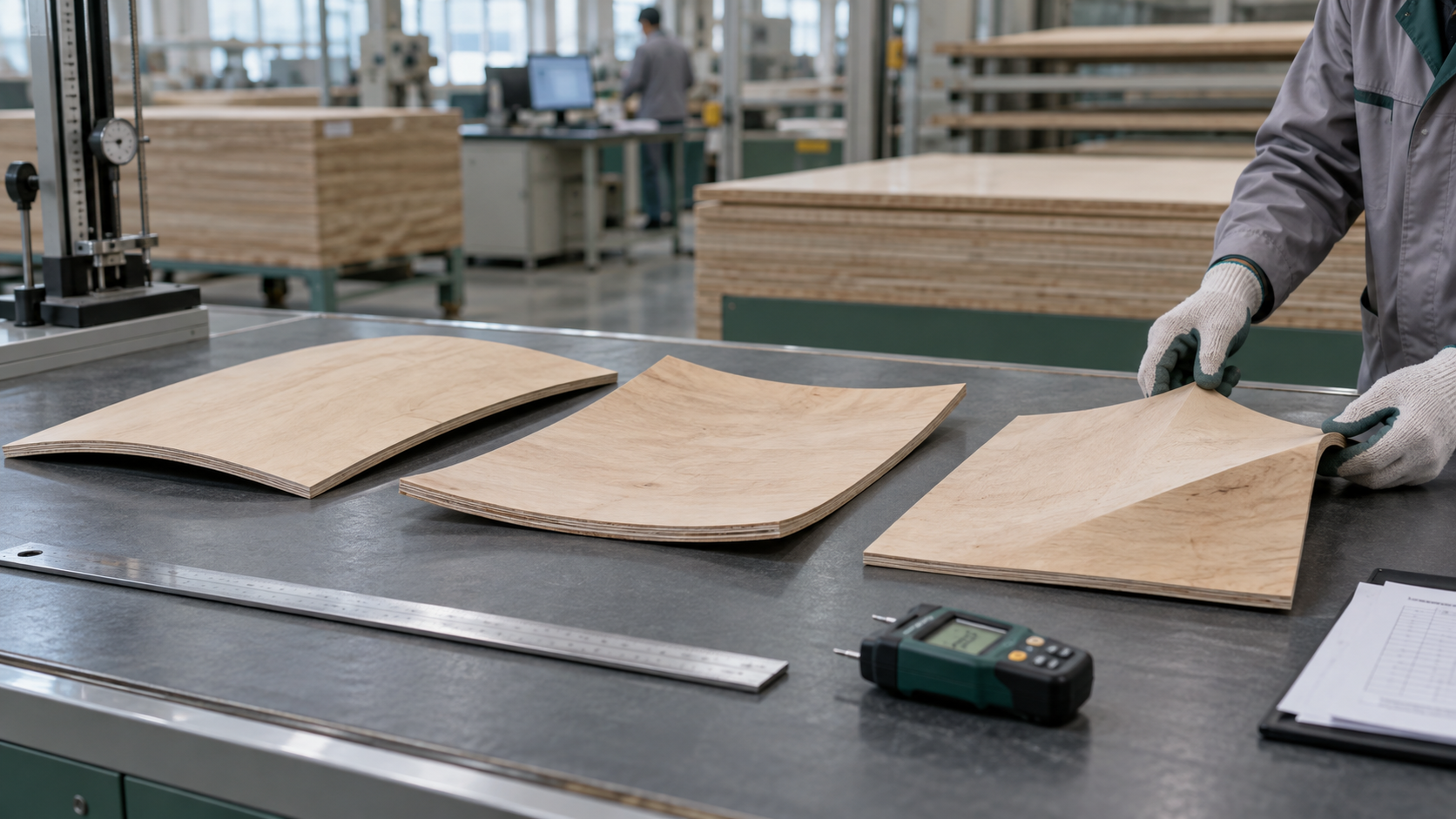
First, identify the shape
- Bow is curvature along the panel length. Viewed from the long edge, the centre or ends rise away from a reference plane.
- Cup is curvature across the width. Viewed from an end, the edges and centre do not sit in the same plane.
- Twist means the four corners are not coplanar. One corner may lift when the other three are supported.
- Local waviness can indicate a ridge, core overlap, void, sanding variation or telegraphing rather than whole-sheet warp.
Panels can show more than one shape. A bowed sheet may also twist after cutting. Record the dominant condition, orientation, location and magnitude. Kosmex covers related visible and internal issues in common plywood defects and how to avoid them.

The main mechanism: unequal dimensional change
Wood exchanges moisture with surrounding air. When moisture content changes, veneer dimensions and internal stresses change. A balanced plywood construction distributes those forces across alternating grain directions. Warp appears when the forces are no longer sufficiently balanced.
The imbalance may exist through the thickness. For example, the top surface can dry while the bottom remains wetter. It may exist between face and back veneers, between different veneer species or between areas of a sheet. It can also be introduced by a coating that slows moisture exchange on only one face.

This explains why “moisture caused it” is incomplete. A technical review should ask where the moisture came from, how it moved through the panel, whether construction was balanced, how quickly conditions changed and how the sheet was supported during that change.
Seven common causes of bow, cup and twist
1. Veneers entered lay-up at different moisture levels
If unusually wet and dry veneers are combined, drying and stress release after pressing may be uneven. Good production uses veneer drying, measurement and sorting before lay-up. Thin panels have less section depth to resist the resulting forces, so process consistency is especially important.
2. Face and back construction was not balanced
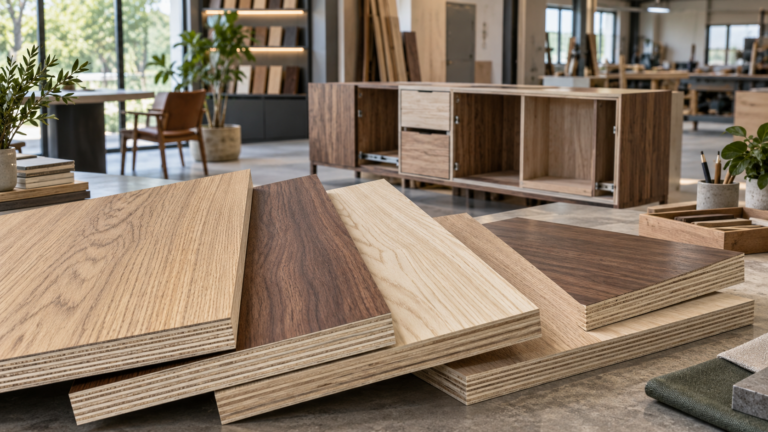
A heavy decorative face over a very different back can create asymmetric behaviour. Balance concerns species, veneer thickness, grain direction, glue, repairs and finish, not just colour. EV plywood buyers should specify the decorative face and the balancing back separately from the core.
3. Veneer tension or grain variation was poorly distributed
Rotary peeled veneer can carry residual stress. Grain deviation, juvenile wood and local density variation affect movement. Sorting and symmetrical lay-up help distribute these differences. Random placement increases the chance that stresses accumulate on one side.
4. Glue spread or press conditions were uneven
Uneven spread, delayed assembly, local temperature variation, poor pressure transfer or an unsuitable press cycle can leave nonuniform bonding and stress. These conditions may also appear as delamination or thickness variation. A review of the complete plywood manufacturing process helps buyers see where control points belong.
5. The panel was sanded or finished asymmetrically
Removing more material from one side changes balance. A laminate, paint, UV coating or paper applied to one face can also change moisture permeability and add curing stress. Prototype the complete decorative schedule, including the reverse face.
6. Storage support or straps imposed a shape
Bundles stored on uneven bearers can take a set. Overhang leaves edges unsupported. Tight straps across poorly spaced supports can create local deformation. Upright storage of large panels can be risky unless the rack supports the full sheet and the method is specifically designed for it.
7. Climate changed too quickly
A cold bundle opened in a warm humid room may develop condensation or a steep moisture gradient. Direct sun or a heater can dry one face faster than the other. Acclimation does not mean leaving sheets exposed indefinitely. It means allowing controlled, even adjustment to the service environment.

Why 6mm, 8mm and 9mm react differently
Thickness changes bending stiffness, handling and the relative influence of faces and coatings. A 6mm panel is easier to deflect during lifting and may react more visibly to an asymmetric finish. An 8mm panel can offer a useful middle ground but still needs a balanced veneer schedule. A 9mm panel is generally stiffer, yet a strong moisture gradient or poor storage can still cause bow or twist.
Ply count and veneer schedule matter with thickness. A nominal 9mm panel made from a few thick veneers does not necessarily behave like one made from more, thinner veneers. Neither construction should be judged only by count, but buyers should know what they are approving. Core joints, repairs and overlaps also affect local stress and surface behaviour. See Kosmex guidance on core gaps and overlaps.
Species influences density, stiffness and moisture response. Eucalyptus, poplar and pine constructions should be compared as complete products. The right question is not “Which species never warps?” It is “Which construction meets the flatness, weight, machining and cost requirements under our conditions?”
Factory cause, logistics cause or application cause?
A fair investigation follows a timeline.
| Evidence | What it may suggest | What to verify |
|---|---|---|
| Warp visible before packing | Construction, pressing, conditioning or finishing issue | In-process records, retained samples, pre-shipment photos |
| Outer sheets affected after wet transit | Packaging breach or container moisture | Wrap damage, container condition, moisture pattern, arrival photos |
| Whole bundle follows uneven bearers | Support or stacking deformation | Bearer spacing, alignment, floor level, overhang |
| Parts warp after one-face lamination | Asymmetric finishing or rapid moisture change | Press cycle, adhesive water, reverse-face treatment, acclimation |
| Twist concentrated in selected sheets | Local veneer stress or construction variation | Panel IDs, lay-up records, core and moisture checks |
The table is diagnostic, not proof of liability. Several mechanisms can occur together. Preserve packaging, labels and representative panels until the parties agree on sampling.
How to document the problem
- Quarantine the affected bundle and record when it was opened.
- Photograph labels, wrap, straps, bearers, container walls and visible moisture.
- Identify each measured sheet and its position in the bundle.
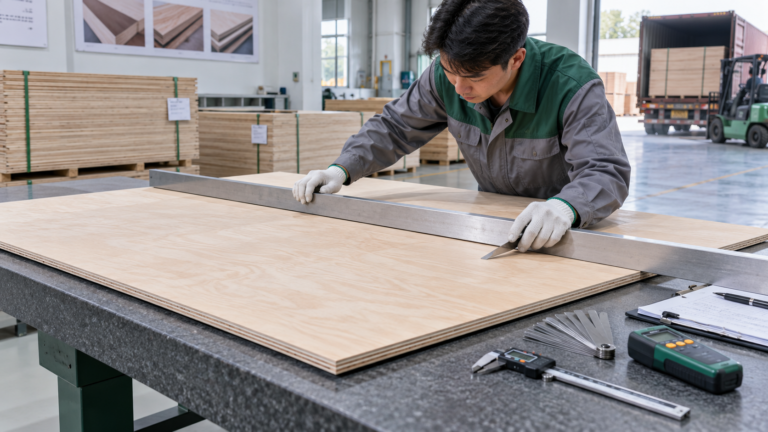
- Place the panel on the agreed flat reference or support arrangement.
- Measure bow, cup and twist separately at defined locations.
- Map moisture at several points on both faces with an appropriate calibrated meter.
- Record room temperature, relative humidity and recent climate changes.
- Measure thickness and diagonals to screen for other dimensional variation.
- Keep unprocessed comparison sheets and, where justified, sealed dispute samples.
A photo of a lifted corner without the support condition, panel ID or scale is weak evidence. Kosmex’s dedicated plywood flatness inspection guide gives buyers a repeatable pre-shipment method.

Can warped plywood be corrected?
Minor movement caused by a temporary moisture gradient may reduce after the panel is supported flat and allowed to reach a uniform condition. That outcome is not guaranteed. Forcing a panel flat with weight can hide the symptom while the underlying imbalance remains. Wetting one face is difficult to control and can damage bonds, surfaces or dimensions.
Do not use a panel in a critical component merely because clamps can pull it into place. Consider whether the assembly will hold the panel safely throughout service, whether the stress will transfer to joints and whether the finish will crack or release. Severe twist, bond failure, mould, crushed edges or persistent deformation usually calls for rejection or a formally approved secondary use.
Prevention at the factory
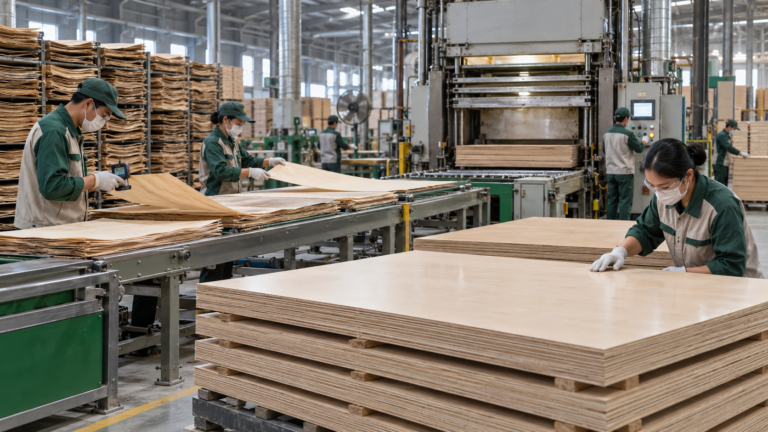
Prevention combines veneer moisture control, grading, balanced lay-up, controlled glue spread, a verified press cycle, post-press conditioning, calibrated sanding and final flatness inspection. The factory should be able to show records rather than only a finished sheet. Kosmex explains this evidence chain in how plywood factories control flatness.
Approval samples should represent the quoted construction. If core species, face veneer, glue or finishing changes, the flatness risk must be reviewed again. A product name cannot replace change control.
Prevention during storage, shipping and use
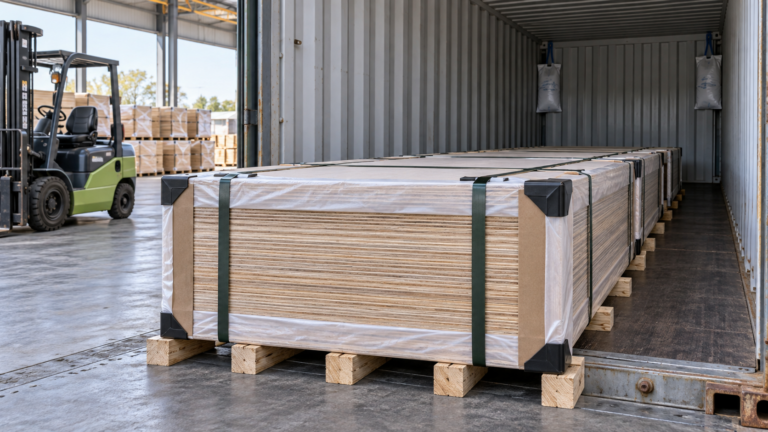
Keep bundles dry, flat and fully supported on aligned bearers. Avoid floor contact, rain, direct sun and heat on one face. Use protective wrapping appropriate to the route while managing trapped moisture. In containers, inspect for leaks and residue, use a condensation plan and photograph loading. Place straps and corner protection so that pressure is distributed rather than concentrated.
At destination, inspect the container and bundle before unstrapping. Move material into a controlled area and allow a planned adjustment to the workshop climate. Maintain support during acclimation. More detail is available in how to store and ship 6mm, 8mm and 9mm plywood without warping.
During fabrication, balance coatings and laminates when possible, use appropriate adhesives and press conditions, and avoid leaving freshly cut wide parts unsupported. Make prototypes for large panels or demanding finishes.
What a credible “warp resistant” offer includes
A credible supplier does not promise that wood can never move. The offer defines the construction, target moisture, inspection support, measurement points, sample size, flatness limits and packing. It also defines what the buyer must do on arrival. That shared method turns a vague claim into an auditable commercial requirement.
When a problem occurs, diagnose the geometry first, then trace moisture, construction, support and timing. Bow, cup and twist are evidence. Used carefully, they can guide corrective action at the factory, in logistics or in the buyer’s process.
Frequently asked questions
Why does plywood warp even though the veneers are cross laminated?
Cross lamination restrains movement, but it cannot remove every moisture gradient, veneer stress or construction imbalance. Unequal face and back conditions can still create curvature.
Can warped plywood become flat again?
Minor temporary movement may reduce after the panel reaches a uniform moisture condition on flat support. Severe or permanent deformation, bond damage and construction imbalance may not recover reliably.
Is 9mm plywood less likely to warp than 6mm plywood?
A thicker panel is generally stiffer, but thickness alone does not guarantee flatness. Veneer moisture, symmetry, pressing, finish and storage can outweigh the thickness difference.
How should buyers document a warp claim?
Identify each panel, photograph the support and measurement, record temperature and moisture conditions, separate bow cup and twist, measure several points and preserve representative samples.
Bình luận