


Because the applications where they differ are exactly the ones where getting it wrong is expensive: bathrooms, hardwood flooring underlayment, long-span joists, and high-humidity environments. This guide covers everything – including the data that most comparison articles skip.
What Are OSB and Structural Plywood?
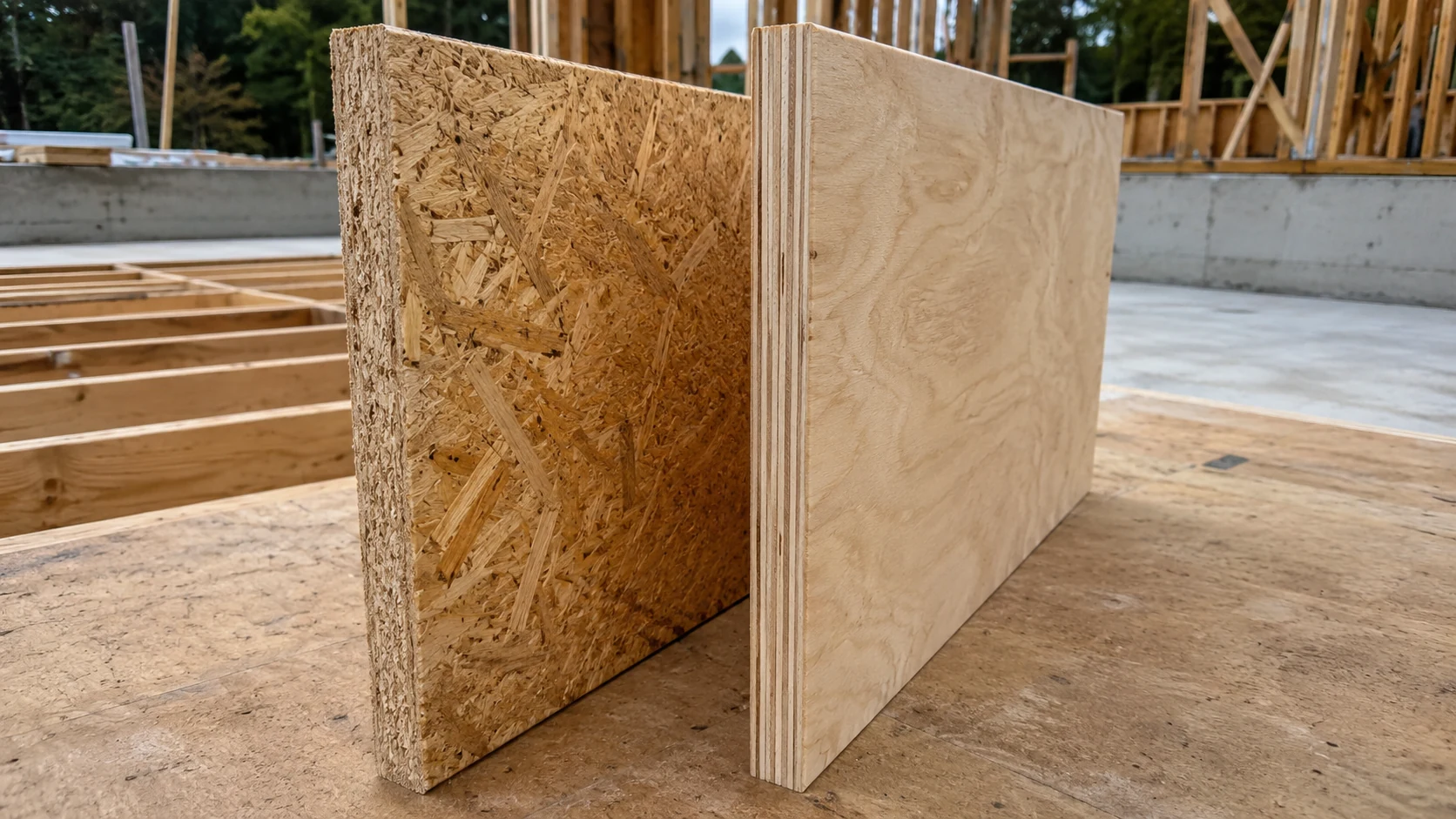
OSB (Oriented Strand Board) is manufactured from wood strands – thin, rectangular pieces of wood – arranged in layers with alternating grain orientation and bonded with wax and resin adhesive under heat and pressure. The strands are oriented for strength (hence the name), producing a panel with good shear strength and uniform structural performance.

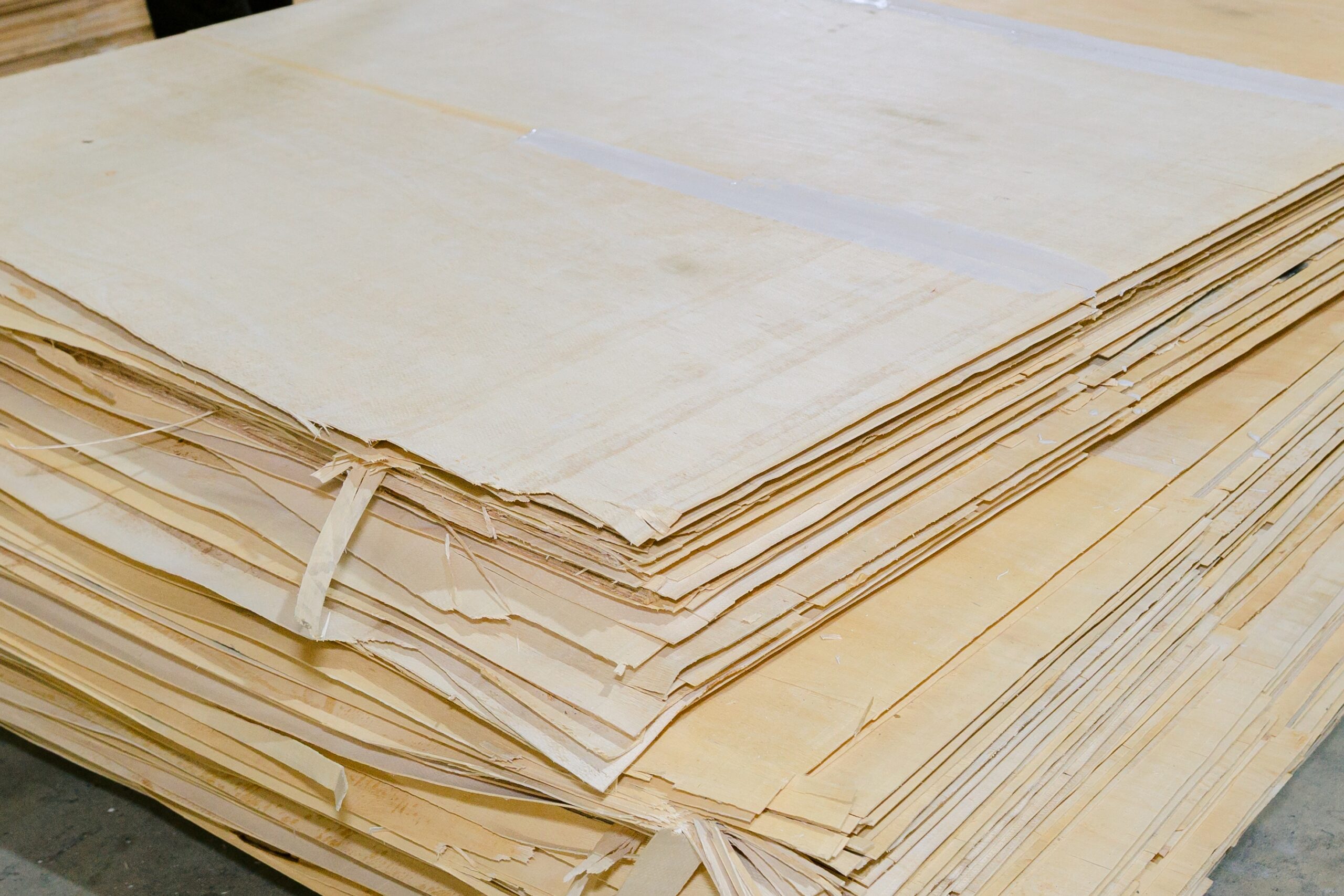
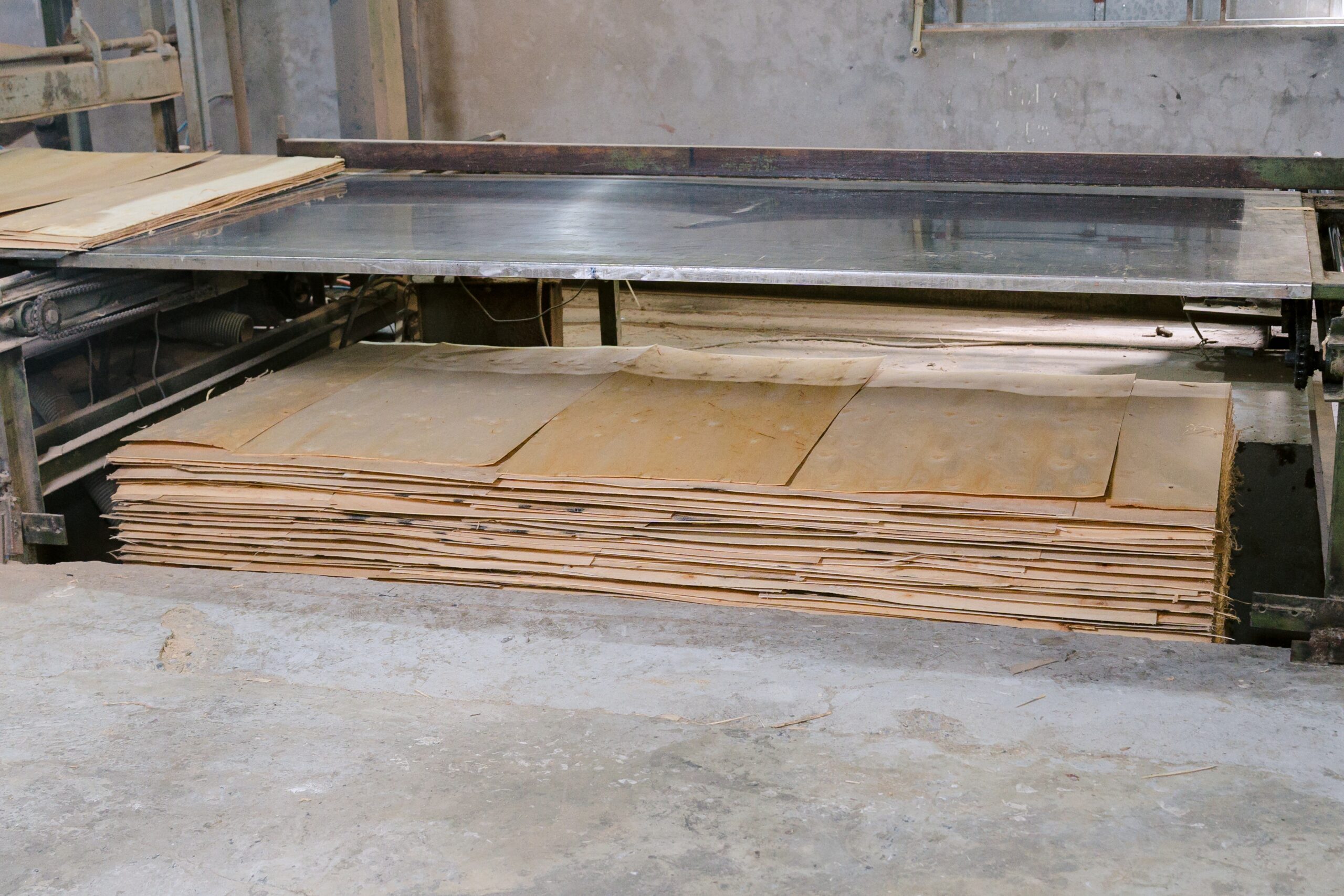
Structural plywood is cross-laminated veneer – thin sheets of wood peeled from logs, dried, and bonded in perpendicular layers. Structural grades (CDX, BCX, OSB-equivalent ratings) use exterior-grade adhesive (phenolic WBP) and are produced to APA, EN 636, or equivalent structural standards.
Both are engineered wood panels – not solid wood, not MDF, not particleboard. Both are produced with exterior-grade adhesive for subfloor use. The difference is in the raw material structure and how that structure responds to moisture, fasteners, and edge conditions.
For more on how plywood is manufactured: Plywood Making Process: 11 Steps from Log to Finished Panel.
Head-to-Head: OSB vs Plywood Subfloor
| Property | OSB | Structural Plywood |
|---|---|---|
| Composition | Wood strands, oriented layers | Cross-laminated veneer |
| Shear strength | Higher – ~2× plywood in some tests | Lower shear; higher nail withdrawal |
| Bending strength (MOR) | 20-30 N/mm² | 28-40 N/mm² |
| Stiffness (MOE) | 3,500-5,000 N/mm² | 6,500-8,500 N/mm² |
| Nail/screw withdrawal | Lower – strands compress and release | Higher – veneer layers grip fastener |
| Surface texture | Rough, strand pattern visible | Smoother, grain visible |
| Panel edges | Swells permanently when wet | Swells temporarily, recovers on drying |
| Moisture absorption rate | Slower at face | Faster at face – but dries faster |
| Moisture recovery | Poor – permanent edge swelling | Good – returns near original dimension |
| Weight (18mm 4×8 sheet) | ~25-28 kg | ~25-33 kg (species dependent) |
| Cost (per 4×8 sheet, 18mm) | $18-28 | $20-32 |
| APA span rating | Rated – same span tables as plywood | Rated – same span tables |
| Code acceptance | Yes – IRC, IBC, EN standards | Yes – IRC, IBC, EN standards |
Thickness and Span Rating Guide
Both OSB and plywood are APA span-rated – the panel is tested and stamped with its rated span for specific joist spacings. Use the panel’s own stamp as the primary guide. General reference:
| Panel thickness | Max joist spacing | Application |
|---|---|---|
| 12mm (1/2″) | 400mm (16″) OC | Light residential, stiff floor system |
| 15mm (5/8″) | 400-500mm (16″-19.2″) OC | Standard residential subfloor |
| 18-19mm (3/4″) | 400-600mm (16″-24″) OC | Most common residential spec |
| 22mm (7/8″) | 500-600mm (19.2″-24″) OC | Long-span or heavy load |
| 25mm (1″) | 600mm (24″) OC | Commercial, heavy-duty |
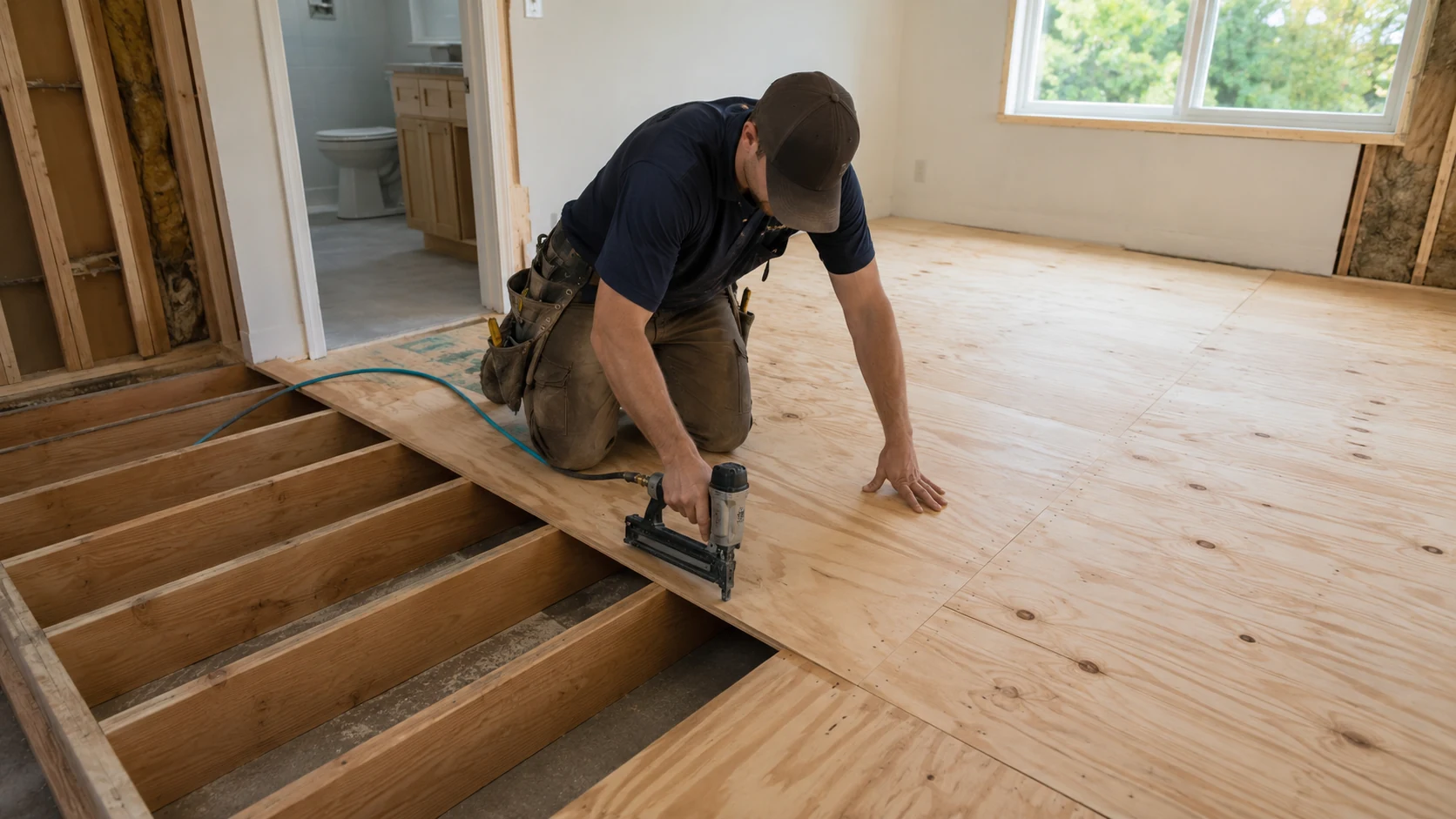
Practical rule: 18-19mm (3/4″) structural panel is the standard subfloor specification for residential construction with joists at 400-600mm. Thinner panels are false economy – subfloor deflection causes floor finish cracking, squeaking, and tile grout failure. Do not undersize.
Moisture Resistance: Where OSB and Plywood Diverge Most
This is the specification-critical difference for anyone building in humid climates, bathrooms, or lower-level floors.
How Each Responds to Water
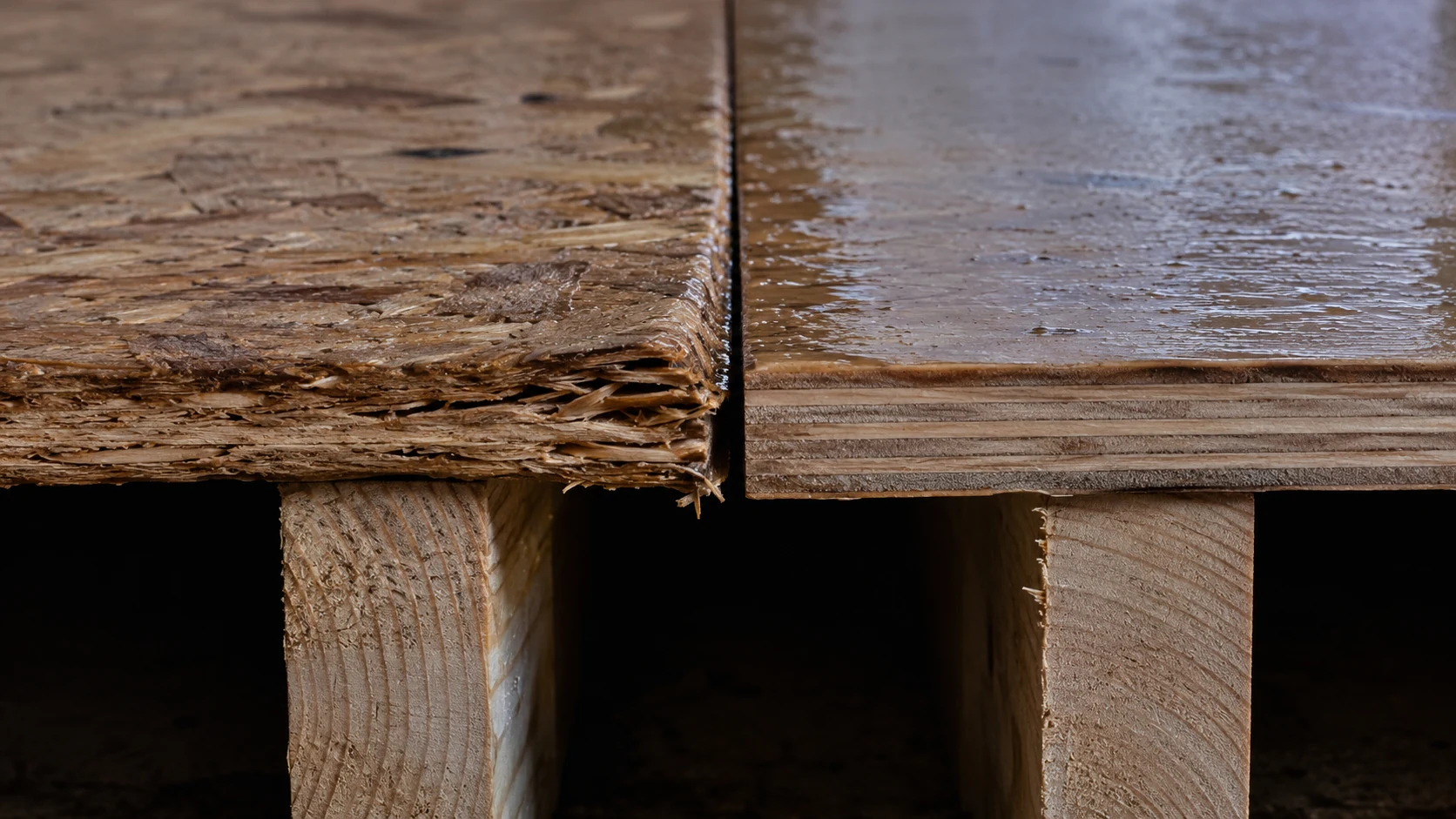
Plywood: Water penetrates the face veneer faster than OSB initially – plywood is more porous at the surface. However, plywood dries faster and returns close to its original dimensions after drying. A plywood subfloor that gets wet during construction and then dries out typically recovers without permanent deformation.
OSB: The face of OSB absorbs water more slowly due to the wax sizing in the manufacturing process. However, the edges of OSB panels are unprotected – water wicks into the exposed strand ends rapidly, and the panel swells permanently at its edges. An OSB subfloor with edge swelling at panel joints will telegraph ridges through vinyl, engineered hardwood, and tile finishes – and the swelling does not reverse on drying.
What This Means in Practice
- Temporary construction moisture (rain during building frame stage): plywood recovers better. OSB edge swelling from construction exposure is a known problem in residential building.
- Sustained humidity (crawl space moisture, concrete slab off-gassing): plywood is more tolerant. Specify a vapour barrier under both, but plywood recovers better if the barrier fails.
- Bathrooms and wet areas: plywood is the safer specification. See dedicated section below.
For a deeper comparison of how glue type affects moisture performance: CDX Plywood vs OSB: Differences, Cost & Strength Guide.
OSB vs Plywood: Bathroom Subfloor
Recommendation: Plywood – always. OSB is not recommended for bathroom subfloor.
The bathroom subfloor is the highest moisture-risk location in a residential floor system:
- Steam condensation from showering penetrates floor finishes over time
- Plumbing leaks – even minor slow leaks – can wet the subfloor before detection
- Grout joints in tile floors are not waterproof – moisture passes through to the substrate
OSB’s permanent edge swelling makes it poorly suited to this risk profile. Tile associations (including the Tile Council of North America) explicitly advise against OSB as a substrate for ceramic and stone tile in wet areas.
Specify for bathroom subfloor:
- Structural plywood, WBP-glued (exterior-grade adhesive)
- 18-19mm (3/4″) minimum
- T&G (tongue and groove) edge profile for panel-to-panel joints
- Vapour barrier below if over concrete or crawl space
For full bathroom plywood specification including vanity, walls, and wet zone guidance: Best Plywood for Bathroom: Moisture-Resistant Grades & What to Avoid.
OSB vs Plywood Under Hardwood Flooring
Recommendation: Plywood for solid hardwood; OSB acceptable for engineered hardwood over dry, controlled subfloor.
Hardwood flooring manufacturers frequently specify the subfloor type in their installation warranty terms – and many solid hardwood flooring manufacturers require plywood as the subfloor substrate.
Why plywood is preferred under solid hardwood:
- Nail withdrawal strength – solid hardwood flooring is typically nail-down installed. Plywood’s cross-laminated veneer grips cleats and nails more reliably than OSB’s strand composite. OSB can release fasteners under the seasonal movement of hardwood flooring.
- Dimensional stability under hardwood movement – solid hardwood expands and contracts seasonally. This cycling creates stress at the subfloor interface. Plywood handles cyclic load better than OSB.
- Warranty compliance – check the hardwood flooring manufacturer’s installation guide. If plywood is specified and OSB is installed, warranty claims for cupping, squeaking, or nail pop may be denied.
For engineered hardwood (floating or glue-down): OSB is generally acceptable over a dry, level subfloor. The floating installation method does not transmit fastener load to the subfloor; glue-down on OSB is accepted by most engineered hardwood manufacturers over dry conditions.
Acclimation and moisture testing: Before installing any hardwood flooring, the subfloor moisture content should be measured and within the flooring manufacturer’s specified range (typically 6-9% for plywood subfloor, with the hardwood within 4% of the subfloor reading). Do not install over a wet or recently wetted subfloor regardless of panel type.
Advantech OSB vs Plywood
Advantech (manufactured by Huber Engineered Woods) is a premium moisture-resistant OSB with a 50-year structural warranty. It is significantly better than standard OSB for moisture performance – addressing the main weakness of conventional OSB.
| Property | Standard OSB | AdvanTech OSB | Structural Plywood |
|---|---|---|---|
| Edge swelling (wet) | High – permanent | Low – resin-sealed edges | Moderate – recovers |
| Moisture resistance | Moderate | High | Moderate-High |
| Nail withdrawal | Lower | Lower (vs plywood) | Higher |
| Cost (per sheet, 3/4″) | $18-28 | $35-55 | $20-32 |
| Warranty | Limited | 50-year structural | N/A |
| Availability | Widely available | US market primarily | Widely available |
When Advantech makes sense:
- New construction in climates with significant rain exposure during building
- Crawl space or slab-on-grade construction with moisture risk
- When the builder wants OSB’s cost advantage with better moisture performance than standard OSB
When plywood is still preferred over Advantech:
- Under solid hardwood flooring (nail withdrawal strength advantage)
- Bathroom subfloor (plywood’s moisture recovery profile is more predictable)
- When cost is the primary driver (standard plywood is cheaper than Advantech)
[ẢNH 3 – Workers / production / factory]
Vị trí: Sau phần Advantech. Inline right.
Cost Comparison: OSB vs Plywood
| Specification | US retail (4×8, 3/4″) | Notes |
|---|---|---|
| Standard OSB 18mm | $18-28 | Price varies significantly by region and supply |
| AdvanTech OSB 18mm | $35-55 | Premium moisture-resistant OSB |
| CDX plywood 19mm (pine) | $22-35 | Standard structural plywood |
| Structural birch-faced plywood 18mm | $45-65 | Premium – smoother face |
| Marine plywood 18mm | $80-120 | Wet-zone specialist spec |
B2B / import pricing (FOB Vietnam):
| Specification | FOB Vietnam |
|---|---|
| Structural pine plywood, 18mm, WBP | $200-260/CBM |
| Commercial birch-faced, 18mm, WBP | $290-360/CBM |
| Film-faced phenolic plywood, 18mm | $320-400/CBM |
For residential construction quantities, the cost difference between OSB and structural plywood per sheet is $2-7 – on a 2,000 sq ft floor (approx. 60 sheets at 3/4″), the total difference is $120-420. This is not a significant project cost relative to the performance differences in critical applications.
Decision Guide: OSB or Plywood?
| Application | OSB | Plywood | Notes |
|---|---|---|---|
| Standard dry interior subfloor | Acceptable | Acceptable | Both code-compliant; OSB slightly cheaper |
| Bathroom subfloor | Not recommended | Required | OSB edge swelling under tile |
| Kitchen subfloor | Acceptable if dry | Preferred | Plywood safer near sink and dishwasher |
| Crawl space / high humidity | Poor choice | Required | Moisture recovery difference critical |
| Under solid hardwood flooring | Check warranty | Preferred | Nail withdrawal and warranty compliance |
| Under engineered hardwood | Acceptable | Acceptable | Both work if dry and level |
| Under tile (dry area) | Add cement board | Preferred | Tile associations prefer plywood base |
| Under vinyl / LVT | Acceptable | Acceptable | Both work; surface must be flat |
| Construction exposure to rain | Use Advantech | Recovers better | Standard OSB edge swelling common issue |
| Long-span joists (600mm OC) | Acceptable (rated) | Acceptable (rated) | Use rated panel, check stamp |
Bình luận