


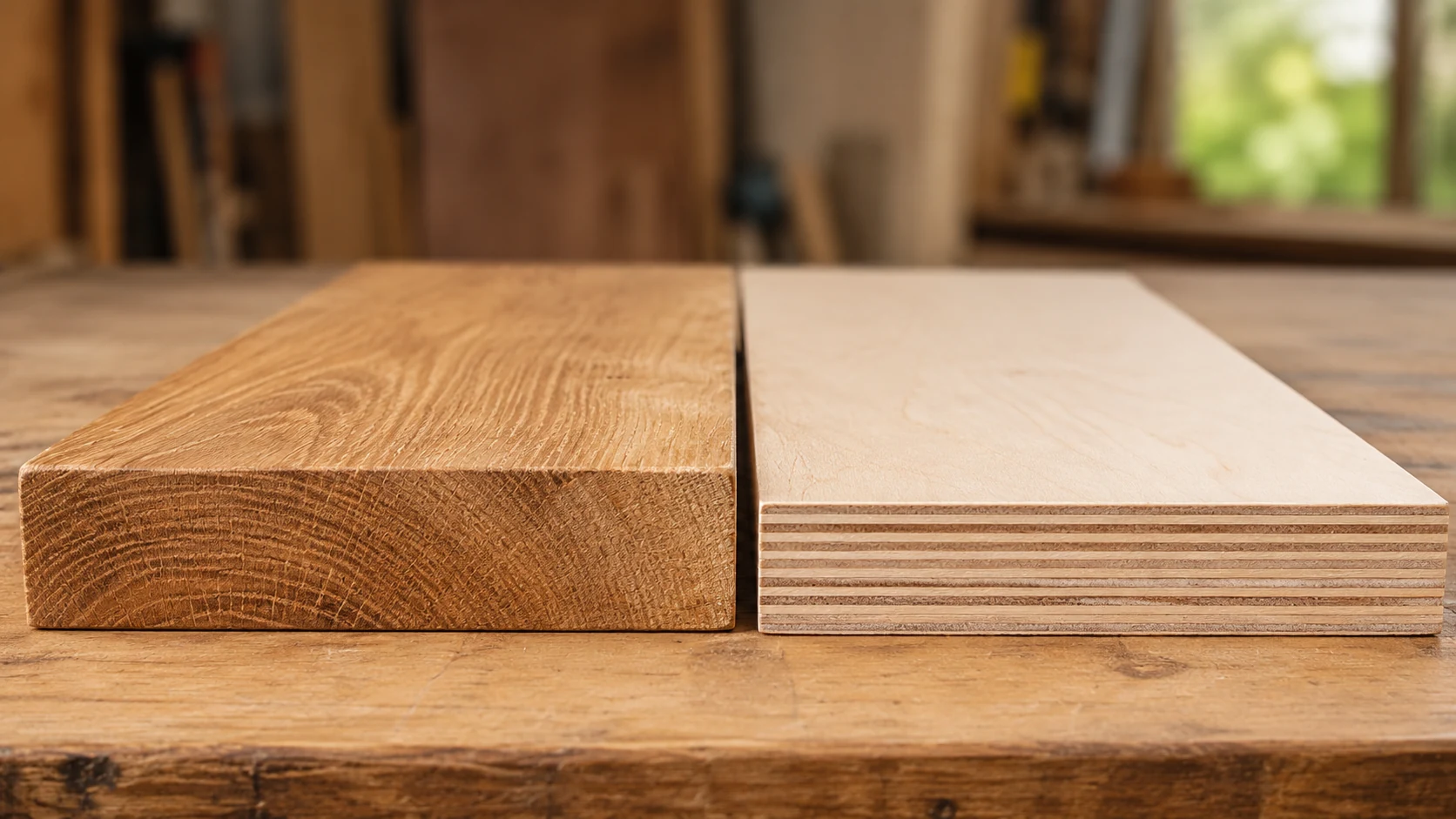
This guide breaks down the real differences across every performance dimension, then gives a clear application-by-application decision framework so you can specify the right material the first time.
Is Plywood Real Wood?
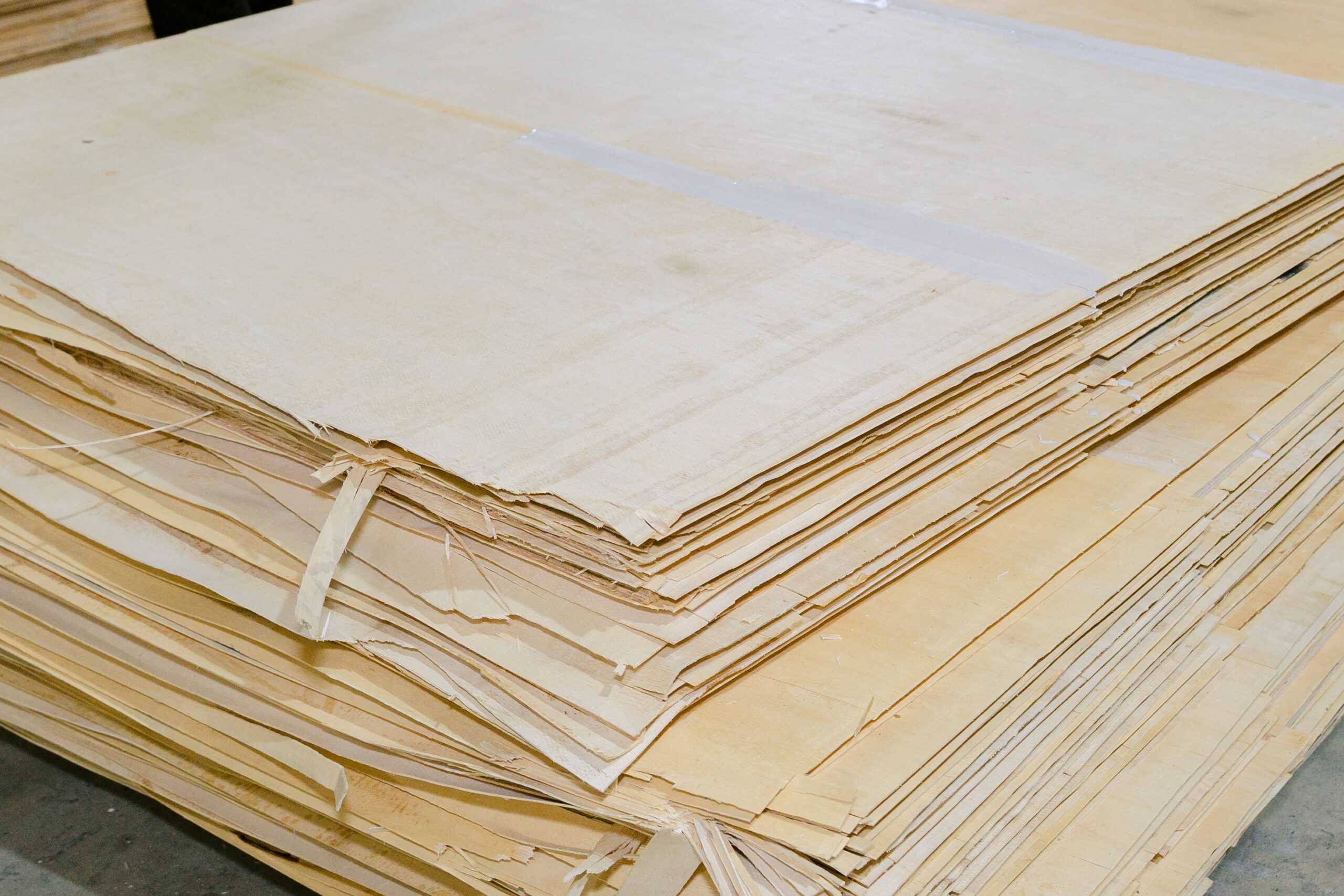
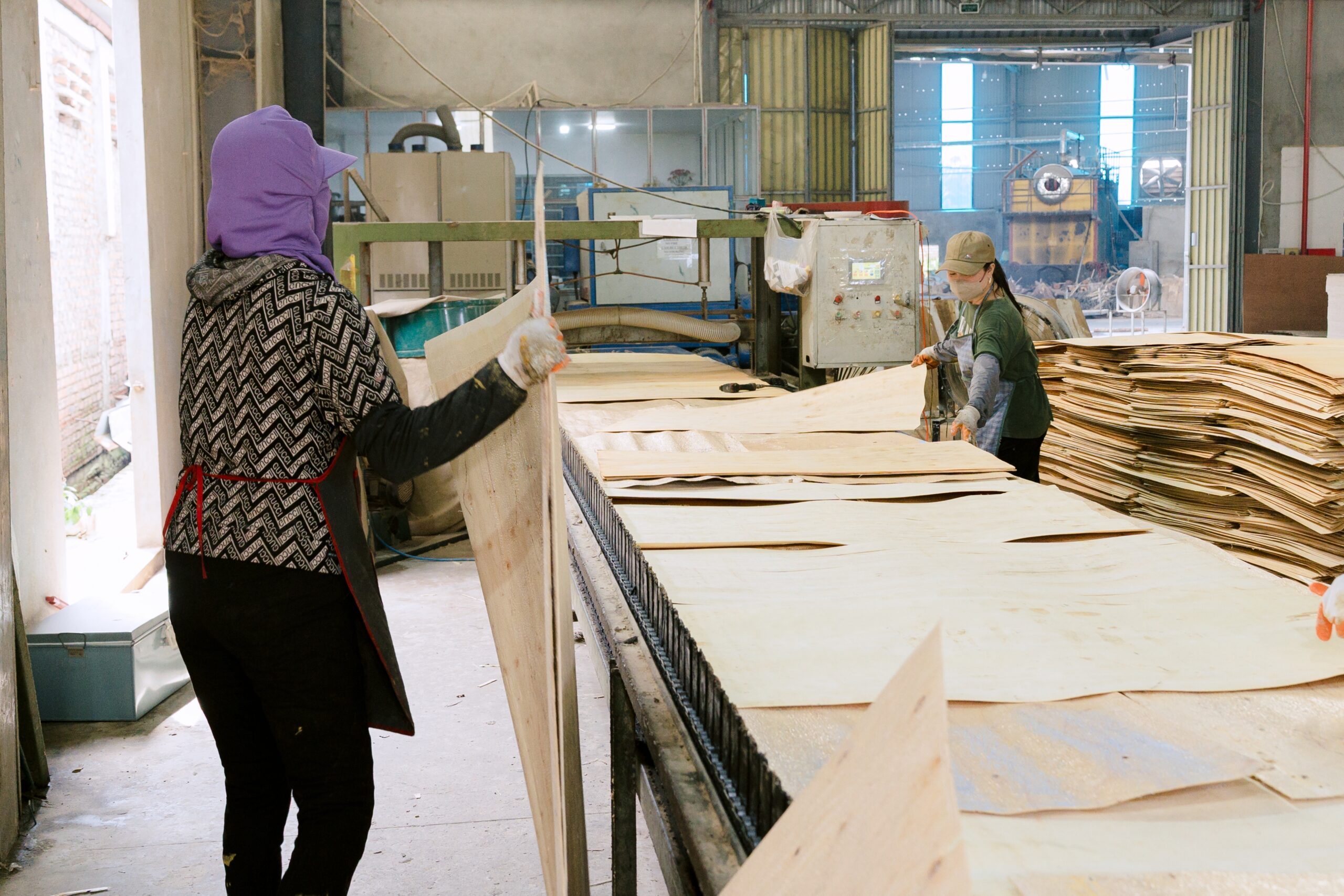
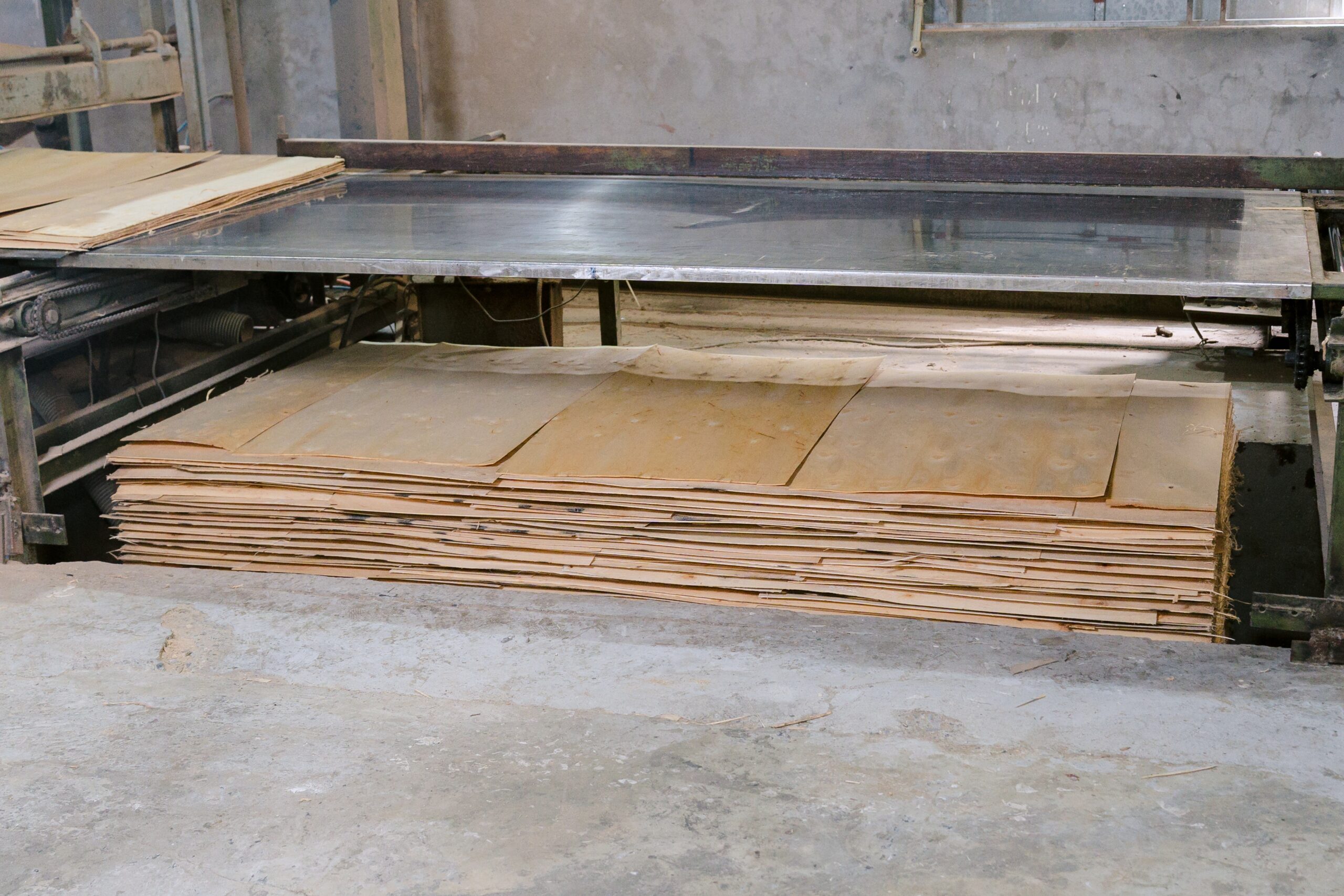
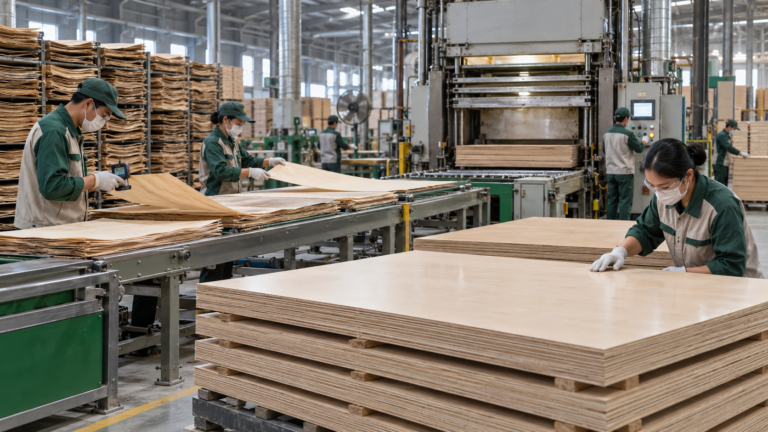
Yes – plywood is made entirely from wood. It is not a synthetic material, a composite of wood fibre and resin (that would be MDF or particleboard), or a plastic laminate. Plywood is produced by peeling logs into thin sheets of veneer, drying them, and then gluing them together in alternating grain directions under heat and pressure.
The key difference from solid wood is how the wood fibres are oriented:

- Solid wood – all grain runs in the same direction, parallel to the plank length
- Plywood – each veneer layer is rotated 90° from the one below (cross-lamination), creating a panel where grain runs in two directions
This cross-lamination is not a compromise – it is an engineering advantage. It is the same reason engineered structural beams outperform dimensional lumber in predictable ways.
Where Does Engineered Wood Fit?
“Engineered wood” is a broad category that includes plywood, MDF, particleboard, OSB, LVL beams, and glulam. Plywood is one type of engineered wood – but engineered wood is not all the same:
| Product | Made from | Structure | Plywood? |
|---|---|---|---|
| Plywood | Wood veneer sheets | Cross-laminated layers | Yes |
| MDF | Wood fibre + resin | Uniform compressed fibre | No |
| Particleboard | Wood chips + resin | Compressed particles | No |
| OSB | Wood strands + resin | Oriented strand layers | No |
| LVL | Veneer sheets | Parallel-laminated | No |
When comparing “plywood vs engineered wood,” the question usually means plywood vs MDF or plywood vs particleboard – not plywood vs LVL or glulam, which are structural products. For the plywood vs MDF comparison specifically, see Birch Plywood vs MDF: Strength, Moisture & Cost.
Head-to-Head Comparison
| Property | Solid Wood | Plywood (birch, combi core) | Plywood (all-birch) |
|---|---|---|---|
| Material | Natural timber | Wood veneer, cross-laminated | Wood veneer, cross-laminated |
| Density | 400-750 kg/m³ (species dependent) | 450-550 kg/m³ | 640-700 kg/m³ |
| Dimensional stability | Low – expands/contracts with humidity | High – cross-lamination resists movement | High |
| Warping risk | High – cups, twists, bows over time | Low | Very low |
| Bending strength (MOR) | 40-100 N/mm² (species dependent) | 28-40 N/mm² | 40-55 N/mm² |
| Screw-holding (face) | Excellent | High | High |
| Screw-holding (edge) | Excellent | Moderate (combi) / High (all-birch) | High |
| Max panel width (stable) | 150-200mm before movement risk | Full sheet – no limit | Full sheet |
| Large panel availability | Glued up required (multiple boards) | 4×8 ft sheets standard | 5×5 ft sheets |
| Surface repairability | High – can be planed, sanded deeply | Moderate – limited veneer thickness | Moderate |
| Paintability | Good – grain shows through | Excellent (birch face) | Excellent |
| Cost (18mm equivalent) | High – species and grade dependent | Mid | Mid-high |
| Sustainability | Old-growth concern; FSC options exist | Efficient log use; FSC available | FSC available |
Strength: Is Plywood Stronger Than Solid Wood?
The honest answer: it depends on what type of strength you mean.
Where Solid Wood Is Stronger
Dense hardwoods – oak, maple, ash, hard maple – have higher MOR (bending strength) than plywood when the load is applied parallel to the grain. A solid oak beam bends and breaks at higher stress than a plywood panel of equal thickness. This is why solid wood is used for structural members, chair legs, table aprons, and joinery where point loads and long-grain strength matter.
Where Plywood Is Stronger
Panel stability under area load. A large plywood sheet loaded evenly across its surface – a shelf, a cabinet back, a subfloor panel – distributes stress across the cross-laminated structure. A large solid wood panel of the same dimensions would shrink, expand, cup, or split across its width over time as humidity changes. Plywood panels remain flat.
Resistance to splitting. Drive a screw near the end of a solid wood board and it will frequently split along the grain. Plywood’s cross-laminated structure means there is no single grain direction to split along – screws near edges are significantly more secure.
Consistent performance. Solid wood has knots, grain deviation, and natural defects that create unpredictable weak points. Structural-grade plywood distributes these defects across multiple layers, averaging out the variability.
Practical summary: Solid wood is stronger per unit in long-grain bending. Plywood is stronger in panel applications – stability, split resistance, and predictable large-format performance.
Warping, Movement & Moisture
This is where plywood has the clearest practical advantage for furniture and cabinetry.
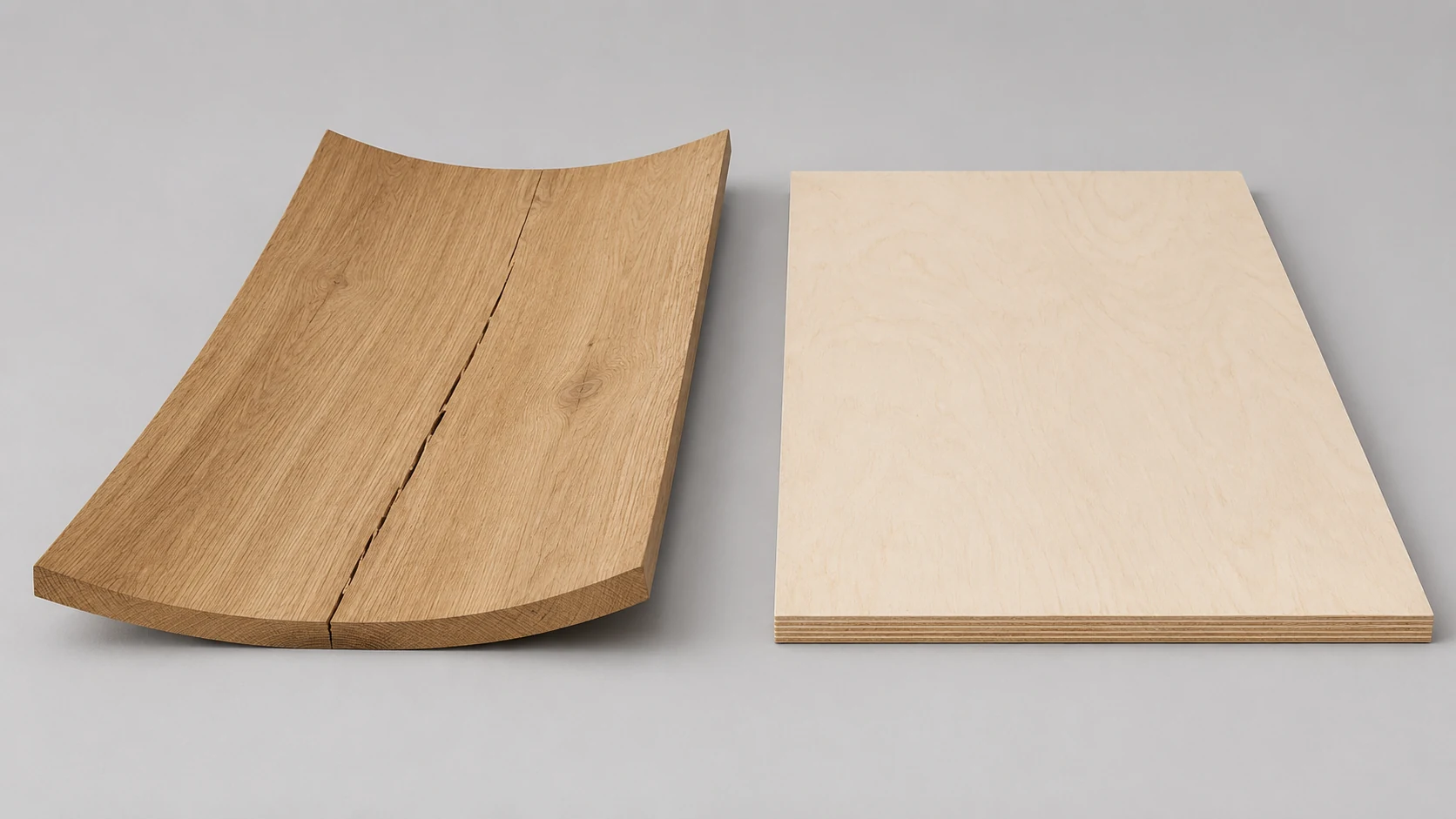
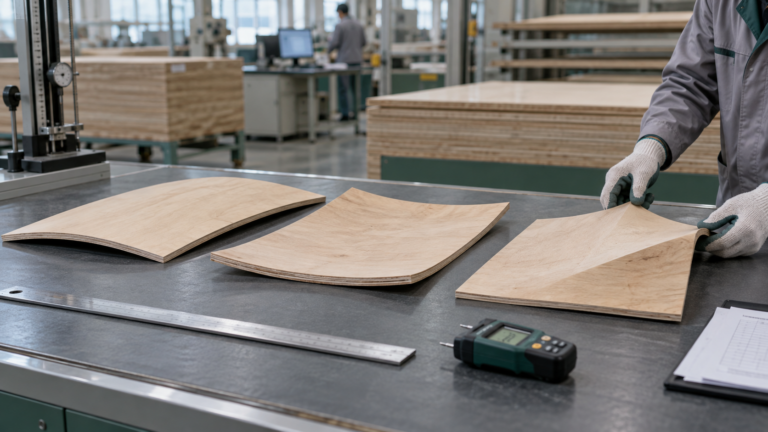
Solid wood moves. Every piece of timber expands across the grain in humidity and contracts in dry conditions. A 600mm wide solid wood cabinet side can move 3-6mm seasonally – enough to crack joints, buckle drawer fronts, or split panel frames if not properly allowed for in the joinery design. Skilled furniture makers account for this movement with floating panels, breadboard ends, and expansion gaps. Beginners often don’t – and their furniture shows it.
Plywood does not move significantly. Cross-lamination means expansion in one veneer layer is restrained by the perpendicular layer above and below. An 18mm birch plywood panel in the same 600mm width moves less than 0.5mm seasonally. Cabinet boxes, shelving, and drawer boxes built from plywood do not require movement allowances.
For kitchen and bathroom applications where humidity cycling is significant, plywood with WBP (phenolic) glue is the specification – moisture-resistant at the adhesive layers as well as at the surface. See Phenolic Plywood: What It Is & When to Specify It.
Application-by-Application: Which to Choose
Kitchen Cabinets: Solid Wood vs Plywood
Winner: Plywood for the box; solid wood for the door
The overwhelming consensus among professional cabinet makers and kitchen designers is:
- Cabinet carcass (box sides, tops, bottoms, shelving): plywood – dimensionally stable, no movement, lighter, easier to cut and assemble, holds screws reliably
- Cabinet doors and drawer fronts: solid wood or MDF – these are show surfaces where grain character or a perfectly paintable face matters, and they are small enough that movement is manageable
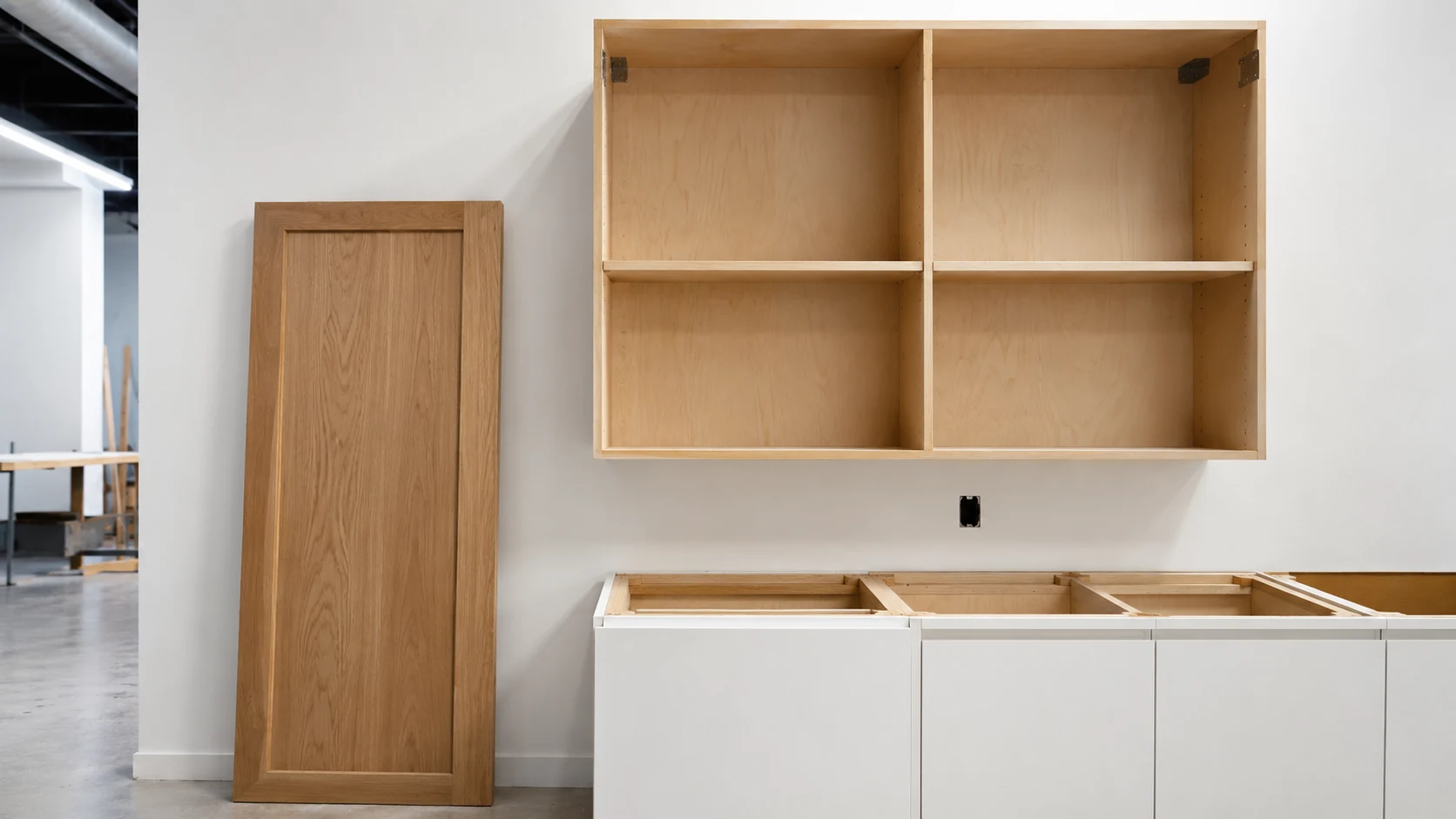
A full solid wood cabinet box is expensive, heavier, and more prone to racking and joint movement over time. A plywood box with solid wood or MDF doors is the industry standard specification for kitchens at every price point above flat-pack.
For full cabinet specification guidance: Best Plywood for Kitchen Cabinets: Grade, Core & Thickness
Furniture Carcassing: Solid Wood vs Plywood
Winner: Plywood for carcasses and panels; solid wood for structural frame members
For bookshelves, wardrobes, TV units, and storage furniture:
- Shelves and panels: plywood – no sag risk over span (higher MOE than particleboard), no warping, wide panels available without gluing up
- Frame members (legs, rails, stiles): solid wood – long-grain strength, traditional joinery, better for turned or shaped profiles
The combination of a solid wood frame with plywood panels is not a compromise – it’s how most quality furniture has been built for the past century.
Drawer Boxes: Solid Wood vs Plywood
Winner: Plywood for most applications; solid wood for traditional hand-cut joinery
Plywood drawer boxes are the standard in modern cabinetry for practical reasons:
- No movement – solid wood drawer boxes can swell in humidity and bind in the opening
- Consistent thickness – plywood is dimensionally uniform; solid wood boards vary
- Lighter – soft-close drawer mechanisms have weight limits; plywood is easier on hardware
- Cheaper at scale – for a kitchen with 20+ drawers, plywood saves significant material cost
Traditional hand-cut dovetail drawer boxes use solid wood – the joinery is the design feature. For concealed-box construction with a solid front face, plywood is the practical specification.
Table Tops: Solid Wood vs Plywood
Winner: Solid wood for dining tables; plywood for work surfaces and utility
A solid wood dining table top – properly dried, glued up from quality boards, and finished – is a premium product that ages well and can be refinished multiple times. The grain character and natural movement (managed with proper base attachment) are part of the aesthetic and value proposition.
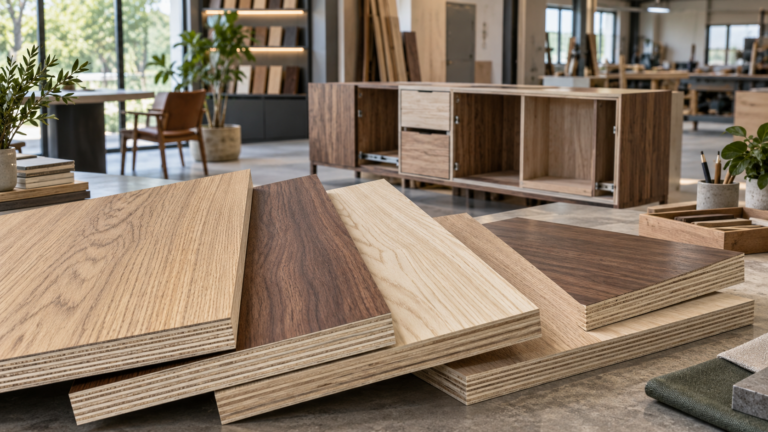
Plywood table tops make sense for:
- Workbenches and workshop surfaces – birch or phenolic-faced plywood is flat, stable, and hard-wearing
- Desk tops – plywood with a veneer or laminate surface provides a wide, flat, warp-free panel
- Substrate for stone or tile tops – plywood is the structural base; the top surface is another material
For a dining table top where the wood grain is the feature, solid wood is the correct specification. For a painted or laminated table top where stability and flatness are priorities, plywood wins.
Cost: Plywood vs Solid Wood
Cost comparison depends heavily on species and grade:
| Material | Typical retail (per sheet/board equivalent) | Notes |
|---|---|---|
| Birch plywood, 18mm combi core, 4×8 | $50-65 | Standard furniture grade |
| Birch plywood, 18mm all-birch, 5×5 | $70-90 | Premium – Baltic birch equivalent |
| Solid pine, 19mm, 1×8 boards (per panel equivalent) | $35-55 | Softwood – requires glue-up for wide panels |
| Solid oak, 20mm, S4S (per panel equivalent) | $120-200 | Hardwood – premium appearance, high movement |
| Solid maple, 20mm | $140-220 | Premium hardwood |
| MDF, 18mm, 4×8 | $30-45 | Low cost – no moisture resistance |
The real cost comparison for cabinetry: A set of kitchen cabinets built with birch plywood boxes costs less in materials than the equivalent in solid oak – and significantly less in finishing time, because solid wood requires more surface preparation, movement allowances, and joinery complexity.
Sustainability
Both solid wood and plywood can be produced sustainably – FSC certification applies to both. The environmental comparison is more nuanced:
- Solid wood from old-growth forests is the highest environmental impact. FSC-certified solid wood from managed forests is comparable to plywood.
- Plywood uses the whole log efficiently – veneer peeling extracts material that would be discarded in sawing. A plywood panel uses approximately 90% of the log volume; dimensional lumber uses 40-60%.
- Adhesives in plywood add a chemical element absent in solid wood. E1-rated (formaldehyde ≤8 mg/100g) plywood is the standard for indoor furniture use.
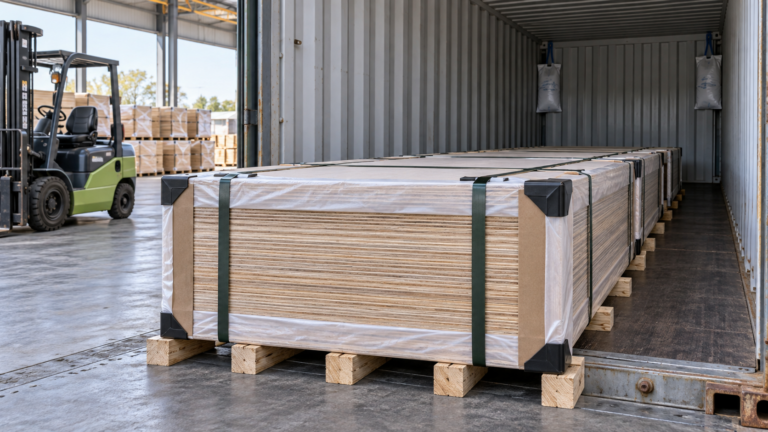
Kosmex produces FSC-certified plywood panels with E1 emission class, CE marked for EU export. Request FSC certificates and documentation →
FAQ
Is plywood real wood?
Yes. Plywood is made entirely from wood veneer – thin sheets peeled from logs, dried, and bonded together with adhesive under heat and pressure. It is not a synthetic material. The cross-laminated construction is an engineered improvement on solid wood’s directional grain, not a departure from wood as a material.
Is plywood stronger than solid wood?
In panel applications – large flat surfaces, shelving, cabinet boxes – plywood is more stable and predictable than solid wood. In long-grain bending (structural beams, chair legs), dense hardwoods can exceed plywood’s bending strength. The comparison depends on the application and the load direction.
Which is better for kitchen cabinets – solid wood or plywood?
Plywood is the professional standard for kitchen cabinet boxes. Solid wood moves with humidity changes, causing joints to crack and drawers to bind. Plywood is dimensionally stable, lighter, and easier to work with at scale. Cabinet doors are typically solid wood or MDF – the box itself is almost always plywood in quality construction.
What is the difference between engineered wood and plywood?
Plywood is one type of engineered wood. “Engineered wood” is a broad category that includes MDF, particleboard, OSB, LVL, and plywood. All are manufactured wood products, but they differ significantly in construction, strength, and appropriate use. Plywood (cross-laminated veneer) is stronger and more moisture-resistant than MDF or particleboard for most structural and furniture applications.
Can plywood replace solid wood for drawer boxes?
Yes – and it does in most professional cabinetry. Plywood drawer boxes are dimensionally stable (don’t swell and bind), lighter (easier on soft-close hardware), and consistent in thickness. Traditional hand-cut dovetail drawers use solid wood, but this is a craft/aesthetic choice, not a performance requirement.
Is solid wood or plywood better for a table top?
For a dining table where grain character is the feature: solid wood. For work surfaces, desks, or laminated/painted tops where flatness and stability are priorities: plywood. Plywood will not warp, cup, or split across the width as seasons change – solid wood requires careful management of seasonal movement in table base attachment.
Summary: When to Choose Each
| Application | Solid Wood | Plywood |
|---|---|---|
| Kitchen cabinet box | Moves, heavier | Stable, standard spec |
| Cabinet doors | Grain character | MDF or solid both work |
| Dining table top | Premium aesthetic | Substrate/work surface |
| Bookshelf panels | Movement risk wide panels | Stable, no glue-up needed |
| Drawer boxes | Can swell and bind | Standard modern spec |
| Chair legs / frame members | Long-grain strength | Not suitable |
| Workbench top | Movement over width | Flat, stable, hard-wearing |
| Subfloor | Tongue & groove option | Structural plywood rated |
| Painted furniture | Grain telegraphs | Smooth birch face |
| Turned / shaped profiles | Workable on lathe | Not suitable |
Related Reading
- Birch Plywood vs MDF: Strength, Moisture & Cost
- Best Plywood for Kitchen Cabinets: Grade, Core & Thickness
- Baltic Birch vs Birch Plywood: What’s Actually Different
- Poplar Core Plywood: What It Is & When to Use It
- Pine Plywood vs Birch Plywood: Strength, Cost & Uses
- How to Finish Birch Plywood: Staining, Painting & Sealing
Bình luận