


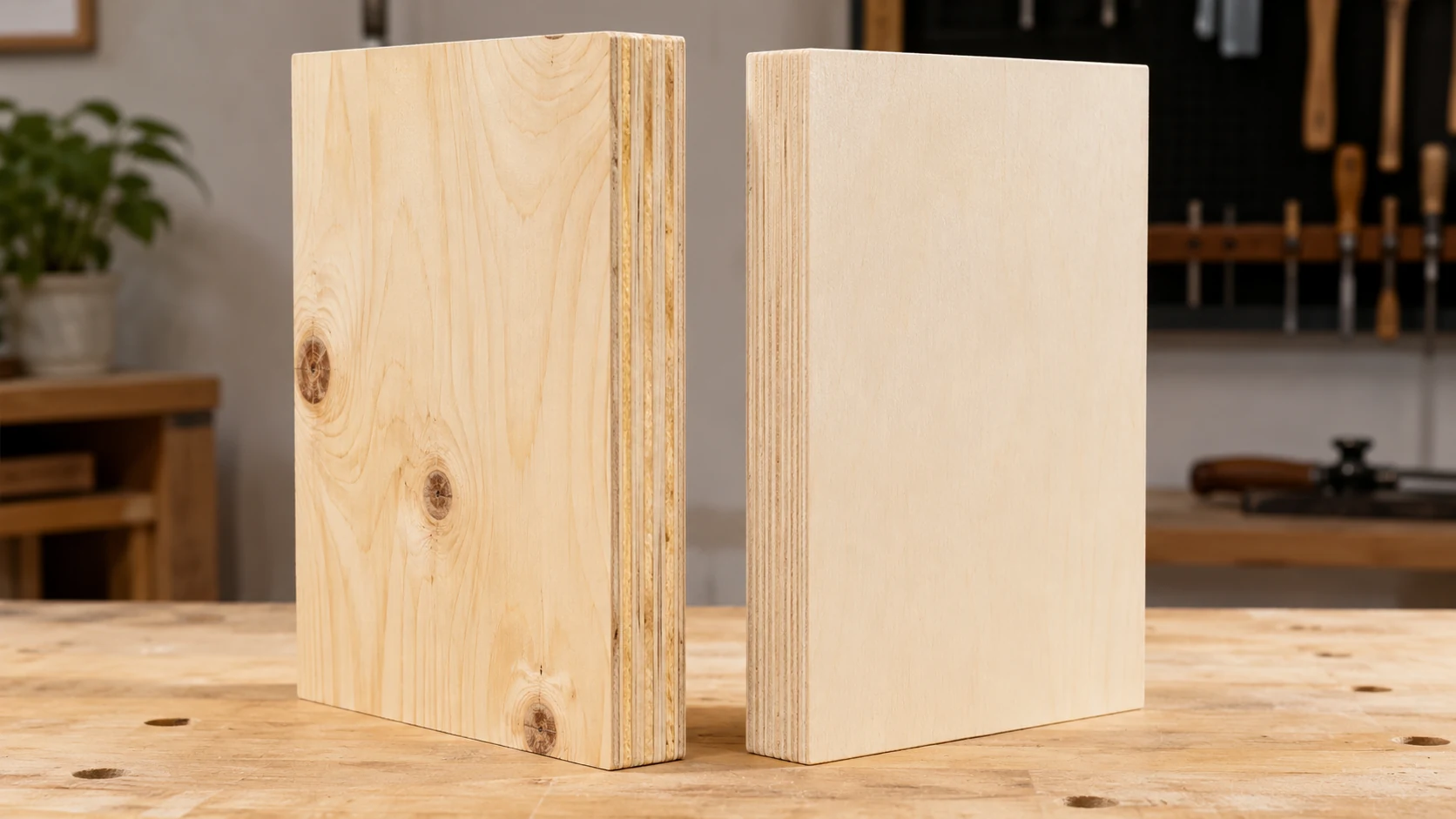
This guide breaks down the real differences: species characteristics, structural performance, workability, cost, and the specific applications where each material has a clear advantage.
Species and Core Construction
Pine Plywood
“Pine plywood” covers several different species and grades depending on the market:
- Radiata pine (Pinus radiata) – the dominant pine plywood species in Australia, New Zealand, South America, and increasingly in Asia. Fast-growing, relatively uniform grain, density 480-540 kg/m³.
- Southern Yellow Pine (SYP) – common in US construction markets. Denser and stronger than radiata (density 560-640 kg/m³), used for structural sheathing and subfloor.
- CDX pine – construction-grade pine plywood with C-grade face, D-grade back, and X (exterior) glue. The most common structural panel in North America.
Pine plywood core construction varies widely by grade:

- Structural/construction grades: softwood core throughout – same species, large-format veneers
- Appearance grades: sometimes uses a pine face over a mixed or poplar core
Birch Plywood
Birch plywood is a hardwood panel, available in two core constructions:
- All-birch (Baltic birch style): birch veneer throughout every layer – face, crossbands, and core. Void-free, 13 plies at 18mm.
- Combi core (commercial birch): birch face and back veneer over a poplar or eucalyptus inner core. Most birch-faced plywood sold commercially is this construction.
For a detailed breakdown of combi vs all-birch core, see Baltic Birch vs Birch Plywood and Poplar Core Plywood: What It Is & When to Use It.
Head-to-Head Comparison
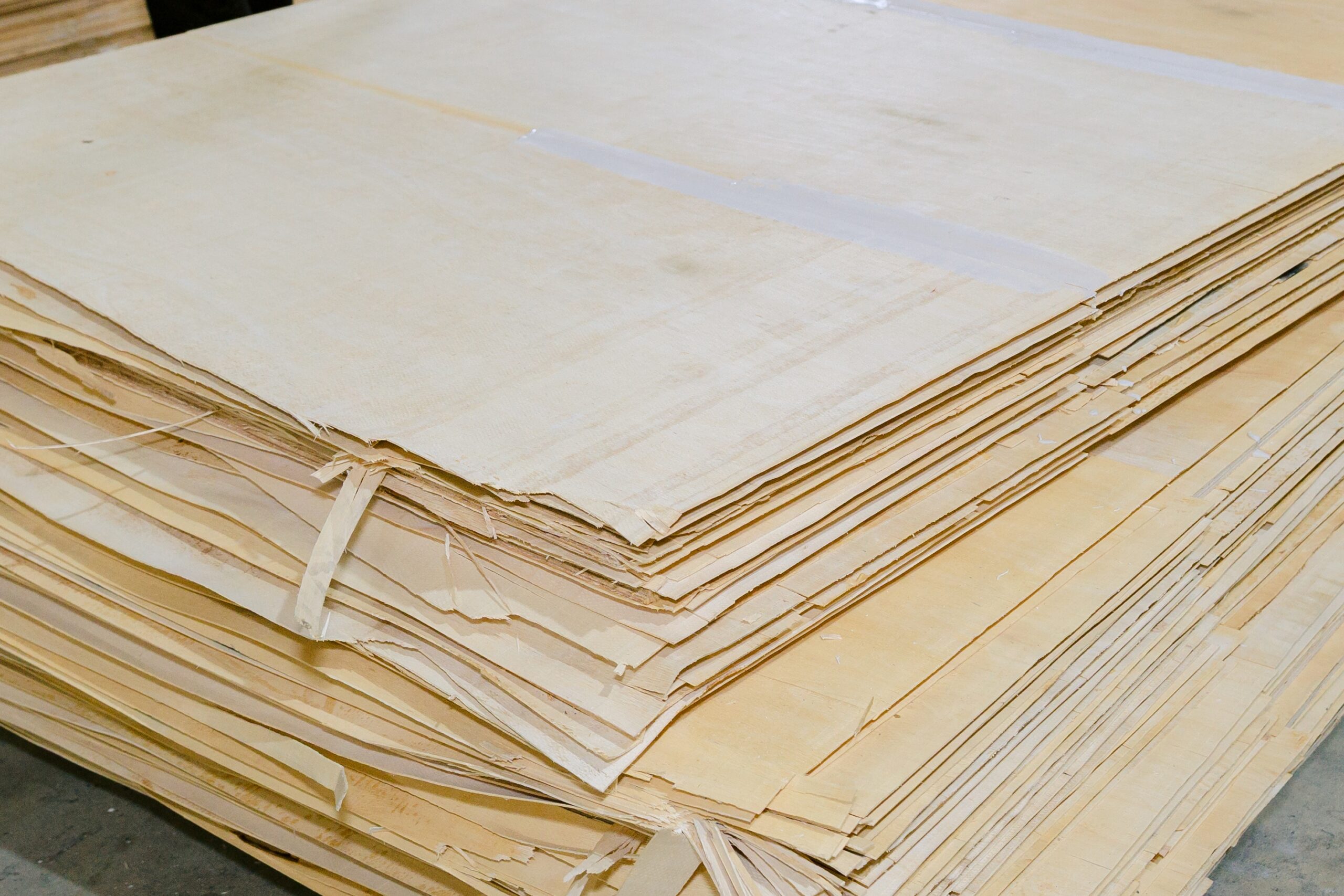
| Property | Pine Plywood | Birch Plywood (combi) | Birch Plywood (all-birch) |
|---|---|---|---|
| Species | Radiata / SYP / CDX | Birch face + poplar core | All-birch |
| Density | 480-640 kg/m³ | 450-550 kg/m³ | 640-700 kg/m³ |
| Weight (18mm 4×8 sheet) | ~25-33 kg | ~25-30 kg | ~36-40 kg |
| Bending strength (MOR) | 28-38 N/mm² | 28-40 N/mm² | 40-55 N/mm² |
| Stiffness (MOE) | 6,500-8,500 N/mm² | 5,500-7,500 N/mm² | 8,000-10,000 N/mm² |
| Surface quality | Knotty, coarse grain | Smooth, fine grain | Smooth, fine grain |
| Core voids | Permitted (grade dependent) | Permitted | None |
| Standard size | 4×8 ft (1220×2440mm) | 4×8 ft (1220×2440mm) | 5×5 ft (1525×1525mm) |
| Glue options | MR / WBP (CDX = exterior) | MR / WBP | WBP standard |
| Paintability | Poor-moderate (grain telegraphs) | Excellent | Excellent |
| Screw-holding (edge) | Moderate | Moderate | High |
| Typical retail price (18mm 4×8) | $35-55/sheet | $45-65/sheet | $70-90/5×5 sheet |
| FOB Vietnam (B2B) | $220-280/CBM | $270-360/CBM | $380-450/CBM |
Strength: Pine vs Birch
Where Pine Has the Structural Advantage
Southern Yellow Pine (SYP) is one of the strongest softwood plywoods available – its MOR of 35-38 N/mm² is comparable to combi-core birch, and its higher MOE in certain grades gives it good stiffness for structural applications. SYP structural panels are rated and certified for load-bearing applications under PS1 (US) and equivalent standards.
For subfloor, wall sheathing, roof decking, and structural framing, pine plywood – specifically CDX or structural-grade panels – is the correct specification. These applications require panels tested and certified to structural standards that furniture-grade birch plywood is not rated for.
Where Birch Has the Strength Advantage
All-birch plywood (Baltic birch construction) has a higher MOR (40-55 N/mm²) and MOE (8,000-10,000 N/mm²) than most pine panels – and significantly more consistent density across the panel surface. This matters for:
- Long unsupported shelf spans – birch deflects less under distributed load
- Edge joinery and screw-holding – denser birch core holds fasteners more reliably
- CNC routing and precision work – consistent density prevents tear-out at core layer transitions
Radiata pine plywood, while adequate for construction, is softer and more prone to surface denting in furniture applications – a birch face takes impact and abrasion noticeably better.
Surface Quality and Workability
This is where the two materials diverge most clearly for woodworkers.
Pine Surface Characteristics
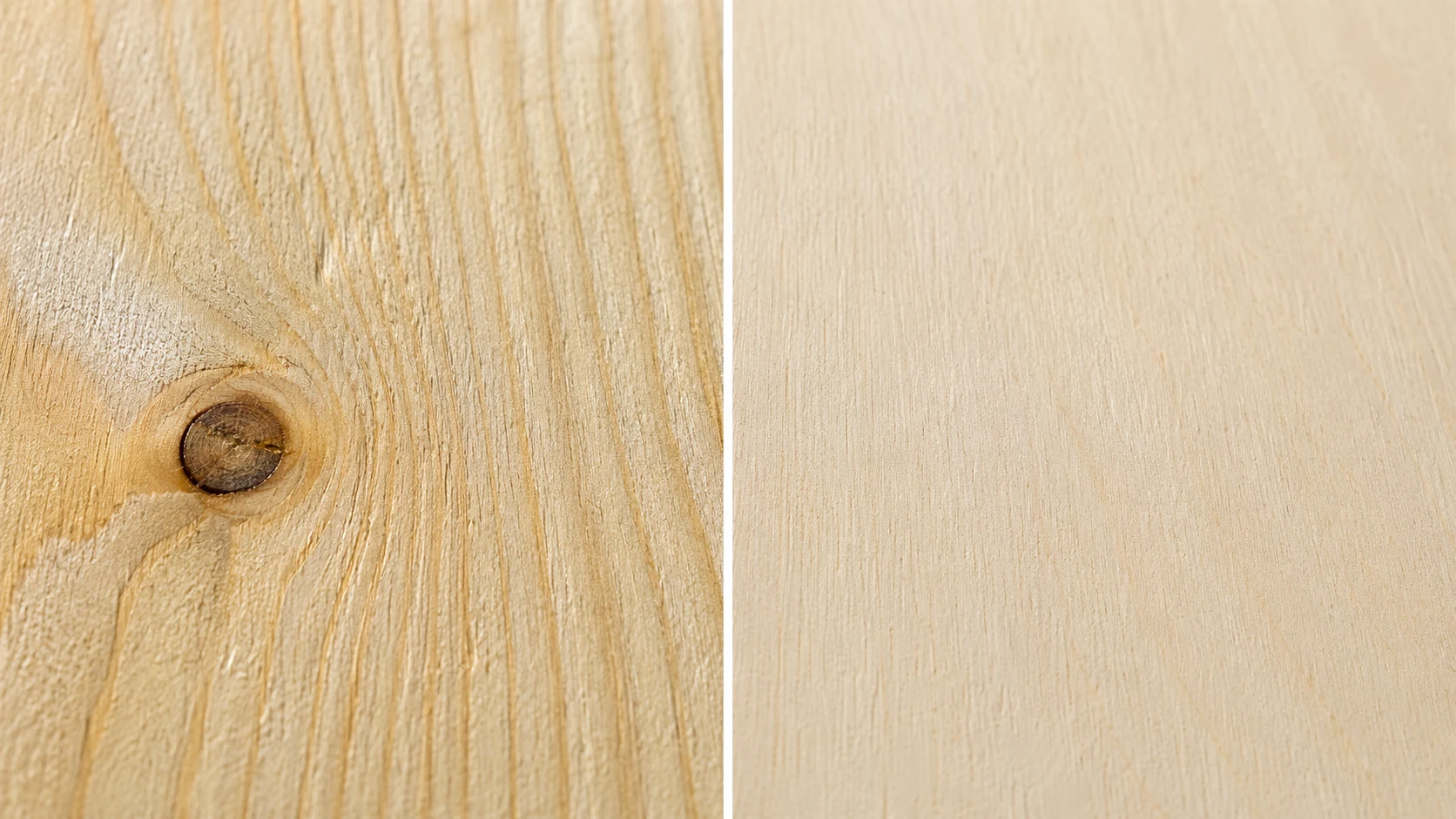
Pine plywood has a pronounced, open grain with frequent knots – even in appearance-grade panels. This creates two problems for finishing:
- Grain telegraphing – paint applied over pine shows the grain pattern through even multiple coats, particularly with latex paints
- Resin bleed – pine contains natural resins that can bleed through primers and paint, causing yellow staining over time if not properly sealed with shellac-based primer
For stained natural finishes, pine plywood has a rustic character that some furniture styles favour. For smooth painted finishes, birch is significantly easier to achieve a flawless result.
Birch Surface Characteristics
Birch veneer has a tight, fine grain with minimal figure – it sands smoothly, takes paint without grain telegraphing, and provides a near-MDF surface quality at appearance grades (B/BB). This is why birch plywood is the default for painted furniture, kitchen cabinets, and built-in millwork.
For full finishing guidance on birch, see How to Finish Birch Plywood: Staining, Painting & Sealing.
Use Cases: Where Each Material Belongs
Pine Plywood Is the Right Choice For:
Structural construction work
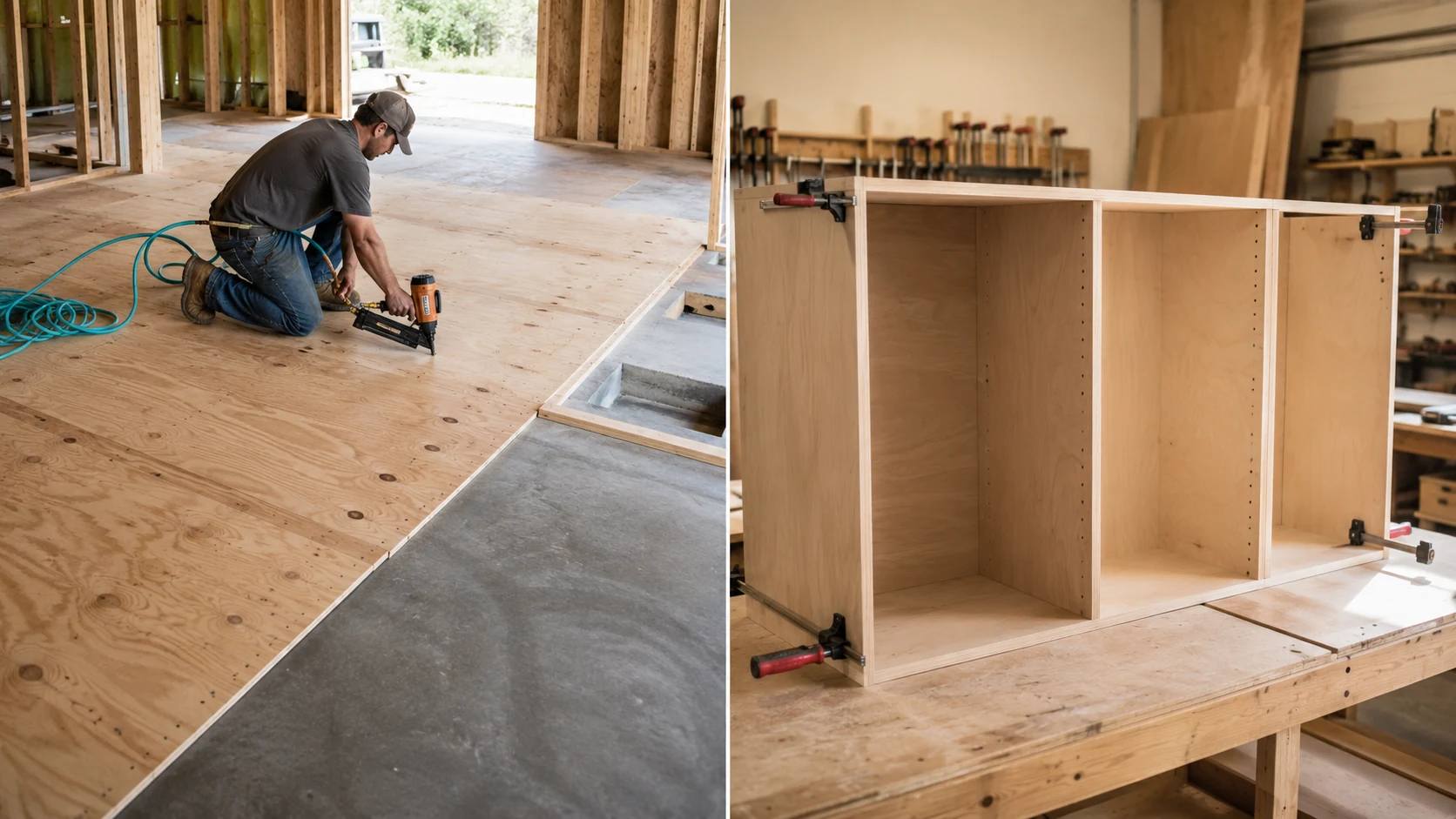
CDX and structural pine plywood is rated for wall sheathing, roof decking, and subfloor applications under building codes. Birch plywood carries no structural rating for these uses. For subfloor specification specifically, see Subfloor Plywood: Types, Thickness & How to Choose.
Site hoarding and temporary work
Pine is cheaper and adequate for formwork backing, site hoarding, and temporary structures where surface quality and longevity are secondary to cost.
Rustic or natural-finish furniture
Where the knotty, characterful grain of pine is a design intention – farmhouse furniture, rustic shelving, workshop benches – pine plywood delivers that aesthetic at lower cost than birch.
Workshop shelving and utility storage
For shop storage, garage shelving, and utility racking where surface appearance is not a priority, pine plywood provides adequate strength at a meaningful cost saving.
Birch Plywood Is the Right Choice For:
Kitchen cabinets and furniture carcassing
Birch face veneer takes paint and finish without grain telegraphing. Edge banding bonds cleanly. Screw-holding is reliable for cabinet assembly hardware. This is why birch plywood – combi core or all-birch – is the specification standard for kitchen cabinet boxes globally.
See: Best Plywood for Kitchen Cabinets: Grade, Core & Thickness
CNC routing and precision joinery
All-birch panels machine with consistent density across every ply – no soft spots, no tear-out at core transitions. Pine’s softer core and lower density creates more variable machining results.
Drawer boxes and interior millwork
Birch is the industry standard for drawer box sides and bottoms – smooth surface, consistent thickness, and the lighter weight of combi-core panels (comparable to pine) suits soft-close mechanism loads.
Painted built-in furniture
Where a flawless painted surface is required – built-in wardrobes, TV units, painted bookcases – birch plywood requires significantly less surface preparation than pine. One coat of primer is typically sufficient on a sanded birch face; pine requires shellac primer plus multiple topcoats to prevent grain telegraphing and resin bleed.
Speaker cabinets and acoustic enclosures
Baltic birch is the default specification for speaker cabinet construction – the void-free all-birch core is acoustically inert and dimensionally stable, preventing resonance and vibration that voids or soft-core panels can introduce.
Radiata Pine vs Birch Plywood
Radiata pine is worth addressing separately because it’s frequently compared to birch in Australian, New Zealand, and Asian markets where radiata is the dominant structural species.
| Property | Radiata Pine Plywood | Birch Plywood (combi core) |
|---|---|---|
| Density | 480-540 kg/m³ | 450-550 kg/m³ |
| Surface grain | Open, knotty | Fine, smooth |
| Structural rating | Yes – F7/F11/F14 rated (AU) | No structural rating |
| Paint finish quality | Poor – significant grain telegraphing | Excellent |
| Moisture resistance | Moderate (exterior glue available) | MR or WBP options |
| Cost | Lower | Higher |
| Availability (AU/NZ) | Widely available at all builders merchants | Specialty timber stores |
In Australian and New Zealand markets, radiata pine structural plywood is the default construction panel. For furniture and cabinetry in these markets, birch-faced combi core or Baltic birch (imported) is the upgrade specification when surface quality matters.
Cost Comparison
| Specification | Retail (per 4×8 sheet approx.) | FOB Vietnam (B2B) |
|---|---|---|
| CDX pine, 18mm | $35-45 | $190-240/CBM |
| Radiata pine appearance grade, 18mm | $45-60 | $220-270/CBM |
| Birch-faced combi core, 18mm, B/BB | $50-65 | $270-340/CBM |
| All-birch, 18mm, B/BB | $70-90 (5×5) | $380-450/CBM |
Pine’s cost advantage is most significant in construction quantities. For furniture manufacturing where the panel count per project is lower, the cost difference per unit is modest relative to the finishing time saved by using birch.
FAQ
Is birch plywood stronger than pine?
It depends on the comparison. All-birch Baltic birch has higher bending strength (MOR 40-55 N/mm²) than most pine panels. However, Southern Yellow Pine structural plywood is comparable in bending strength to combi-core birch, and carries structural certifications that birch does not. For furniture strength – screw-holding, edge joinery, long-span shelving – birch is the stronger choice. For structural construction applications, pine is the rated and certified specification.
Can I use pine plywood for kitchen cabinets?
Technically yes, but it’s not recommended for painted cabinets. Pine grain telegraphs through paint, requiring shellac primer and multiple coats to achieve a smooth finish. Resin bleed can cause yellow staining over time. Birch plywood provides a significantly better painted surface with less preparation. For stained or natural-finish rustic cabinets, pine is a viable lower-cost option.
Is radiata pine the same as regular pine plywood?
No. Radiata pine (Pinus radiata) is a specific species grown in Australia, New Zealand, Chile, and parts of Asia. It is the dominant pine plywood species in southern hemisphere markets. North American pine plywood typically uses Southern Yellow Pine or Douglas Fir. Both are softwood species, but radiata is generally softer and lower density than SYP.
Which is better for shelving – pine or birch?
For short spans (under 800mm) with light loads, pine is adequate and cheaper. For spans over 900mm or heavy loads (books, dense storage), birch plywood – particularly all-birch – deflects less under load due to its higher stiffness (MOE). The practical recommendation: use birch for shelving in living spaces where both appearance and load performance matter; pine for utility storage where neither is a priority.
Can you finish pine plywood to look like birch?
No – the grain character is fundamentally different. Pine has a pronounced open grain with annual ring structure and frequent knots. Birch has a fine, tight, relatively uniform grain. Staining pine darker can reduce the contrast, but the grain pattern remains visible. If the target look is a smooth, even surface, the correct specification is birch from the start.
Which is more moisture-resistant – pine or birch?
Both are available with WBP (exterior) glue that resists moisture at the adhesive layers. The face veneer of birch is a denser hardwood and absorbs surface moisture more slowly than pine. For moisture-critical applications (kitchens, bathrooms, outdoor covered areas), specify WBP glue in either species, and consider phenolic-faced plywood for highest performance – see Phenolic Plywood: What It Is & When to Specify It.
Summary
| Application | Best choice |
|---|---|
| Subfloor, wall sheathing, roof decking | Structural pine (CDX / radiata) |
| Painted kitchen cabinets | Birch-faced combi core, B/BB, WBP |
| Rustic natural-finish furniture | Pine appearance grade |
| CNC routing, jigs, precision joinery | All-birch (Baltic birch) |
| Drawer boxes | Birch combi core 12mm |
| Heavy-load shelving >900mm | All-birch |
| Utility shelving / workshop storage | Pine – cost-efficient |
| Painted built-in furniture | Birch-faced combi core |
| Speaker cabinets | All-birch, void-free |
| Budget construction framing | CDX pine |
Related Reading
- Baltic Birch vs Birch Plywood: What’s Actually Different
- Birch Plywood Grades: A, B/BB, BB/BB, C2 Explained
- How to Finish Birch Plywood: Staining, Painting & Sealing
- Best Plywood for Kitchen Cabinets
- Subfloor Plywood: Types, Thickness & How to Choose
- Poplar Core Plywood: What It Is & When to Use It
- CDX Plywood vs OSB: Differences, Cost & Strength
Bình luận