


Birch Plywood for Furniture: Grade, Thickness and Joinery Guide
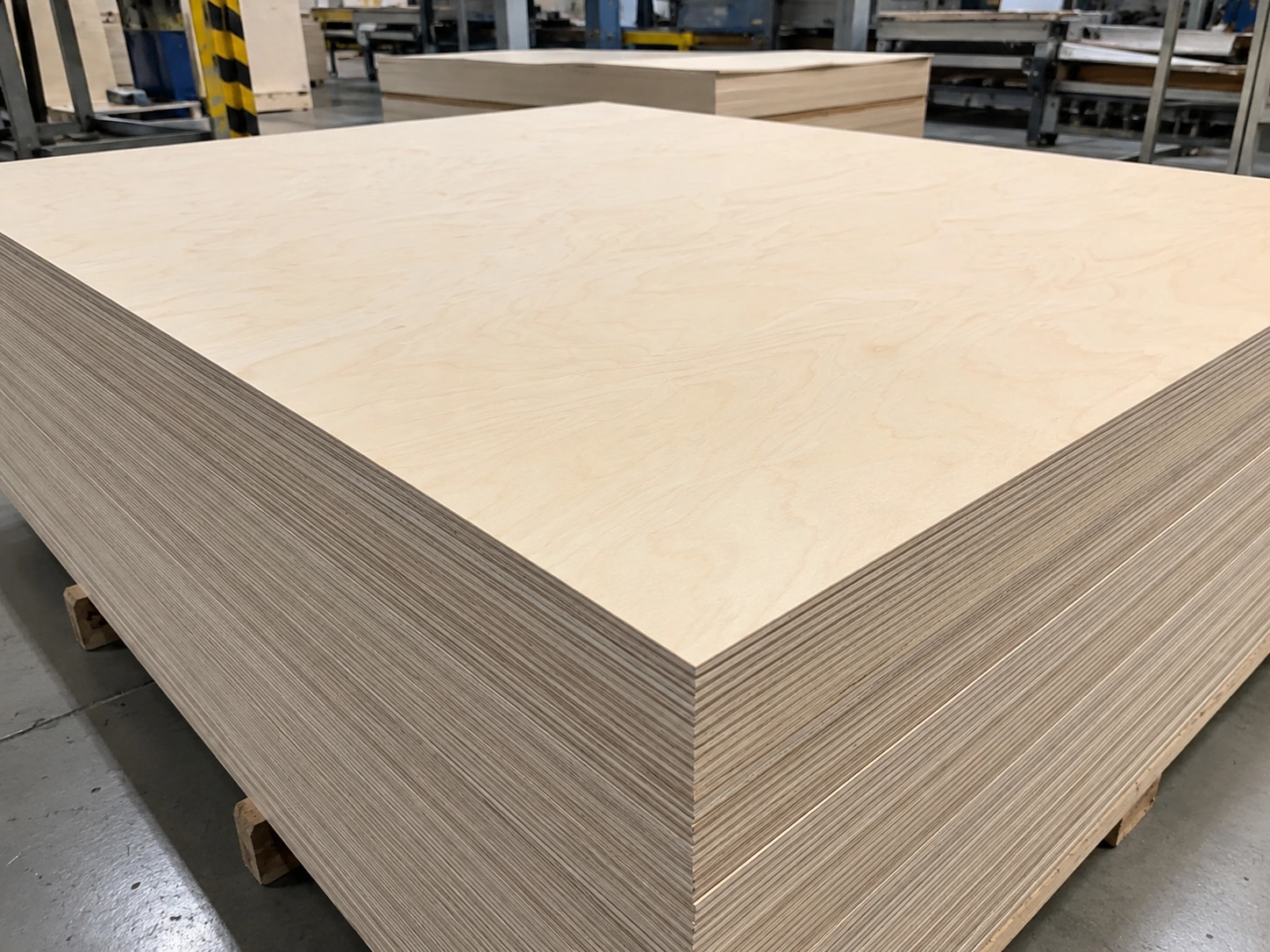
Birch plywood is the default material for professional furniture manufacturing for three reasons: surface quality, dimensional stability, and consistent structural performance. Unlike solid wood, it does not move seasonally. Unlike MDF, it holds screws reliably at edges and faces. Unlike particleboard, it does not sag under sustained load.
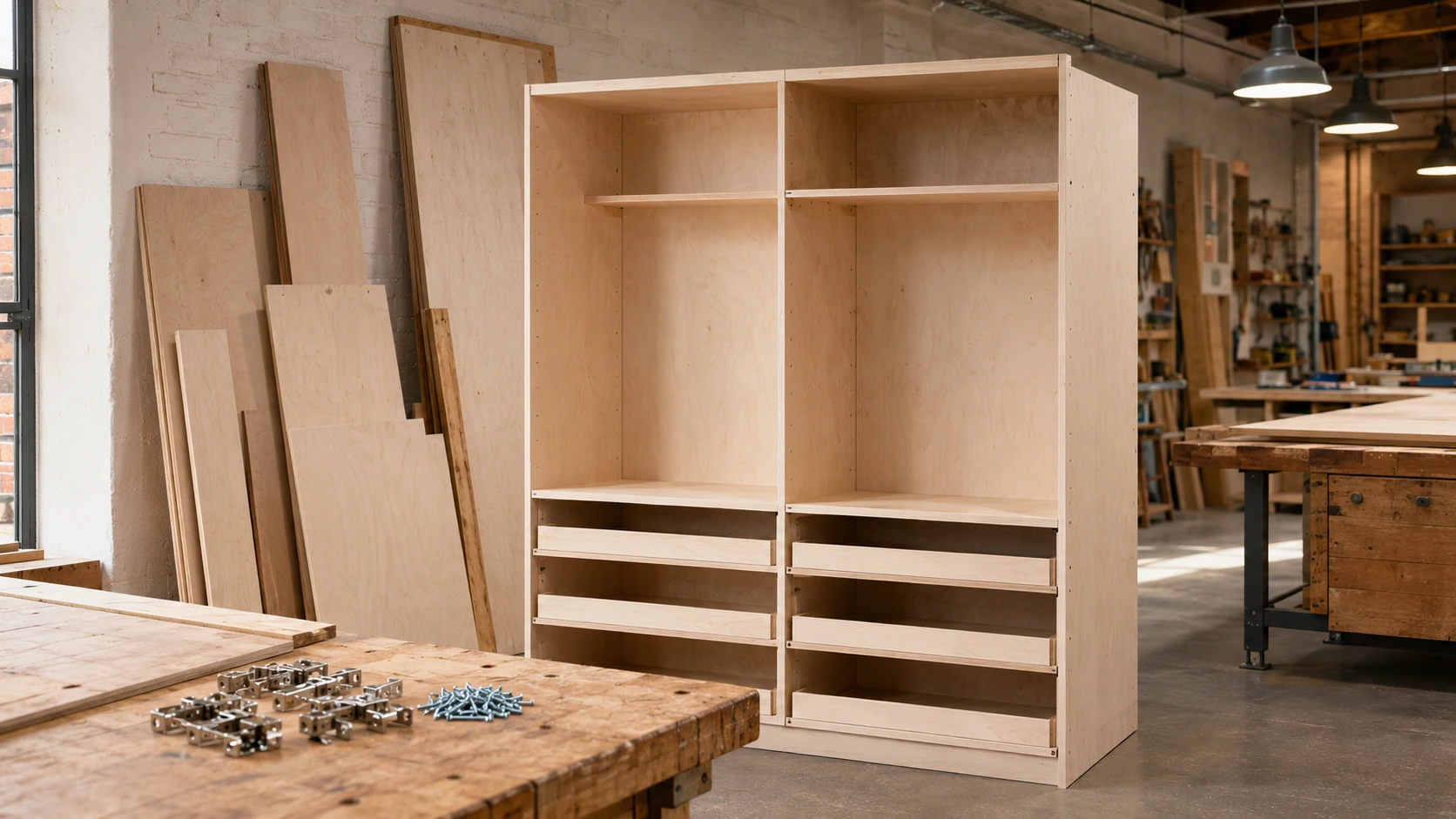
This guide covers the complete specification for furniture making with birch plywood: grade selection by furniture type, thickness by component, joinery methods, and finishing sequence.

Why Birch Plywood for Furniture
| Material | Surface quality | Screw holding | Moisture resistance | Stability | Cost |
|---|---|---|---|---|---|
| Birch plywood B/BB | Excellent | High face / Moderate edge (combi) / High edge (all-birch) | MR or WBP options | High | Mid |
| Solid hardwood | Variable (knots, grain) | Excellent | Low to moderate | Low, moves seasonally | High |
| MDF | Excellent | Low at edges | Poor | High | Low |
| Particleboard | Moderate | Very low | Very poor | High | Very low |
| All-birch (Baltic birch) | Excellent | High (face and edge) | WBP standard | Very high | Mid-high |
For furniture carcassing (wardrobe boxes, cabinet sides, shelving units, TV units), birch plywood is unambiguously the professional specification. Its combination of stability, surface quality, and edge hardware performance is not matched by any alternative at comparable cost.
For a full comparison: Plywood vs Solid Wood: Strength, Stability and Cost.
Grade Selection by Furniture Type
Visible Interior and Exterior Surfaces: B/BB
B/BB grade has a nearly clear face (B, small filled knots permitted, no open defects) and a patched back (BB, small repairs permitted). For furniture where both faces are potentially visible (open shelving, glass-fronted wardrobes, visible cabinet interiors), B/BB is the correct specification.
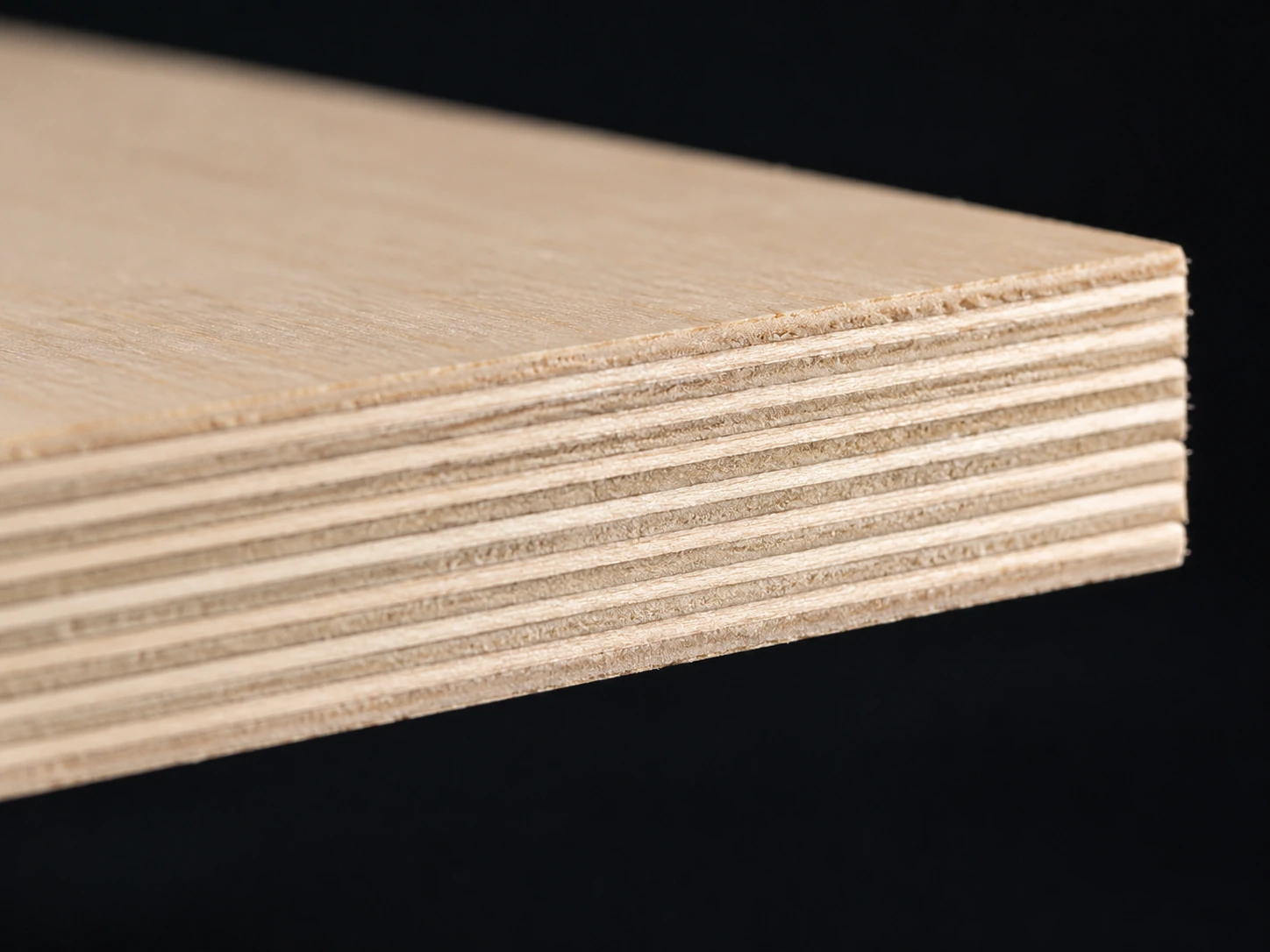
Applications: bookshelf panels, wardrobe interiors, display unit sides, TV unit shelving
Hidden or Painted Surfaces: BB/BB
BB/BB has small patches on both faces. Both are paintable, but neither is as clean as B-grade. For cabinet box components that will be painted, or for interior surfaces that are technically visible but not prominently so, BB/BB is the cost-effective specification.
Applications: wardrobe box sides, painted cabinet carcass, painted shelving
Structural or Hidden Components: BB/CP or CDX
BB/CP has a good face (BB) and a lower-grade back (CP, patches and some knots). The back face will not be visible in the final piece.
Applications: cabinet back panels, concealed structural panels, utility shelving backs
For full grade definitions: Birch Plywood Grades: A, B/BB, BB/BB, C2 Explained.
Thickness Guide by Component
| Component | Recommended thickness | Notes |
|---|---|---|
| Wardrobe side panels | 18mm | Standard, provides rigidity for full-height units |
| Wardrobe top and bottom | 18mm | Structural, supports rail and hanger load |
| Wardrobe back panel | 6mm or 9mm | Provides racking resistance |
| Shelving (span under 700mm) | 18mm combi core | Standard |
| Shelving (span 700 to 900mm) | 18mm all-birch or 22mm combi | Higher stiffness, prevents visible sag |
| Shelving (span over 900mm) | 25mm or add centre support | Mandatory, 18mm sags visibly at over 900mm under book load |
| Drawer box sides | 12mm | Balance strength and weight, soft-close slides have weight limits |
| Drawer box bottom | 6mm | Structural, provides floor support |
| Table top (work surface) | 25mm | Thickness provides rigidity and prevents flex under use |
| Table top (dining) | 18 to 22mm | Substrate, typically laminated or veneered over |
| Bed slat frame | 18mm | Structural, carries body weight load |
| Cabinet door fronts | 18mm | Standard, hinge hardware dimensioned for 16 to 19mm |
| Decorative panel (lightweight) | 12mm | Adequate for panels with sufficient frame support |
Core Type: Combi Core vs All-Birch
When to Specify Combi Core
Combi core (birch face over poplar/eucalyptus inner layers) is the standard for:
- All painted furniture components. The poplar core does not affect the painted birch face.
- Shelf panels for standard spans (under 700mm under normal load)
- Drawer boxes where weight saving matters for soft-close mechanisms
- Budget-conscious projects where all-birch premium is not justified
FOB Vietnam price: $270 to $360/CBM
When to Specify All-Birch (Baltic Birch)
All-birch core is warranted for:
- Long-span shelving (700mm+) under book or heavy load. Higher MOE (8,000 to 10,000 N/mm2) vs combi (5,500 to 7,500 N/mm2).
- Exposed edge design. Clean 13-ply lamination line as a visible design feature.
- CNC-produced furniture with machined joints. Void-free core prevents bit deflection at core layer transitions.
- Speaker cabinets and acoustic enclosures. Consistent density, acoustically inert.
FOB Vietnam price: $380 to $450/CBM
For the full comparison: Baltic Birch vs Birch Plywood: What’s Actually Different.
Joinery Methods for Birch Plywood Furniture
Pocket Screws (Kreg Jig)
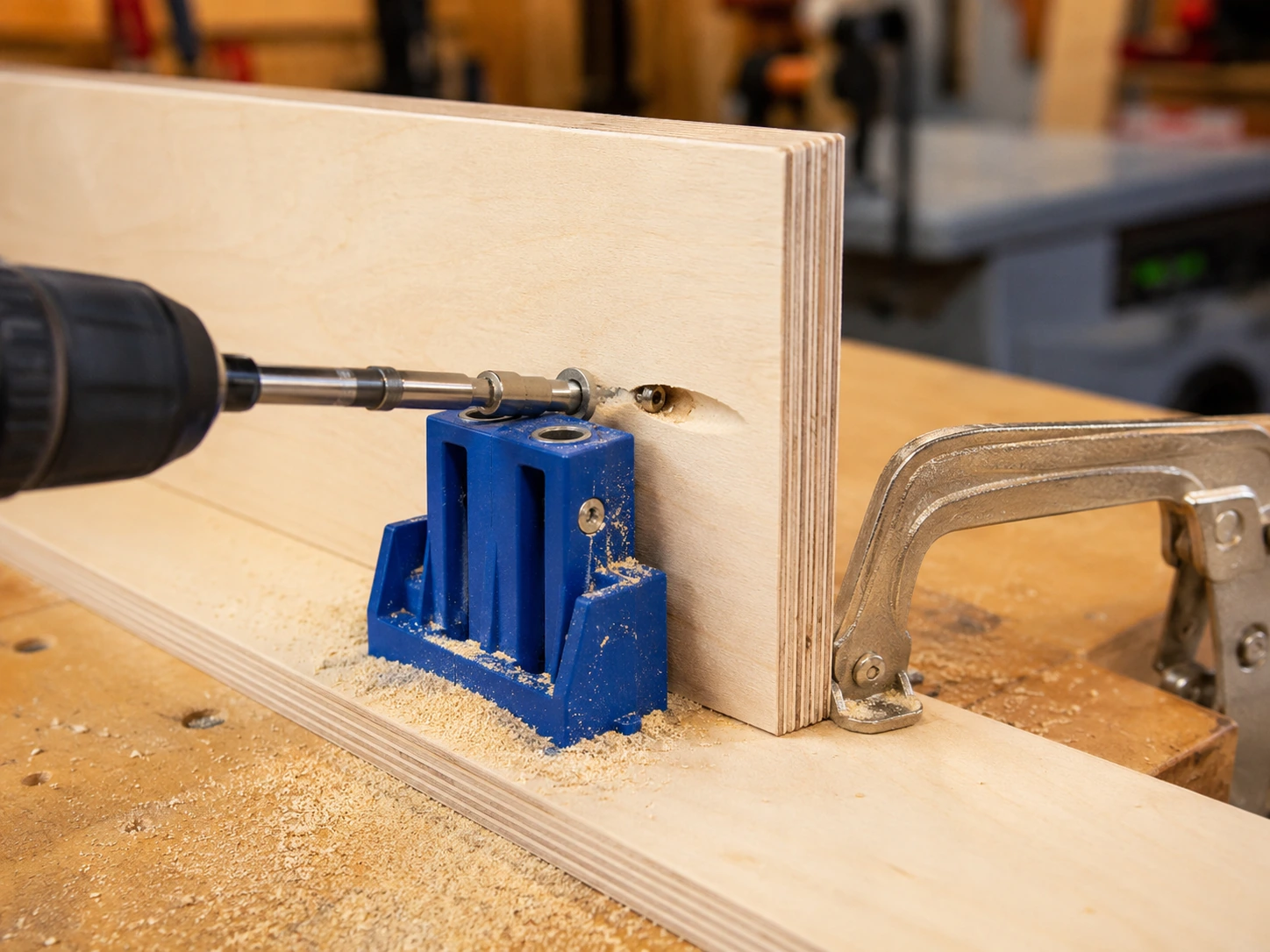
The fastest method for carcass assembly. Pocket screws pull two panels tight at a 90 degree joint. Works well in the face of birch plywood.
Limitation: pocket screws in the edge of combi-core birch have lower pull-out strength than in solid wood or all-birch. For structural connections subject to racking (wardrobe top-to-side joint), supplement with L-bracket or dado joint.
Dado and Rabbet Joints
Dado: a slot routed across the width of one panel, into which a second panel slides. Provides significant resistance to racking. The mechanical fit of the joint, not just fasteners, carries the load.
Rabbet: an L-shaped cut at the edge of a panel, typically used to recess back panels. Standard for wardrobe and cabinet back panel attachment.
Both joints are straightforward to cut with a router or table saw dado stack. All-birch core produces cleaner dado cuts than combi core (no soft poplar core layers to tear out).
Biscuit / Domino Joinery
Biscuit and Festool Domino joints provide alignment and some mechanical strength at panel joints. More common in furniture production than DIY. Requires a biscuit joiner or Domino machine. Useful for aligning face-to-face joints where a flush surface is required.
Confirmat Screws / Cam and Pin (Euro-Style)
European cabinet hardware (Hettich, Blum, Hafele) uses confirmat screws (6x50mm or 6x70mm) for carcass assembly and cam-and-dowel connections for knockdown assembly. This is the assembly method used in flat-pack and semi-custom cabinetry.
Birch plywood B/BB at 18mm holds confirmat screws well in the face. In the edge, all-birch core is superior to combi. Confirmat in the end grain of combi poplar core can pull out under load.
Building a Wardrobe in Birch Plywood: Specification Summary
A standard built-in wardrobe (2400mm H x 1800mm W x 600mm D):
| Component | Qty | Spec | Sheet use |
|---|---|---|---|
| Side panels | 2 | 18mm B/BB WBP 2400x600mm | 1 sheet |
| Top panel | 1 | 18mm BB/BB WBP 1764x600mm | 0.5 sheet |
| Bottom panel | 1 | 18mm BB/BB WBP 1764x600mm | 0.5 sheet |
| Back panel | 1 | 6mm BB/CP WBP 2400x1800mm | 1 sheet |
| Shelves (x4) | 4 | 18mm BB/BB WBP 1764x580mm | 2 sheets |
| Total | Approx. 5 sheets 18mm + 1 sheet 6mm |
At FOB Vietnam pricing ($290 to $360/CBM for combi birch BB/BB): approximately $120 to $150 in panel material for the carcass. Edge banding, hardware, and paint/finish are additional.
Finishing Birch Plywood Furniture
Natural and Clear Finish
- Sand to 180 grit (not coarser, veneer is thin)
- Apply pre-conditioner if using water-based stain
- Stain or first clear coat
- Sand lightly with 220 grit (raised grain)
- Two further clear coats (lacquer, hardwax oil, or polyurethane)
For full guide: How to Finish Birch Plywood: Staining, Painting and Sealing
Painted Finish
- Sand to 120 grit
- Fill any surface defects with wood filler
- Two coats water-based primer (sand 180 grit between)
- Two coats water-based alkyd enamel
- Edge banding before painting on all exposed core edges
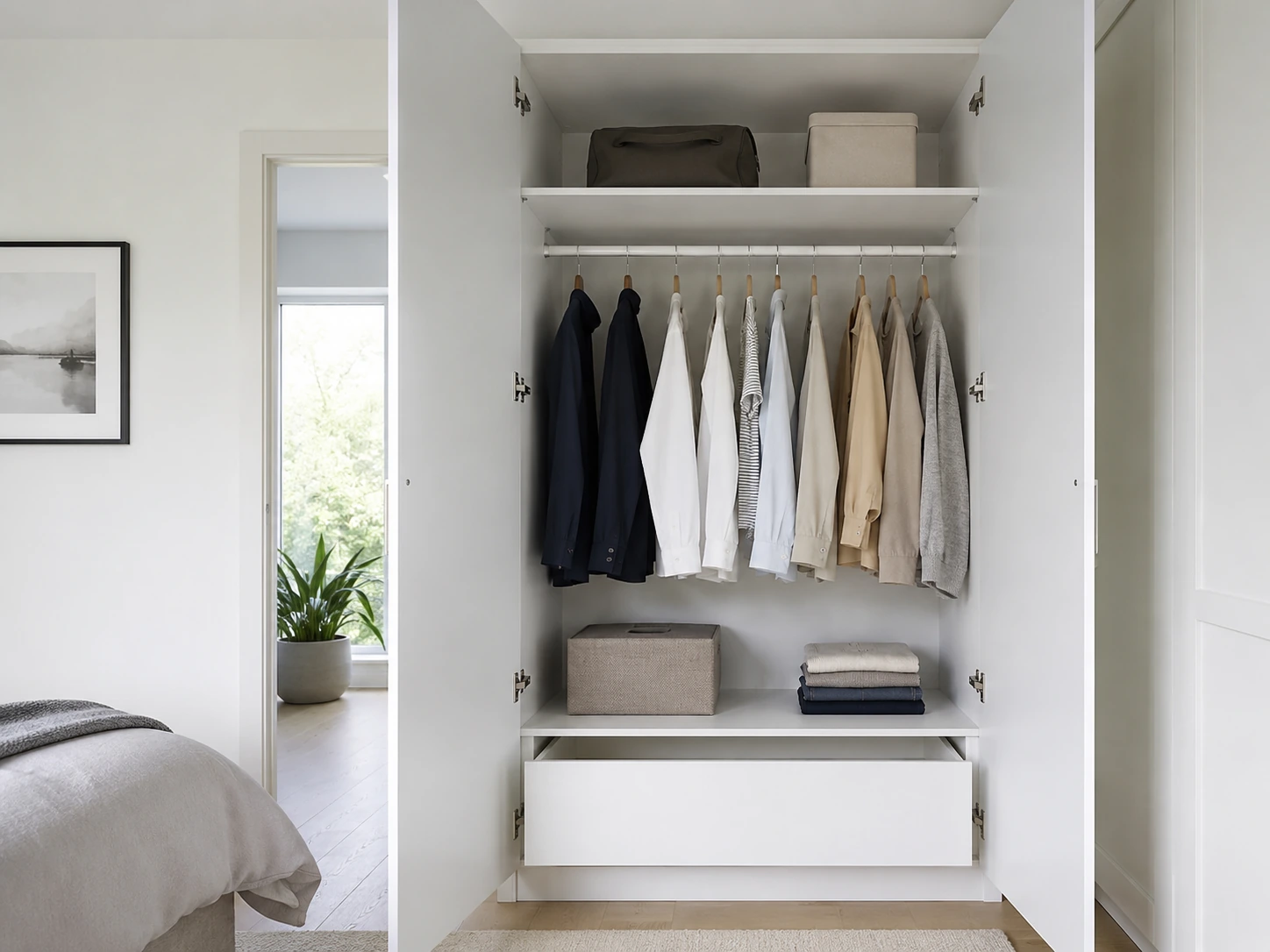
Painted birch plywood furniture does not show grain through the topcoat. This is why it is the professional specification for painted kitchen cabinets, wardrobes, and built-in millwork. For step-by-step: How to Paint Plywood: Prep, Primer and Best Paint
FAQ
What grade of birch plywood is best for furniture?
B/BB for visible surfaces with natural or stained finish. BB/BB for painted furniture where both faces may be seen but colour and minor repairs are acceptable. The grade determines the face quality. For painted furniture, BB/BB provides an equivalent painted result at lower cost than B/BB.
What thickness birch plywood for furniture?
18mm for all structural panels (sides, tops, bottoms, shelving at standard spans). 12mm for drawer box sides. 6mm for back panels and drawer bottoms. 25mm for workbench tops, dining table substrates, and long-span heavy-load shelving.
Is birch plywood good for furniture?
Yes. It is the professional standard for furniture carcassing globally. Dimensionally stable (does not move seasonally like solid wood), smooth face veneer for paint or stain, reliable edge screw-holding for hardware, and available in full sheets without glue-up.
Should I use combi core or all-birch for furniture?
Combi core for most furniture applications: lighter, lower cost, equivalent painted surface quality. All-birch for long-span shelving (700mm+), CNC-produced joinery, exposed edge design, and speaker cabinets. The all-birch premium (approximately 40 to 60% over combi) is only justified where its specific performance advantages are required.
How do I prevent warping in birch plywood furniture?
Finish both faces of every panel. Unfinished panels absorb and release moisture unevenly between faces, causing cupping. Apply at minimum a sealer coat on the hidden face of any panel that will be finished on one face only. Store panels flat and in a climate-controlled environment before cutting.
Order Specification for Furniture Manufacturing
Application:     Furniture carcassing, wardrobes, shelving, cabinet boxes
Species:         Birch face/back
Core:            Combi core, birch/poplar (standard furniture)
                 All-birch (long-span / CNC / exposed edge)
Grade:           B/BB, visible natural or stained surfaces
                 BB/BB, painted furniture, hidden-back applications
Thickness:       18mm (plus or minus 0.5mm), carcass panels
                 12mm, drawer sides
                 6mm, back panels, drawer bottoms
Sheet size:      1220x2440mm standard
Glue:            MR (EN 314-2 Class 1), dry interior furniture
                 WBP (EN 314-2 Class 3), kitchen / bathroom adjacent
Emission:        E1 (formaldehyde 8 mg/100g dry board or less)
Certification:   CE marked; FSC available on request
Kosmex produces birch-faced furniture plywood in B/BB and BB/BB grades, combi core and all-birch, both MR and WBP glue. CE marked, E1 emission, FSC available. For specifications and FOB pricing: anna@kosmexgroup.com
Related Reading
- Birch Plywood Grades: A, B/BB, BB/BB, C2 Explained
- Baltic Birch vs Birch Plywood: What’s Actually Different
- How to Finish Birch Plywood: Staining, Painting and Sealing
- How to Paint Plywood: Prep, Primer and Best Paint
- Best Plywood for Kitchen Cabinets: Grade, Core and Thickness
- Best Plywood for Shelving: Grade, Thickness and Span Guide
- Walnut Plywood vs Birch Plywood: Grain, Cost and When to Use Each
- Oak Plywood vs Birch Plywood: Strength, Cost and When to Use Each
Bình luận