


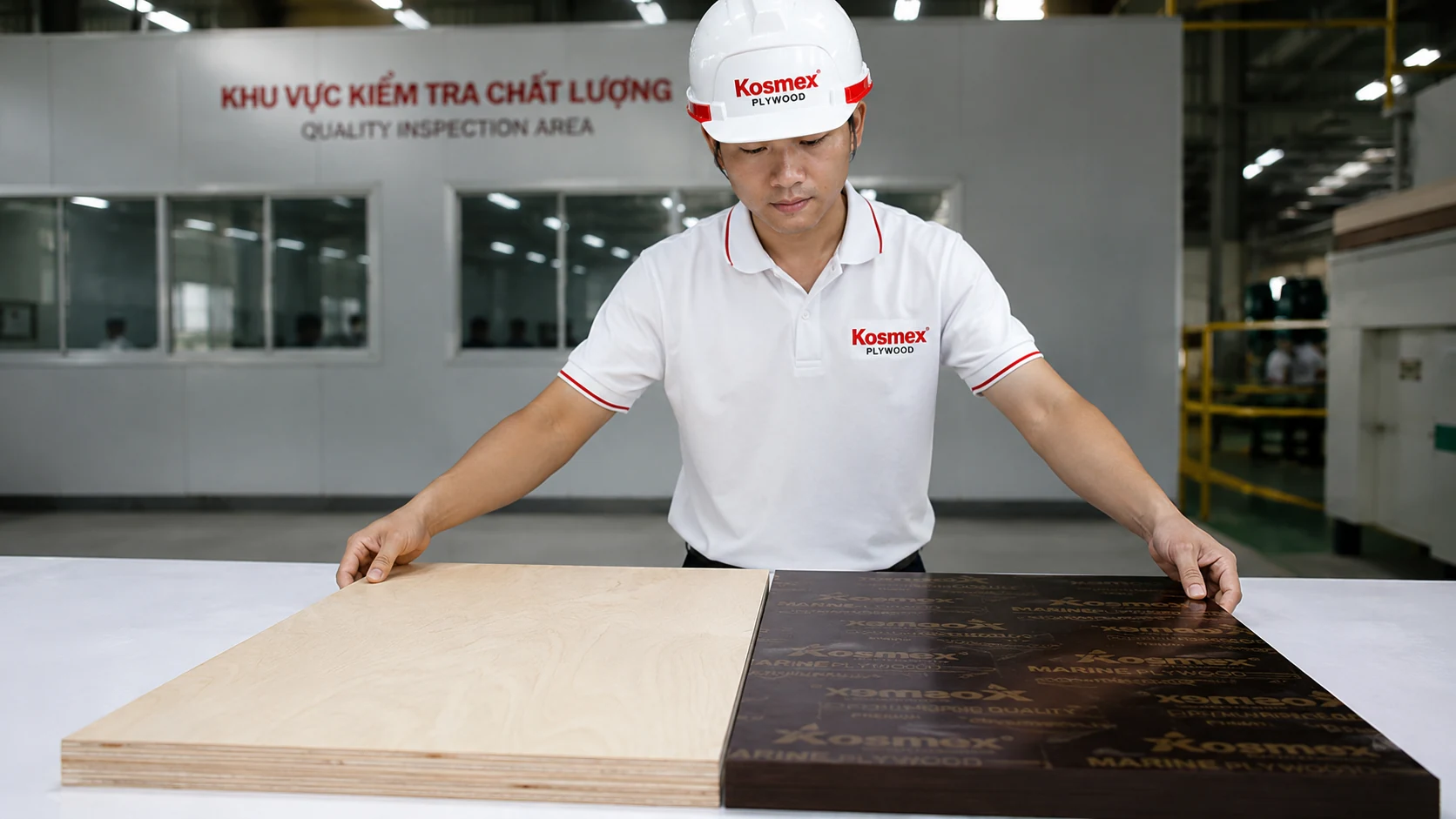
What Actually Separates Commercial from Marine Plywood
The difference is not just waterproofing. It is a combination of four compounding factors – and understanding each one determines whether you’re ordering the right product or paying a premium you don’t need. See Kosmex’s commercial plywood and film-faced plywood product pages for current specifications.
| Factor | Commercial Plywood | Marine Plywood |
|---|---|---|
| Glue type | Urea-formaldehyde (MR grade) | Phenol-formaldehyde (WBP / phenolic) |
| Bond standard | EN 314-2 Class 1 (interior) | EN 314-2 Class 3 (exterior/boil-proof) |
| Core voids | Permitted (gaps filled or left) | Zero voids – full contact between all plies |
| Veneer quality | B to D face grade; defects permitted | A to B face; no open defects in any ply |
| Species selection | Mixed hardwood, eucalyptus, poplar | Selected tropical hardwood (okoume, meranti, hevea) or birch – consistent throughout |
| Certification | E1/CARB P2 for formaldehyde | BS 1088 (most recognized), EN 636-3 |
| FOB Vietnam price (18mm) | $310-$380 / CBM | $580-$750 / CBM |
| Typical lifespan | 8-15 years (dry interior) | 20-30+ years (wet/exterior) |
The Glue Is the Core Difference – And It’s Testable
Every commercial vs marine article mentions “waterproof glue” for marine. Very few explain what that means in practice or how to verify it.
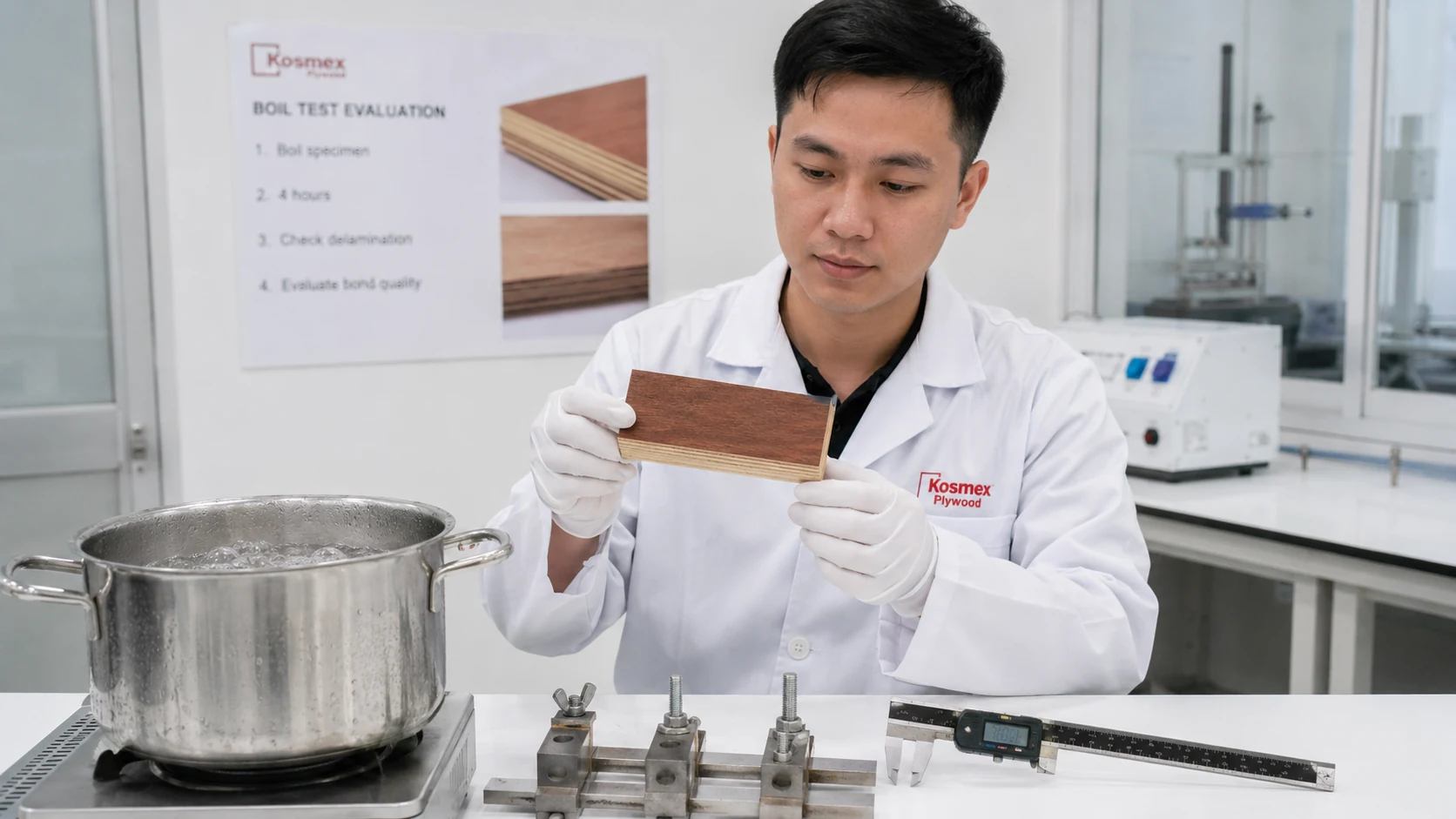
MR (Moisture Resistant) Glue – Used in Commercial Plywood
- Material: Urea-formaldehyde (UF) resin
- Performance: Survives short-term moisture and humidity – classified as EN 314-2 Class 1
- Failure mode: Prolonged water immersion causes bond hydrolysis – the glue literally dissolves, leading to delamination
- Test: EN 314-1 cold water soak (24 hours) – passes; boiling water cycle – fails
- Common application: Furniture, interior partitions, cabinetry in dry environments
WBP (Weather and Boil Proof) Glue – Used in Marine Plywood
- Material: Phenol-formaldehyde (PF) resin – phenolic glue
- Performance: Bond survives repeated boiling water cycles without failure – classified as EN 314-2 Class 3
- Test: EN 314-1 boiling water cycle – multiple immersion/drying cycles – bond holds
- Key point: The “boil test” is not about boiling temperatures in use – it is an accelerated durability test. A panel that passes EN 314-2 Class 3 will withstand years of outdoor exposure, continuous humidity, and water contact without delaminating.
Buyer verification: Ask your supplier for the EN 314-2 bond class statement on the test report. Class 1 = commercial/interior. Class 3 = marine/exterior. Any supplier claiming marine performance without a Class 3 test report is selling you commercial product at marine price. See how Kosmex tests birch phenolic glue bonds: Birch Phenolic Glue Plywood EN 314-2 Explained.
Void Standards: Why Marine Plywood Costs More to Manufacture
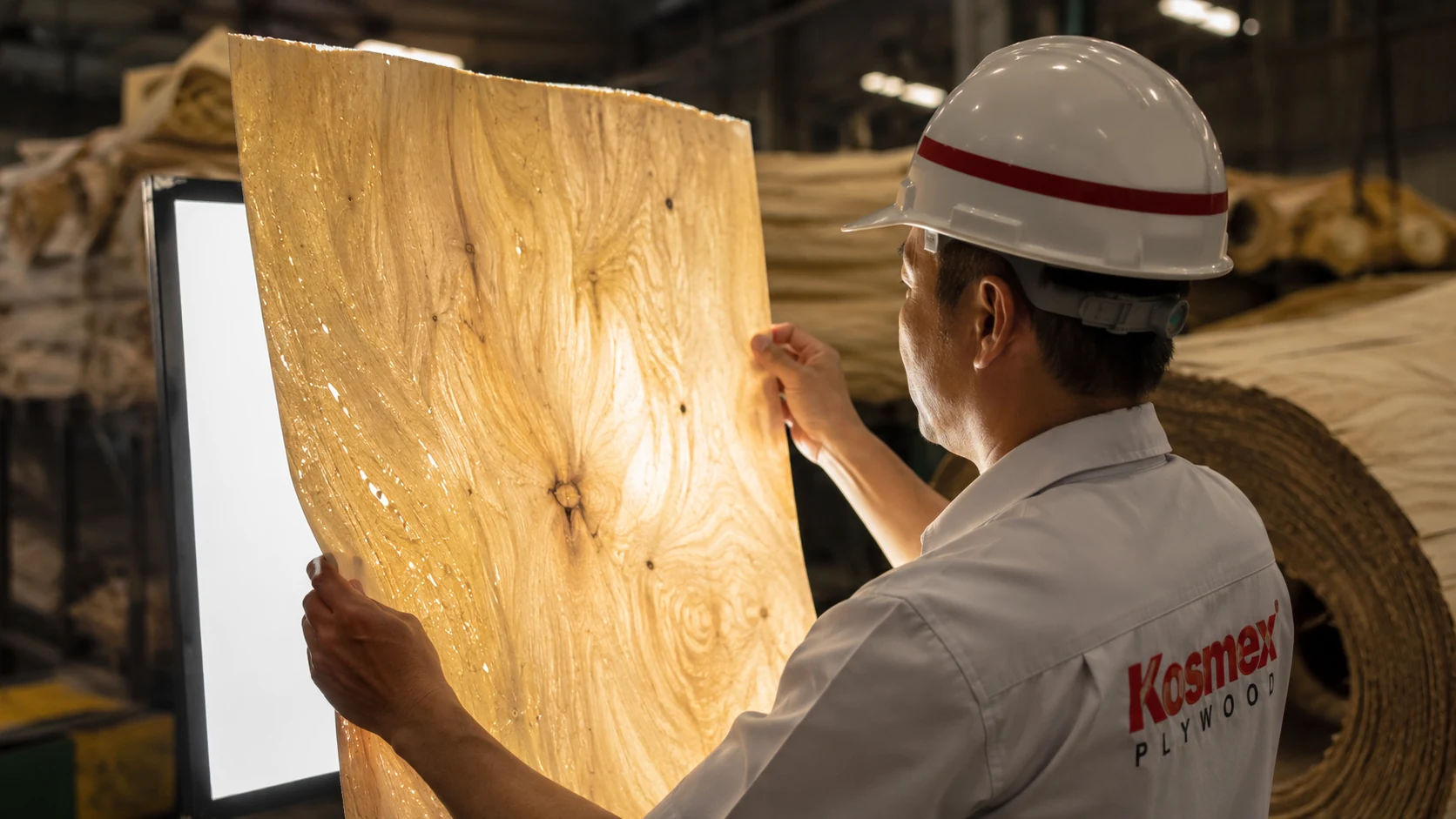
Commercial plywood allows gaps and voids within the inner plies. Manufacturers fill these with putty or leave them unfilled. Voids are invisible from the surface but become critical failure points when the panel is:
- Subjected to sustained load (they compress and collapse)
- Exposed to moisture (water collects in voids, accelerating delamination)
- Cut at the edge for CNC or machining (voids appear as black holes in the edge)
Marine plywood by BS 1088 standard requires:
- Zero voids in any ply, including inner core layers
- All veneer plies from the same species throughout – see how birch plywood grades are classified
- Defect-free face and back veneers (maximum A/B grade)
- All plies of consistent thickness
This is why marine plywood costs significantly more: the veneer yield rate is lower (more material rejected during grading), sorting is labor-intensive, and manufacturing waste is higher.
For a practical illustration: a mill producing commercial plywood might yield 85-90% of logs into usable panels. The same mill producing BS 1088 marine plywood might yield 60-65% due to the strict void and defect rejection standards.
BS 1088: What It Is and How to Verify It
BS 1088 is the British Standard for marine plywood. It is the most widely recognized international certification for marine-grade panels and is required by most boat builders, marine architects, and premium outdoor construction specifications.
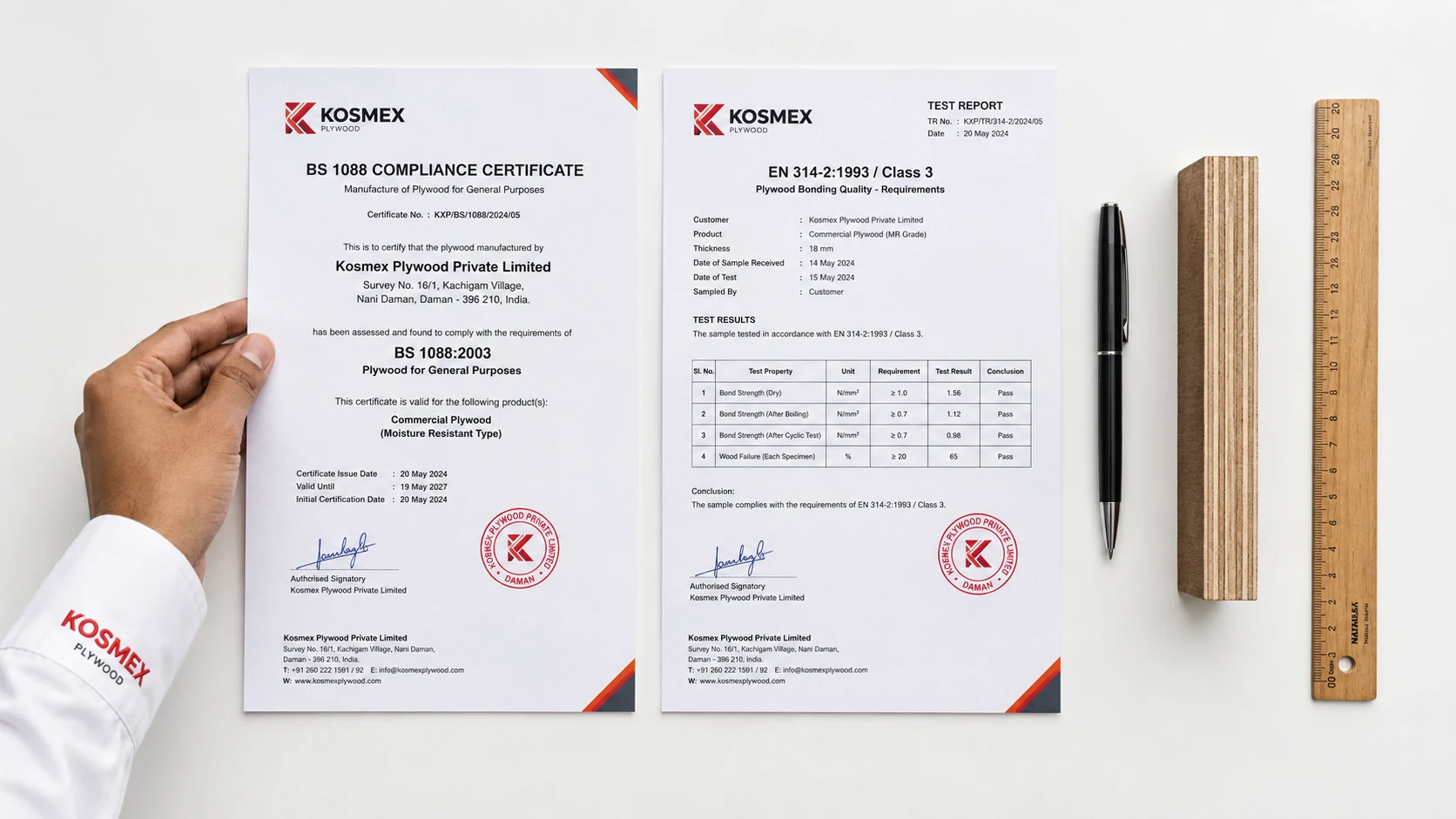
What BS 1088 requires:
- Phenolic WBP adhesive (EN 314-2 Class 3)
- Specified tropical hardwood species (okoume, meranti, sapele, and others) or equivalents
- No splits, open defects, or voids in face, back, or core
- Minimum veneer thickness: 1.27mm per ply
- Dimensional tolerance: ±0.5mm on thickness
How to verify from a Vietnam supplier:
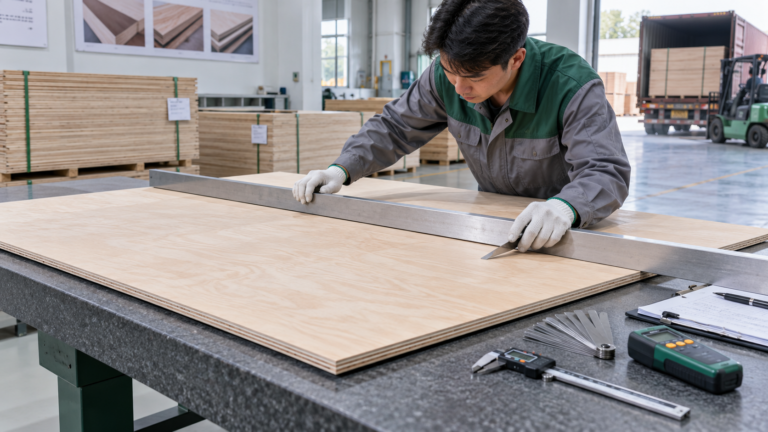
- Request the BS 1088 test report – it must come from an accredited third-party laboratory, not the factory’s internal QC
- Check that the species stated on the report matches what is physically in the panel (okoume, meranti, or hevea are typical)
- Request an EN 314-2 bond test report confirming Class 3 classification
- Inspect sample panels at the edge – a genuine BS 1088 panel will show zero voids in cross-section
Warning: Many suppliers label panels “marine grade” without BS 1088 certification. These may use WBP glue (which is a step up from MR) but do not meet the void, species, or veneer thickness requirements of BS 1088. The price gap between certified and uncertified “marine” panels is typically $80-$150/CBM.
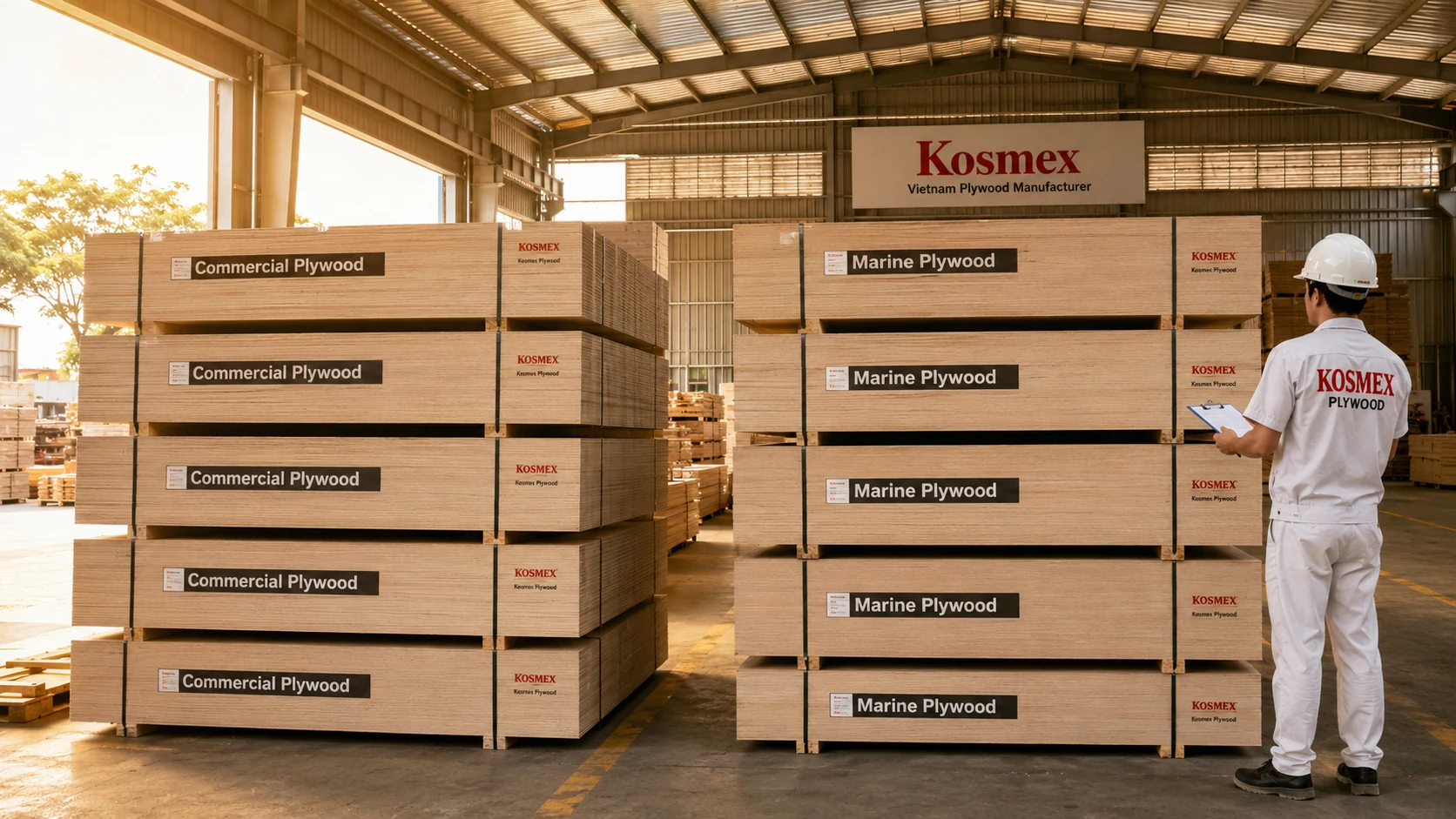
Real Price Data: Commercial vs Marine Plywood (FOB Vietnam, 2026)
| Product | Specification | FOB Vietnam Price |
|---|---|---|
| Commercial plywood 18mm | Eucalyptus core, BB/CC, E1 | $310-$340 / CBM |
| Commercial plywood 18mm | Acacia core, BB/BB, E1 | $350-$390 / CBM |
| Marine plywood 18mm | Hevea core, WBP, BS 1088 | $580-$650 / CBM |
| Marine plywood 18mm | Okoume core, WBP, BS 1088 premium | $680-$750 / CBM |
A standard 40′ container holds approximately 20-22 CBM of 18mm plywood. At these rates, the price difference between a container of commercial and marine plywood is $5,000-$8,000 per container – a meaningful decision for any importer. For broader Vietnam plywood price context, see the Vietnam Plywood Price Trend guide.
The Gray Zone: Applications Where Buyers Get This Wrong
Most articles split the world into “indoor = commercial, outdoor/marine = marine.” Real projects are not that clean.
Kitchens and Bathrooms – Commercial Is Usually Enough
Kitchen and bathroom cabinets are humid but not wet. Steam exposure is intermittent. A properly finished commercial plywood panel with sealed edges and moisture-resistant paint or laminate will perform adequately in most residential kitchens for 10-15 years.
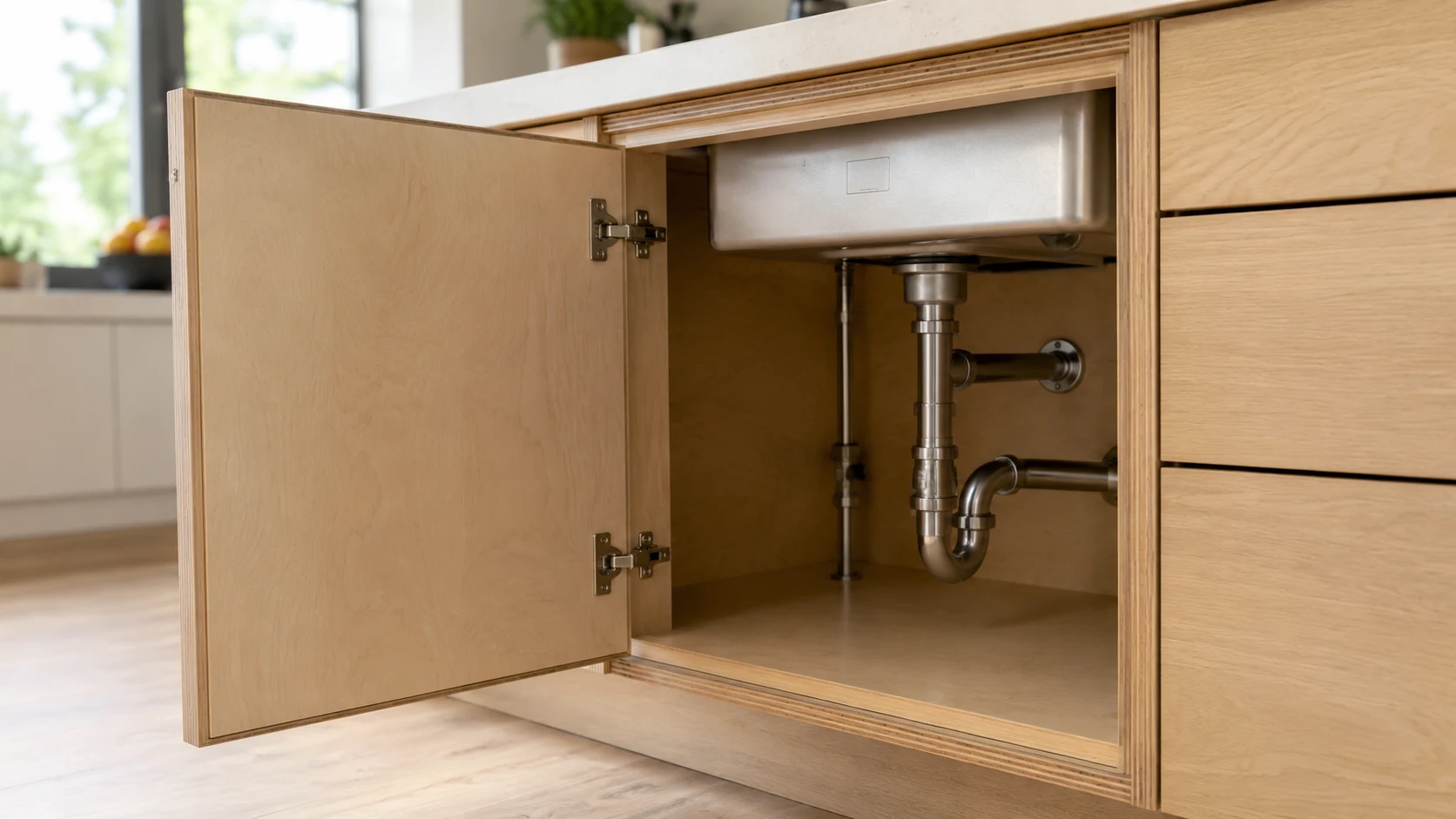
Where commercial plywood fails in kitchens:
- Under-sink cabinet directly adjacent to plumbing leaks (even slow leaks)
- Cabinet bases sitting on wet tile floors with poor ventilation
- Panels with unsealed edges exposed to repeated steam from dishwashers
Verdict: Commercial plywood with WBP glue (not standard MR) is the practical choice for most kitchen cabinets. Full marine-grade BS 1088 is unnecessary and over-specified for this application unless you’re building a high-end fitted kitchen near a coastal/humid climate.
Outdoor Covered Structures – Depends on Exposure
A pergola, covered deck, or outdoor kitchen with good roof overhang. For a full comparison of outdoor-rated panels, see Best Plywood for Outdoor Use:
- Direct rain contact: Marine required
- Protected from rain but exposed to humidity: Commercial with exterior finish may work; marine is safer long-term
- Painted and protected on all faces: Commercial plywood with WBP glue is often used in practice
Boat Building – Marine Required, BS 1088 Preferred
There is no substitution here. Structural boat components require void-free panels, WBP bond, and certified veneer species. Using commercial plywood in a boat hull risks delamination that can be catastrophic rather than merely inconvenient.
Concrete Formwork – Neither; Use Film-Faced Plywood
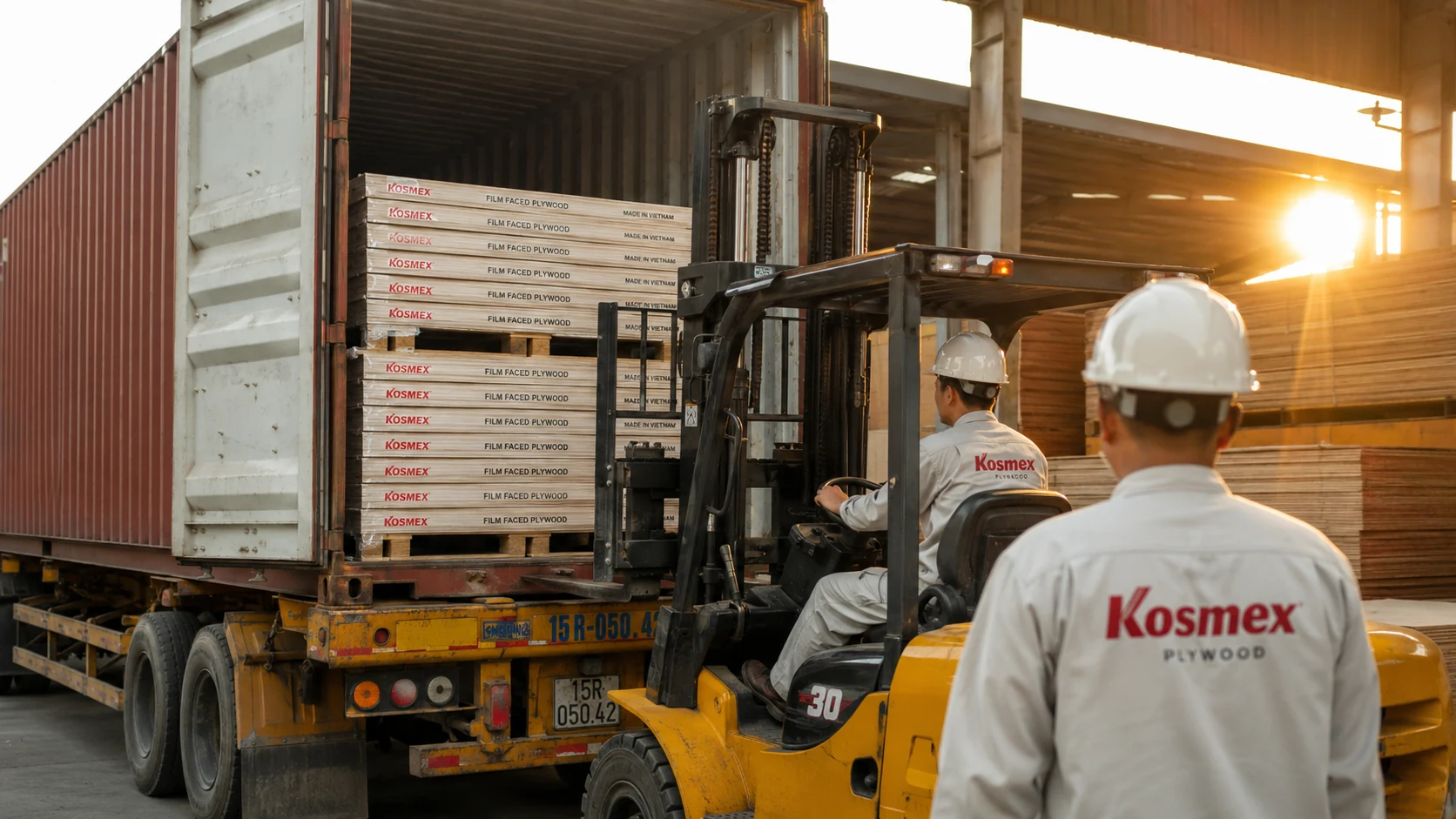
Both commercial and marine plywood are the wrong choice for concrete formwork. Formwork requires a phenolic film coating for concrete release and reuse performance. Film-faced plywood with 120g/m² phenolic film and WBP core glue is the correct specification. Marine plywood without film coating will absorb concrete and degrade rapidly. See the full Formwork Plywood buyer’s guide for detailed specs.
[ẢNH 6 – GRAY ZONE: KITCHEN APPLICATION]
Prompt: Cận cảnh bên trong tủ bếp dưới bồn rửa – lớp plywood cabinet màu sáng, cạnh được phủ edge banding gọn, ống nước inox bên trong rõ ràng. Không có người – product shot thuần túy. Ánh sáng trong sạch, phong cách editorial interior photography, shallow depth of field, 50mm lens.
Alt text:
Under-sink kitchen cabinet built with commercial WBP plywood - properly sealed edges and edge banding
Caption: Commercial plywood with WBP glue and sealed edges performs well in most kitchen cabinet applications – marine spec is rarely necessary here.
Vị trí: Sau subsection “Kitchens and Bathrooms”, trước “Outdoor Covered Structures”. Minh họa trực tiếp use case gray zone được đề cập.
Side-by-Side Decision Framework
Use this to resolve the commercial vs marine question for any specific application:
| Application | Moisture Exposure | Recommended | Reason |
|---|---|---|---|
| Interior furniture | None / low humidity | Commercial (MR grade) | No moisture stress |
| Kitchen cabinets | Steam, occasional drips | Commercial (WBP glue) | Sealed edges sufficient |
| Bathroom vanities | High humidity | Commercial (WBP) or marine | Depends on ventilation |
| Under-sink cabinets | Potential leak contact | Marine | Direct water exposure risk |
| Outdoor furniture (covered) | Rain-protected | Marine (WBP minimum) | Seasonal humidity cycling |
| Outdoor furniture (exposed) | Direct rain | Marine BS 1088 | Full weather exposure |
| Boat construction | Continuous immersion | Marine BS 1088 only | Structural safety |
| Concrete formwork | Alkaline + moisture | Film-faced plywood | Neither type is correct |
| Packaging / pallets | Handling only | Commercial (low grade) | No moisture requirement |
How to Specify When Ordering from a Vietnam Factory
When placing a sourcing inquiry, use this language to get accurate quotes for each type:
For commercial plywood:
Species: Eucalyptus or acacia core, mixed hardwood face
Grade: BB/BB (or BB/CC for hidden applications)
Glue: E1 formaldehyde emission class (UF resin)
Thickness: 18mm ±0.5mm
Size: 1220 × 2440mm
Certification: FSC (if required), CARB P2 (US market)
For marine plywood:
Species: Hevea (rubber wood) core or okoume - specify
Grade: B/BB minimum, void-free core
Glue: WBP phenolic resin, EN 314-2 Class 3 certified
Thickness: 18mm ±0.3mm
Size: 1220 × 2440mm
Standard: BS 1088 compliant - third-party test report required
Certification: FSC chain of custody
Ordering tip: If a Vietnam supplier quotes marine plywood at less than $500/CBM FOB for 18mm, ask for the BS 1088 test report immediately. Panels at that price point are typically commercial-grade panels with WBP glue – an upgrade from MR, but not true marine specification. See the full list of documents to request from a Vietnam plywood supplier before confirming any order.
Frequently Asked Questions
Is commercial plywood waterproof?
No. Commercial plywood uses MR (moisture resistant) grade urea-formaldehyde glue, which withstands brief humidity but will delaminate under sustained water exposure. It is not waterproof and should not be used in applications with direct or prolonged water contact.
Can I use commercial plywood for kitchen cabinets?
Yes, with conditions. Properly finished commercial plywood with sealed edges and a moisture-resistant laminate or paint performs adequately in most residential kitchen environments. Specify WBP glue (not standard MR) if the application is near a sink, dishwasher, or in a coastal/humid climate.
What is the difference between WBP and BS 1088?
WBP (Weather and Boil Proof) describes the adhesive bond class – it means the glue passes the EN 314-2 Class 3 boil test. BS 1088 is a full panel standard that requires WBP glue PLUS void-free core, specified veneer species, minimum veneer thickness, and third-party certification. A panel can have WBP glue without meeting BS 1088.
How much more expensive is marine plywood than commercial?
At FOB Vietnam 2026 rates, marine plywood (BS 1088 certified, 18mm) costs approximately $580-$750/CBM versus $310-$390/CBM for commercial grade – roughly 1.7-2.4× higher. Per sheet (1220 × 2440 × 18mm), the difference is approximately $15-$22 per panel.
Can I substitute marine plywood with film-faced plywood for outdoor use?
Not directly. Film-faced plywood is designed for concrete formwork (alkaline, high-moisture environment) and uses phenolic film coating for concrete release. It is not suited for exposed outdoor furniture or boat construction. Marine plywood and film-faced plywood serve different applications despite both using WBP adhesive.
How do I verify a supplier is sending genuine marine plywood?
Request: (1) EN 314-2 Class 3 bond test report from a third-party lab, (2) BS 1088 compliance certificate, (3) species identification for the core veneers, and (4) a sample panel to inspect the edge cross-section for voids. Any visible gaps in the cross-section indicate the panel does not meet marine specification.
Summary
| Commercial Plywood | Marine Plywood | |
|---|---|---|
| Glue | MR (urea-formaldehyde) | WBP (phenolic, EN 314-2 Class 3) |
| Voids | Permitted | Zero |
| Standard | E1 / CARB P2 | BS 1088 / EN 636-3 |
| Price (18mm FOB VN) | $310-$390 / CBM | $580-$750 / CBM |
| Right for | Interior furniture, dry cabinets, packaging | Boat building, outdoor structures, wet environments |
| Wrong for | Boats, outdoor exposed, formwork | Standard interior furniture (over-specified) |
The marine premium is real and justified – but only when your application genuinely demands EN 314-2 Class 3 bond performance and void-free construction. Paying marine prices for kitchen cabinets in a dry climate is unnecessary. Using commercial plywood in a boat hull is dangerous.
Match the spec to the moisture envelope. Then ask for the test report.
[Request a quote for commercial or marine plywood →]Related reading: Commercial Plywood – Product Page · Film-Faced Plywood Guide · Phenolic vs Melamine Glue · Plywood Grades Explained
Bình luận