


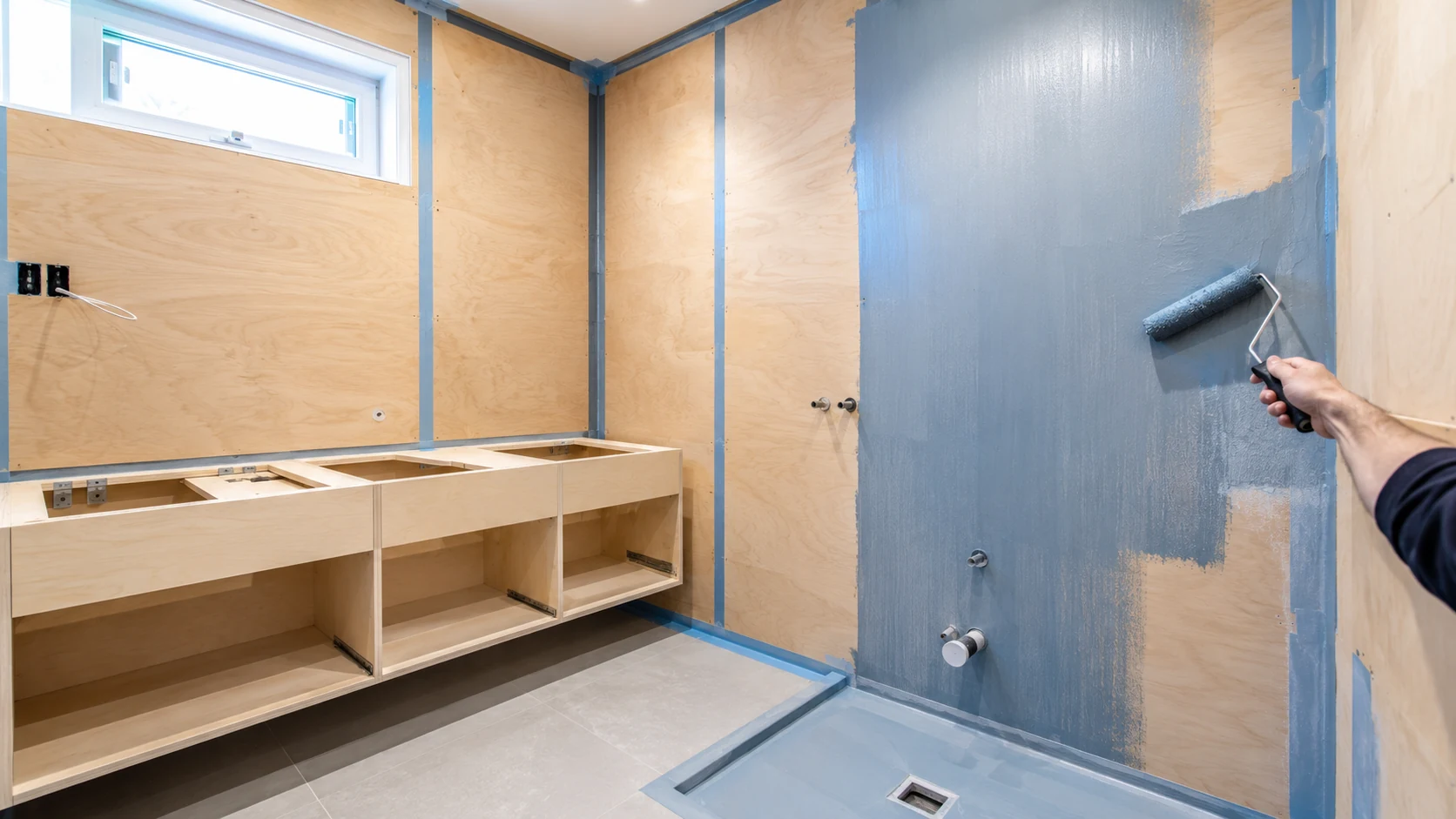
The key decision in bathroom plywood is not species – it’s glue type and application zone.
The Critical Distinction: Wet Zone vs Dry Zone
Not every surface in a bathroom is equally exposed to moisture. Specifying correctly means understanding the zone:
| Zone | Description | Risk level | Required spec |
|---|---|---|---|
| Wet zone | Shower walls, bath surrounds, areas with direct water contact | Very high | Marine or phenolic plywood – or tile backer board |
| Damp zone | Subfloor, vanity cabinet, under-sink area | High | WBP-glued plywood (EN 314-2 Class 3) |
| Adjacent dry zone | Wall framing, ceiling, areas with only condensation risk | Moderate | WBP-glued plywood or MR with vapour barrier |
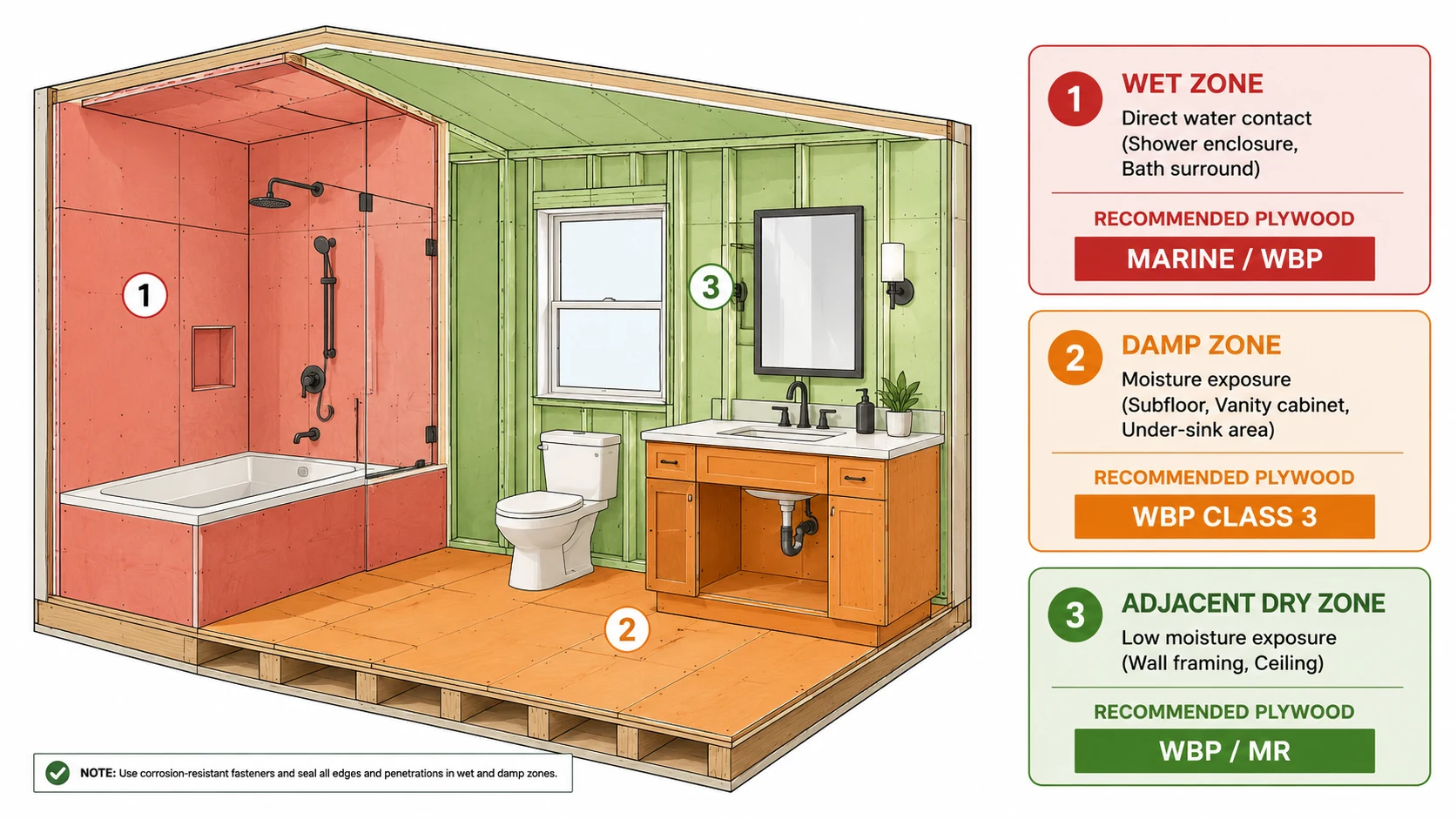
Important: Plywood is not a waterproof surface material – it is a structural substrate. In wet zones (shower walls, bath surrounds), plywood must be overlaid with a waterproof membrane, tile, or wet-area lining board. The plywood provides structural backing; the overlay provides the water barrier.
Glue Type: The Most Important Specification
The moisture resistance of a plywood panel is determined primarily by the adhesive between layers, not by the face species.
MR Glue (Urea-formaldehyde – EN 314-2 Class 1)
- Interior use only
- Fails when subjected to sustained moisture or humidity cycling
- Will delaminate within 6-18 months in a bathroom environment without protection
- Not suitable for any bathroom application
WBP Glue (Phenol-formaldehyde – EN 314-2 Class 3)
- Resists boiling water in standard test conditions
- Maintains structural integrity in sustained humidity and wet exposure
- Required for all bathroom subfloor, vanity, and wet-adjacent applications
- Standard adhesive in marine plywood and film-faced plywood
Marine Plywood
- All-hardwood core, no voids, WBP glue throughout – EN 314-2 Class 3
- BS 1088 certified marine plywood is the highest specification for structural wet-area use
- Required for direct water exposure (shower walls as substrate, boat interiors)
- Higher cost: FOB Vietnam $580-750/CBM vs $290-360/CBM for standard WBP commercial plywood
For a full comparison of standard vs marine specification: Commercial Plywood vs Marine Plywood: Glue, Grade & When to Pay the Premium.
Best Plywood for Bathroom Subfloor
Specification: Structural plywood, WBP glue, EN 314-2 Class 3, 15-19mm
The bathroom subfloor sits under tiles, vinyl, or wet-area flooring and is exposed to:
- Sustained humidity from shower steam and bathing
- Occasional water spills and leaks
- Moisture vapour from below (ground floor installations)
Recommended specification:
- Thickness: 15mm minimum over joists at 400mm centres; 19mm for joists at 600mm centres
- Glue: WBP phenolic (EN 314-2 Class 3) – mandatory
- Grade: Structural or CDX-equivalent with exterior glue rating; face grade is irrelevant (will be covered)
- Species: Birch-faced or eucalyptus-faced – species matters less than glue type here
What to avoid: OSB (oriented strand board) in bathroom subfloors. OSB swells significantly at edges when wet – even moisture-resistant OSB (OSB/3) is less reliable than WBP plywood in sustained bathroom humidity. See: OSB vs Plywood for Subfloor.
What to avoid: Standard “interior” plywood from a hardware store without verifying glue class. Most hardware-store plywood is MR-glued unless specifically labelled “exterior” or “WBP.”
Best Plywood for Bathroom Vanity and Under-Sink Cabinets
Specification: Birch-faced WBP plywood, 18mm, B/BB or BB/BB grade
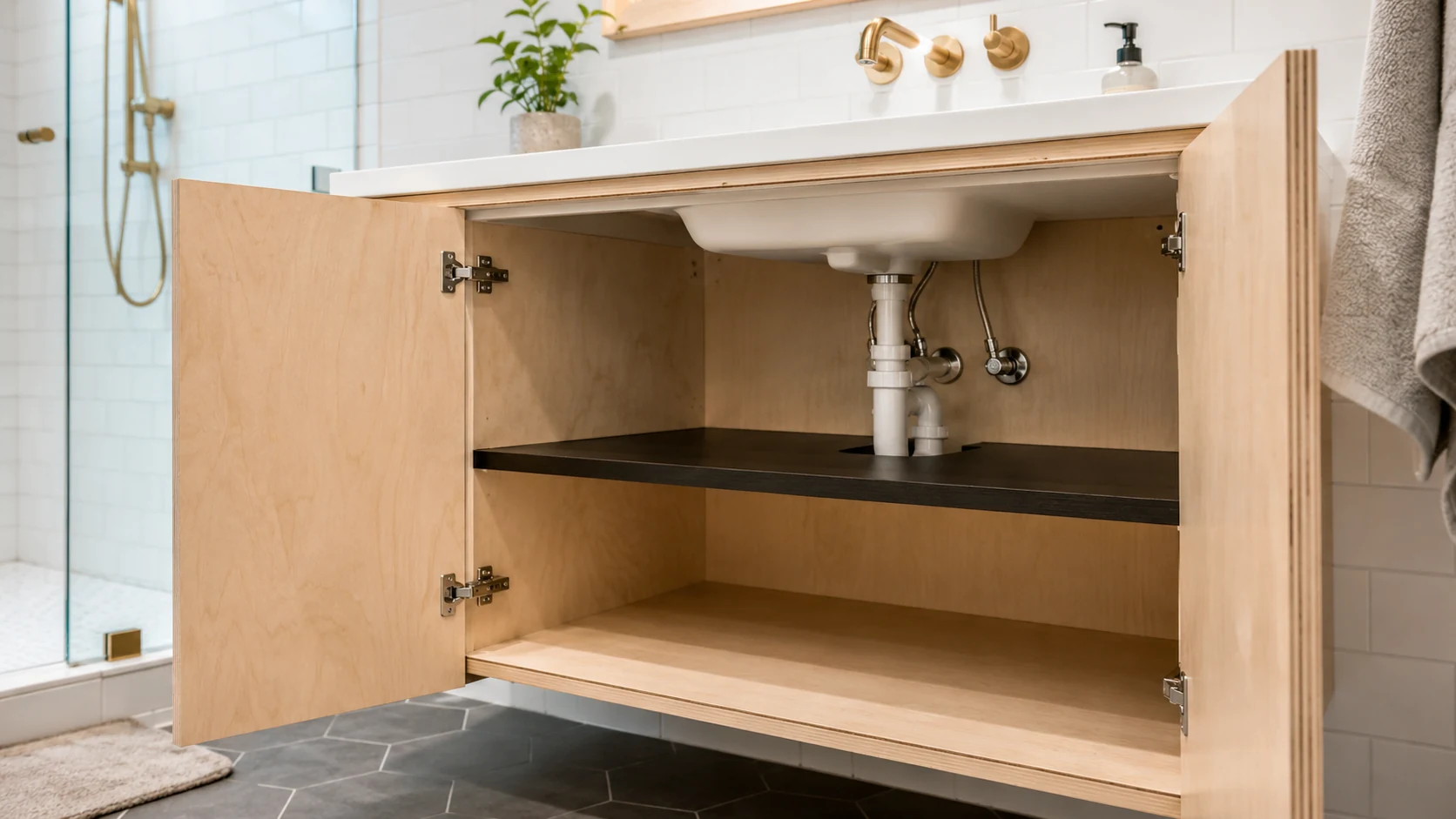
The vanity cabinet is in the damp zone – not directly wet, but exposed to:
- Steam condensation from showers
- Occasional water drips at the sink
- Humidity cycling as the bathroom heats and cools
Recommended specification:
- Core: Birch combi core with WBP glue – the birch face finishes cleanly for paint or lacquer; the WBP glue protects the core structure
- Thickness: 18mm for carcass sides, top, and bottom; 12mm for back panel
- Grade: B/BB for visible interior surfaces; BB/BB acceptable for painted or laminated finishes
- Edge sealing: All cut edges must be sealed with primer or edge sealant before installation – exposed plywood edges absorb moisture faster than the face veneer
For the under-sink area specifically: this is the highest moisture-risk zone in a vanity – pipe condensation, plumbing leaks, and cleaning spray all concentrate here. Consider phenolic-faced plywood (film-faced or smooth phenolic) for the under-sink shelf and floor – it is fully wipeable and the phenolic surface is impervious to water. See: Phenolic Plywood: What It Is & When to Specify It.
Best Plywood for Bathroom Walls
Specification: WBP structural plywood 12mm as substrate; waterproof overlay required
Bathroom wall plywood is a substrate, not a finished surface. The plywood provides:
- Flat, rigid backing for tiles, waterproof panelling, or wet-area lining board
- Structural support for wall-mounted fittings (towel rails, grab rails, vanity units)
- Base layer for waterproofing membrane application
In wet zones (shower walls, bath surrounds):
Use 12mm WBP-glued plywood as backing. Apply a continuous waterproofing membrane (liquid membrane or sheet membrane) over the entire plywood surface before tiling. The tile grout and adhesive are not waterproof – the membrane is the water barrier, the plywood is the structural substrate.
In dry zones (general bathroom walls not in direct water contact):
12mm WBP plywood or moisture-resistant plasterboard are both acceptable. Plywood has the advantage of accepting screws anywhere for fitting attachment without needing to locate studs.
Is Marine Plywood Necessary for Bathrooms?
For most bathroom applications: no – WBP-glued commercial plywood is sufficient.
Marine plywood (BS 1088 certified) is specified for:
- Boat building and marine structures with sustained water immersion
- Applications where the plywood itself must resist water penetration (not just humidity)
- High-end wet room construction where the substrate is the primary structural element
For a typical bathroom subfloor, vanity cabinet, or wall substrate, WBP-glued birch or eucalyptus plywood (EN 314-2 Class 3) provides adequate moisture resistance at significantly lower cost.
Marine plywood makes sense in bathrooms when:
- The installation is a wet room (fully tiled floor-to-ceiling, no separate shower enclosure)
- Plumbing access panels may be exposed to water
- The structure requires maximum durability (commercial bathrooms, hotel rooms with heavy use)
FOB price reference: WBP commercial plywood $290-360/CBM vs BS 1088 marine $580-750/CBM. The premium is significant – marine specification is not necessary for standard residential bathrooms.
Common Mistakes in Bathroom Plywood Specification
1. Using MR-glued plywood
The most common and costly mistake. MR plywood looks identical to WBP plywood – there is no visible difference. Always verify glue class on the panel certification or stamp before installation.
2. Not sealing cut edges
Panel face veneer is sealed by the finish coat. Cut edges expose raw core veneer that absorbs moisture rapidly. All edges must be sealed with primer, edge sealant, or solid wood lipping before installation in a bathroom.
3. Using OSB for bathroom subfloor
OSB swells at panel edges when wet – even moisture-resistant grades. In a bathroom where water ingress is possible, WBP plywood is more reliable.
4. Assuming “waterproof plywood” exists
No plywood is fully waterproof as a panel. WBP glue resists the adhesive layers failing under water exposure – but the veneer faces and core will still absorb and swell with sustained water contact. Plywood is a structural substrate; waterproofing is applied on top.
Specification Summary
| Application | Thickness | Species | Glue | Grade |
|---|---|---|---|---|
| Bathroom subfloor | 15-19mm | Any structural | WBP Class 3 | Structural |
| Vanity carcass | 18mm | Birch | WBP Class 3 | B/BB or BB/BB |
| Under-sink shelf | 12-18mm | Phenolic-faced | WBP Class 3 | N/A – phenolic surface |
| Shower wall substrate | 12mm | Birch or structural | WBP Class 3 | Structural |
| Dry zone walls | 12mm | Birch or structural | WBP Class 3 | Any |
| Wet room (full) | 18mm | All-hardwood | WBP Class 3 / Marine | Void-free |
FAQ
What plywood should I use for a bathroom subfloor?
Structural plywood with WBP (phenolic) glue, EN 314-2 Class 3, 15-19mm thickness depending on joist spacing. The glue type is the critical specification – MR-glued plywood will delaminate in bathroom humidity.
Is birch plywood waterproof?
No plywood is fully waterproof, but WBP-glued birch plywood is moisture-resistant – the adhesive layers will not fail under sustained humidity or occasional water exposure. The veneer surface should be sealed with paint, lacquer, or laminate. See Is Birch Plywood Waterproof?
Can I use regular plywood in a bathroom?
Only if it is WBP-glued (EN 314-2 Class 3 / exterior grade). “Regular” interior plywood with MR glue will delaminate within months in bathroom conditions. Always verify the glue class before purchase.
Do I need marine plywood for a bathroom?
For most residential bathrooms, WBP-glued commercial plywood is sufficient. Marine plywood (BS 1088) is the specification for sustained water immersion and commercial wet rooms. The cost premium is significant – specify marine only when the performance requirement justifies it.
What is the best plywood for a bathroom vanity?
Birch-faced combi core, 18mm, WBP glue (EN 314-2 Class 3), B/BB grade for visible interior surfaces. Seal all cut edges before installation. For the under-sink zone, consider phenolic-faced plywood for its fully wipeable surface.
Order Specification
Application: Bathroom subfloor / vanity / wet-area substrate
Species: Birch face (B/BB) or structural grade
Core: Combi core or all-birch
Thickness: 18mm (±0.5mm)
Glue: WBP phenolic – EN 314-2 Class 3 (MANDATORY)
Emission: E1
Certification: CE marked
Kosmex produces WBP-glued birch-faced plywood and phenolic plywood panels, CE marked, with full EN 314-2 Class 3 test certification available on request. For specifications and FOB pricing, contact our export team: anna@kosmexgroup.com
Bình luận