


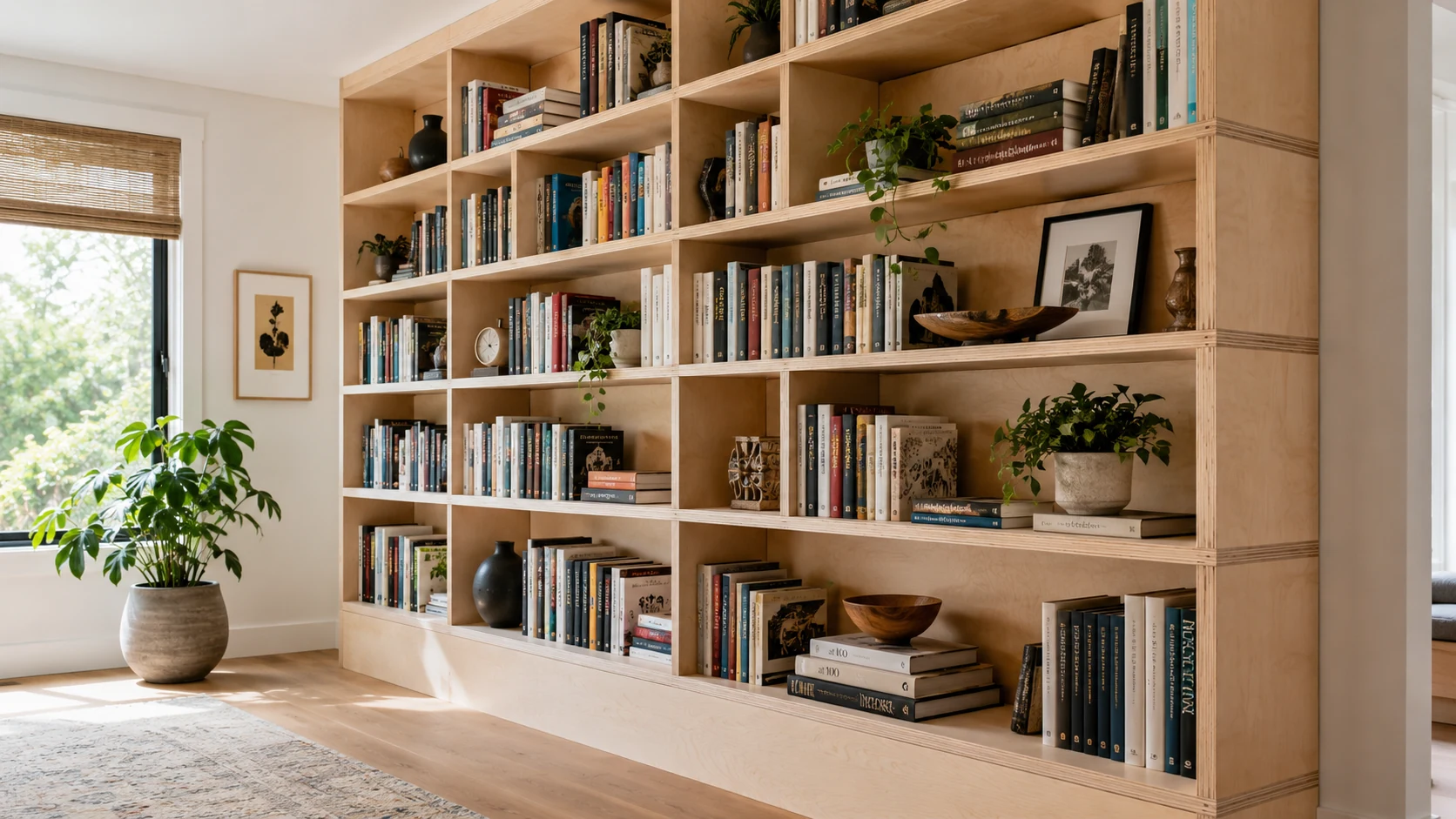
The right plywood for a shelf depends on three variables: span (distance between supports), load (what goes on it), and environment (dry interior, humid bathroom, unheated garage). This guide walks through each application with specific grade, thickness, and span recommendations.
The Short Answer by Application
| Application | Recommended spec | Thickness | Max span (no sag) |
|---|---|---|---|
| Bookshelf (heavy books) | Birch plywood B/BB, all-birch core | 19mm (3/4″) | 700mm |
| Bookshelf (light items) | Birch combi core B/BB | 19mm (3/4″) | 900mm |
| Garage shelves (heavy tools) | CDX or structural ply | 19mm (3/4″) | 600mm |
| Garage shelves (light storage) | CDX or combi core | 15mm (5/8″) | 800mm |
| Closet shelves (clothes) | Birch combi core B/BB | 15mm (5/8″) | 900mm |
| Floating shelves | Birch all-birch or MDF | 19mm (3/4″) | 600mm |
| Pantry shelves (food, cans) | Birch combi core B/BB | 19mm (3/4″) | 750mm |
| Painted shelves | Birch B/BB or MDF | 19mm (3/4″) | Per above |
| Storage shelves (utility) | CDX or structural ply | 19mm (3/4″) | 800mm |
Why Plywood – Not Particleboard or Solid Wood
Before choosing which plywood, it’s worth confirming plywood is the right material class.
Plywood vs particleboard for shelving: Particleboard (the material in most flat-pack furniture) sags under sustained load faster than plywood – its bending stiffness (MOE) is 2,500-3,500 N/mm² vs plywood’s 5,500-10,000 N/mm². A particleboard shelf under a full row of hardcover books will visibly deflect within months. Plywood does not. For any shelf carrying real weight, plywood is the correct base material.

Plywood vs solid wood for shelving: Solid wood is strong per unit, but wide solid wood shelves require edge-glued panels and movement allowance – seasonal expansion can crack joints and bow the shelf. Plywood panels are stable, available in full-width sheets, and do not require movement allowance. See Plywood vs Solid Wood: Strength, Stability & Cost.
Plywood vs MDF for shelving: MDF has a smoother surface for painting but lower stiffness and poor moisture resistance. For painted shelves in dry interiors where load is light, MDF is acceptable. For any shelf with real weight, humidity exposure, or where edge screws are used, plywood is the stronger specification. See Birch Plywood vs MDF.
Thickness and Span: The Core Decision
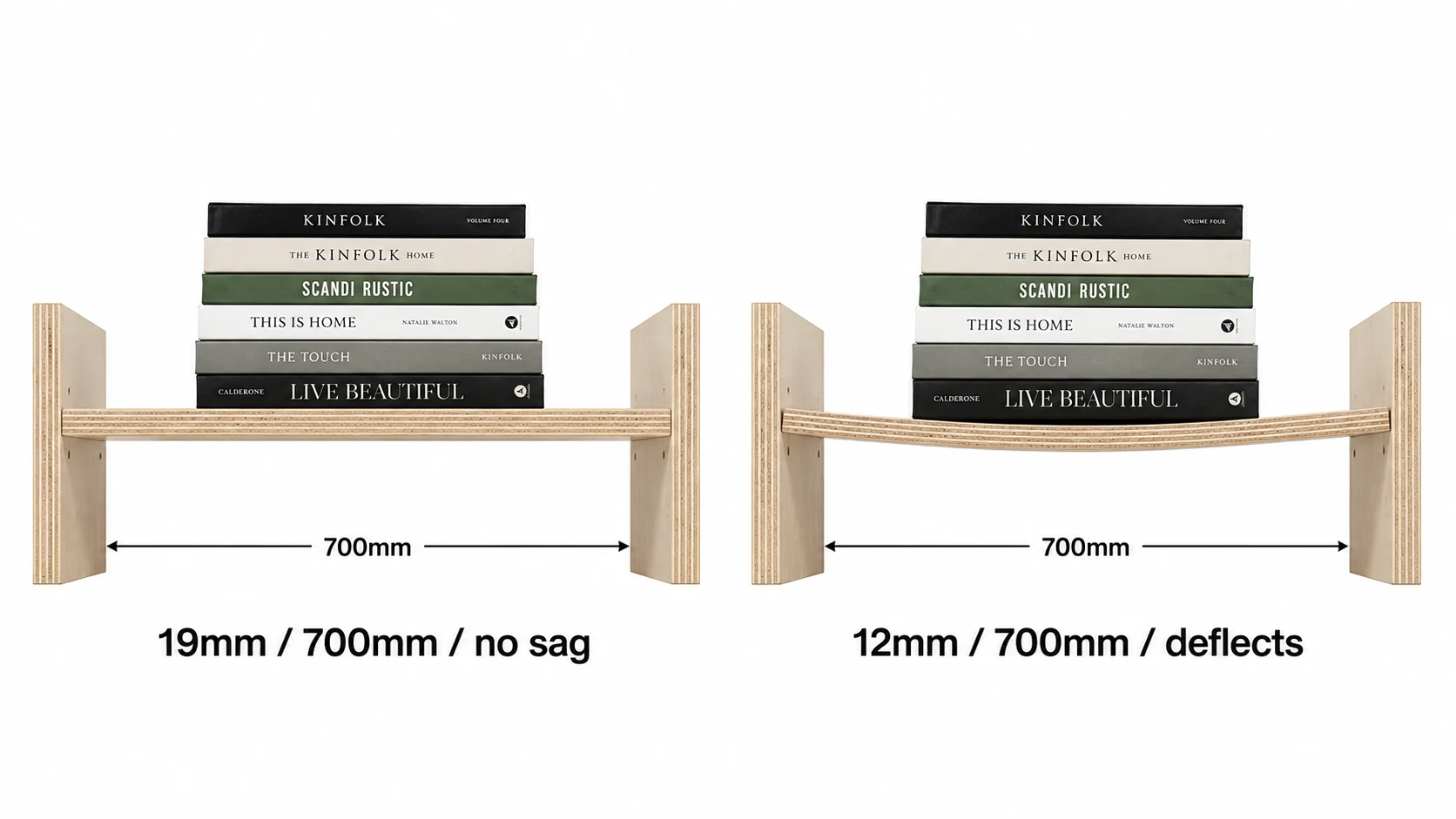
Shelf deflection is the practical failure mode – a shelf that looks fine when empty but visibly sags when loaded. The two variables that control deflection are thickness and span (the unsupported distance between brackets or supports).
General rule of thumb:
| Plywood thickness | Max span (light load – books, light items) | Max span (heavy load – tools, full boxes) |
|---|---|---|
| 12mm (1/2″) | 600mm | 450mm |
| 15mm (5/8″) | 800mm | 600mm |
| 19mm (3/4″) | 1,000mm | 700-800mm |
| 25mm (1″) | 1,200mm+ | 1,000mm |
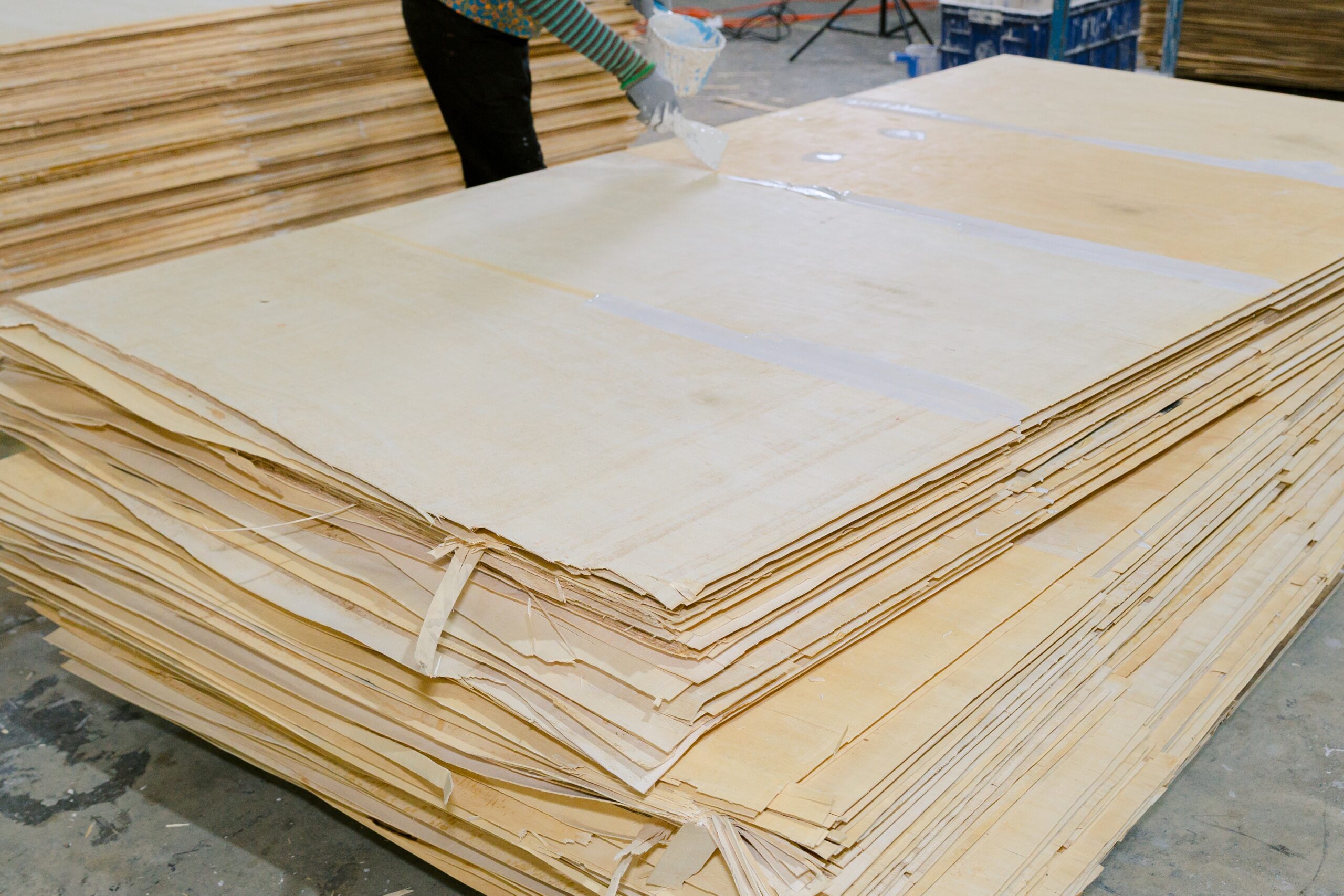
Core species matters here. All-birch core has a higher MOE (8,000-10,000 N/mm²) than combi/poplar core (5,500-7,500 N/mm²). For the same thickness and span, all-birch deflects less. For spans over 900mm carrying real weight, all-birch or adding a centre support is the safer specification.
Best Plywood for Bookshelves
Specification: Birch plywood B/BB, 19mm, all-birch core preferred
Books are dense – a standard 900mm shelf of hardcovers weighs 25-35 kg. That is the load case that separates adequate from inadequate shelf material.
- 19mm (3/4″) all-birch: recommended for spans over 700mm – highest stiffness, no visible deflection under full book load
- 19mm combi core: acceptable for spans under 800mm with a centre support at the midpoint
- Face grade: B/BB minimum if the shelf interior is visible – the smooth birch face takes stain or clear finish cleanly without grain filler
For natural or stained wood bookshelves, birch plywood provides a consistent pale blonde face that photographs well and takes oil, wax, or lacquer without blotching. For painted bookshelves, see the painted shelves section below.
What to avoid: 12mm or 15mm for spans over 600mm – undersized for book loads regardless of species.
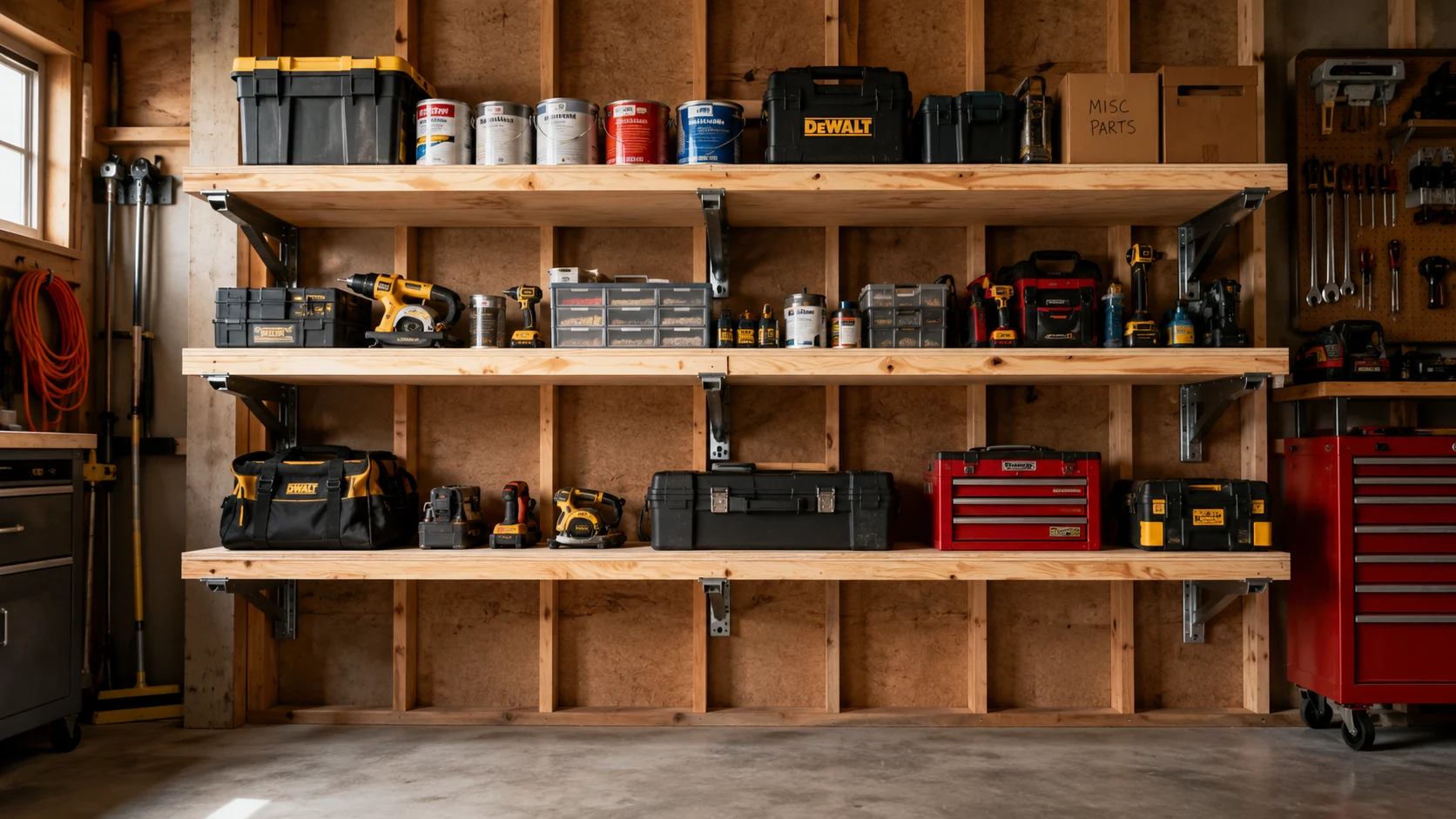
Best Plywood for Garage Shelves
Specification: CDX structural ply or birch combi core, 19mm, WBP glue
Garage environments present two challenges standard interior plywood is not designed for:
- Temperature cycling – unheated garages can drop below freezing and reach 40°C+ in summer
- Humidity variation – condensation, rain spray, and humidity swings are common
For garage shelving, the glue specification matters as much as the species:
- MR glue (urea-formaldehyde, EN 314-2 Class 1): interior only – will delaminate in sustained humidity. Not suitable for garages without climate control.
- WBP glue (phenolic, EN 314-2 Class 3): resists moisture cycling and temperature extremes. Required for garage use.
Recommended spec for garage:
- CDX structural plywood (pine or fir, exterior-glued) – cost-effective, available at builders merchants, rated for moisture exposure
- Birch combi core with WBP glue – if a cleaner surface is wanted for a finished garage or workshop
Span for garage shelves: Keep spans under 800mm for 19mm panels carrying tool loads (power tools, paint cans, hardware boxes). Add a centre bracket for spans over 900mm.
Best Plywood for Closet Shelves
Specification: Birch combi core B/BB, 15mm or 19mm, MR glue acceptable for climate-controlled interiors
Closet shelving typically carries folded clothes, shoes, and lightweight boxes – load is light compared to bookshelves or garage storage. The priority shifts from stiffness to surface quality and appearance.
- 15mm (5/8″) combi core: adequate for spans under 900mm with clothes, shoes, and folded items
- 19mm (3/4″) combi core: use for spans over 900mm or if shelves will carry heavier items (shoe boxes stacked, seasonal storage bins)
- Face grade: B/BB for closets where the shelf surface is visible. BB/BB acceptable for utility closets
Painted closet shelves: Birch B/BB face takes paint smoothly – one coat of primer, two topcoats, minimal grain telegraphing. MDF is also acceptable here if the shelf will never get wet (no shoes with moisture, no bathroom-adjacent installation). See How to Finish Birch Plywood.
Best Plywood for Floating Shelves
Specification: Birch all-birch or Baltic birch B/BB, 19mm minimum, shorter spans
Floating shelves (wall-mounted with concealed brackets, no visible support) carry load differently from bracket-supported shelves. The cantilevered load creates significant stress at the wall mount point – and any visible sag at the shelf tip is immediately obvious.
Rules for floating shelves:
- Maximum span: 600mm between bracket/support points for 19mm all-birch under moderate load. Beyond 600mm, increase thickness to 25mm or add a hidden centre support.
- Core: All-birch – the higher stiffness (MOE 8,000-10,000 N/mm²) is meaningfully better than combi core for cantilever applications
- Edge appearance: Baltic birch shows clean lamination lines on exposed edges – this is a design feature in Scandinavian-style interiors. Standard combi core shows the poplar core colour on edges – less attractive without edge banding.
For floating shelves where the edge is a visible design element, Baltic birch plywood (all-birch, 13-ply at 19mm) is the premium specification.
Best Plywood for Pantry Shelves
Specification: Birch combi core B/BB, 19mm, MR or WBP glue
Pantry shelves carry canned goods, bottles, and bulk dry goods – moderate to heavy load, standard interior humidity. The surface should be easy to clean (smooth face, sealed with a food-safe finish or washable paint).
- 19mm combi core: sufficient for spans under 800mm with typical pantry loads
- All-birch at 19mm: for spans 800-1,000mm or when carrying heavy glass jars and bulk items
- Finish: seal the birch face with a water-based polyurethane or paint for easy cleaning. An unfinished birch surface will absorb spills.
Best Plywood for Painted Shelves
Specification: Birch B/BB face, 19mm, combi core acceptable
For painted shelves, the face veneer quality determines finishing ease. Birch B/BB grade provides:
- Smooth, tight grain – no open pores to fill before painting
- Consistent blonde colour – no bleed-through or resin issues (unlike pine)
- Sands flat – minimal primer coats needed
MDF as an alternative for painted shelves: MDF has a slightly smoother surface than birch for painting (no grain at all), but has poor moisture resistance and heavy weight. For dry interior painted shelves under light load, MDF is acceptable. For anything with real weight or potential moisture exposure, birch plywood is the stronger specification.
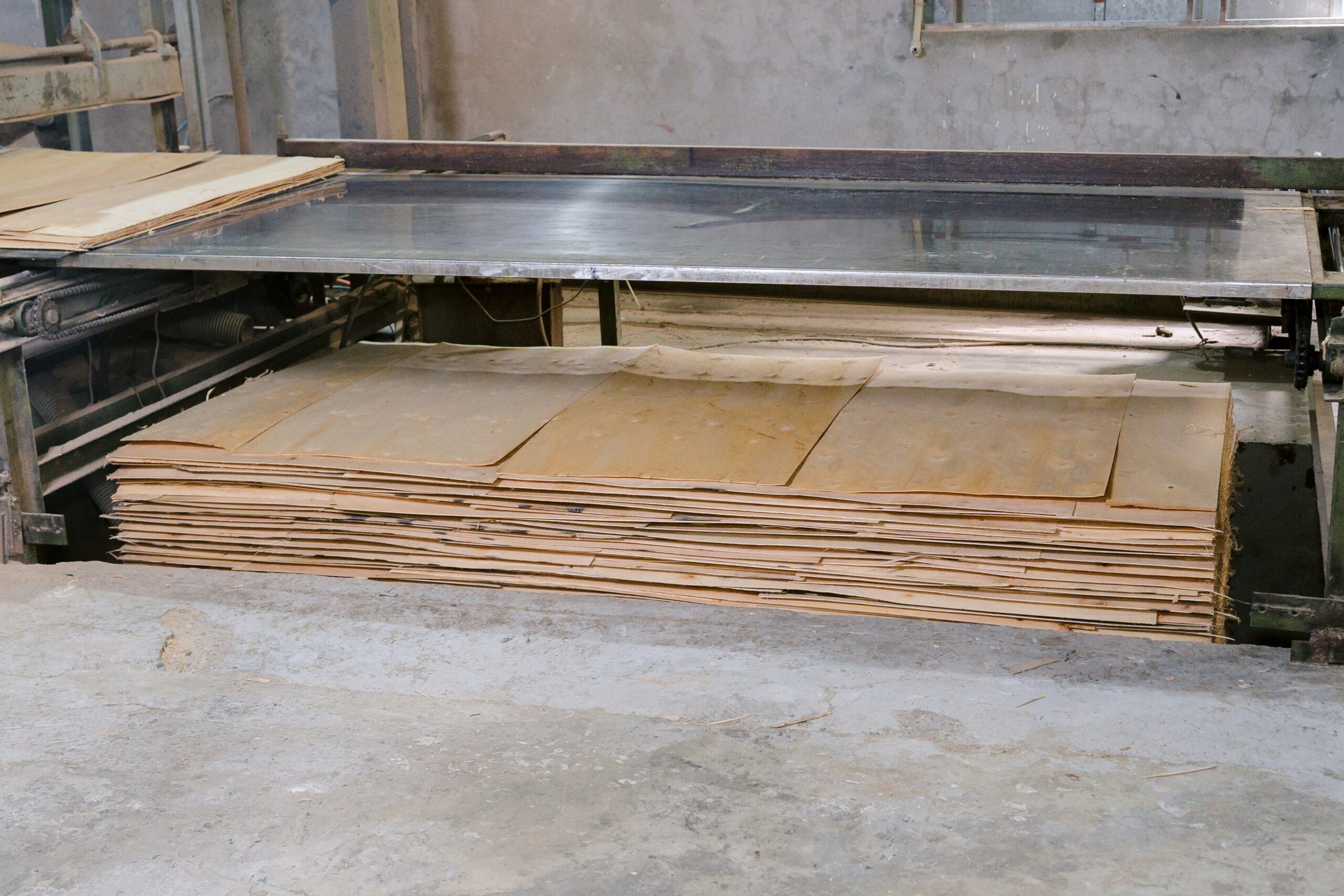
Finishing sequence for painted birch shelves: sand to 180 grit → one coat shellac or water-based primer → light sand → two topcoats latex or enamel. Result: smooth, grain-free painted surface. Full guide: How to Finish Birch Plywood.
Grade Guide for Shelving
| Grade | Face | Back | Best for |
|---|---|---|---|
| B/BB | Smooth, nearly clear | Small patches | Visible shelves – stained or clear finish |
| BB/BB | Small patches both faces | Small patches | Painted shelves – both faces may show |
| BB/CP | Patches | Larger knots | Utility – back face not visible |
| CDX | C-grade knotty | D-grade | Garage, utility, structural |
For full grade definitions with visual examples: Birch Plywood Grades: A, B/BB, BB/BB, C2 Explained.
FAQ
What thickness plywood for shelves?
19mm (3/4″) is the standard for most shelving applications. Use 15mm (5/8″) for short spans under 800mm carrying light loads (clothes, light boxes). Use 25mm (1″) for long spans over 1,000mm or heavy loads. Undersizing thickness is the most common shelving mistake – the shelf looks fine empty but sags visibly when loaded.
Is birch plywood good for shelves?
Yes – birch plywood is the standard specification for interior furniture shelving. The smooth face finishes cleanly for paint or stain, the dense core holds edge screws and shelf pins reliably, and the panel is dimensionally stable (no seasonal movement like solid wood). All-birch core is preferred for heavy-load or long-span applications.
What is the best plywood for garage shelves?
CDX structural plywood (pine or fir, exterior-rated) or birch combi core with WBP (exterior) glue. The key specification for garage use is the glue type – MR (interior) glue will delaminate with humidity cycling in an unheated garage. Specify WBP phenolic glue explicitly when ordering.
Can I use 12mm plywood for shelves?
For spans under 600mm with light loads (small items, decorative objects), yes. For anything wider or heavier, 12mm is inadequate – it will deflect visibly. Standard shelving minimum is 15mm for light use or 19mm for normal furniture and storage.
What is the best plywood for floating shelves?
All-birch core, 19mm minimum, maximum 600mm unsupported span. Baltic birch (13-ply, void-free) is the premium specification – the clean laminated edge is a visible design feature, and the higher stiffness resists tip sag in cantilever applications.
Birch plywood or MDF for painted shelves?
Birch plywood for most applications – better moisture resistance, lighter weight, stronger edge screw-holding, and comparable painted surface quality. MDF only where: (a) load is very light, (b) environment is completely dry, and (c) edges will be covered or banded (MDF edge is unattractive and absorbent).
Order Specification for Shelving Plywood
When ordering direct from a Vietnam factory:
Species: Birch face/back (B/BB grade)
Core: All-birch [heavy load / long span]
Combi core – birch/poplar [standard shelving]
Thickness: 19mm (±0.5mm)
Sheet size: 1220×2440mm
Glue: MR (EN 314-2 Class 1) – dry interior
WBP (EN 314-2 Class 3) – garage / humid areas
Emission: E1
Kosmex produces birch-faced plywood in B/BB and BB/BB grades, both combi core and all-birch construction, CE marked and FSC on request. For specifications and FOB pricing, contact our team: anna@kosmexgroup.com
Related Reading
- Birch Plywood Grades: A, B/BB, BB/BB, C2 Explained
- Baltic Birch vs Birch Plywood: What’s Actually Different
- How to Finish Birch Plywood: Staining, Painting & Sealing
- Birch Plywood vs MDF: Strength, Moisture & Cost
- Plywood vs Solid Wood: Strength, Stability & Cost
- Poplar Core Plywood: What It Is & When to Use It
Bình luận