


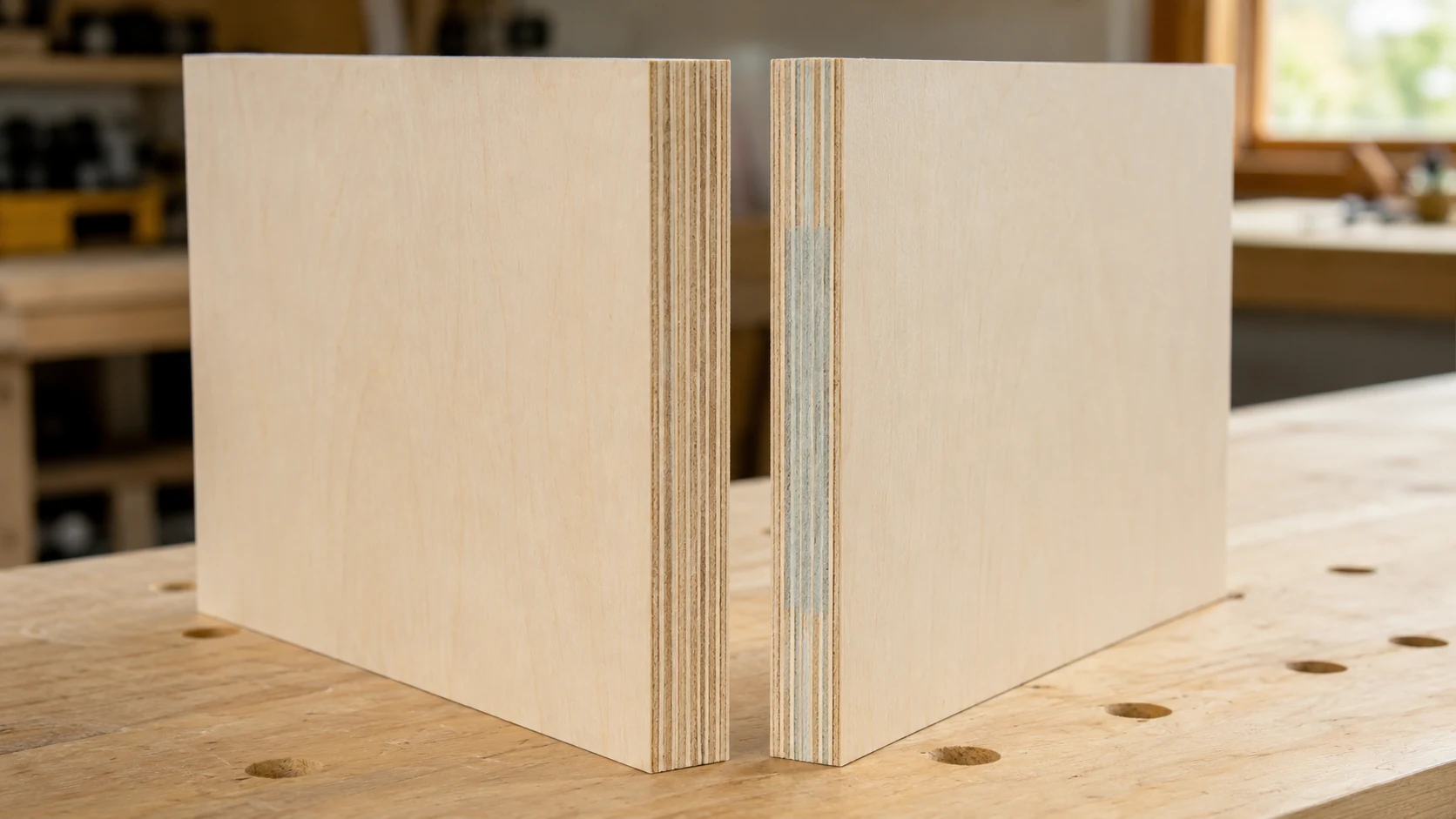
Understanding the distinction matters when you’re specifying for furniture, cabinetry, CNC work, or placing a factory order – because paying birch prices and receiving a combi-core panel with a birch face is a genuinely common outcome.
The Core Difference: What’s Inside the Panel
The most important difference between Baltic birch and standard birch plywood is not the face – it’s the core.
Baltic birch plywood is built with birch veneer throughout every layer. Face, crossbands, and core are all birch. The veneers are thin (approximately 1.5mm per ply) and the core is void-free – no gaps, no filler species, no mixed construction. A 3/4″ (18mm) Baltic birch panel contains 13 plies. A standard 3/4″ construction plywood might have 5-7 plies with softwood or filler core species between a hardwood face.

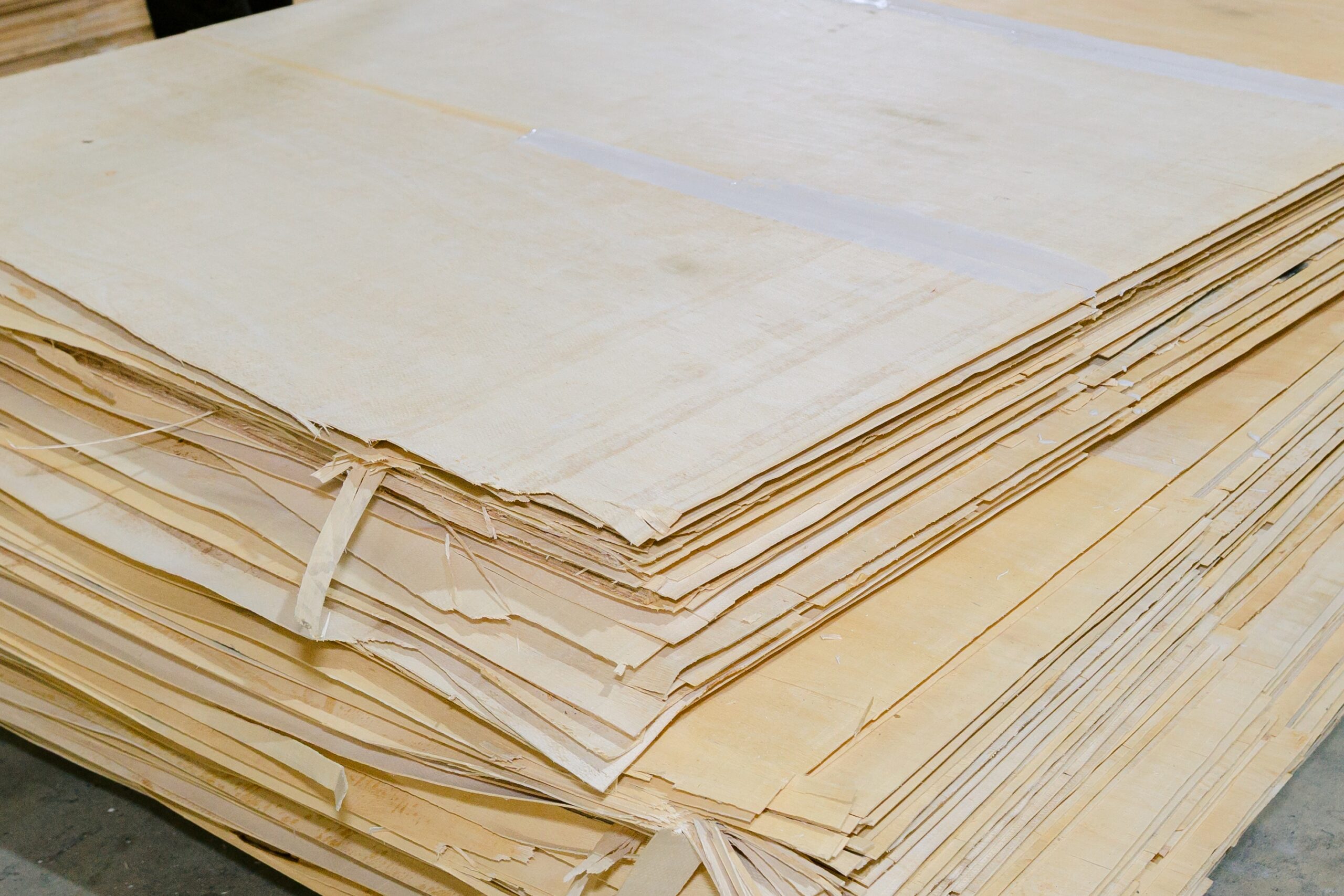
Standard birch plywood (also called “birch-faced plywood” or “commercial birch plywood”) uses birch veneer on the face and back, but the inner core layers may be poplar, eucalyptus, pine, or a mix – depending on the factory and specification. This is called combi core or mixed core construction. The face looks identical to Baltic birch. The panel behaves differently under load, machining, and edge treatment.
| Baltic Birch Plywood | Standard Birch Plywood | |
|---|---|---|
| Core species | All birch – every ply | Combi core (poplar, eucalyptus, or mixed) |
| Ply count (18mm) | 13 plies | 5-9 plies (fewer, thicker) |
| Veneer thickness per ply | ~1.5mm | 2.5-4mm (inner plies) |
| Core voids | None – void-free standard | Permitted (varies by grade) |
| Face appearance | Birch, smooth | Birch, smooth |
| Standard sheet size | 5×5 ft (1525×1525mm) | 4×8 ft (1220×2440mm) |
| Grade system | European: B/BB, BB/BB, CP | US: A, B, C, D / European mix |
| Density | 640-700 kg/m³ | 450-550 kg/m³ (combi) |
| Weight (18mm sheet) | ~36-40 kg (4×8 equivalent) | ~25-30 kg (combi core) |
| Typical price (retail US) | ~$70-90 per 5×5 sheet (3/4″) | ~$40-60 per 4×8 sheet (3/4″) |
| FOB Vietnam (B2B) | $380-450/CBM | $270-360/CBM |
The Grade System: European vs US Grading
This is where the most confusion occurs – because Baltic birch uses a completely different grading nomenclature from standard US plywood grades.
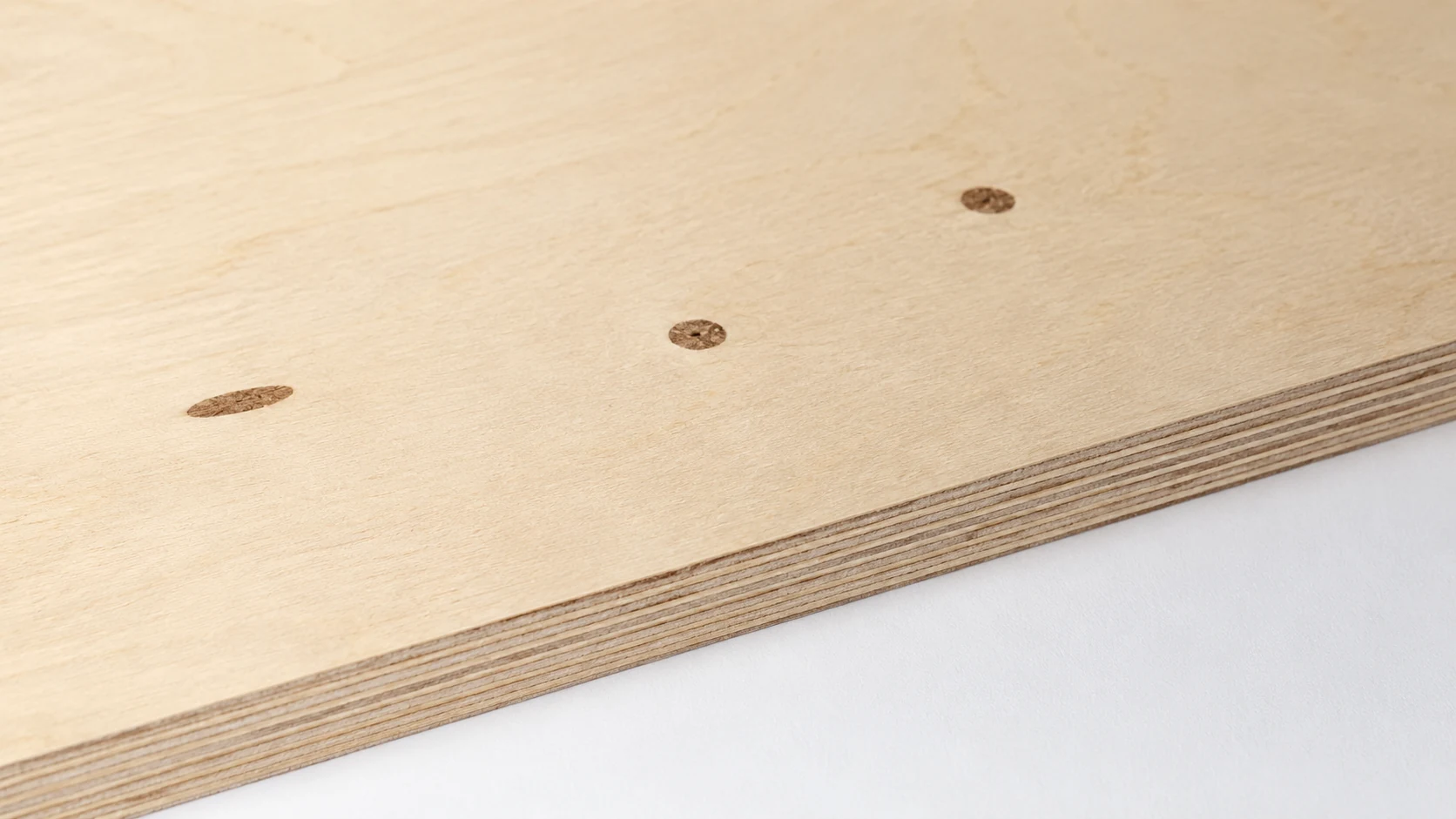
Baltic Birch Grades (European system)
| Grade | Face | Back | What it means |
|---|---|---|---|
| B/BB | Smooth, virtually clear | Small knots, patches | Best face grade – used where face will be visible |
| BB/BB | Small knots, circular patches | Small knots, patches | Standard grade – patches on both faces |
| BB/CP | Small patches | Larger knots, some splits | Economy – back face not intended for visibility |
| CP/CP | Knots, splits permitted | Knots, splits permitted | Structural only |
The circular or “football-shaped” patches you see on BB-grade Baltic birch are not defects – they are precision-cut fillers replacing knots, sanded flush, and considered part of the grade standard.
Standard US Birch Grades
Standard US-graded birch plywood uses A-D face grading:
- A face: Smooth, sanded, minimal patches
- B face: Solid surface, patches and tight knots permitted
- C face: Open knots, patches, limited splits
- D face: Larger knots, splits – structural use
The A/B or A/C designation refers to face/back grade. The core is not graded by this system – which is why a panel can be graded A/B on the face while containing filler species or voids in the core.
For full grade definitions with photos and measurement standards, see Birch Plywood Grades: A, B/BB, BB/BB, C2 Explained.
Size: Why Baltic Birch Comes in 5×5
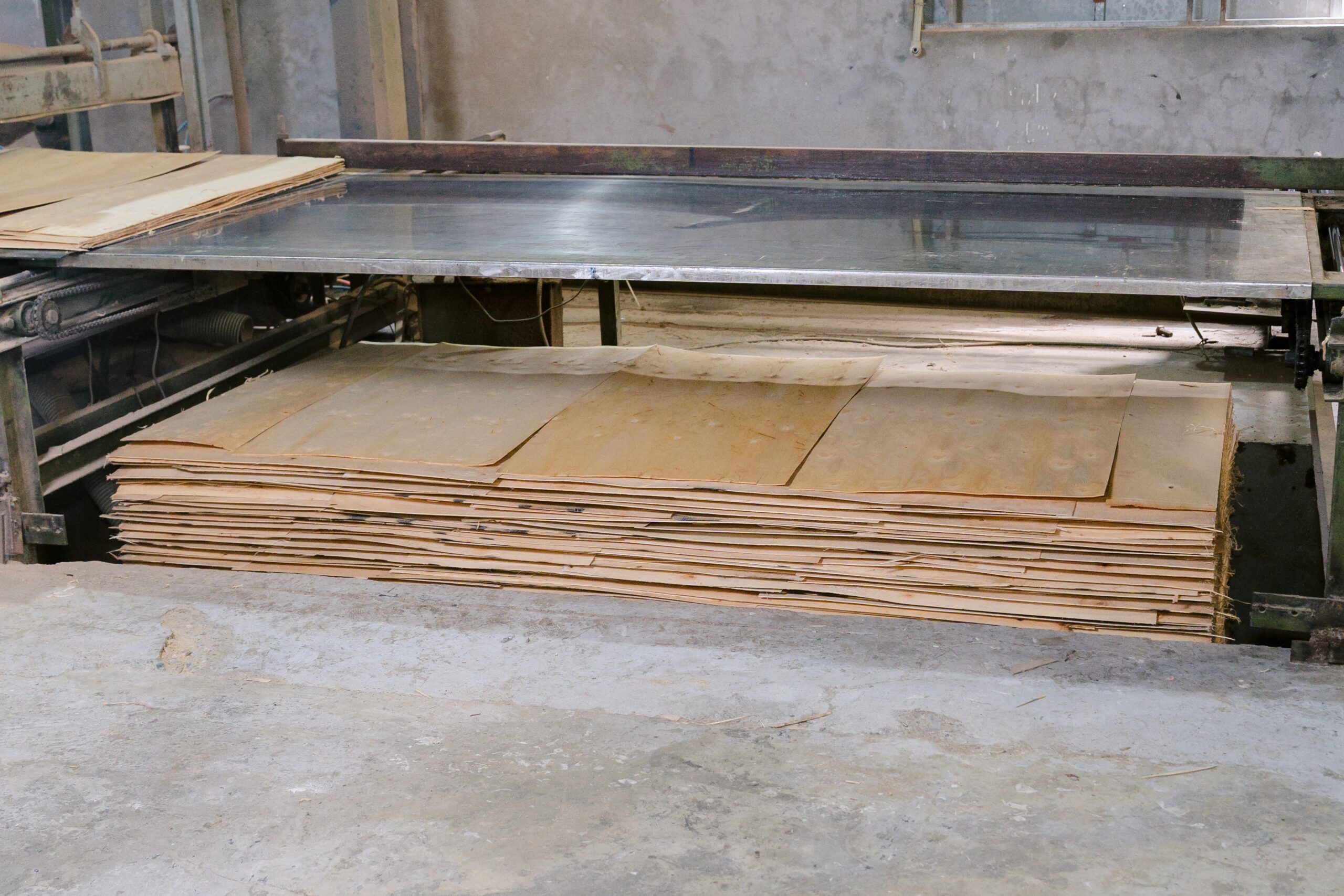
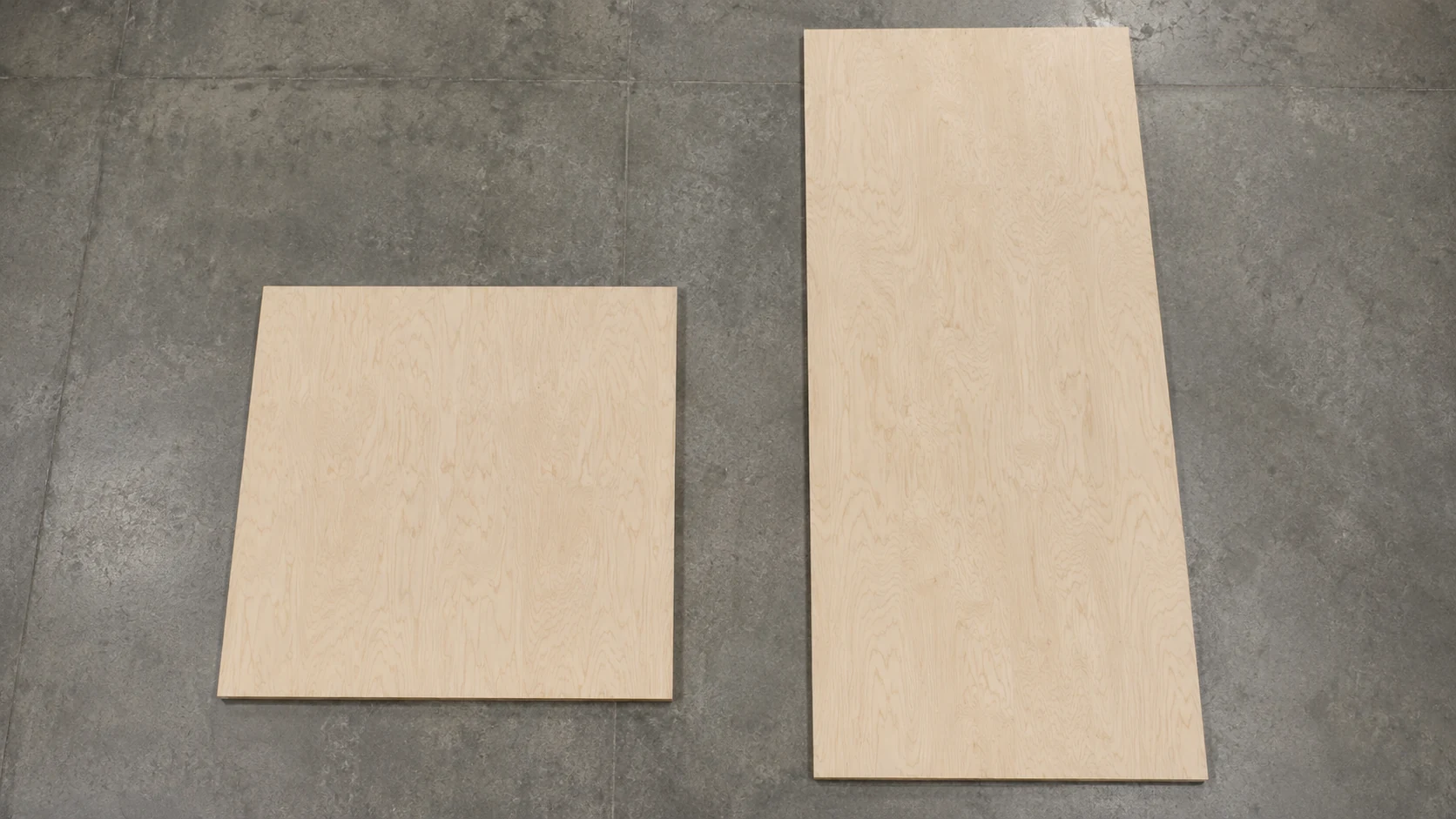
Baltic birch is produced in 5×5 ft (1525×1525mm) sheets – not the standard 4×8 ft (1220×2440mm) that most building material is sold in. This is a direct result of the Baltic manufacturing tradition (originally from Finland and the Baltic states, now also Russia and Eastern Europe), where 5×5 became the standard for the species and equipment configuration.
Practical implications:
- 5×5 sheets don’t fit standard 4×8 panel saws or router tables without modification
- Cut sheets (typically 12×24″, 24×30″, or 24×48″) are widely sold by woodworking retailers as a workaround
- For full-panel work, you need to account for the larger format in your material planning and waste calculation
- 4×8 Baltic birch is becoming more available but is still not the norm in most markets
Standard birch-faced plywood is almost universally available in 4×8 ft sheets – which fits standard construction workflow and is easier to handle in smaller shops.
Strength and Performance: Where the Difference Shows Up
CNC Routing and Precision Work
The higher ply count and void-free core of Baltic birch make it the preferred choice for CNC routing, jig-making, and precision joinery. Thinner veneer layers mean more consistent material density across the cut path – router bits and saw blades don’t skip across core boundaries. Edges can be left exposed and sanded smooth, revealing clean lamination lines rather than a rough core.
Standard birch-faced plywood with combi core will show the poplar or filler core on any exposed edge – which matters if edges are visible in the final piece.
Screw-Holding
All-birch core holds fasteners more reliably – both face screws and edge screws – because birch veneer is consistent in density throughout the panel. In combi-core panels, edge screws driven into poplar inner layers have less material to grip, particularly after repeated assembly/disassembly.
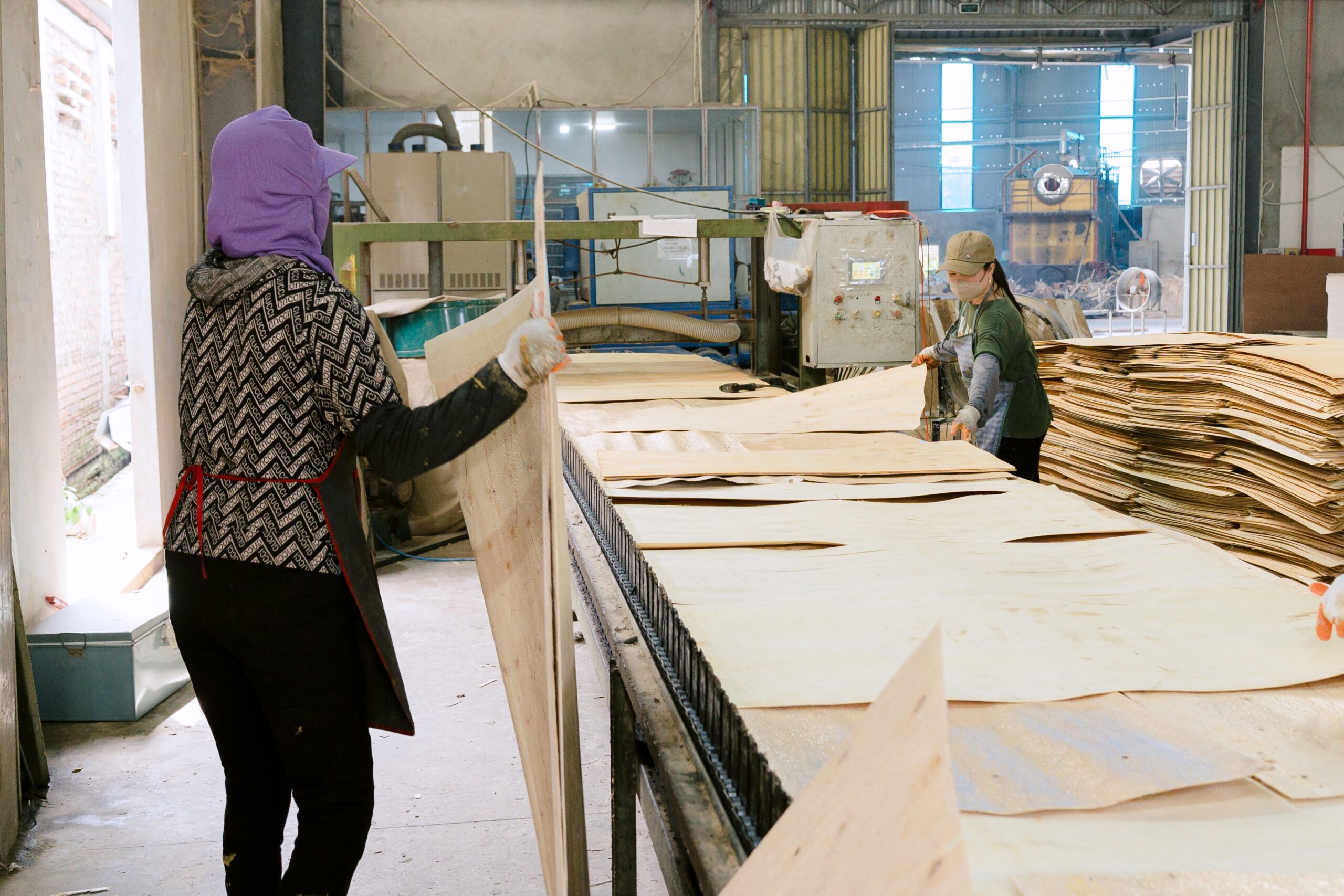
For face-screw applications (cabinet assembly, face frames), the difference is minimal because you’re always driving into the birch face veneer. For edge-screw applications (shelf pins, knock-down hardware, rabbet joinery), all-birch performs noticeably better.
Shelf Deflection Over Long Spans
Baltic birch’s higher stiffness (MOE 8,000-10,000 N/mm² vs 5,500-7,500 N/mm² for combi core) means less deflection over unsupported spans. For shelving over 900mm, book storage, or kitchen upper cabinets with heavy loads, all-birch is the more reliable specification.
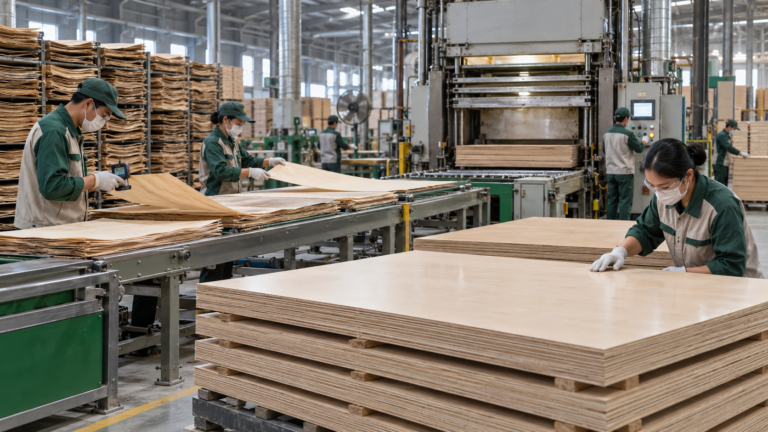
[ẢNH 3 – Veneer layup / workers at production tables]
Vị trí: Sau phần Strength and Performance. Inline right.
Use Cases: Which to Choose
Choose Baltic Birch When:
- Edges will be visible – the laminated edge is a design feature in exposed-edge furniture, shelving, and speaker cabinets
- CNC routing or precision joinery – consistent density across all plies is critical
- Shop jigs and fixtures – void-free core means no soft spots or tear-out under clamps and routers
- Drawer boxes – the clean edge and consistent structure is the industry standard for high-end drawer construction
- Heavy-load shelving – higher stiffness handles long unsupported spans better
Choose Standard Birch-Faced Plywood When:
- Edges will be banded or covered – combi core is invisible behind edge tape or solid wood lipping
- Painted surfaces – birch face takes paint identically regardless of core species
- Cost is a primary factor – combi core panels are typically 20-35% cheaper per CBM on import orders
- Large-volume cabinet carcassing – for box construction where edges are covered, combi core is the efficient specification
- Weight matters – combi core panels are 25-35% lighter per sheet, relevant for shipping cost and installation
See: Best Plywood for Kitchen Cabinets: Grade, Core & Thickness
Baltic Birch vs Russian Birch: Are They Different?
Historically, “Baltic birch” referred specifically to birch plywood produced in Finland and the Baltic states (Estonia, Latvia, Lithuania). The majority of the world’s Baltic birch supply subsequently came from Russia – using the same species (Betula pendula and Betula pubescens), similar manufacturing standards, and the 5×5 format.
Following the 2022 sanctions on Russian timber exports to the EU, UK, and US markets, Russian birch plywood became unavailable or heavily restricted in most Western markets. The result:
- Finnish and Baltic-state production ramped up but could not fully replace Russian volume
- Vietnam, China, and other Asian manufacturers began producing all-birch or combi-core panels marketed as “birch plywood” to fill the gap
- Prices for genuine all-birch panels from compliant sources rose significantly
What this means for buyers today:
- “Baltic birch” on a North American or European supplier’s price list should now indicate non-Russian origin – but verify
- FSC certification and CE marking are the most reliable verification tools for compliant sourcing
- Vietnamese-produced all-birch panels (birch veneer throughout, void-free) are a legitimate alternative, but must be specified explicitly
Kosmex produces FSC-certified birch-faced plywood with both all-birch and combi core options, CE marked for EU export. Request origin documentation and specifications →
Baltic Birch vs Maple Plywood
Maple plywood is a closer competitor to Baltic birch than standard birch-faced panels – both are dense hardwood-core products used in precision woodworking and furniture.
| Baltic Birch | Maple Plywood | |
|---|---|---|
| Face species | Birch | Hard maple |
| Core species | All birch | Varies (maple, poplar, MDF) |
| Surface hardness | High | Higher – maple is harder |
| Grain appearance | Fine, consistent | Fine, tight-grained, lighter |
| Machinability | Excellent | Good – slightly more blunting |
| Painted finish | Excellent | Excellent |
| Cost | Mid-high | Higher |
| Availability | Specialty stores | Specialty stores – less common |
For most furniture and cabinetry applications, Baltic birch and hard maple plywood deliver comparable results. Maple’s advantage is hardness (more scratch-resistant surface); birch’s advantage is cost and wider availability in larger formats.
ApplePly vs Baltic Birch
ApplePly is a branded all-hardwood plywood produced by States Industries in the US, using alder species (not apple – the name refers to the colour and fine-grained appearance). It is the closest domestic US alternative to Baltic birch in construction and application.
| Baltic Birch | ApplePly | |
|---|---|---|
| Species | Birch | Alder (domestic hardwood) |
| Core construction | All-birch, void-free | All-hardwood, void-free |
| Ply count (3/4″) | 13 | 13 |
| Sheet size | 5×5 ft | 4×8 ft (standard US size) |
| Edge appearance | Blonde lamination lines | Blonde, similar to Baltic birch |
| Availability | Specialty stores, import | Domestic US – wider availability |
| Price | Similar | Similar to slightly higher |
The practical case for ApplePly over Baltic birch is primarily availability in 4×8 format (fits standard shop equipment) and domestic US sourcing. The case for Baltic birch is wider international availability and the established grade system.
How to Specify When Ordering
Whether ordering retail or direct from a factory, the specification should be explicit – “birch plywood” alone does not communicate core construction.
For all-birch (Baltic birch equivalent):
Species:         Birch - all-birch core construction
                 (No combi/mixed core - birch throughout)
Face grade:      B/BB or BB/BB (European grade)
Ply count:       13 plies minimum at 18mm
Core voids:      None permitted
Sheet size:      1525×1525mm (5×5) or 1220×2440mm (4×8)
Thickness:       18mm (±0.3mm tolerance)
Glue:            WBP phenolic - EN 314-2 Class 3
Emission:        E1 formaldehyde class
Certification:   FSC / CE marked [if required]
For standard birch-faced (combi core):
Species:         Birch face/back - poplar or eucalyptus core
Face grade:      B/BB or BB/BB
Sheet size:      1220×2440mm (4×8)
Thickness:       18mm (±0.5mm)
Glue:            MR (EN 314-2 Class 1) or WBP Class 3
Emission:        E1
Certification:   CE marked [if required]
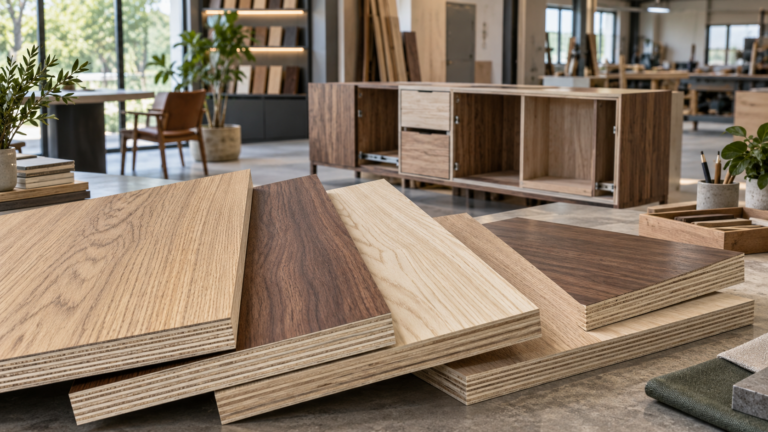
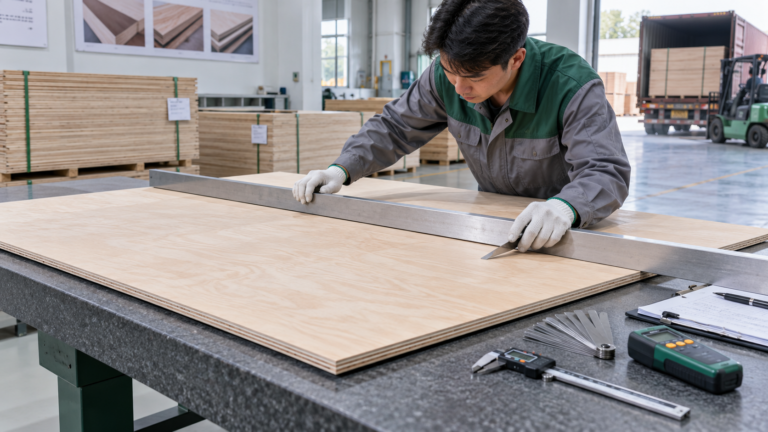
Always request a cross-section photo of the panel edge before confirming a large order. All-birch and combi-core panels are visually distinguishable from the edge – birch core is consistent pale yellow throughout; poplar core is noticeably lighter/whiter in the inner layers.
FAQ
Is Baltic birch better than regular birch plywood?
For precision work, CNC routing, exposed edges, and heavy-load applications – yes. For painted furniture, covered cabinetry, and cost-sensitive projects where edges will be banded – standard birch-faced combi core is equally appropriate at lower cost. Neither is universally better; they suit different applications.
Why does Baltic birch come in 5×5 sheets?
The 5×5 format is a manufacturing standard from the Baltic/Scandinavian production tradition. The machinery, log peeling, and drying equipment in those facilities was configured for this size. 4×8 Baltic birch is becoming more available but the 5×5 format remains dominant.
Is Russian birch the same as Baltic birch?
They use the same species and construction standards. Historically most “Baltic birch” on Western markets came from Russian mills. Following 2022 sanctions, Russian birch is no longer available in EU/UK/US markets – product now labelled Baltic birch should originate from Finland, Baltic states, or other compliant countries.
Can I substitute regular birch plywood for Baltic birch in a project?
For painted or edge-banded applications: yes, without visible difference. For exposed edges, CNC work, or shop jigs: no – the combi core will show on edges and machine less consistently.
What is the difference in weight between Baltic birch and regular birch plywood?
At 18mm, all-birch panels weigh approximately 36-40 kg per 4×8 equivalent. Combi-core birch-faced panels weigh 25-30 kg – roughly 25-35% lighter. For large installations or shipping cost-sensitive orders, this is a meaningful practical difference.
How do I know if a panel is genuine all-birch core?
Check the edge. All-birch core shows consistent, uniform pale yellow-blonde veneer layers of equal thickness throughout. Combi core panels show distinctly lighter (almost white or grey-green) inner layers that contrast with the birch face veneers. If ordering remotely, request an edge cross-section photo before shipment.
Summary
| Requirement | Specification |
|---|---|
| Exposed edges – furniture, shelving | Baltic birch / all-birch core, B/BB grade |
| CNC routing, jigs, fixtures | All-birch, void-free, 13-ply at 18mm |
| Painted cabinet boxes | Standard birch-faced combi core – B/BB |
| Drawer boxes – high-end | Baltic birch 12mm |
| Heavy-load shelving (>900mm span) | All-birch core |
| Budget cabinet carcassing | Combi core BB/BB – birch face |
| Lightweight shipping-sensitive orders | Combi core (25-30% lighter) |
Bình luận