


Types of Eucalyptus Plywood: Core, Face, Marine, Film Faced & More
Eucalyptus plywood is not a single product. It is a broad category that encompasses several distinct types, each built around different core compositions, face veneers, glue systems, and surface treatments designed for specific applications and performance demands.
The common thread across all types is the eucalyptus species itself: a fast-growing, high-density hardwood with natural oils that contribute to moisture resistance and structural stability. But how that timber is layered, what it is paired with, and how the finished panel is surfaced determines whether the result is a construction-grade formwork panel, a furniture-grade interior board, a marine-rated sheet, or a decorative veneer panel.
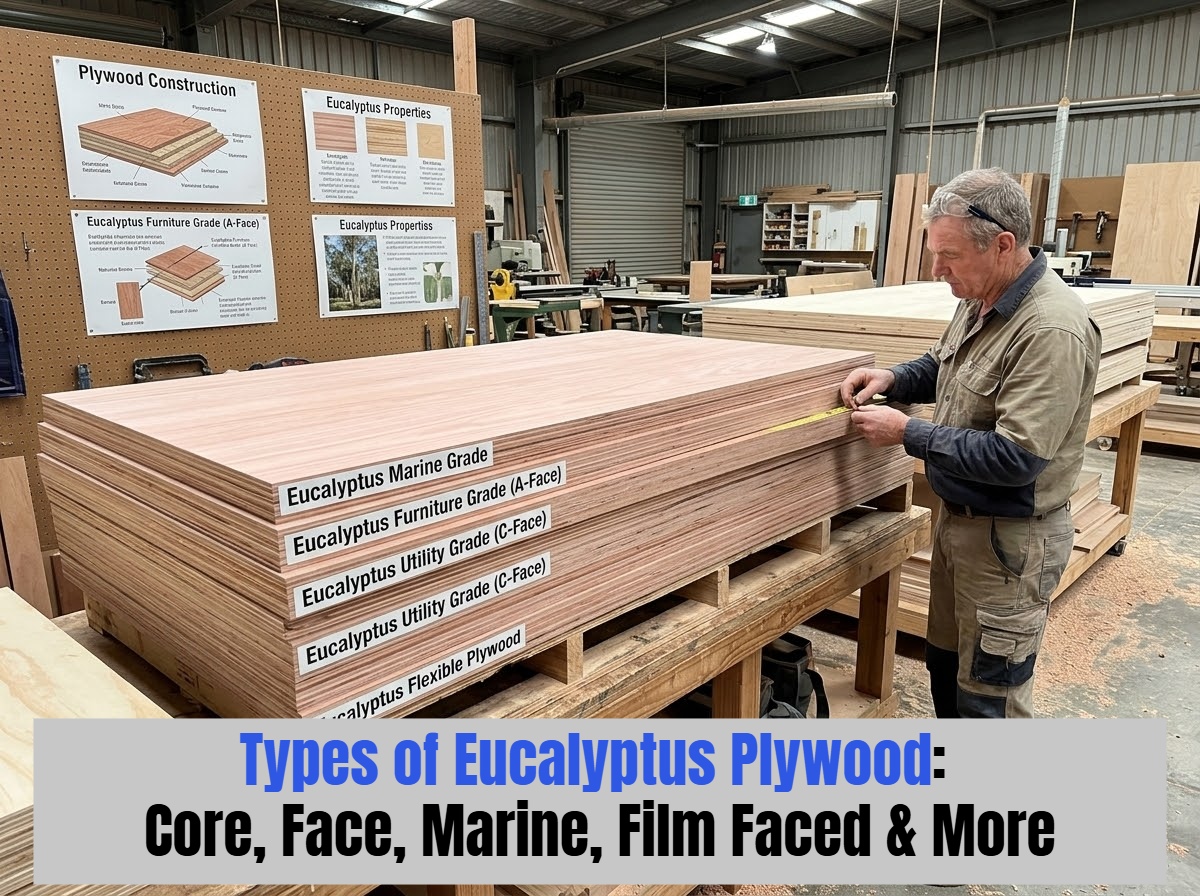
This guide covers every main type of eucalyptus plywood by both composition and application, explains the specifications that define each type, and helps match the right panel to the right job. For a foundational overview of the material’s core properties, see our complete eucalyptus plywood guide.
Why Eucalyptus Plywood Comes in Multiple Types
Eucalyptus plywood’s versatility as a base material creates a wide range of product types because the species performs well across very different manufacturing routes. Its density (typically 550 to 620 kg/m3) gives structural strength at thinner gauges. Its natural oils contribute moisture resistance that can be enhanced further with exterior-grade adhesives and surface films. And its fast plantation growth means it is available in sufficient volume to serve both construction-grade and furniture-grade markets.
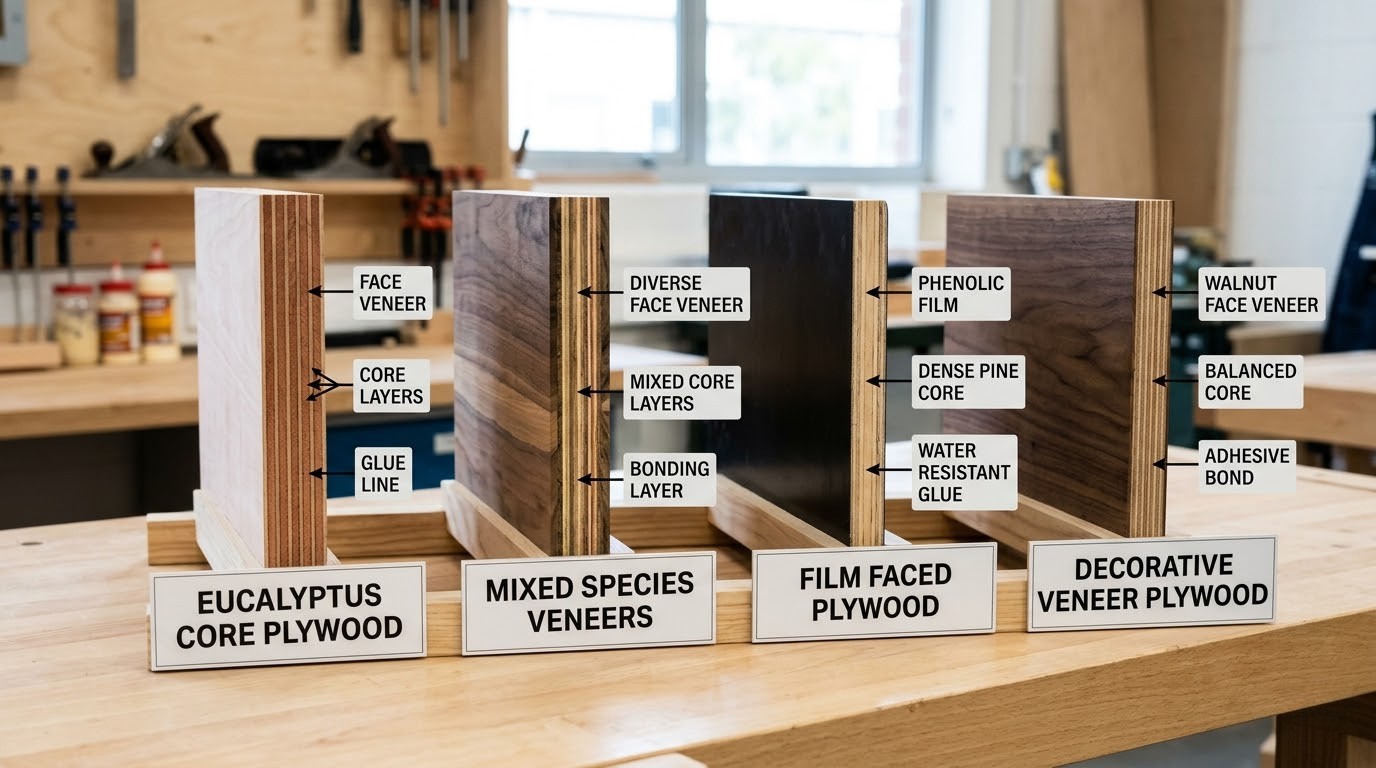
The types of eucalyptus plywood differ primarily along three axes: the core construction (full eucalyptus versus mixed-species), the face veneer (eucalyptus, birch, okoume, bintangor, or film overlay), and the glue system (WBP phenolic for exterior and wet conditions versus MR melamine for interior applications). Understanding where a panel sits on each of these three axes is the starting point for correct specification. For an overview of how plywood types and grades are categorized more broadly, our types of plywood complete guide provides useful context.
Types of Eucalyptus Plywood by Core Composition
1. Full Eucalyptus Plywood
Full eucalyptus plywood, also referred to as 100% eucalyptus plywood or structural eucalyptus plywood, uses eucalyptus veneers throughout all plies: face, back, and every core layer. This all-eucalyptus construction produces the densest, stiffest, and most structurally capable panel in the eucalyptus plywood range.
Because every ply is the same species, density is consistent from face to core. This means screw-holding performance, bending stiffness, and moisture resistance are uniform across the full panel thickness rather than varying between a dense eucalyptus face and a lighter softwood core. Full eucalyptus panels are the correct specification for applications where maximum structural performance is required: heavy furniture, structural flooring, workbenches, and load-bearing construction components.
- All plies: eucalyptus veneer
- Density: consistent throughout at 550 to 620 kg/m3
- Glue: WBP phenolic (exterior) or MR melamine (interior)
- Grades: BB/BB for furniture; BB/CC or CC/CC for structural
- Common thickness: 12 mm to 25 mm
Best for: Structural furniture, load-bearing flooring, heavy shelving, workbenches, and construction applications where maximum panel strength is required.
2. Eucalyptus Core Plywood (Mixed Face)
Eucalyptus core plywood uses eucalyptus veneer for the core plies but pairs it with a premium face veneer in a different species. Common face veneer options include birch, bintangor, and okoume. The core provides the structural backbone of the panel: the density, rigidity, and screw-holding that eucalyptus delivers well. The face veneer provides the surface quality and appearance the application requires. 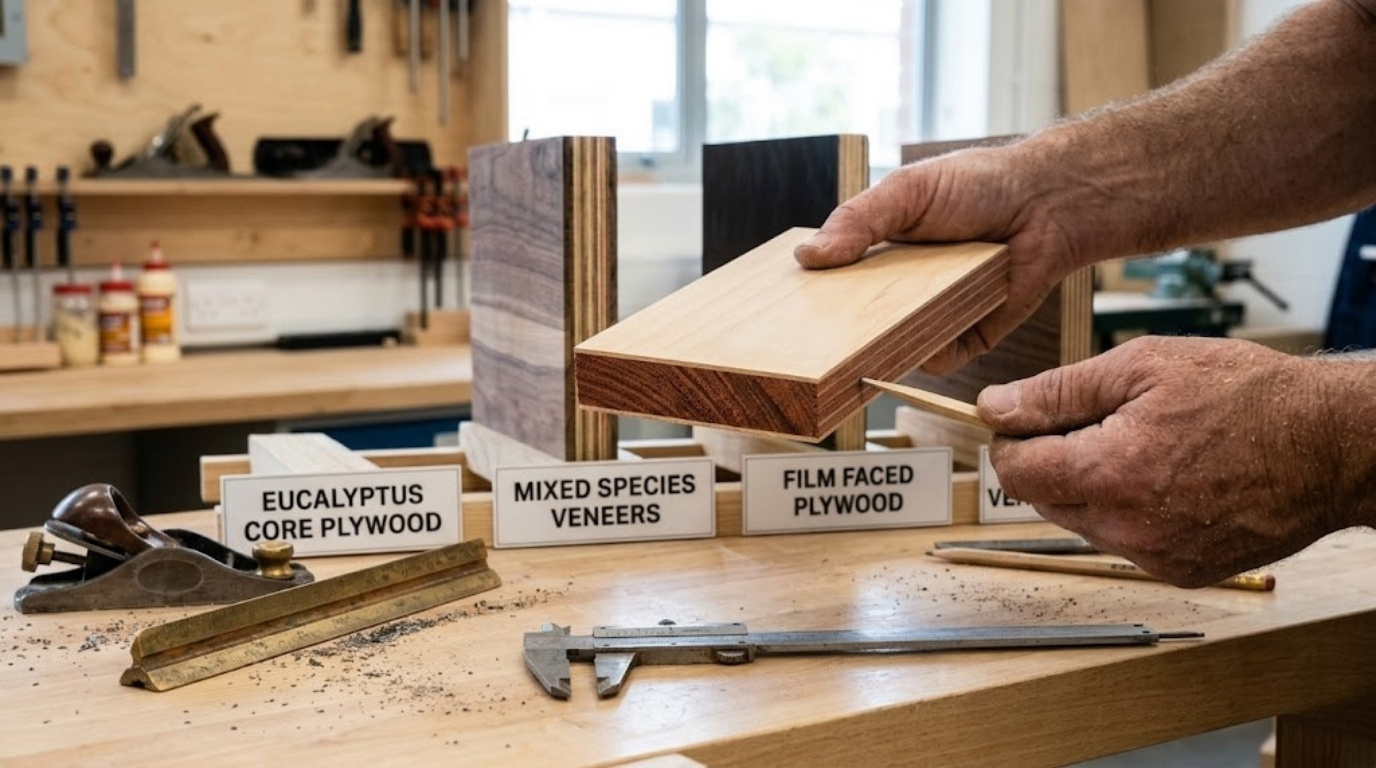
This combination is widely used for furniture-grade and commercial-grade plywood where the structural performance of a eucalyptus core is needed but the smooth, fine-grained surface of birch or the warm, even surface of bintangor is preferred for finishing. Kitchen cabinet carcasses, wardrobe systems, and shopfitting panels are common applications. Eucalyptus core plywood with a birch face is one of the closer alternatives to pure birch plywood at a somewhat lower cost per sheet.
- Core plies: eucalyptus veneer
- Face and back: birch, bintangor, okoume, or other premium species
- Glue: typically MR melamine for interior cabinetry; WBP available for exposed applications
- Grades: BB/BB most common for furniture-grade
- Common thickness: 9 mm to 25 mm
Best for: Furniture carcasses, kitchen and wardrobe cabinetry, interior joinery, and commercial shopfitting where surface quality and structural performance are both required.
3. Eucalyptus and Softwood Combination Plywood
Combination plywood uses eucalyptus veneers for the outer plies and a softer, lighter species such as poplar, pine, or acacia for the inner core layers. This construction reduces panel weight and cost compared to full eucalyptus while retaining the eucalyptus species’ surface hardness and appearance on the face.
The trade-off is a reduction in overall panel stiffness and screw-holding consistency through the panel thickness, since the softer core layers are less dense than eucalyptus. Fasteners driven into the face or back of the panel will still perform well, but fasteners driven into edges or through the core section will encounter the lower-density softwood core rather than eucalyptus.
Combination panels are a practical cost-reduction approach for applications where the full structural premium of eucalyptus throughout is not required: lightweight furniture backs, non-structural interior paneling, and packaging.
- Face and back: eucalyptus veneer
- Core: poplar, pine, acacia, or other softwood species
- Density: lower overall than full eucalyptus due to lighter core
- Cost: lower than full eucalyptus or eucalyptus core panels
Best for: Budget-sensitive interior paneling, lightweight furniture components, packaging, and non-structural applications where surface hardness matters but through-panel structural performance does not.
Types of Eucalyptus Plywood by Surface Treatment
4. Eucalyptus Film Faced Plywood
Eucalyptus film faced plywood is a construction-grade panel that uses a eucalyptus core, typically all-eucalyptus or eucalyptus-dominant, with a phenolic resin film bonded to the face and back surfaces. The film dramatically increases surface hardness, water resistance, and abrasion resistance, transforming a structural plywood panel into one that can withstand the demanding conditions of concrete formwork, scaffold boards, and site construction use.
The phenolic film is available in two standard colors: brown and black. Brown film faced plywood uses a standard phenolic overlay; black film faced plywood uses a denser, darker phenolic resin that is associated with higher hardness and longer service life in heavy-use formwork applications. Both variants share the same core structure: a eucalyptus or eucalyptus-dominant panel bonded with WBP (Water Boiled Proof) exterior-grade adhesive throughout. Kosmex Group supplies film faced plywood in both smooth and patterned surface configurations.
- Core: full eucalyptus or eucalyptus-dominant
- Surface: phenolic resin film (brown or black)
- Glue: WBP phenolic throughout
- Common thickness: 12 mm to 21 mm for formwork; 15 mm to 18 mm most common
- Reuse cycles: typically 5 to 20+ pours depending on grade and handling
Best for: Concrete formwork, construction shuttering, scaffolding, trailer flooring, and any application requiring a tough, water-resistant surface that can withstand repeated use.
5. Anti-Slip Film Faced Eucalyptus Plywood (Hexagon / Wire Mesh Pattern)
Anti-slip film faced plywood adds a textured pattern to the phenolic film surface to create a high-friction, non-slip working surface. The two most common patterns are the hexagon (honeycomb) pattern and the wire mesh (cross-hatch) pattern. Both are applied by pressing a patterned film onto the face of the panel during the lamination process, creating a raised surface texture that increases grip underfoot or under load.
Anti-slip eucalyptus plywood is used for vehicle flooring (trucks, trailers, buses), scaffold boards, temporary flooring in construction and event settings, and any platform where personnel or equipment need secure footing on a wooden surface. The eucalyptus core provides the density and rigidity that keeps the panel flat and strong under load, while the anti-slip film adds the surface functionality required for safety. Our anti-slip film faced plywood is available in both hexagon and wire mesh patterns.
- Core: full eucalyptus or eucalyptus-dominant
- Surface: patterned phenolic film (hexagon or wire mesh / rice pattern)
- Glue: WBP phenolic throughout
- Typical thickness: 12 mm to 21 mm
Best for: Truck and trailer flooring, scaffold boards, construction site platforms, vehicle loading floors, and safety-critical applications where slip resistance on a flat surface is required.
6. Eucalyptus Veneer Faced Plywood
Eucalyptus veneer faced plywood refers specifically to panels where the face veneer is thin-sliced eucalyptus, typically 0.5 mm to 0.6 mm thick, applied over a substrate that may be a different species or a composite core. This product type is used in decorative and furniture applications where the eucalyptus grain pattern and warm reddish-brown color are valued as a visual finish rather than a structural material.
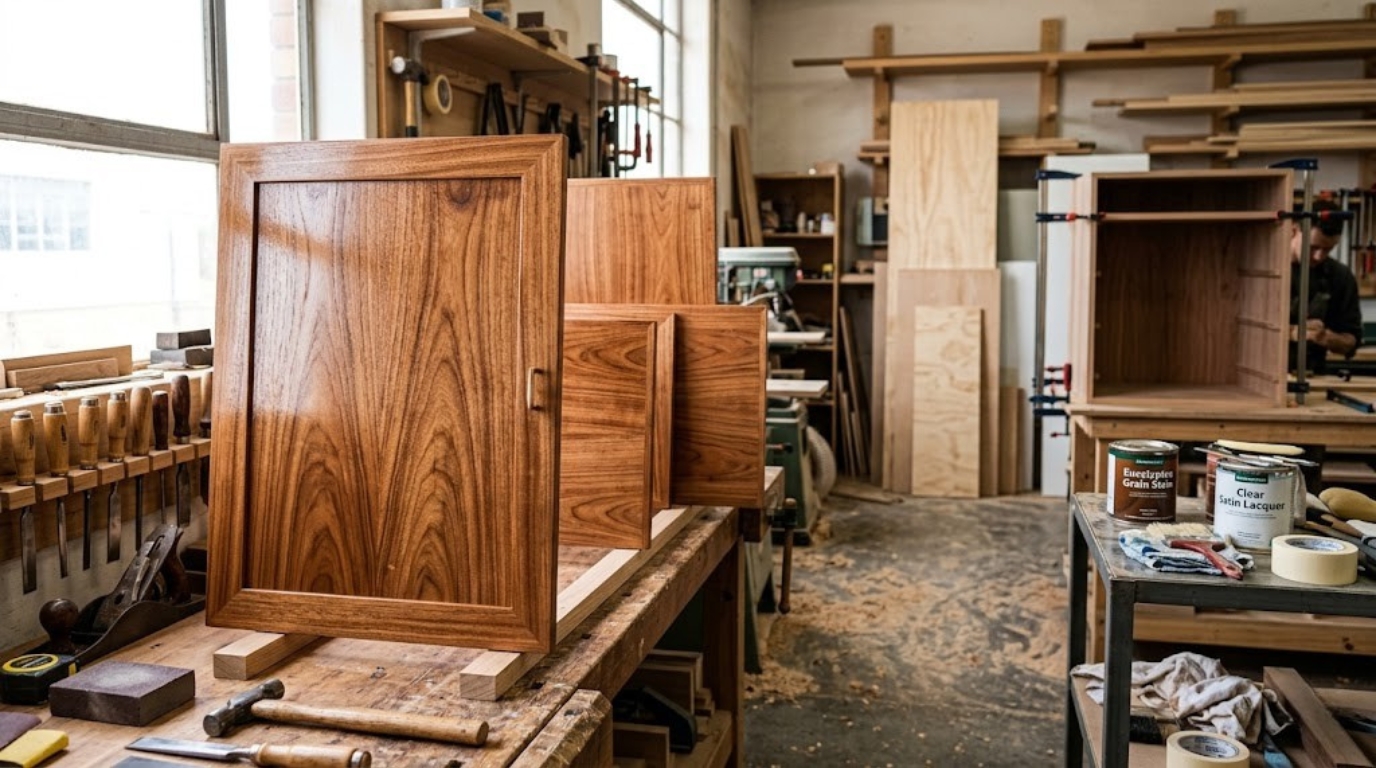
Eucalyptus veneer-faced panels are distinct from solid eucalyptus plywood in that the eucalyptus layer is purely decorative: the structural properties of the panel depend on the substrate beneath the veneer face, not the thin face layer itself. These panels are used for cabinet doors, interior wall cladding, furniture panels, and decorative surfaces where the appearance of solid eucalyptus is desired at lower material cost than a full eucalyptus panel.
- Face: thin eucalyptus veneer (0.5 to 0.6 mm)
- Core: MDF, HDF, or alternative plywood substrate
- Primary purpose: decorative appearance of eucalyptus grain
- Structural performance: determined by core substrate, not face veneer
Best for: Decorative cabinet doors, interior wall panels, furniture faces, and surfaces where the visual character of eucalyptus is the primary requirement.
7. Eucalyptus Marine Plywood
Eucalyptus marine plywood is manufactured to marine-grade specifications, using full eucalyptus veneers throughout and WBP (Water Boiled Proof) phenolic adhesive for all bond lines. Marine-grade plywood is characterized by void-free core construction, meaning there are no gaps, splits, or hollow areas within the panel that could trap moisture and cause internal rot or delamination. The most recognized standard for marine plywood is BS1088, which specifies maximum permissible defects, veneer thickness, and adhesive performance for each panel.
Eucalyptus’s natural oil content makes it a well-suited species for marine plywood applications, as the oils contribute inherent moisture resistance that complements the waterproof adhesive system. Eucalyptus marine plywood is used in boat building, dock construction, pontoon decking, and any marine or waterside application where the panel will face sustained exposure to moisture, humidity, or direct water contact.
- All plies: eucalyptus veneer, void-free
- Glue: WBP phenolic throughout (waterproof)
- Standard: BS1088 or equivalent marine-grade specification
- Key feature: no internal voids; all bond lines waterproof
- Common thickness: 6 mm to 25 mm
Best for: Boat building, dock and pontoon construction, marine structures, and any application requiring a fully waterproof, void-free plywood panel.
8. Eucalyptus CDX Plywood
Eucalyptus CDX plywood applies the CDX grading convention, commonly used in North American construction plywood, to eucalyptus-core panels. CDX grading means: C-grade face veneer, D-grade back veneer, and X (Exposure-rated) adhesive. A CDX-grade eucalyptus panel is a construction-grade structural plywood intended for applications where the panel will face short-term moisture exposure but is not required to be fully waterproof.
Eucalyptus CDX plywood combines the structural density advantage of the eucalyptus species with the standard North American construction plywood specification. It is used for roof decking, wall sheathing, subflooring, and other structural panel applications where a high-density, exposure-rated panel is required. The eucalyptus core gives CDX-grade eucalyptus panels a structural edge over equivalent-thickness softwood CDX panels. For context on CDX plywood as a category, see our CDX plywood vs OSB guide and what is CDX plywood article.
- Core: eucalyptus veneer
- Glue: exposure-rated (X) exterior adhesive
- Grade: C-face, D-back
- Common thickness: 12 mm to 19 mm
Best for: Roof decking, wall sheathing, subflooring, and structural construction applications requiring an exposure-rated panel with higher density than standard softwood CDX.
Glue Systems: WBP vs MR in Eucalyptus Plywood
The adhesive used to bond eucalyptus veneers is as important a specification as the veneer composition itself, because it determines the panel’s moisture resistance and suitability for different environments.
WBP Phenolic Glue (Exterior Grade)
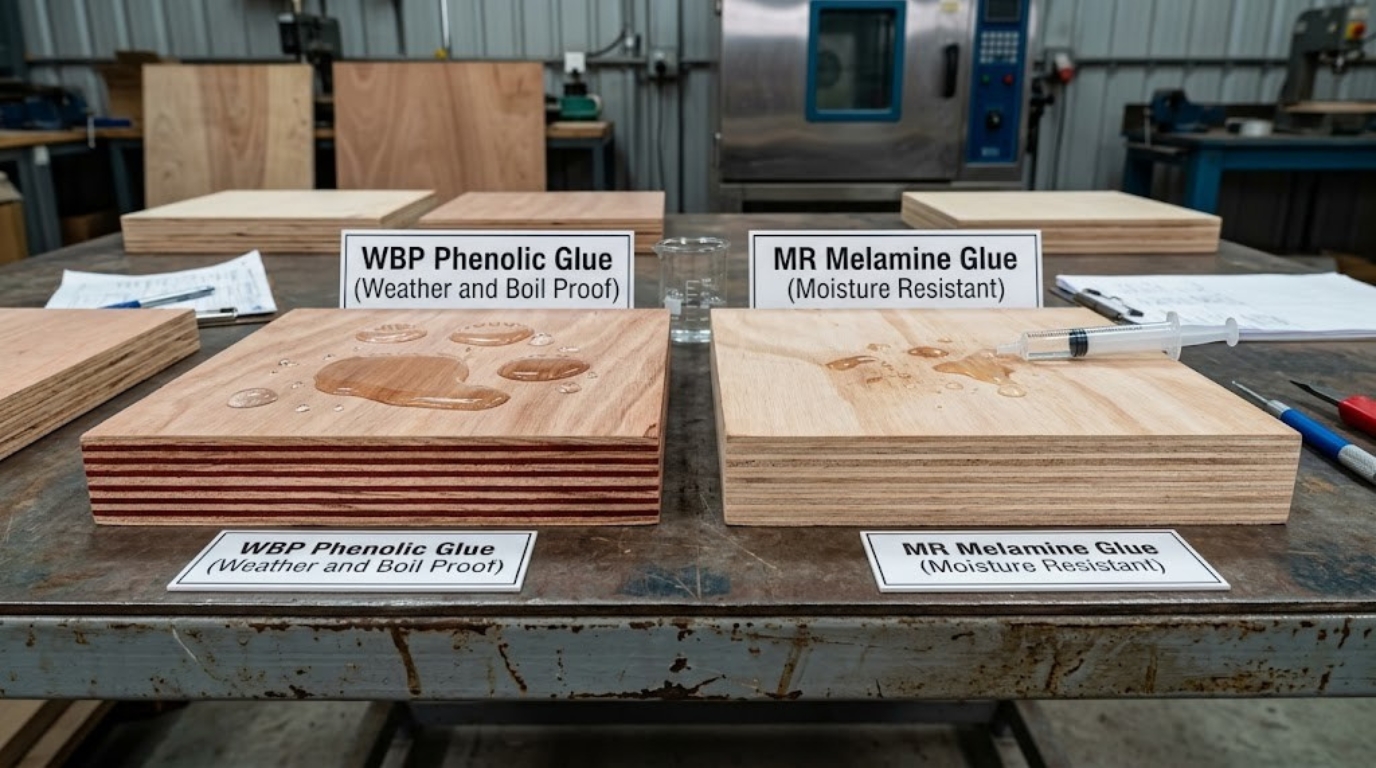
WBP stands for Water Boiled Proof, which is the test standard for exterior-grade plywood adhesives. WBP phenolic adhesive withstands prolonged exposure to moisture, boiling water testing, and wet-dry cycling without bond failure. All film faced plywood, marine plywood, and construction-grade eucalyptus panels use WBP adhesive.
WBP adhesive is the correct specification for any eucalyptus plywood application that involves outdoor exposure, moisture-prone environments, concrete formwork (where water contact is continuous), or marine use. It adds some cost over MR adhesive but is essential for panel performance and longevity in wet conditions.
MR Melamine Glue (Interior Grade)
MR stands for Moisture Resistant, which is a lower standard than WBP: MR adhesive resists occasional humidity and moisture contact but is not suitable for sustained wet environments or outdoor exposure. Interior furniture-grade eucalyptus plywood and commercial plywood for dry indoor use typically uses MR melamine adhesive, which is sufficient for the conditions these panels face and keeps panel cost lower than WBP-bonded equivalents.
For kitchen and bathroom cabinetry, MR adhesive is generally adequate given that the panels will be protected by surface finishes and will not face direct water contact. For anything exposed to the elements or to regular moisture, WBP adhesive should be specified.
Eucalyptus Plywood Types: Quick Reference
The table below summarizes the main eucalyptus plywood types alongside their key specifications and primary applications:
| Type | Core | Glue | Primary Applications |
| Full Eucalyptus | 100% Eucalyptus | WBP or MR | Structural furniture, flooring, workbenches |
| Eucalyptus Core (Birch/Bintangor face) | Eucalyptus | MR or WBP | Cabinet carcasses, furniture, joinery |
| Eucalyptus + Softwood Mix | Eucalyptus + Poplar/Pine | MR | Budget furniture, interior paneling |
| Film Faced (Brown/Black) | Eucalyptus-dominant | WBP | Concrete formwork, construction |
| Anti-Slip Film Faced | Eucalyptus-dominant | WBP | Trailer flooring, scaffolding, platforms |
| Eucalyptus Veneer Faced | MDF/HDF or plywood | MR | Decorative panels, cabinet doors |
| Marine Plywood | 100% Eucalyptus, void-free | WBP | Boat building, dock construction |
| CDX Grade | Eucalyptus | Exposure-rated X | Roof sheathing, wall sheathing, subfloor |
Common Grades for Eucalyptus Plywood
Eucalyptus plywood is sold across a range of surface grades that indicate the quality of the face and back veneer. Understanding grades is essential for specifying the right panel for a given finish requirement. Our plywood grades guide covers the grading system in full detail; the summary below focuses on grades commonly applied to eucalyptus panels.
BB/BB
Both face and back veneers are BB grade: smooth, with small, repaired defects permitted but no open holes or splits. BB/BB is the standard furniture-grade specification for eucalyptus plywood used in visible cabinetry, shelving, and interior joinery. Both faces are suitable for paint, stain, or clear finish.
BB/CC
The face is BB grade (suitable for finishing) and the back is CC grade, which allows more defects and is generally not intended for visible use. BB/CC is common for furniture panels where only one face will be visible in the finished piece, allowing cost savings on the back face specification.
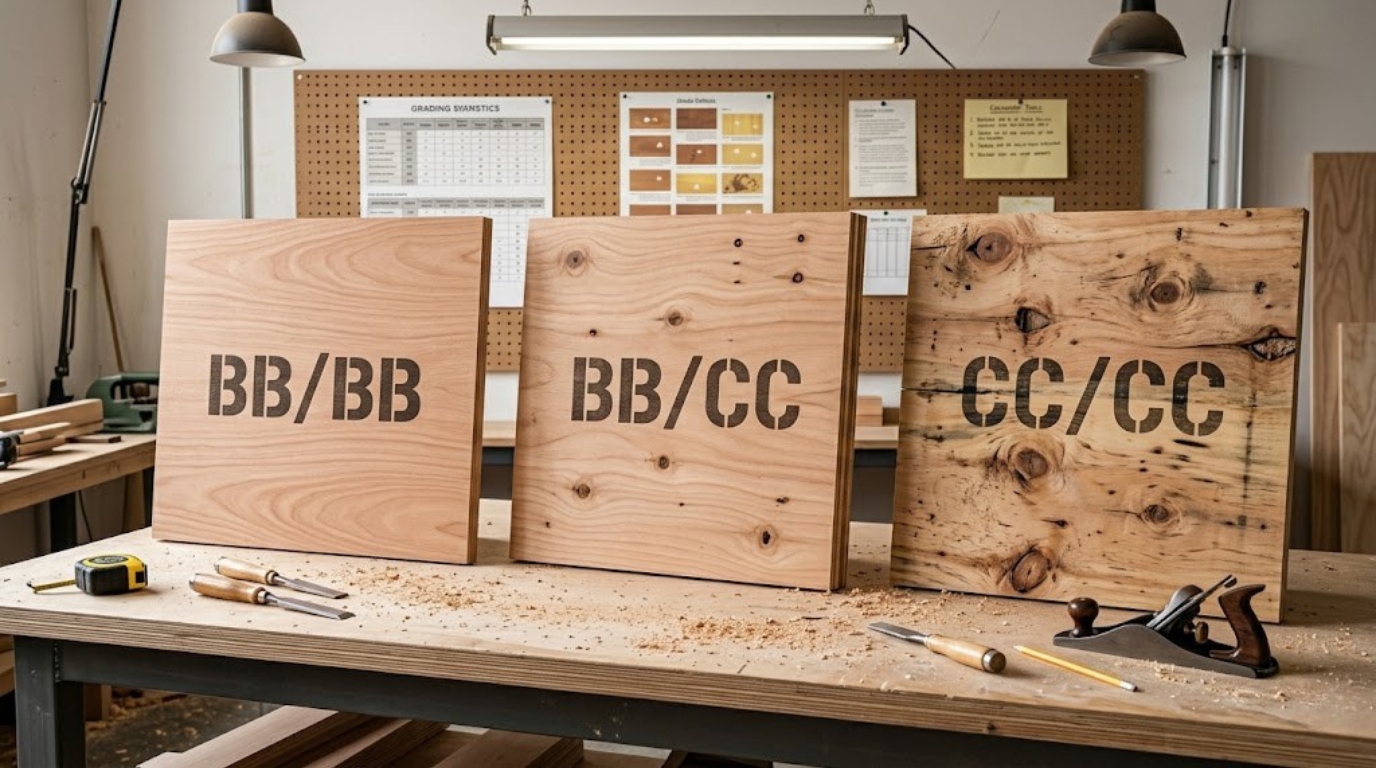
CC/CC
Both faces are CC grade, allowing more visible defects and a rougher surface. CC/CC eucalyptus plywood is typically used for structural applications, packaging, and construction components where surface appearance is not a priority and structural performance is the key requirement.
Film Faced Grades
Film faced eucalyptus panels are not graded by veneer quality in the same way as uncoated panels, since the film covers the face and back. Instead, they are specified by film weight (grams per square meter), number of permitted reuse cycles, and film color (brown or black). Higher film weight and black phenolic film generally indicate higher durability and longer service life.
Standard Thicknesses for Eucalyptus Plywood
Eucalyptus plywood is manufactured in thicknesses from 4 mm to 25 mm across the full product range, with specific thickness preferences varying by panel type. For a detailed breakdown of how thickness maps to applications, see our eucalyptus plywood thickness guide.
- Thin decorative and backing panels: 4 mm to 6 mm
- Light furniture and cabinetry components: 9 mm to 12 mm
- Standard furniture and cabinet carcasses: 15 mm and 18 mm (most widely specified)
- Heavy structural, formwork, and flooring: 18 mm to 25 mm
For film faced formwork panels, 15 mm and 18 mm are the most common specifications in standard construction applications, with 12 mm used for lighter shuttering work and 21 mm for heavy-duty pours.
How to Choose the Right Type of Eucalyptus Plywood
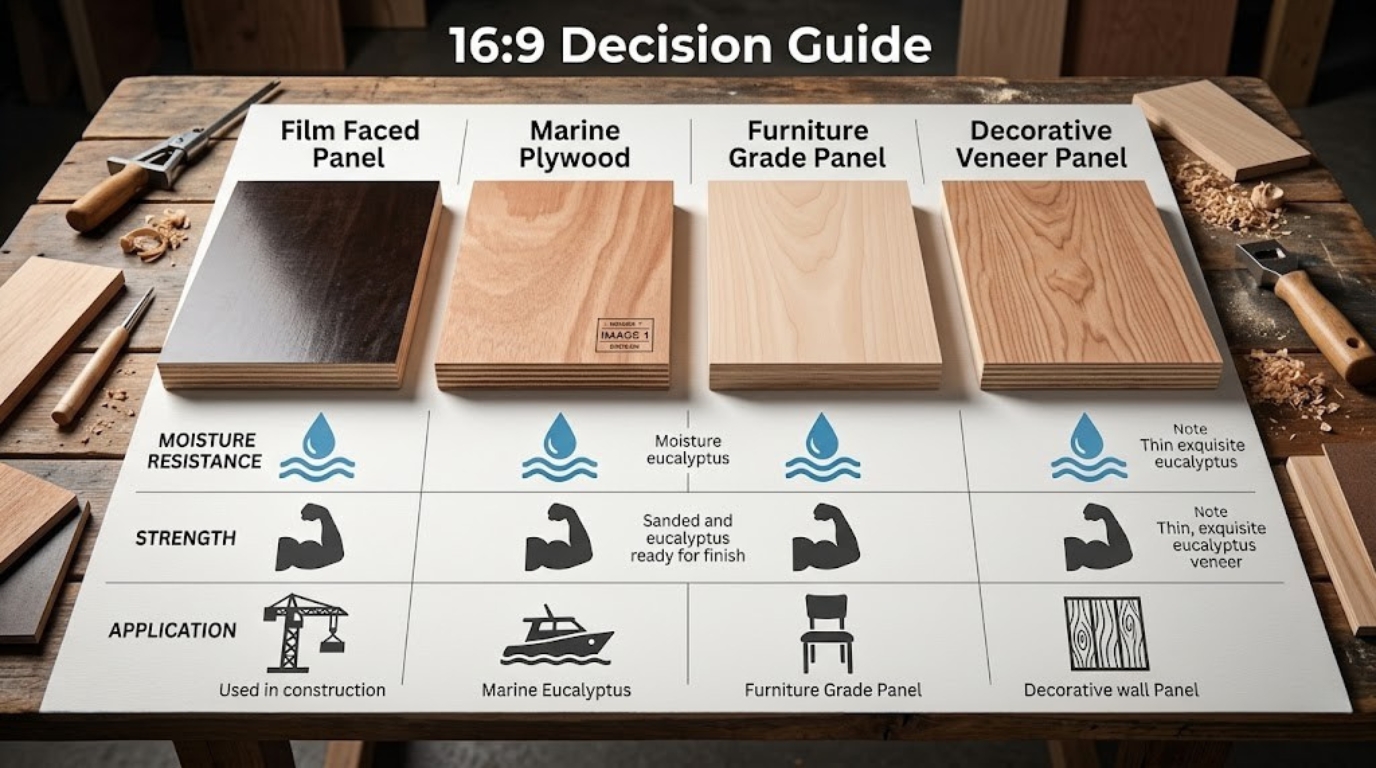
Selecting the correct type of eucalyptus plywood requires answering four questions: What is the application? What are the moisture conditions? What surface quality is required? What is the budget constraint?
Step 1: Define the Application
Construction formwork and site use points to film faced or anti-slip film faced eucalyptus plywood with WBP adhesive. Furniture and cabinetry points to full eucalyptus or eucalyptus core panels with a premium face veneer and MR or WBP adhesive depending on the installation environment. Marine and waterside applications require marine-grade, void-free, WBP-bonded panels. Decorative surfaces where appearance is the primary need point to eucalyptus veneer-faced panels over a stable substrate.
Step 2: Assess Moisture Exposure
Indoor furniture in a dry, climate-controlled environment: MR melamine adhesive is adequate. Kitchen or bathroom cabinetry with incidental moisture: MR adhesive with a sealed surface finish is typically sufficient. Outdoor, marine, or formwork use with direct water contact: WBP phenolic adhesive is essential.
Step 3: Specify Surface Grade
For visible finished surfaces in furniture or cabinetry: BB/BB grade minimum. For surfaces that will be painted or laminated: BB/CC is adequate and reduces cost on the non-visible face. For structural or construction applications: CC/CC or film-faced grade.
Step 4: Match to Budget
Full eucalyptus panels with BB/BB grade and WBP adhesive represent the premium specification. Eucalyptus-softwood combination panels with MR adhesive represent the budget option within the eucalyptus category. For applications where the cost of eucalyptus plywood exceeds the budget, commercial plywood provides a practical alternative for interior non-structural applications.
Frequently Asked Questions
What are the different types of eucalyptus plywood?
The main types are: full eucalyptus structural plywood (100% eucalyptus veneers throughout), eucalyptus core plywood with premium face species (birch, bintangor, okoume), eucalyptus-softwood combination plywood, film faced eucalyptus plywood (brown and black phenolic), anti-slip film faced plywood (hexagon and wire mesh patterns), eucalyptus veneer faced decorative panels, eucalyptus marine plywood (void-free, WBP), and eucalyptus CDX construction plywood.
Is eucalyptus wood good for plywood?
Yes. Eucalyptus is an excellent plywood species. Its high density (550 to 620 kg/m3), natural oil content, and fast plantation growth make it a strong, moisture-resistant, and sustainably sourced panel material. It performs well across furniture, construction, and marine applications. See our eucalyptus plywood properties guide for a full breakdown.
What is the difference between full eucalyptus and eucalyptus core plywood?
Full eucalyptus plywood uses eucalyptus veneer in every ply, including all core layers, producing the highest-density and most structurally consistent panel. Eucalyptus core plywood uses eucalyptus for the core plies but pairs it with a different species on the face and back, typically a premium species like birch or bintangor chosen for better surface quality or appearance for the finished application.
What are the disadvantages of eucalyptus wood?
The main disadvantages of eucalyptus as a plywood species are: higher cost and lower availability than standard softwood panels in some markets; heavier weight due to high density, which increases handling effort and shipping cost; and the natural oils that provide moisture resistance can interfere with some adhesives and finishes if the surface is not properly prepared before bonding or coating.
What glue is used in eucalyptus plywood?
Eucalyptus plywood uses either WBP (Water Boiled Proof) phenolic adhesive for exterior, marine, and formwork applications, or MR (Moisture Resistant) melamine adhesive for interior furniture and cabinetry applications. WBP is the correct specification wherever the panel will face moisture, humidity, or water contact. MR is adequate for dry interior use.
What are the four types of plywood generally?
Plywood is generally categorized into: structural plywood (for construction and load-bearing applications), furniture-grade plywood (for cabinetry and interior joinery), marine plywood (void-free, waterproof for wet applications), and decorative plywood (with premium face veneers for visible surfaces). Eucalyptus plywood has variants across all four categories. Our complete types of plywood guide covers each category in detail.
Conclusion
Eucalyptus plywood is a genuinely versatile panel material precisely because it comes in so many distinct types. The same species that delivers density and natural moisture resistance in a furniture-grade carcass panel also underpins some of the most durable construction formwork available, and can be finished with phenolic films, anti-slip surfaces, or premium face veneers to meet very different end-use requirements.
The key to specifying eucalyptus plywood correctly is understanding which type matches the combination of application, moisture conditions, surface quality, and budget of the project. Full eucalyptus for maximum structural performance, eucalyptus core with premium face for furniture and cabinetry, film faced or anti-slip for construction and site use, and marine-grade for wet environments: each type has a clear purpose.
Kosmex Group supplies film faced plywood, anti-slip film faced plywood, and commercial plywood across a range of specifications. For sourcing guidance or to discuss a specific panel requirement, explore our product range or review our plywood grades guide and standard plywood sizes reference to complete your specification.
Bình luận