


Density of Birch Plywood: Weight, Strength & Thickness Explained
When specifying birch plywood for furniture, cabinetry, or CNC work, density is one of the most important material properties to understand. It determines how much the panel weighs, how well it holds screws and fasteners, how stiff it is under load, and ultimately whether it is the right material for the job.
Birch plywood, and Baltic birch plywood in particular, sits at the high-density end of the hardwood plywood spectrum. Its density is not accidental: it is a direct result of the slow growth of birch trees in cold northern climates, which produces tight, dense grain that translates into a heavy, hard, structurally capable panel.
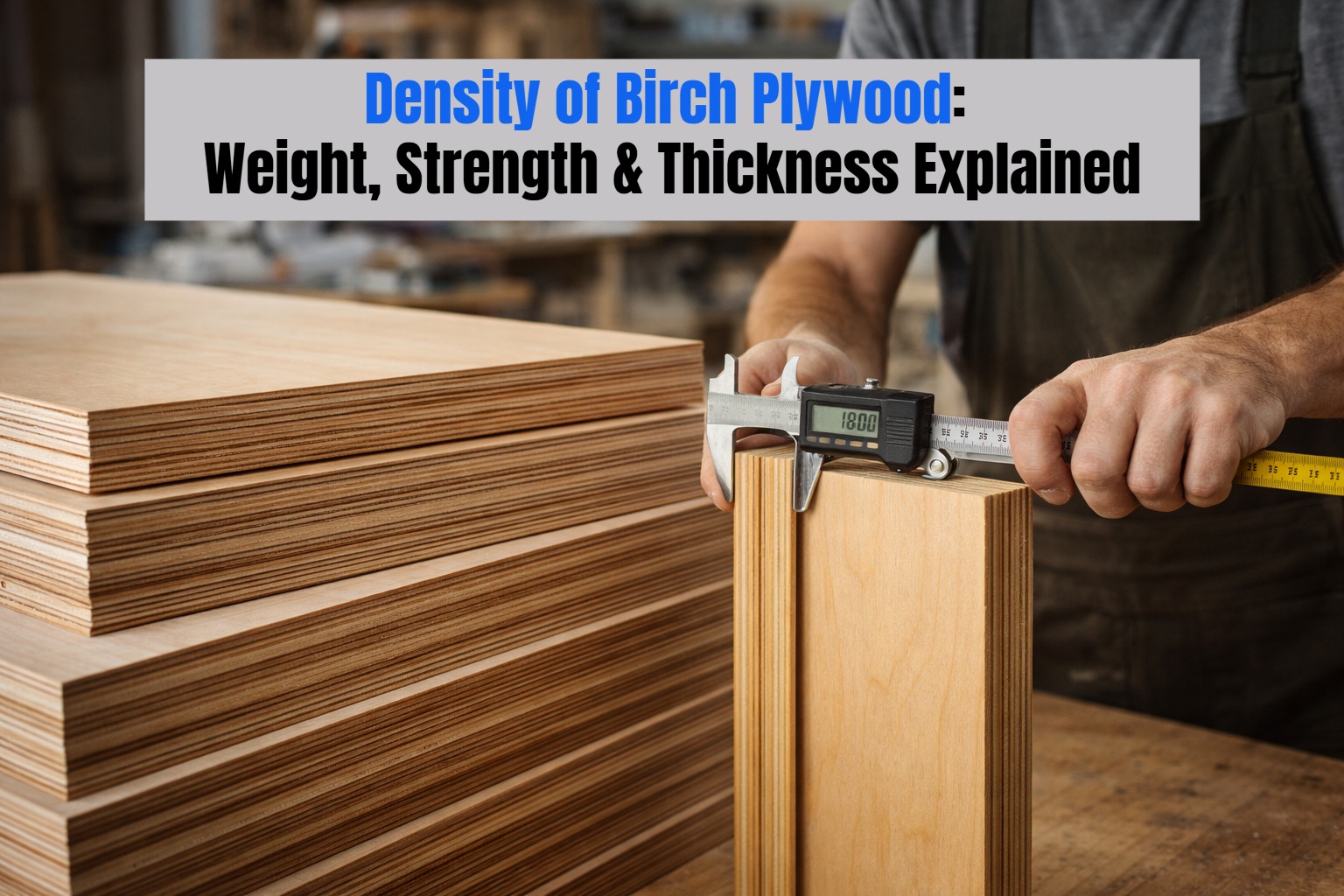
This guide covers the density range of birch plywood, how that density translates into real-world weight by sheet size and thickness, what it means for strength and structural performance, and how birch compares to other common panel materials. For a broader introduction to the material, see our complete birch plywood guide.

What Is the Density of Birch Plywood?
Birch plywood’s density typically falls in the range of 650 to 700 kg/m3, with some high-quality Baltic birch panels reaching up to 760 kg/m3 depending on the veneer species, moisture content at manufacture, and the specific core composition of the panel.
To put that in perspective: standard softwood construction plywood typically has a density around 450 to 550 kg/m3, while MDF sits at roughly 700 to 800 kg/m3. Birch plywood at 650 to 700 kg/m3 is denser than softwood plywood and comparable to MDF in weight, but with the structural advantages of a cross-laminated wood veneer panel rather than a compressed fiber product.
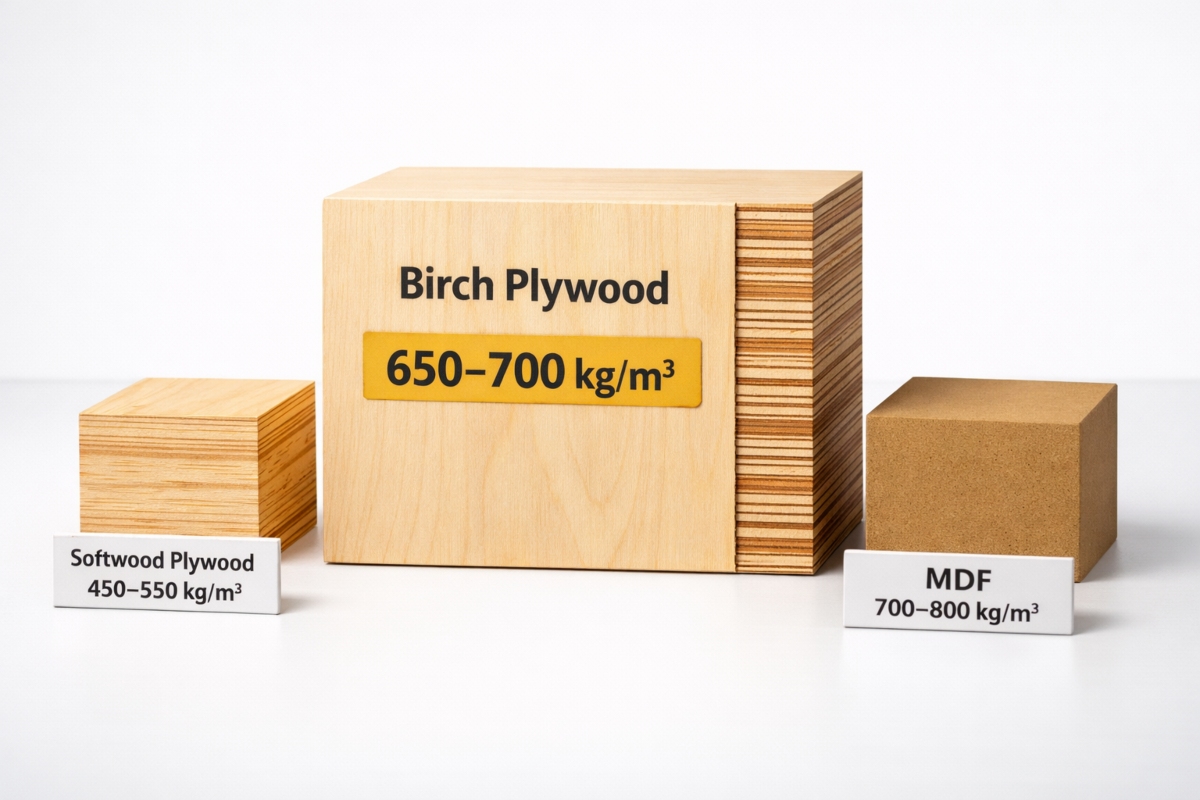
In imperial units, birch plywood density is approximately 40 to 44 lb/ft3. This figure is useful for calculating sheet weights when working in imperial measurements, which is covered in the section below.
Key figure: Birch plywood density range: 650 to 700 kg/m3 (standard). Baltic birch and film-faced variants may reach 680 to 760 kg/m3.
Why Is Birch Plywood So Dense?
The density of birch plywood traces directly back to the biology of birch trees and the conditions in which they grow. Birch is a species native to northern temperate regions, particularly Scandinavia, Russia, and the Baltic states. In these cold climates, trees grow slowly during short growing seasons, producing wood with tightly packed growth rings and dense cell structure.
This slow, cold-climate growth results in a hardwood with naturally high density and a fine, consistent grain. When that timber is processed into veneers and laminated into plywood, those density characteristics carry through into the finished panel. Each veneer layer in Baltic birch plywood is typically around 1.5 mm thick, and the plies are stacked without gaps or softwood filler layers, producing a panel that is dense and consistent from face to core.
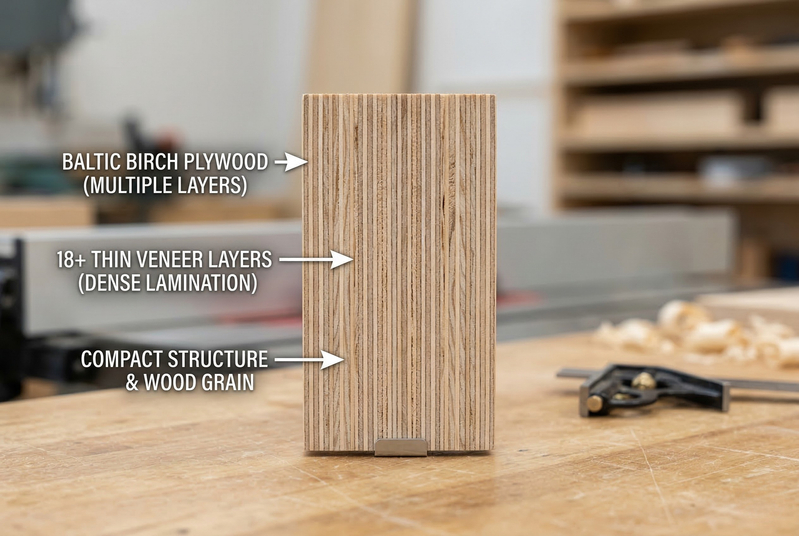
This is what distinguishes Baltic birch plywood from lower-grade hardwood panels that use softwood core plies to reduce weight and cost. In Baltic birch, every ply is birch veneer, which is why its density is consistent through the full panel thickness rather than varying between a dense face and a lighter core. Our birch plywood grades guide covers how ply construction and grading relate to each other in detail.
Birch Plywood Weight by Thickness
Understanding how density translates into real panel weight is essential for planning material handling, structural load calculations, and shipping costs. The weight of a birch plywood sheet depends on three variables: its density, its area (length x width), and its thickness.
For a standard 4 x 8 foot (approximately 1220 x 2440 mm) sheet at a density of 680 kg/m3, the approximate weights by thickness are:
| Thickness (mm) | Imperial | Weight per sheet (kg) | Weight per sheet (lbs) | Approx. plies |
| 6 mm | 1/4″ | ~12 kg | ~26 lbs | 5 plies |
| 9 mm | 3/8″ | ~18 kg | ~40 lbs | 7 plies |
| 12 mm | 1/2″ | ~24 kg | ~53 lbs | 9 plies |
| 15 mm | ~5/8″ | ~30 kg | ~66 lbs | 11 plies |
| 18 mm | 3/4″ | ~37 kg | ~81 lbs | 13 plies |
| 21 mm | ~13/16″ | ~43 kg | ~95 lbs | 15 plies |
| 25 mm | 1″ | ~51 kg | ~112 lbs | 17 plies |
Note: These figures are calculated estimates based on a density of 680 kg/m3 and a sheet size of 1220 x 2440 mm. Actual panel weight will vary depending on the specific manufacturer’s density, moisture content at time of delivery, and sheet dimensions. Always request weight certificates from your supplier for precise logistics planning.
For reference on standard sheet dimensions used for these calculations, see our standard plywood sizes guide.
How Heavy Is a 4×8 Birch Plywood Sheet?
The 4 x 8 foot sheet is the standard format for North American plywood supply, and the question of how much a full sheet weighs is one of the most practical questions a buyer or contractor needs to answer before a job. Based on birch plywood’s typical density range, here is how to think about the weight:
- A 1/4 inch (6 mm) 4×8 birch plywood sheet weighs approximately 22 to 26 kg (48 to 57 lbs)
- A 1/2 inch (12 mm) 4×8 birch plywood sheet weighs approximately 22 to 27 kg (48 to 60 lbs) — note that this aligns with the commonly cited reference of 22 to 27 kg for standard half-inch birch
- A 3/4 inch (18 mm) 4×8 birch plywood sheet weighs approximately 34 to 40 kg (75 to 88 lbs)
- A 1 inch (25 mm) 4×8 birch plywood sheet weighs approximately 48 to 55 kg (106 to 121 lbs)
These weights have real practical implications for job-site handling. A single 18 mm birch plywood sheet at the upper end of the weight range is at or near the recommended single-person lift limit, making two-person handling standard practice on professional installations. For high-volume projects, mechanical handling or delivery direct to the work area significantly reduces labor costs and the risk of panel damage during handling.
Practical note: When ordering large quantities of birch plywood, always factor sheet weight into your logistics plan. An 18 mm sheet at 37 to 40 kg is a two-person lift. A pallet of 50 sheets represents 1,850 to 2,000 kg of panel weight alone.
How Strong Is Birch Plywood?
Birch plywood’s strength is directly linked to its density and its all-birch-veneer ply construction. It is one of the stronger hardwood plywood options commercially available, which is why it is the default specification for quality furniture, cabinetry, and precision CNC applications. For context on how these strength properties apply in practice, see our birch plywood complete guide.
Bending Strength and Stiffness
Birch plywood’s high density gives it excellent bending stiffness, meaning it resists deflection under load across unsupported spans. A 18 mm birch plywood shelf, for example, will deflect measurably less under the same load than an 18 mm shelf made from lower-density softwood plywood of equivalent thickness. This matters in practice for bookshelves, kitchen cabinet shelves, and any horizontal surface carrying sustained weight.
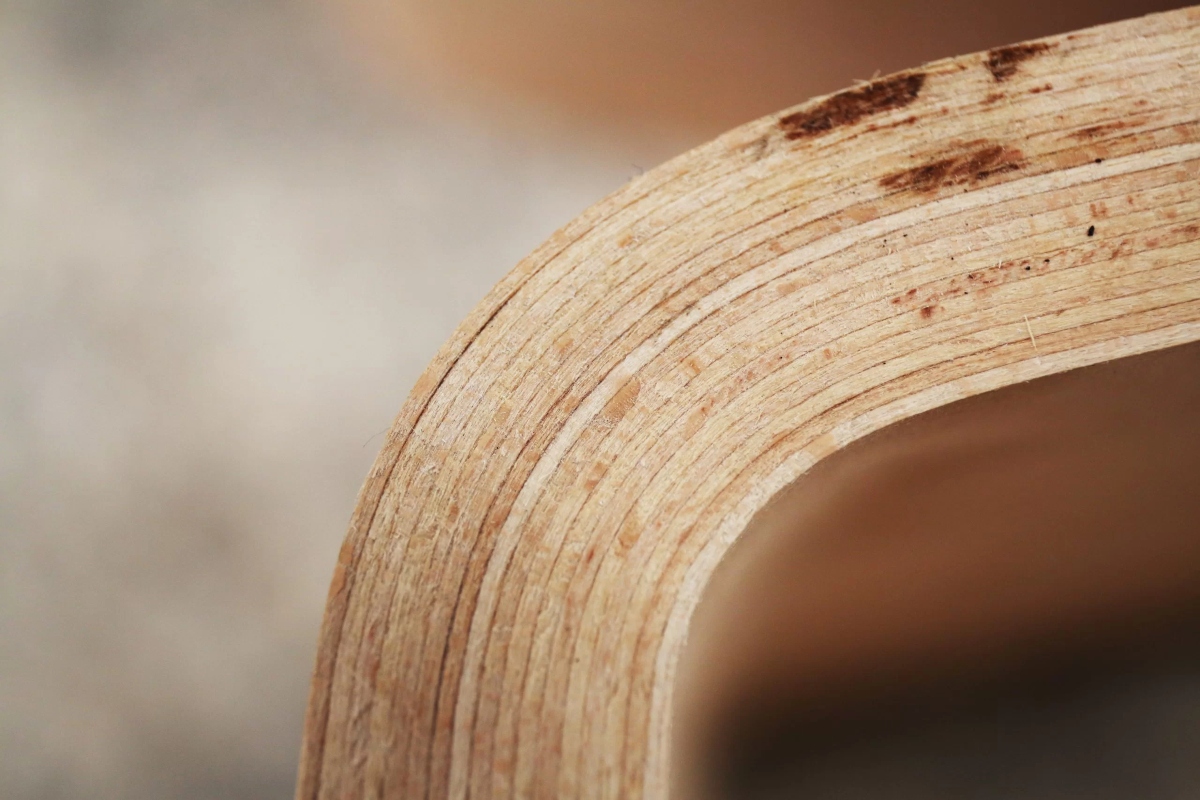
The cross-laminated veneer structure distributes bending stress across multiple plies, with the outer plies carrying most of the tension and compression. Because all plies in Baltic birch are birch veneer, there are no weak softwood core layers that create a density and stiffness discontinuity through the panel.
Screw and Fastener Holding
One of the most practically significant strength properties of birch plywood is its screw-holding performance. The dense grain of birch veneer resists thread stripping and pull-out more effectively than lower-density panels. This is particularly important for furniture joints, hinge mounting, drawer slides, and hardware attachment points that carry repeated loads over time.
In Baltic birch plywood, screw-holding is consistent across the full panel thickness because every ply is the same species and density. In mixed-core panels where inner plies are softwood, screws driven near the edge or into the core layers encounter the lower-density softwood, reducing holding strength. This is a relevant consideration when specifying panels for furniture assembly methods that rely on screw joints.
Impact Resistance and Surface Hardness
Birch plywood’s density translates into good surface hardness and impact resistance. The face plies resist denting and surface damage better than softwood panels, and the panel is less likely to sustain damage from the ordinary bumps and knocks of workshop or installation use. This is one reason birch plywood is favored for CNC router tables and workbench tops where repeated tool contact is expected. For furniture applications specifically, our birch plywood furniture ideas guide illustrates how these strength properties are used in practice.
Structural Load Capacity
For structural applications, birch plywood’s load capacity at a given thickness exceeds that of lower-density species plywood by a meaningful margin. This means that in some applications, a thinner birch plywood panel can replace a thicker softwood panel while maintaining equivalent or better structural performance, potentially reducing overall material weight and cost in a well-optimized design.
Is Birch Plywood Lightweight?
No. Birch plywood is not a lightweight panel material. At 650 to 700 kg/m3, it is among the heavier commercially available hardwood plywoods, and significantly heavier than softwood plywood at the same thickness. For projects where weight is the primary concern, birch plywood is not the right specification.
That said, the density that makes birch plywood heavy is the same property that makes it strong, stable, and effective as a structural and furniture material. The weight is a direct expression of quality: denser grain, tighter veneer, more material per unit volume. For applications where the structural benefits justify the weight, birch plywood is an excellent choice. For applications where weight reduction is critical without sacrificing surface quality, alternative panels should be considered.
Specialty lightweight birch plywood variants do exist, using either thinner veneers, mixed cores with lighter species, or honeycomb cores that reduce panel weight while retaining a birch face. These are niche products available from specialist suppliers and are outside the scope of standard commercial birch plywood. For a comparison of birch plywood against a lighter alternative, see our birch plywood vs MDF comparison, which covers the weight-versus-strength trade-off in detail.
Weight comparison: 18 mm birch plywood: approximately 37 to 40 kg per 4×8 sheet. 18 mm softwood construction plywood: approximately 28 to 32 kg per 4×8 sheet. 18 mm MDF: approximately 40 to 45 kg per 4×8 sheet.
How Thick Is Birch Plywood?
Birch plywood is available in a full standard thickness range from 3 mm to 30 mm, covering decorative, furniture-grade, and structural applications. The most commonly specified thicknesses for furniture and cabinetry work are 12 mm, 15 mm, and 18 mm, with 18 mm being the dominant standard for cabinet carcasses and structural furniture.
A distinctive feature of Baltic birch plywood’s thickness composition is that each ply is typically 1.5 mm thick, which means the ply count scales predictably with thickness:
| Thickness | Ply count | Ply thickness each |
| 6 mm | 5 plies | ~1.2 mm |
| 9 mm | 7 plies | ~1.3 mm |
| 12 mm | 9 plies | ~1.3 mm |
| 15 mm | 11 plies | ~1.4 mm |
| 18 mm | 13 plies | ~1.4 mm |
| 21 mm | 15 plies | ~1.4 mm |
| 25 mm | 17 plies | ~1.5 mm |
The high ply count relative to panel thickness is one of the structural advantages of Baltic birch plywood. More, thinner plies means more glue lines per panel, which distributes stress more evenly and reduces the risk of delamination or cracking along any single ply boundary. It also means more consistent screw-holding performance across the full thickness of the panel.
For a full breakdown of how thickness choices map to applications across eucalyptus and other hardwood plywood, see our plywood grades guide for grade and specification guidance.
Birch Plywood Density vs Other Panel Materials
Understanding how birch plywood’s density compares to other materials helps clarify when it is the right choice and when alternatives might be better suited to the application.
| Material | Density (kg/m3) | Relative Weight | Key Trade-off vs Birch |
| Baltic birch plywood | 650 to 760 | Heavy | Reference point |
| Standard softwood plywood | 450 to 550 | Lighter (~25% less) | Less strong, cheaper |
| Eucalyptus plywood | 550 to 620 | Lighter (~10% less) | Better moisture resistance |
| MDF | 700 to 800 | Heavier | Smoother surface, no structural strength |
| Poplar plywood | 450 to 500 | Lighter (~30% less) | Significantly less strong |
| Basswood plywood | 400 to 450 | Lighter (~35% less) | Very light, much weaker |
| OSB | 550 to 650 | Similar | Weaker, no face quality |
Birch plywood is approximately 30% denser than poplar plywood and significantly denser than softwood structural panels. This density advantage directly translates into superior strength and screw-holding per millimeter of thickness, which is why it commands a price premium over standard construction plywood. For a direct comparison with a frequently discussed alternative, our sande plywood vs birch plywood guide walks through the density and performance differences between these two widely used hardwood panels.
For buyers considering birch plywood alongside particle board, our particle board vs plywood comparison covers how the structural properties of solid-veneer panels compare to compressed fiber boards across key application criteria.
How Density Affects Birch Plywood Applications
Birch plywood’s density is not just a specification number. It has direct, practical consequences for how the material performs across different applications.
Furniture and Cabinetry
In furniture and cabinetry, birch plywood’s density provides the screw-holding strength that keeps assembled joints tight over time, the rigidity that prevents shelves from sagging under load, and the surface hardness that resists scratching and denting in daily use. These are the properties that make it the preferred hardwood panel for quality furniture manufacturing and fitted cabinetry. See our birch plywood furniture ideas for practical applications.
CNC Routing and Precision Work
Dense, consistent panels machine more predictably than variable-density materials. Birch plywood’s uniform density across the full panel means CNC router bits and saw blades encounter consistent resistance throughout a cut, producing cleaner edges, less tearout, and more predictable tolerances. This is why Baltic birch is a preferred panel material for CNC-cut furniture components, speaker boxes, and precision joinery applications.
Finishing: How to Finish Birch Plywood
Density affects finishing behavior as well. Birch plywood’s dense grain absorbs stain and finish more evenly than lower-density panels, but it can be prone to blotchy absorption if applied without preparation. A pre-conditioner or wash coat applied before staining helps achieve even color across the panel. For detailed guidance on achieving a quality surface finish, see our how to finish birch plywood guide.
Structural and Load-Bearing Use
For structural applications such as subfloors, wall sheathing, and load-bearing platforms, birch plywood’s density and all-veneer construction give it strong structural credentials. Our subfloor plywood guide covers how plywood density and grade specifications map to subflooring requirements in residential and commercial construction.
Film Faced Birch Plywood: Density and Weight
Film faced birch plywood, which uses birch veneer panels with a phenolic resin film bonded to the face and back, is slightly denser than standard birch plywood due to the added weight of the film layer. Density for film faced birch typically ranges from 680 to 760 kg/m3, which adds a small but measurable amount of weight to each sheet compared to uncoated birch panels of the same thickness.
The film facing is added primarily to improve surface durability and water resistance for construction and concrete formwork applications, not to alter the structural properties of the birch core. The base panel’s strength, screw-holding, and rigidity characteristics remain those of birch plywood. For construction-grade film faced plywood specifications, see our film faced plywood product page.
Frequently Asked Questions
What is the density of birch plywood in kg/m3?
Birch plywood typically has a density of 650 to 700 kg/m3 for standard commercial grades. Baltic birch plywood and film-faced birch variants may reach 680 to 760 kg/m3. This places birch plywood in the high-density range for hardwood plywood, denser than softwood construction panels and comparable to MDF in weight per unit volume.
How heavy is a 4×8 sheet of birch plywood?
The weight of a 4×8 foot birch plywood sheet depends primarily on thickness. As general estimates at a density of approximately 680 kg/m3: a 6 mm sheet weighs around 12 kg (26 lbs), a 12 mm sheet around 24 kg (53 lbs), an 18 mm sheet around 37 kg (81 lbs), and a 25 mm sheet around 51 kg (112 lbs). Actual weights vary with manufacturer density and moisture content.
How strong is birch plywood?
Birch plywood is among the strongest commercially available hardwood plywood panels. Its high density gives it excellent bending stiffness, screw-holding power, and surface hardness. Baltic birch in particular, with its all-birch-veneer construction and high ply count, delivers consistent strength across the full panel thickness. For detailed structural applications, see our complete birch plywood guide.
Is birch plywood lightweight?
No. Birch plywood is a heavy panel material due to its high density. An 18 mm sheet weighs approximately 37 to 40 kg for a standard 4×8 format, which is significantly heavier than equivalent-thickness softwood plywood. The weight is a direct expression of the material’s density and strength. Specialty lightweight birch variants exist but are niche products outside the standard commercial range.
What is the density of plywood in kg/m3 generally?
Plywood density varies considerably by species. Softwood construction plywood typically ranges from 450 to 550 kg/m3. Hardwood plywoods such as birch range from 650 to 700 kg/m3. MDF, for comparison, is 700 to 800 kg/m3. Eucalyptus plywood sits between softwood and birch at 550 to 620 kg/m3. The species, core construction, and moisture content all influence the final panel density.
What is the weight of plywood in kg/m2?
Plywood weight in kg per square meter depends on both the species density and the panel thickness. For birch plywood at approximately 680 kg/m3, the weight per square meter at common thicknesses is approximately: 6 mm = 4.1 kg/m2; 12 mm = 8.2 kg/m2; 18 mm = 12.2 kg/m2; 25 mm = 17.0 kg/m2. These figures are calculated estimates and should be confirmed with supplier data sheets for precise specification work.
Conclusion
Birch plywood’s density of 650 to 700 kg/m3 is not a peripheral specification detail. It is the foundational property from which its strength, screw-holding performance, surface hardness, and predictable machining behavior all derive. Understanding density helps explain why birch plywood costs more than softwood panels, why it performs better in demanding furniture and cabinetry applications, and why it is heavier to handle.
For buyers specifying birch plywood, the practical takeaways are straightforward: account for panel weight in logistics planning, particularly for 18 mm and thicker sheets; expect better structural performance per millimeter of thickness than lower-density alternatives; and confirm density specifications with your supplier when precise structural calculations are required.
Kosmex Group supplies high-quality birch plywood across a full range of grades and thicknesses. For full specification guidance before ordering, our birch plywood grades guide, standard plywood sizes reference, and plywood grades overview provide the reference information needed to specify the right panel for your application.
Bình luận