Best Plywood for Kitchen Cabinets: Which Grade, Core & Thickness to Specify When Ordering
Henry Le18 June, 2026346 lượt xem
Kitchen cabinets take more abuse than almost any other furniture in your home — daily impacts, steam, humidity, heavy loads. The plywood you specify at the ordering stage determines whether those cabinets last 5 years or 25.
This guide cuts through the noise. Whether you’re a cabinet maker ordering panels from a factory, an importer specifying materials for a batch run, or a homeowner planning a kitchen renovation, here is exactly what to ask for and why.
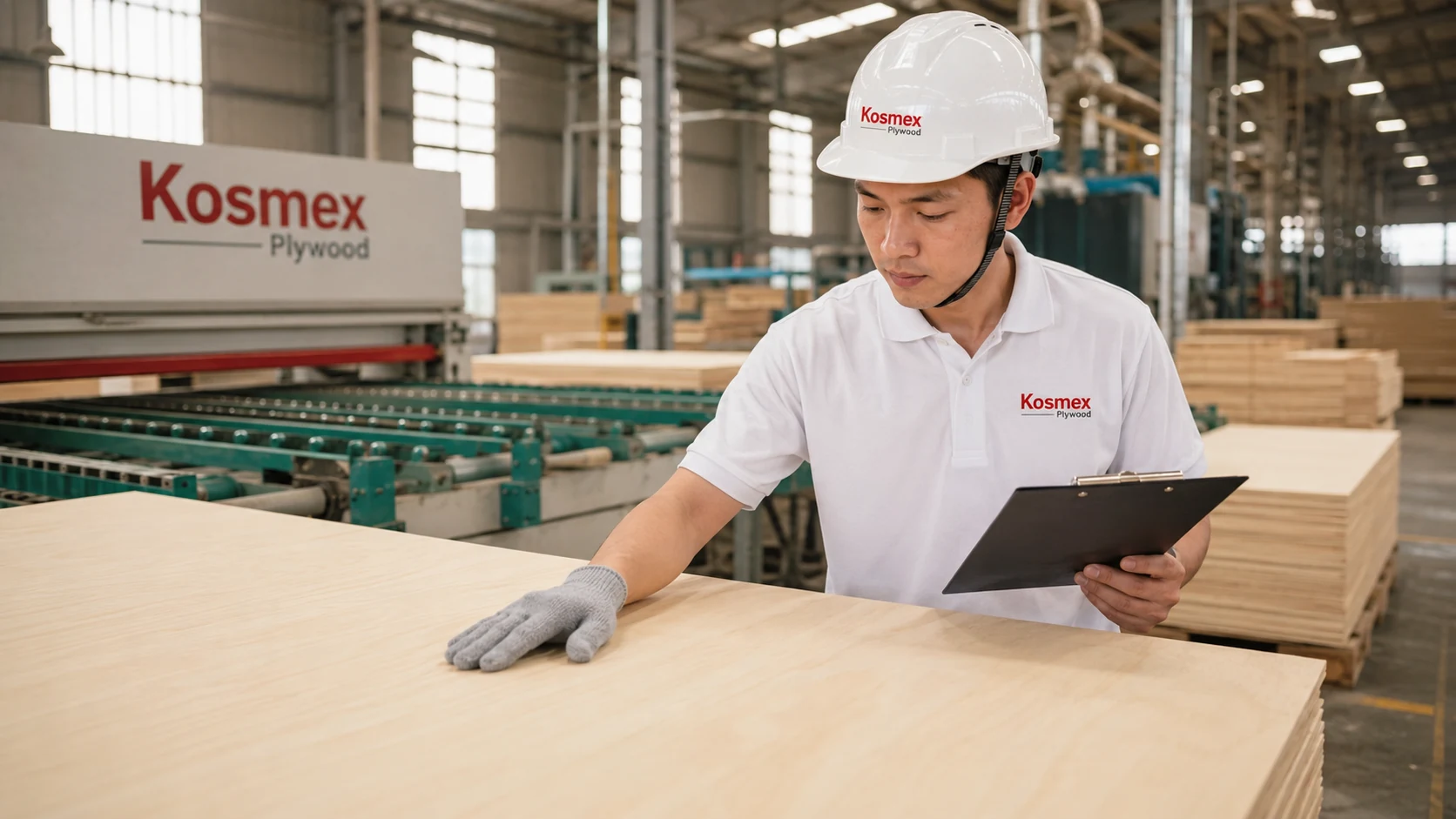
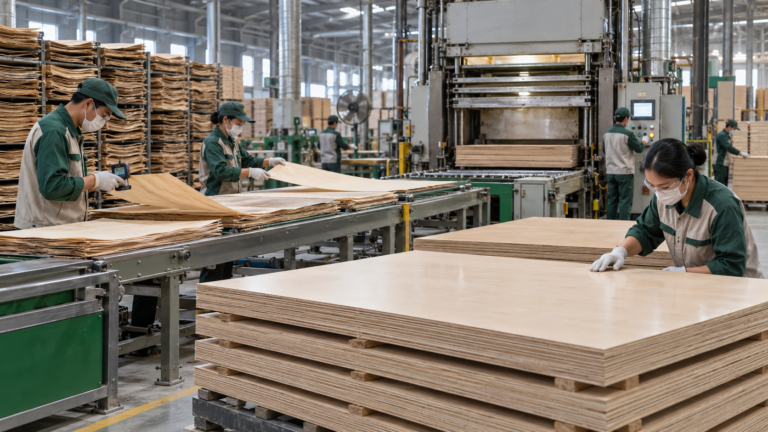
Kosmex’s production line — every birch plywood panel is inspected before export.
Why Plywood Is the Default Choice for Kitchen Cabinets
Most professional cabinet shops and importers default to plywood over MDF or particle board for one simple reason: it holds screws and keeps holding them after years of door slams and hinge wear.
Plywood’s cross-layered veneer construction distributes load across the grain in multiple directions. This matters for kitchen cabinets because:
Hinge points carry repeated stress every time a door opens — plywood handles this far better than particle board
Base cabinet shelves hold heavy items (stand mixers, cast iron pans) — 3/4″ plywood resists sag where MDF deflects
Moisture cycling from cooking steam causes MDF to swell at edges and joints over time; plywood with WBP (waterproof boil-proof) glue is significantly more stable
That said, plywood is not all equal. The grade, core, and thickness you specify have a greater impact on cabinet performance than the species printed on the order sheet.
Plywood Grade for Kitchen Cabinets: What to Specify
Cabinet-grade plywood uses a two-letter grade system describing the face veneer (visible side) and back veneer (hidden side).
Grade Combination
Face Quality
Best Use in Cabinets
Typical Price Index
A/A
Both sides smooth, no defects
Visible doors, open shelving
Highest
B/BB
Clean face, minor patches on back
Cabinet box sides, visible interior
High
BB/BB
Small patches both sides
Box construction, standard kitchen carcasses
Mid
BB/CP
Patches + some knots on back
Hidden panels, back walls
Low-mid
B/WG
Clean face, rough back
Where only one side shows
Low
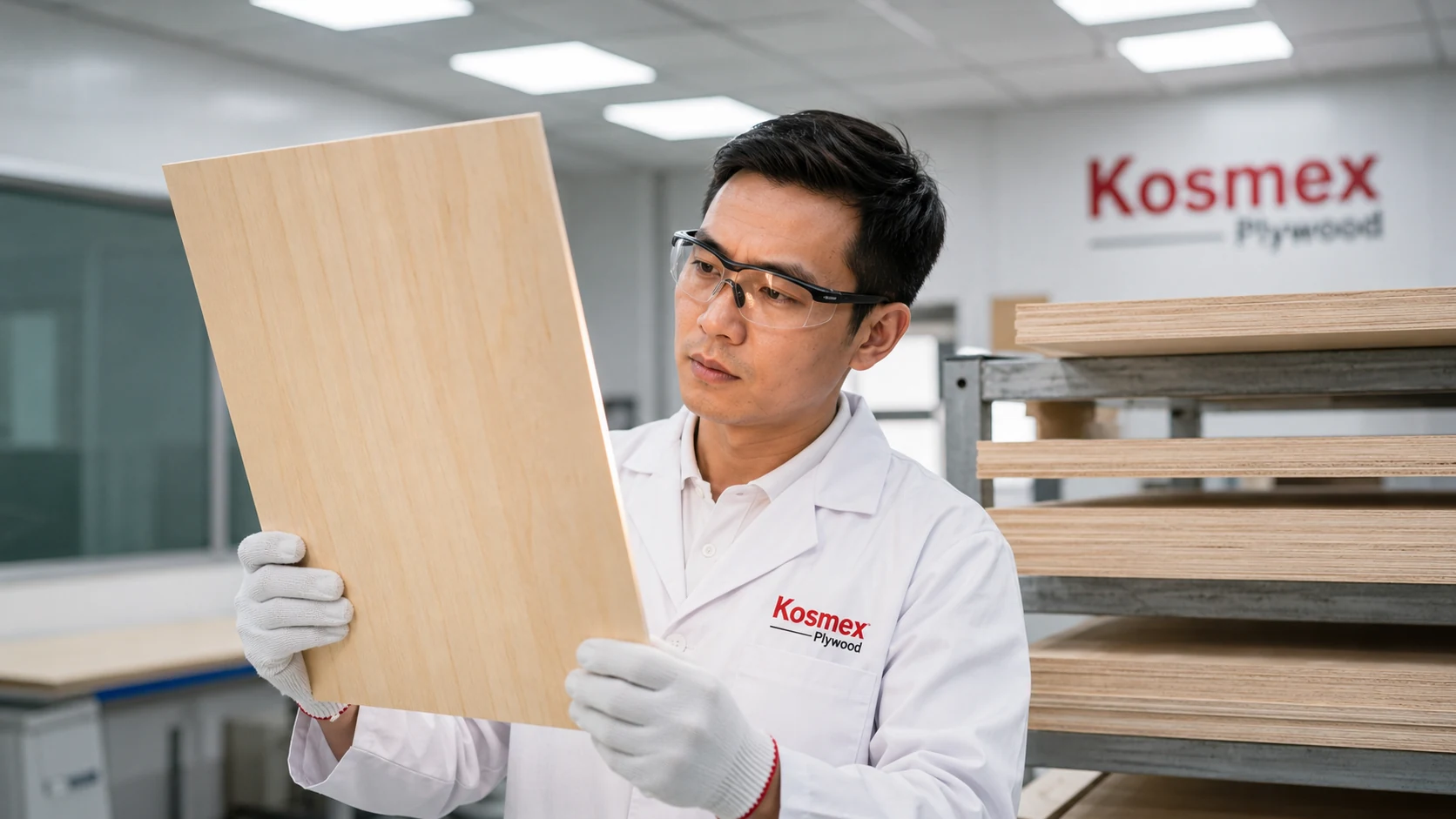
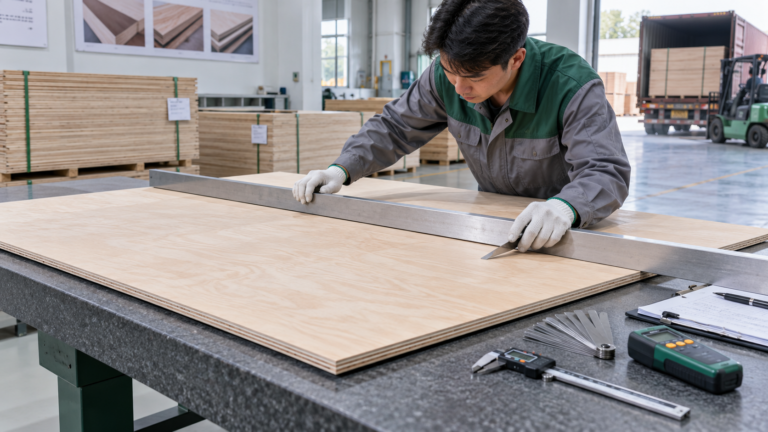
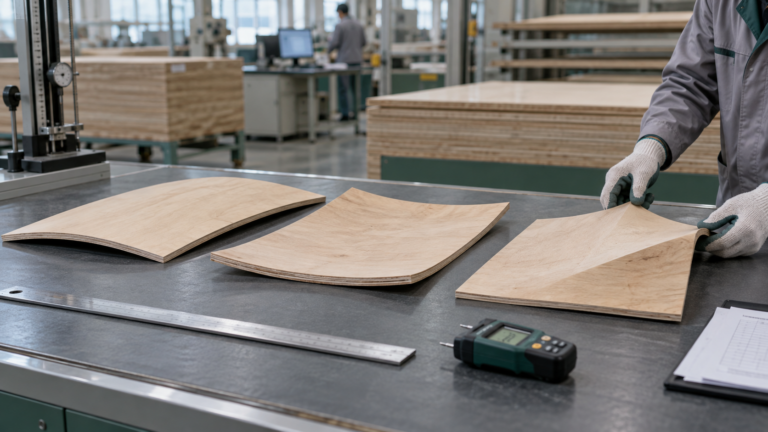
Kosmex QC technician grading birch plywood veneer surface for cabinet-grade specificationFor most kitchen cabinet projects, specify B/BB or BB/BB.
B/BB is the standard for quality kitchen cabinet boxes where the interior is sometimes visible (open shelving, glass-front cabinets)
BB/BB is the most cost-efficient option for closed cabinet carcasses where neither face is in the final line of sight
A/A is typically reserved for visible cabinet doors and face frames — but most manufacturers apply a separate veneer or laminate over the door surface anyway, making the face grade redundant
Ordering tip: When sourcing from Vietnam factories, always specify both face and back grade explicitly. “Cabinet grade” alone means different things to different suppliers. Ask for BB/BB minimum for box construction and B/BB for any panel with an exposed interior face.
Core Type: The Specification Nobody Talks About
Face grade gets all the attention, but the core is what determines how the panel behaves structurally over time.
Full Birch Core (All-Birch Plies)
All veneer layers are birch throughout
No voids, no gaps between plies
Best screw-holding, best resistance to delamination
Recommended for: base cabinets, drawer boxes, high-load shelves
Common spec: Baltic birch (all-birch, typically 9-ply for 18mm)
Combi Core (Hardwood Face + Poplar/Mixed Inner Plies)
Birch or hardwood face veneers over softer inner plies (poplar, eucalyptus, mixed)
Lighter than all-birch; lower cost
Adequate for most wall cabinet boxes and upper cabinets
Good balance of weight, cost, and performance for standard kitchen builds
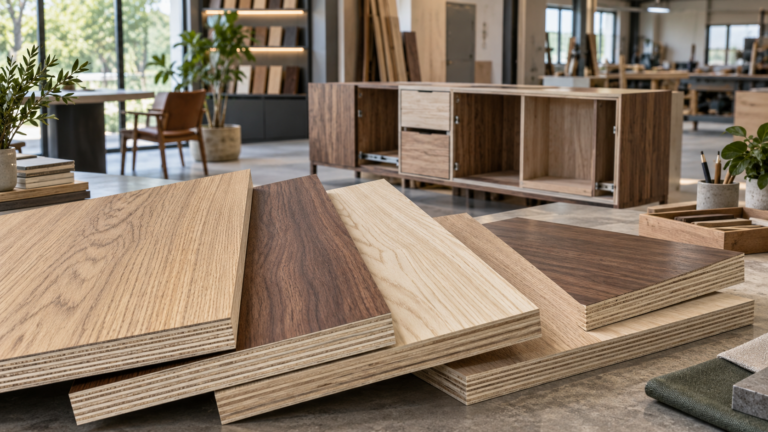
Birch plywood cross-section showing 9-ply all-birch core for kitchen cabinet construction
Screw holding is adequate for light-duty upper cabinets
Not recommended for base cabinets with heavy contents
MDF Core (with hardwood face veneer)
Ultra-smooth face surface
Ideal for painted cabinet doors (no grain telegraphing)
Poor moisture resistance in the core
Not recommended for cabinet boxes; use only for door panel blanks in dry environments
Bottom line for kitchen cabinets: Specify all-birch or combi core with birch face for base cabinets. Combi core or poplar core is acceptable for upper cabinets. Avoid MDF core for anything structural.
Thickness Guide: 3/4″ vs 1/2″ Plywood for Cabinets
This is the most common specification question — and the answer depends on which part of the cabinet you’re building.
3/4″ (18–19mm) — Use For:
Cabinet sides (left, right, top, bottom of the box)
Fixed shelves inside base cabinets
Face frames
Cabinet doors (solid plywood door blanks)
Drawer fronts (false fronts)
3/4″ provides the rigidity needed for structural joints and screw purchase for hinges and drawer slides. Most professional cabinetmakers use 3/4″ for all primary box components.
1/2″ (12mm) — Use For:
Cabinet backs (wall cabinets)
Drawer sides and bottoms
Interior dividers in upper cabinets
Light-duty shelves in upper cabinets (span under 600mm)
Using 1/2″ for backs reduces weight and cost without compromising structural integrity. A typical kitchen project specifying 3/4″ for structure and 1/2″ for backs reduces total panel cost by 15–20%.
1/4″ (6mm) — Use For:
Back panels in face-frame cabinets (attached to rabbeted back)
Decorative inserts
Drawer bottoms in smaller drawers
Cabinet Component
Recommended Thickness
Core Recommendation
Base cabinet sides
3/4″ (18–19mm)
All-birch or combi core
Base cabinet shelves
3/4″ (18–19mm)
All-birch
Wall cabinet sides
3/4″ (18–19mm)
Combi or poplar core
Wall cabinet backs
1/2″ (12mm)
Combi or poplar core
Cabinet doors (plywood blank)
3/4″ (18–19mm)
MDF core (painted) or birch (natural finish)
Drawer sides
1/2″ (12mm)
Birch or combi
Drawer bottoms
1/4″ (6mm)
Any hardwood face
Plywood vs MDF for Kitchen Cabinets: Where Each Wins
Both materials have legitimate use cases in kitchen cabinetry. The mistake is using one for everything.
Factor
Plywood
MDF
Structural strength
Superior
Adequate for light loads
Screw holding
Excellent
Poor (especially at edges)
Moisture resistance
Good (WBP glue)
Poor (swells at edges)
Paint finish (smoothness)
Grain shows through
Ultra-smooth
Weight
Lighter
Heavier
Cost
Higher upfront
Lower upfront
Lifespan in kitchen
20–30 years
5–10 years near moisture
Edge finishing
Requires edge banding
Machines cleanly
Practical recommendation: Use plywood for box construction (sides, shelves, base) and MDF for cabinet door blanks where a painted finish is required. This combination gives you structural durability where it matters and paint-ready surfaces where appearance counts.
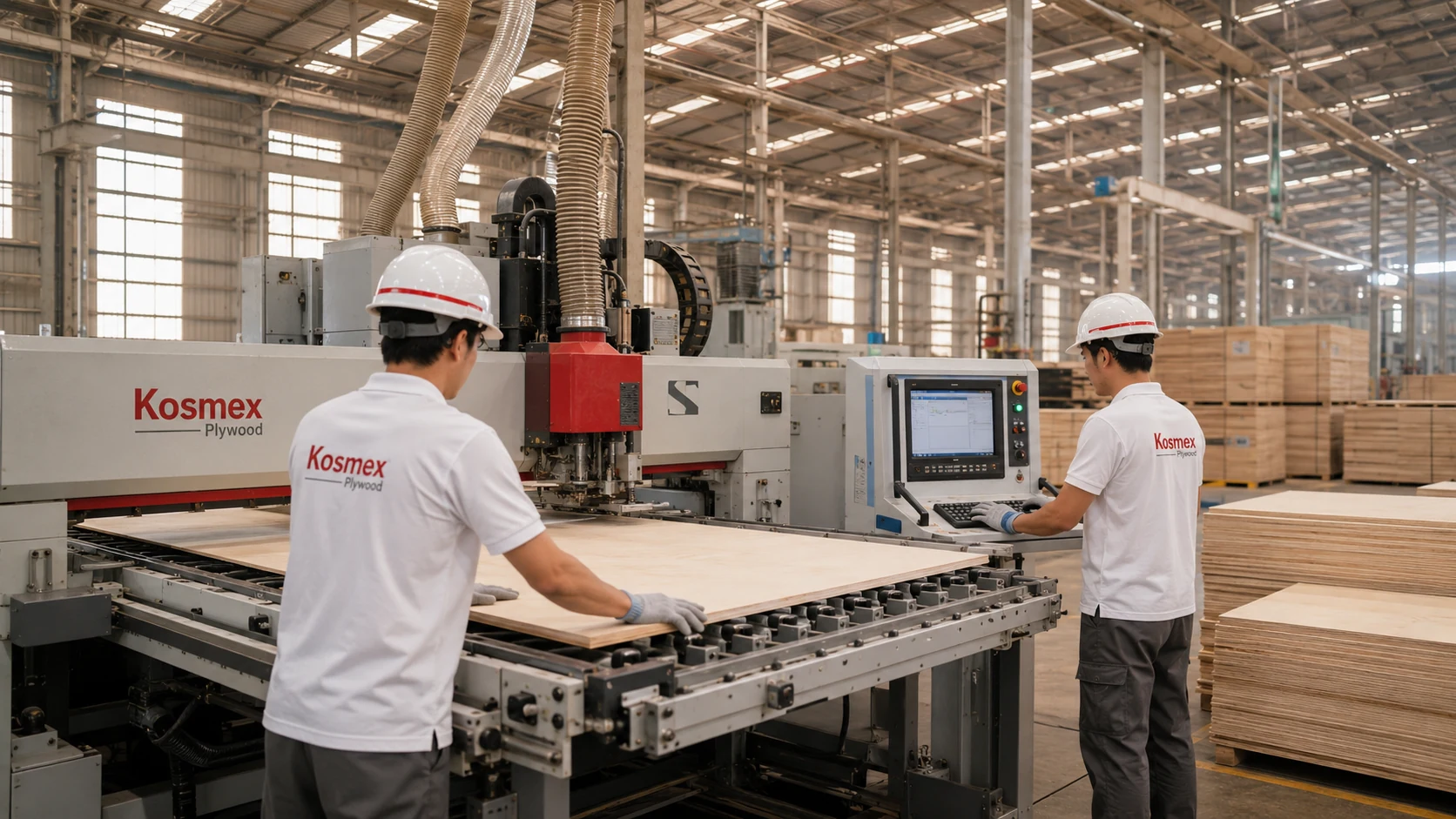
[ẢNH 4 — NHÓM CÔNG NHÂN / DÂY CHUYỀN CNC]
Prompt: Hai công nhân Kosmex vận hành máy CNC cắt tấm birch plywood — áo trắng in chữ “Kosmex Plywood” ở lưng, mũ bảo hộ trắng viền đỏ, môi trường nhà máy sạch sẽ, ánh sáng tự nhiên từ cửa sổ nhà xưởng.
Alt text:Kosmex factory workers operating CNC plywood cutting machine for cabinet panels
Caption: Precision CNC cutting at Kosmex — panels cut to ±0.5mm tolerance for cabinet-ready sheets.
Vị trí: Sau bảng so sánh Plywood vs MDF, trước H2 “Which Plywood Species” — tạo nhịp thở sau 2 bảng dữ liệu liên tiếp.
Which Plywood Species Is Best for Kitchen Cabinets?
Birch Plywood
The industry standard for kitchen cabinet boxes worldwide. Birch plywood offers:
Consistent, tight grain that accepts stain evenly
High density (600–680 kg/m³) for excellent screw holding
Smooth face surface compatible with laminate, veneer, and direct paint
Available in full-birch core (Baltic birch) or combi core at lower cost
Birch is the default specification for cabinet manufacturers importing from Vietnam, Eastern Europe, and Scandinavia. It performs reliably across humidity ranges typical in residential kitchens.
Maple Plywood
Harder and denser than birch (approximately 700+ kg/m³). Maple’s fine, closed grain gives a premium surface with minimal blotching when stained. It costs 15–25% more than comparable birch plywood.
Specify maple when the natural wood face will be fully visible and stained — for example, shaker-style doors with a clear finish. For painted cabinets or laminated boxes, the premium is unnecessary.
Commercial Plywood (Poplar/Eucalyptus Face)
A cost-effective option for closed cabinet boxes where no face veneer will be visible. Commercial-grade plywood with eucalyptus or poplar faces provides adequate structural performance for base and wall cabinet boxes at a significantly lower price point than birch.
Raw Plywood Cabinets and RTA Plywood Cabinets: Specification Notes
Raw Plywood Cabinets (Exposed Ply Edge Aesthetic)
A growing trend in modern and Scandinavian-influenced kitchens: leaving the ply edge exposed rather than covering it with edge banding. This requires:
B/BB or BB/BB grade minimum — visible ply edges on lower grades show voids and dark glue lines
All-birch core — the distinctive multi-layer edge effect is only achieved with uniform birch plies throughout
Sanded faces — 120-grit minimum sanding on both faces before applying a clear oil or lacquer finish
No void-filling compound in the edge — any repairs show through a clear finish
If ordering from a factory for raw-edge cabinet builds, specify: “BB/BB grade, all-birch core, void-free, sanded both faces, no edge filling.”
RTA (Ready-to-Assemble) Plywood Cabinets
RTA cabinet manufacturers source plywood by the container load and assemble in-factory before shipping flat-pack. If you’re specifying plywood for RTA production runs:
Standard spec: BB/BB, 18mm (3/4″), combi core with birch face, E1 formaldehyde emission class
For US market: add CARB Phase 2 compliance
For EU market: add EN 717-1 (E1) and CE marking under EN 13986
Backer sheet: 12mm (1/2″) poplar core for back panels
How to Specify Plywood When Ordering from a Vietnam Factory
Vietnam has become one of the primary supply bases for cabinet-grade plywood exported to the EU, US, and Australian markets. When placing an order, include the following in your specification sheet:
Checklist for cabinet plywood specification:
[ ] Species: Birch face veneer (state: full-birch core or combi core)
[ ] Thickness: 18mm ±0.5mm (3/4″) for structure; 12mm ±0.5mm (1/2″) for backs
[ ] Sheet size: 1220 × 2440mm (standard) or custom
[ ] Glue type: WBP / phenolic (specify EN 314-2 Class 3 for moisture-resistant bond)
[ ] Emission class: E1 (EU) or CARB P2 (US)
[ ] Certification: FSC if required by end market
[ ] Sanding: Both faces sanded to 120-grit minimum
[ ] Moisture content: 8–12% at time of shipment
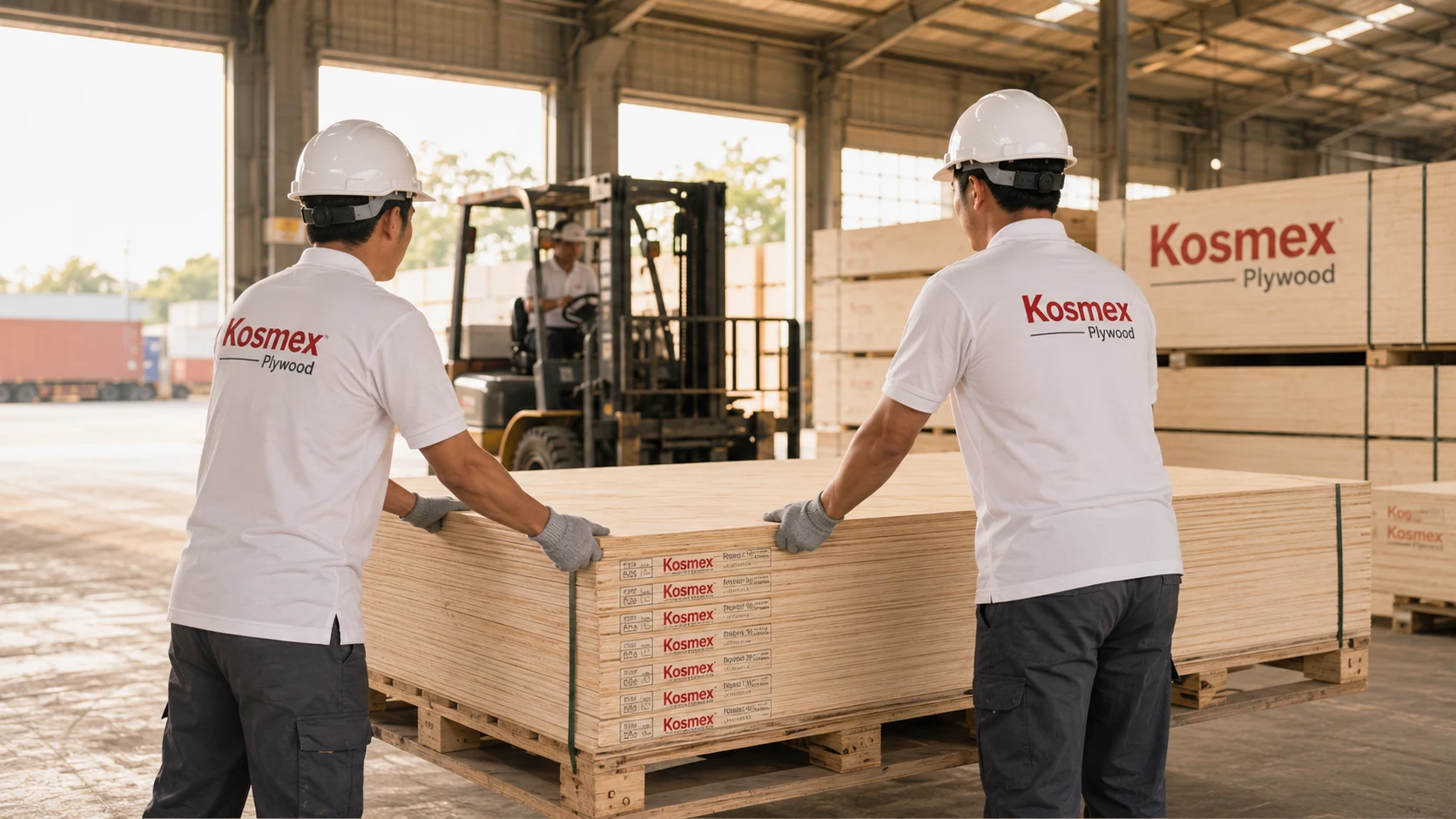
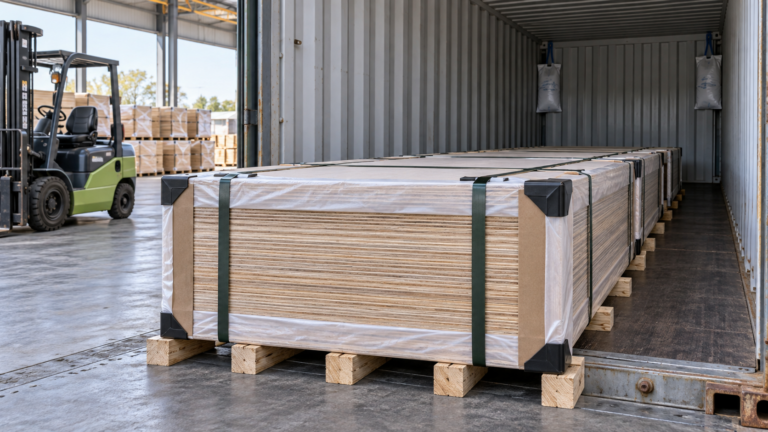
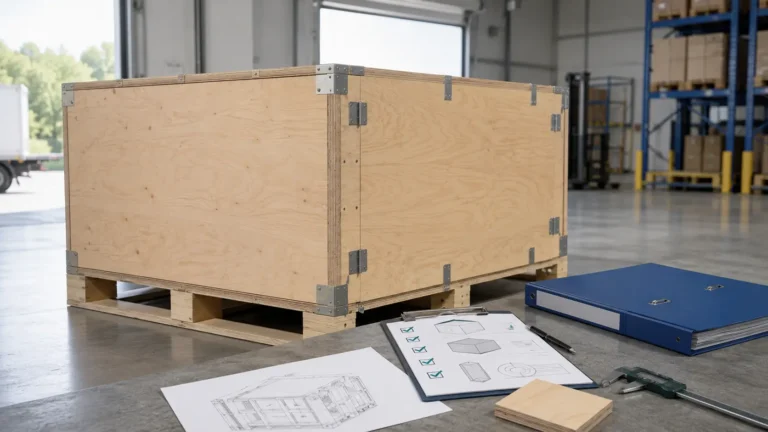
Kosmex warehouse workers palletizing birch plywood for export to EU and US cabinet manufacturers
Providing this checklist when requesting a quote eliminates ambiguity and ensures you receive panels that meet cabinet production standards — not general construction panels shipped under a “cabinet grade” label.
Frequently Asked Questions
What is the best plywood grade for kitchen cabinets?
BB/BB is the most practical grade for kitchen cabinet box construction — it provides a consistent face with minor repairs that are invisible once assembled. Upgrade to B/BB for cabinets with visible interior faces (open shelving, glass-front doors).
Should I use 1/2″ or 3/4″ plywood for kitchen cabinets?
Use 3/4″ (18–19mm) for all structural components: sides, base, fixed shelves. Use 1/2″ (12mm) for cabinet backs and drawer sides. This combination balances strength and cost without compromising cabinet longevity.
Is birch plywood good for kitchen cabinets?
Yes — birch plywood is the industry standard for kitchen cabinet boxes. Its density provides excellent screw holding, its surface accepts paint and laminate evenly, and it outperforms particle board and MDF in moisture-prone kitchen environments.
Can I use commercial plywood for kitchen cabinets?
Commercial plywood is suitable for closed box construction in budget builds. It is not recommended for exposed faces or high-humidity areas near sinks and dishwashers. For those applications, specify birch with WBP glue.
What plywood do professional cabinet makers use?
Most professional cabinet shops specify 3/4″ (18mm) BB/BB or B/BB birch plywood with an all-birch or combi core for box construction, and 1/2″ (12mm) birch for backs and drawer parts. For painted door blanks, 3/4″ MDF core with hardwood face veneer is also common.
What is the difference between Baltic birch and regular birch plywood for cabinets?
Baltic birch uses all-birch plies throughout the core with no voids — typically 9 plies in 18mm. Standard birch plywood (or combi core birch) may use softer inner plies (poplar, eucalyptus). Baltic birch is preferred for exposed-edge work and drawer boxes; combi core birch is adequate for closed box construction and is lower cost.
Summary: What to Specify for Kitchen Cabinet Plywood
Requirement
Specification
Box construction (standard kitchen)
18mm BB/BB birch, combi core, E1/CARB P2
Box construction (high-end / visible edge)
18mm BB/BB all-birch core, void-free
Back panels
12mm BB/CP birch or poplar core
Cabinet door blanks (painted finish)
18mm MDF core, hardwood face veneer
Cabinet door blanks (natural/stained finish)
18mm B/BB birch, all-birch core
Budget builds (closed cabinets)
18mm commercial plywood, eucalyptus/poplar face
For importers and cabinet manufacturers sourcing from Vietnam: request a full specification sheet with grade, core, emission class, and glue type stated explicitly — not just a generic “cabinet grade plywood” label.
[Request a quote for cabinet-grade birch plywood →]



Bình luận