


Is Plywood Sustainable? The Truth About Eco-Friendly Wood Choices
Sustainability is no longer just a buzzword, it is a key factor that builders, architects, DIY enthusiasts, and consumers weigh when selecting materials for their projects. Amid growing concerns about deforestation, carbon emissions, and environmental responsibility, one question keeps coming up: is plywood sustainable?
In this guide, Kosmex Plywood will break down everything you need to know about plywood sustainability – from how it is made and sourced, to how it compares with alternatives, and how to choose the most eco-friendly option for your next project.
What Is Plywood and How Is It Made?
Before assessing its sustainability, it helps to understand what plywood actually is. Plywood is an engineered wood panel made by gluing together multiple thin sheets of wood veneer – called plies – with the grain of each layer running perpendicular to the one above it. This cross-grain construction is what gives plywood its exceptional strength, dimensional stability, and resistance to warping.

The manufacturing process typically begins with sourcing logs, which are then debarked, heated, and soaked to soften the wood fibers. A rotating lathe peels ultra-thin veneers – usually between 1.5 mm and 4 mm thick – from the log in a continuous sheet. These veneers are then dried, sorted, coated with adhesive, stacked in alternating grain directions, and pressed under high heat and pressure to form the final panel.
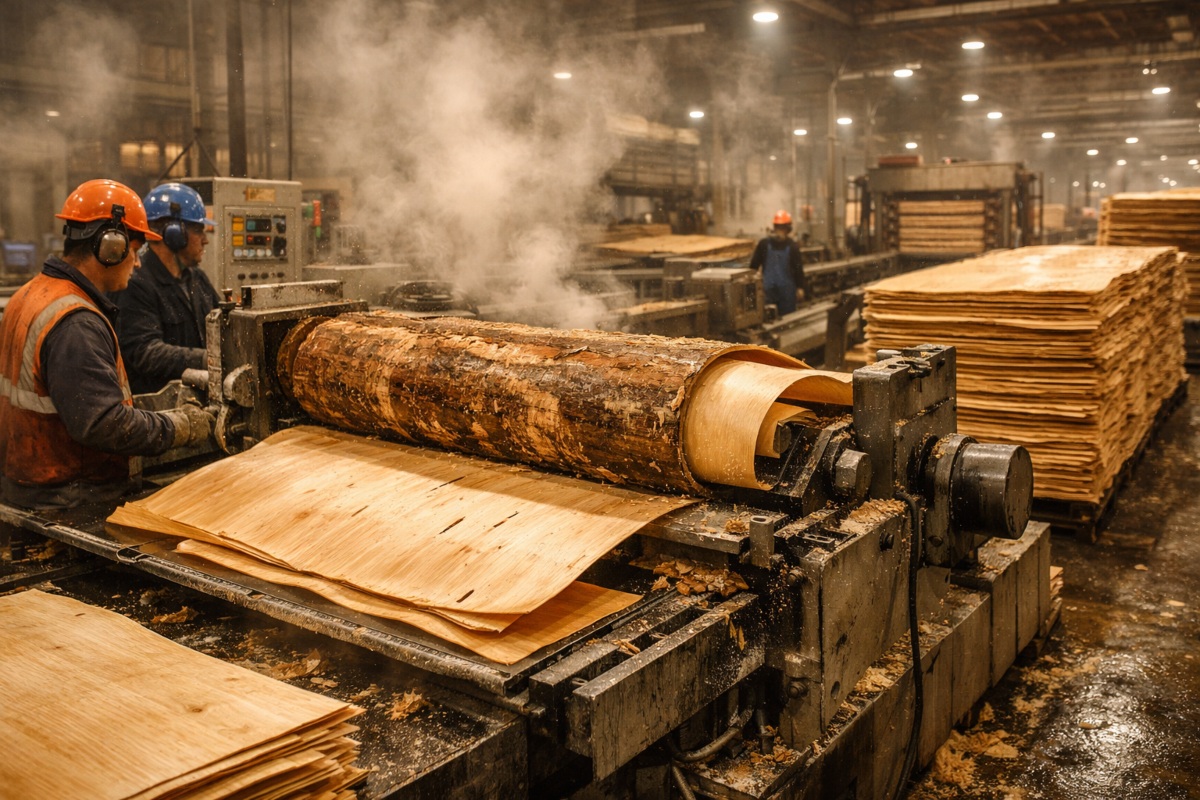
This process is highly efficient. Because the veneer is peeled rather than sawn, far less wood is wasted compared to cutting solid timber planks. Almost the entire log can be utilized, with bark and waste chips often used as biomass fuel or recycled into other wood products.
Common wood species used in plywood production include softwoods such as pine, spruce, fir, and cedar – ideal for structural and construction applications – as well as hardwoods like birch, oak, beech, and poplar, which are preferred for furniture, cabinetry, and finishing work. Among these, birch plywood is widely regarded as one of the most sustainable options, as birch trees are fast-growing, widely abundant in the northern hemisphere, and support natural biodiversity when managed responsibly.
Is Plywood a Sustainable Material?
Plywood earns its reputation as a relatively sustainable building material for several interconnected reasons. Understanding these factors helps clarify why it is often preferred over alternatives such as MDF, solid hardwood, concrete, or steel when environmental impact is a priority.
1. Efficient Use of Timber Resources
One of plywood’s strongest sustainability credentials is how efficiently it uses wood. Solid wood products require large, straight-grained logs with few defects – a demanding specification that results in considerable waste during milling. Plywood, by contrast, can make use of smaller-diameter logs, fast-growing plantation trees, and imperfect timber that would otherwise be discarded.
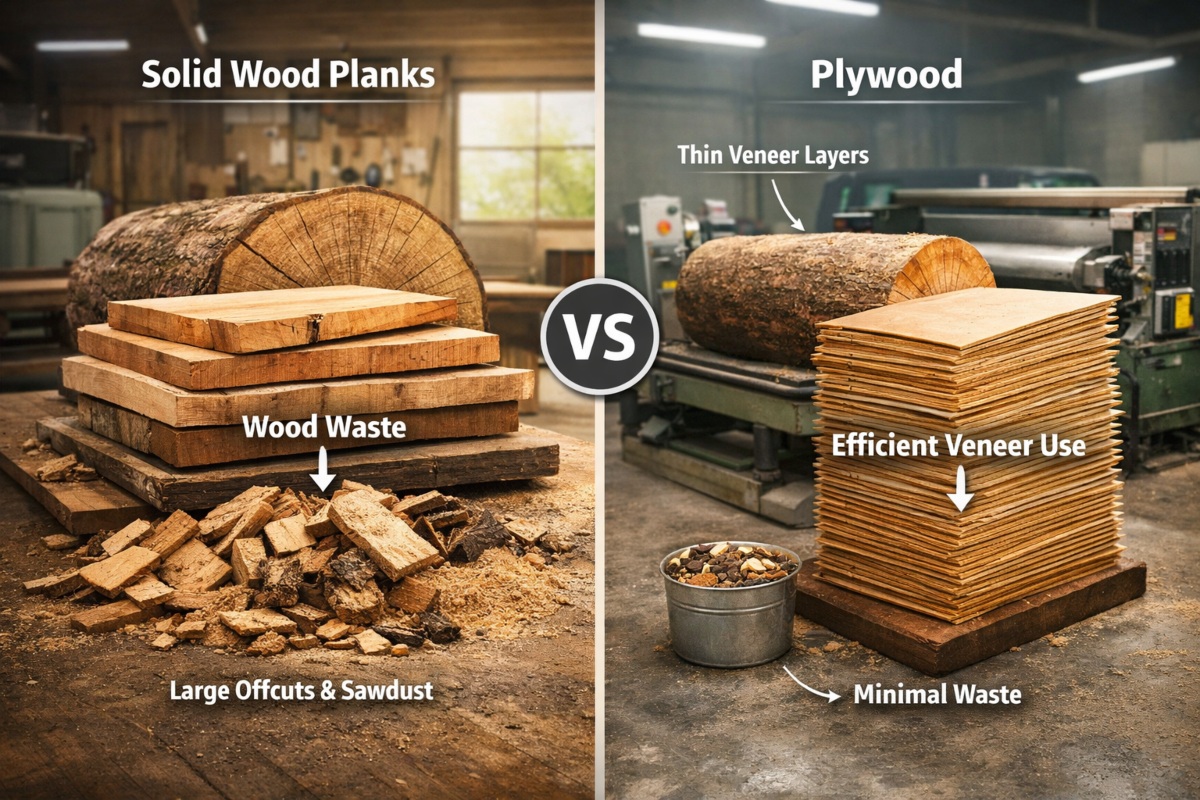
The veneer-peeling process extracts far more usable surface area per log than sawing planks. Even the offcuts, bark, and sawdust generated during production are typically recycled or used as biomass fuel, meaning almost no part of the tree goes to waste. This makes plywood one of the most resource-efficient timber products available.
2. Renewable and Naturally Carbon-Sequestering
Wood is a renewable resource – unlike concrete, steel, or plastics, it can be replenished through responsible forest management. When trees are harvested from certified, well-managed forests and replanted, the forest ecosystem is maintained and even improved over time. Importantly, wood also acts as a carbon store: trees absorb CO2 from the atmosphere as they grow, and much of that carbon remains locked within the wood product for the duration of its service life.
This means that a well-sourced plywood panel is effectively a form of long-term carbon storage. When compared to energy-intensive materials like steel or concrete – both of which generate significant CO2 during production – plywood’s carbon footprint is considerably lower, particularly when sourced from responsibly managed forests.
3. Durability and Long Service Life
Sustainability is not just about what a product is made of – it is also about how long it lasts. A material that needs frequent replacement creates more waste and consumes more resources over time, even if it is made from seemingly eco-friendly ingredients. Plywood scores well on this front.
Thanks to its cross-laminated construction, plywood is exceptionally strong for its weight and highly resistant to warping, splitting, and shrinkage. When correctly specified and properly installed, plywood used in structural applications such as flooring, roofing, and wall sheathing can last for decades – and in some cases, for the entire lifespan of the building. This durability directly reduces the frequency of replacement and, by extension, the overall consumption of resources.
4. Strength-to-Weight Ratio Reduces Material Consumption
Because plywood achieves high structural performance with relatively little material, less of it is needed to accomplish the same job compared to solid wood or other alternatives. A thinner plywood panel can often perform the same load-bearing role as a much thicker piece of solid timber, meaning less overall wood is consumed per project. This intrinsic efficiency is a meaningful sustainability advantage, particularly in large-scale construction.
Key Takeaway: Plywood is widely considered a sustainable building material due to its efficient timber use, carbon storage potential, long service life, and compatibility with certified responsible forestry. However, its full environmental profile also depends on the adhesives used and end-of-life managemen
Environmental Concerns Around Plywood
While plywood has a strong sustainability case, it is not without environmental trade-offs. A balanced assessment requires acknowledging the areas where plywood production can cause harm or generate concern.
Adhesives and Formaldehyde Emissions
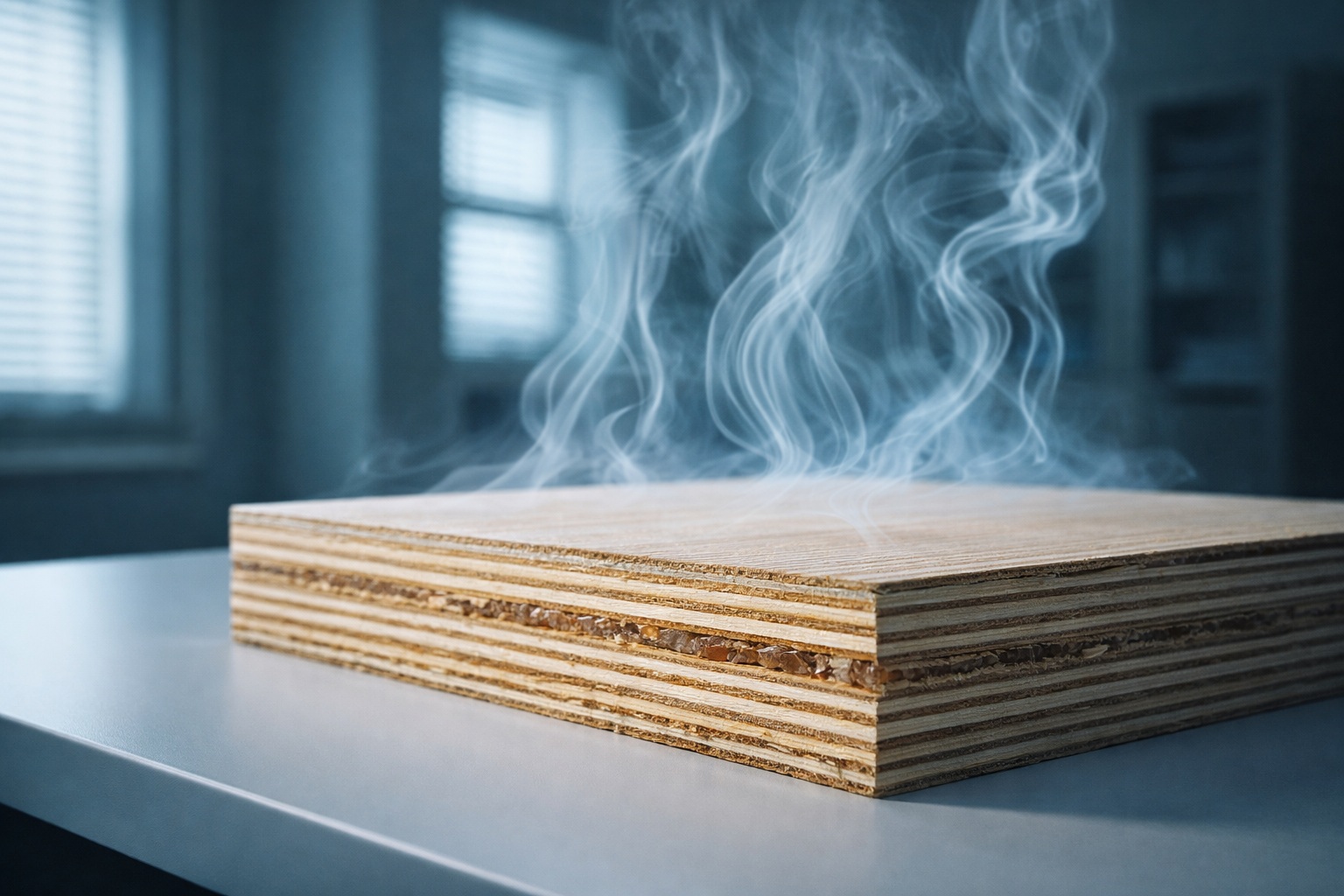
The most significant environmental drawback of conventional plywood is the adhesive used to bond the veneer layers. Many standard plywood products use urea-formaldehyde (UF) or phenol-formaldehyde (PF) resins. These adhesives can emit volatile organic compounds (VOCs), including formaldehyde gas, both during manufacturing and throughout the lifespan of the product – a process known as off-gassing.
Formaldehyde is a recognized irritant and, at high concentrations, a carcinogen. Indoor use of conventional plywood – particularly in enclosed spaces with poor ventilation – has raised health concerns for occupants. From an environmental standpoint, formaldehyde-based resins also complicate plywood’s biodegradability and recyclability at end of life.
The good news is that the industry has responded with alternatives. Low-emission plywood products are now widely available, rated E0 or E1 under European standards, indicating minimal formaldehyde off-gassing. Some manufacturers have gone further, developing plywood bonded with soy-based or other bio-derived adhesives that eliminate synthetic resins entirely. These products represent a meaningful step forward for environmentally conscious buyers.
Timber Sourcing and Deforestation Risk
The sustainability of any wood product is fundamentally tied to where the timber comes from. Plywood sourced from illegally logged forests or from ecosystems with poor regeneration management can contribute to deforestation, biodiversity loss, and habitat destruction – outcomes that are deeply unsustainable regardless of the product’s other attributes.
This is why responsible sourcing certifications matter enormously when evaluating plywood sustainability. The Forest Stewardship Council (FSC) and the Programme for the Endorsement of Forest Certification (PEFC) are the two most widely recognized independent bodies that verify responsible forest management practices. Plywood bearing FSC or PEFC certification has been verified to come from forests where harvesting rates do not exceed regeneration, biodiversity is protected, and local communities and workers are treated fairly.
Energy Consumption During Manufacturing
Plywood production is an energy-intensive process. Drying veneers, pressing panels, and running large-scale industrial equipment all require significant energy inputs. Depending on the energy source used by the manufacturer, this can result in meaningful greenhouse gas emissions. Manufacturers who operate with renewable energy sources or who use waste biomass from their own production to power their kilns substantially reduce this environmental impact – but not all producers take these steps.
Biodegradability Limitations
Unlike untreated solid timber, most plywood is not readily biodegradable at end of life due to the synthetic resins and adhesives embedded in the panel. This means that plywood cannot simply be composted or left to break down naturally. In landfill conditions, it may persist for a very long time. However, this is not an insurmountable problem – plywood can be recycled, repurposed, or used as biomass fuel, all of which represent more responsible end-of-life pathways than landfill disposal.
How Does Plywood Compare to Other Building Materials?
Context matters when evaluating sustainability. Comparing plywood to the alternatives it replaces helps clarify its relative environmental position.
| Material | Renewable | Carbon Footprint | Recyclability | Durability |
| Plywood | Yes (if certified) | Low–Medium | Moderate | High |
| MDF | Partially | Medium | Low | Moderate |
| Solid Hardwood | Yes (slow-growing) | Low | High | Very High |
| Concrete | No | Very High | Low | Very High |
| Steel | No | High | High | Very High |
| OSB | Yes (fast-growing) | Low–Medium | Moderate | Moderate |
Compared to MDF – a competing engineered wood panel – plywood generally comes out ahead on sustainability. MDF is made from wood fibers bonded with a high proportion of resin, making it harder to recycle and more prone to moisture damage, which shortens its service life. Plywood’s higher durability and better moisture performance mean it lasts longer and is replaced less frequently.
Against concrete and steel, plywood is substantially more sustainable. Both materials require highly energy-intensive industrial processes and generate significant CO2 emissions during production. Wood-based materials, including plywood, have a much lower embodied energy and sequester carbon for the duration of their use.
FSC and PEFC Certification: Why It Matters
If there is one single step you can take to ensure that the plywood you are buying is genuinely sustainable, it is to look for third-party certification. FSC and PEFC certification are the global benchmarks for responsible forestry and are your most reliable assurance that the timber in your plywood was sourced without contributing to deforestation or ecosystem damage.
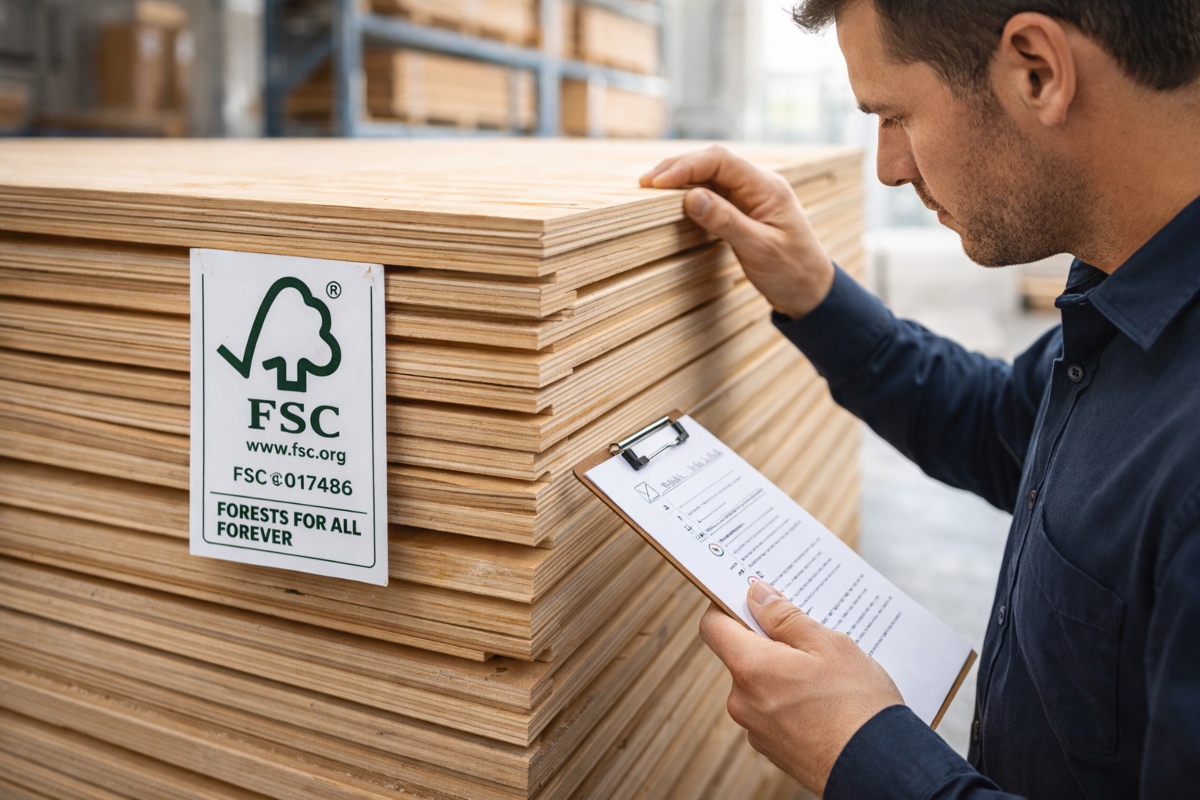
FSC-certified forests are managed according to a strict set of principles covering environmental, social, and economic criteria. This includes maintaining biodiversity, protecting water sources, respecting the rights of indigenous and local communities, and ensuring that harvesting does not outpace natural regeneration. PEFC operates similarly, with a particular focus on regional and national forest certification programs.
When shopping for certified plywood, look for the FSC or PEFC logo on the product label or request certification documentation from your supplier. It is worth noting that certification applies not just to the timber but to the entire chain of custody – from the forest, through the mill, to the retailer. A product with full chain-of-custody certification provides the highest level of assurance.
How to Choose the Most Sustainable Plywood
Not all plywood is equally sustainable, and the choices you make as a buyer have a direct impact on the environmental outcomes associated with your project. Here is a practical checklist to guide more responsible plywood purchasing:
- Look for FSC or PEFC certification: This is your single most important check. Certified plywood guarantees responsible sourcing from managed forests.
- Check formaldehyde emission levels: Opt for E0 or E1 rated plywood for indoor use. Better still, look for products using soy-based or other bio-derived adhesives with no added formaldehyde.
- Choose locally sourced timber where possible: Transportation is a significant source of carbon emissions. Plywood manufactured from locally grown timber and produced closer to your project site has a lower transport-related footprint.
- Consider the wood species: Fast-growing species such as birch, pine, and spruce that are sourced from well-managed plantation forests are generally more sustainable than slow-growing tropical hardwoods.
- Buy the right grade for your application: Over-specifying plywood – using a higher grade or greater thickness than the project actually requires – wastes resources. Match the specification to the need.
- Plan for reuse and recycling: Before purchasing, think about what will happen to the plywood at the end of the project. Can it be reused? Will it be easy to take apart and recycle? Designing for disassembly supports a more circular use of materials.
Can Plywood Be Recycled or Reused?
The end of a product’s life is one of the most important – and most frequently overlooked – dimensions of sustainability. Fortunately, plywood offers several responsible end-of-life pathways.
Reusing Plywood
Reuse is always preferable to recycling, as it avoids the energy consumption associated with reprocessing. Plywood panels used in construction, formwork, staging, or furniture can often be repurposed for new applications after their initial use. Because plywood is sold in standardized sheet sizes, offcuts and partially used panels are easy to incorporate into smaller projects. Trimming away damaged edges and flattening any minor warping is usually all that is needed to give a plywood panel a second life.
For reference on standard sheet dimensions used for these calculations, see our standard plywood sizes guide.
Donating usable plywood to community workshops, schools, or maker spaces is another excellent reuse pathway that keeps material out of the waste stream and benefits others.
Recycling Plywood
Plywood is classified as Class B timber – treated wood – which means it cannot be mixed with untreated Class A wood in standard timber recycling streams. It must be taken to a dedicated recycling facility equipped to handle engineered wood. At such facilities, plywood is typically chipped and processed into animal bedding, particleboard feedstock, or biomass fuel.
While this is less ideal than direct reuse, it is far preferable to landfill disposal. Burning treated plywood at home or in open fires is not recommended, as the resins and adhesives can release harmful compounds when incinerated without proper controls.
Using Plywood as Biomass
In some regions, treated wood including plywood can be accepted at waste-to-energy facilities where it is burned under controlled, high-temperature conditions to generate electricity or heat. This is not ideal from a circular economy perspective – it consumes a resource rather than extending its useful life – but it is a better outcome than landfill and allows the energy stored in the wood to be recovered.
Birch Plywood: A Sustainability Standout
Among the many types of plywood available, birch plywood is consistently highlighted by sustainability experts and environmental advocates as one of the best choices from an ecological standpoint. Understanding why helps illustrate what to look for in any plywood product.
Birch trees are fast-growing hardwoods that are abundantly distributed across the northern hemisphere, particularly in Scandinavia, the Baltic states, and Russia. They are well-suited to managed forestry because they regenerate relatively quickly and support the natural biodiversity of boreal forest ecosystems without disrupting them. When managed responsibly, birch forests can be harvested on a sustainable rotational basis without net loss of forest cover.
Birch plywood also has exceptionally high material efficiency. Nearly the entire tree can be used – not just the trunk, but the branches and bark as well. Waste generated at the mill is recycled into particleboard or used as biomass fuel. This near-zero-waste utilization profile is a significant sustainability advantage compared to many other timber species.
From a performance standpoint, birch plywood is dense, strong, and dimensionally stable – qualities that contribute to a long service life and reduce the frequency of replacement. Its smooth, consistent surface also lends itself well to finishing, reducing the need for additional coatings or materials.
Sustainable Finishes for Plywood
The adhesives and finishes applied to plywood after manufacture are an important but often overlooked dimension of its overall environmental profile. Conventional oil-based paints and solvent-based varnishes contain VOCs that contribute to indoor air pollution and have environmental impacts during application and disposal.
For a more sustainable approach to finishing plywood, consider the following alternatives:
- Water-based paints and varnishes: These products contain significantly lower levels of VOCs than solvent-based equivalents and are safer for both the installer and occupants.
- Natural oils such as linseed oil or tung oil: These penetrate the wood fibers and cure to form a durable, protective surface without relying on synthetic chemistry. They are biodegradable and renewable.
- Beeswax and natural wax finishes: Suitable for interior applications, these provide a natural protective layer and can be reapplied easily over time to extend the life of the surface.
- Low-VOC hardeners and primers: For applications requiring more robust protection, low-VOC formulations are increasingly available and perform comparably to conventional products.
By choosing eco-friendly finishes alongside certified, low-emission plywood, you can substantially reduce the total environmental footprint of your project.
Frequently Asked Questions About Plywood Sustainability
Is plywood better than solid wood for the environment?
It depends on the species and source. Plywood made from fast-growing certified plantation timber is generally more sustainable than solid wood from slow-growing tropical hardwoods because it uses timber more efficiently and exerts less pressure on old-growth forests. However, reclaimed solid wood – repurposed from existing structures – is arguably the most sustainable wood option of all.
Is plywood biodegradable?
Standard plywood is not readily biodegradable due to the synthetic resins used in its manufacture. Unlike untreated solid timber, it will not break down naturally in a useful timeframe. However, it can be recycled, repurposed, or used as biomass, all of which are preferable to landfill disposal.
What is the most eco-friendly type of plywood?
FSC-certified birch plywood made with low-emission (E0) or no-added-formaldehyde adhesives is widely regarded as among the most sustainable options available. Sourcing plywood from local manufacturers further reduces the transport-related carbon footprint.
Is OSB more sustainable than plywood?
OSB (Oriented Strand Board) is made from fast-growing, smaller-diameter trees and uses the wood very efficiently, which are both sustainability positives. However, OSB typically contains a higher proportion of synthetic resins relative to wood, which can mean more formaldehyde emissions. The relative sustainability of OSB versus plywood depends heavily on the specific products being compared and how they are certified.
How can I dispose of old plywood responsibly?
The best options, in order of preference, are: reuse it for another project, donate it to a community workshop or school, take it to a Class B timber recycling facility, or use it as biomass fuel at an appropriate facility. Avoid burning it in open fires or disposing of it in general household waste.
Conclusion: Is Plywood Sustainable?
Plywood is, on balance, a genuinely sustainable building material – but its environmental credentials depend substantially on how it is sourced, manufactured, used, and disposed of. When produced from certified, responsibly managed forests, bonded with low-emission or bio-derived adhesives, and used in applications that take advantage of its durability and longevity, plywood is one of the more environmentally responsible structural materials available.
The key factors to bear in mind are certification, adhesive chemistry, species choice, and end-of-life planning. By prioritizing FSC or PEFC certified plywood with low formaldehyde emissions, selecting fast-growing species such as birch or pine from well-managed sources, and planning for reuse or responsible recycling at the end of the project’s life, you can be confident that your choice of plywood supports rather than undermines a sustainable future.
Whether you are a professional builder, an architect specifying materials for a large development, or a DIY enthusiast tackling a weekend project, the growing range of certified sustainable plywood products means you have more good options than ever before. The environment – and the people who inhabit the spaces you build – will be better off for choosing thoughtfully.
Bình luận