


Particle Board vs Plywood: Differences, Cost, Durability & Best Uses 2026
Choosing between particle board vs plywood is one of the most important decisions when building furniture, cabinetry, or tackling home renovation projects. Both materials serve different purposes, offer distinct advantages, and come with specific limitations. Understanding these differences helps you select the right material for your needs and budget.
This comprehensive guide compares particle board and plywood across strength, cost, durability, moisture resistance, and practical applications. Whether you’re building budget furniture or investing in long-term cabinetry, this guide provides the information needed to make an informed choice.
What is Particle Board vs Plywood?
What is Particle Board?
Particle board is manufactured from wood chips, sawdust, and wood shavings bonded together with synthetic resin adhesive under high heat and pressure. This process compresses the waste wood materials into dense panels suitable for budget furniture and cabinetry applications.
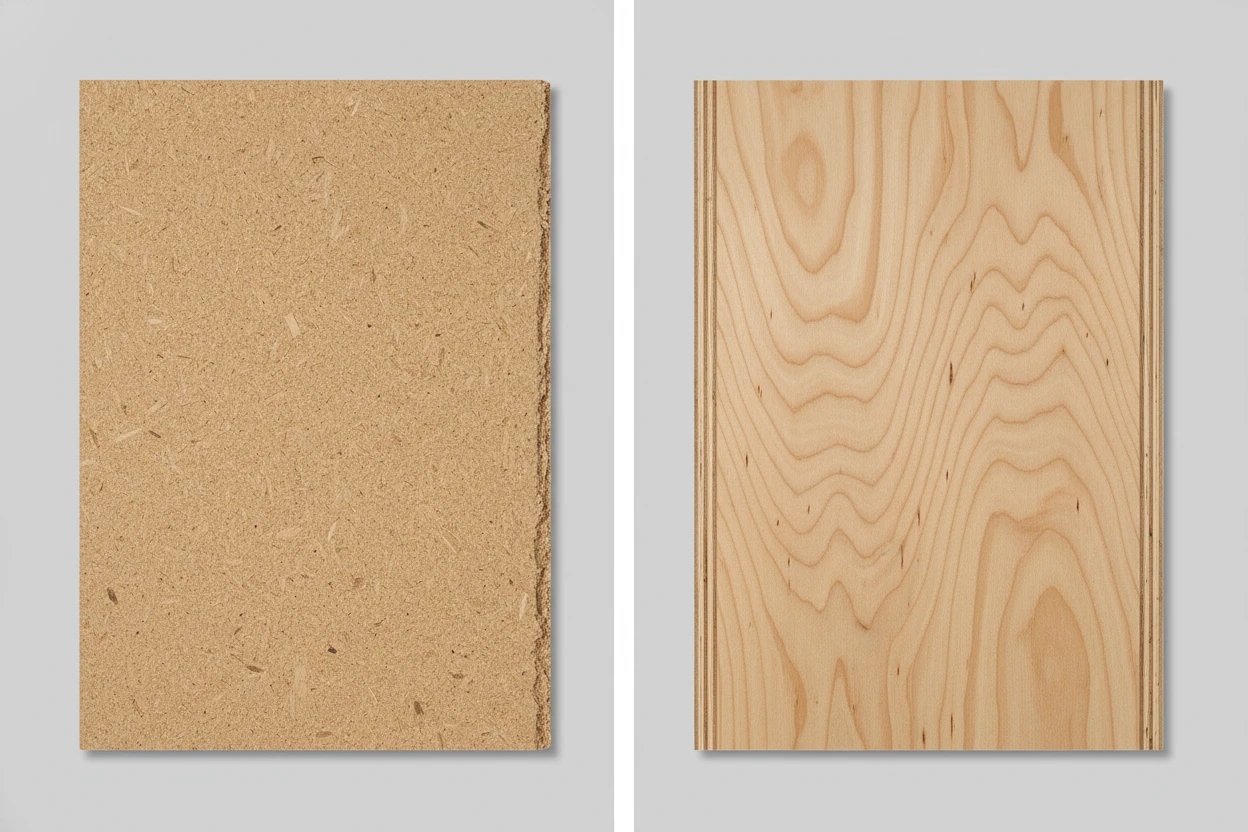
Particle board is lightweight, cost-effective, and provides a smooth surface for lamination and finishing. However, the material lacks structural strength and is highly susceptible to moisture damage. Common applications include ready-to-assemble (RTA) furniture, budget cabinetry, and decorative panels where appearance and cost are priorities.
What is Plywood?
Plywood is engineered wood constructed from multiple thin layers of wood veneer arranged in alternating grain directions and bonded with adhesive. This cross-grain lamination provides superior strength and stability compared to solid wood or particle board.
Read more: Birch Plywood Grades Explained: How to Choose the Right Grade for Your Project
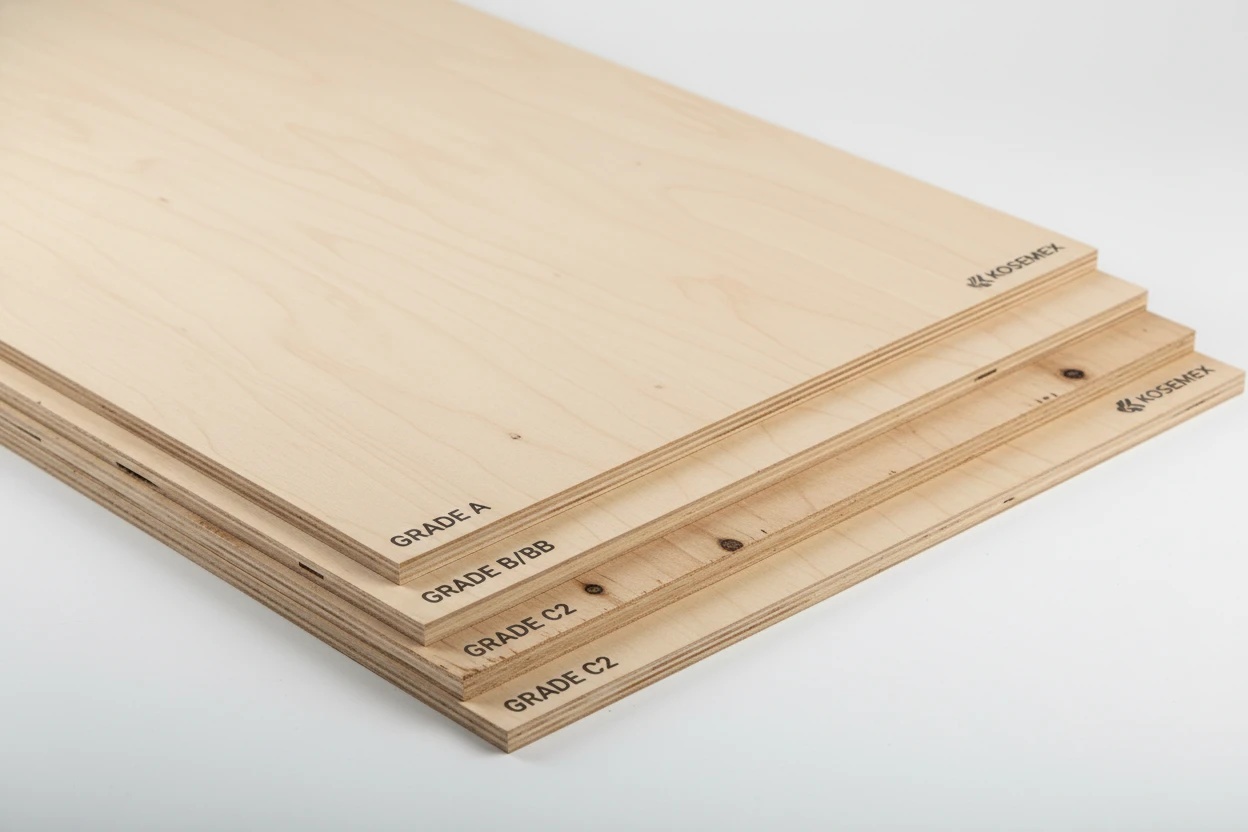
Plywood offers excellent structural integrity, durability, and moisture resistance when properly finished. Premium options like Baltic Birch plywood feature higher ply counts (7, 9, or more layers) and superior veneers, delivering enhanced performance. Plywood is suitable for furniture, cabinetry, flooring, and structural applications where durability matters.
Particle Board vs Plywood: Key Differences Explained
Material Composition and Manufacturing
Particle board compresses ground wood waste and resin into panels using industrial presses. The random orientation of wood particles provides uniform surface smoothness but limited strength in specific directions.
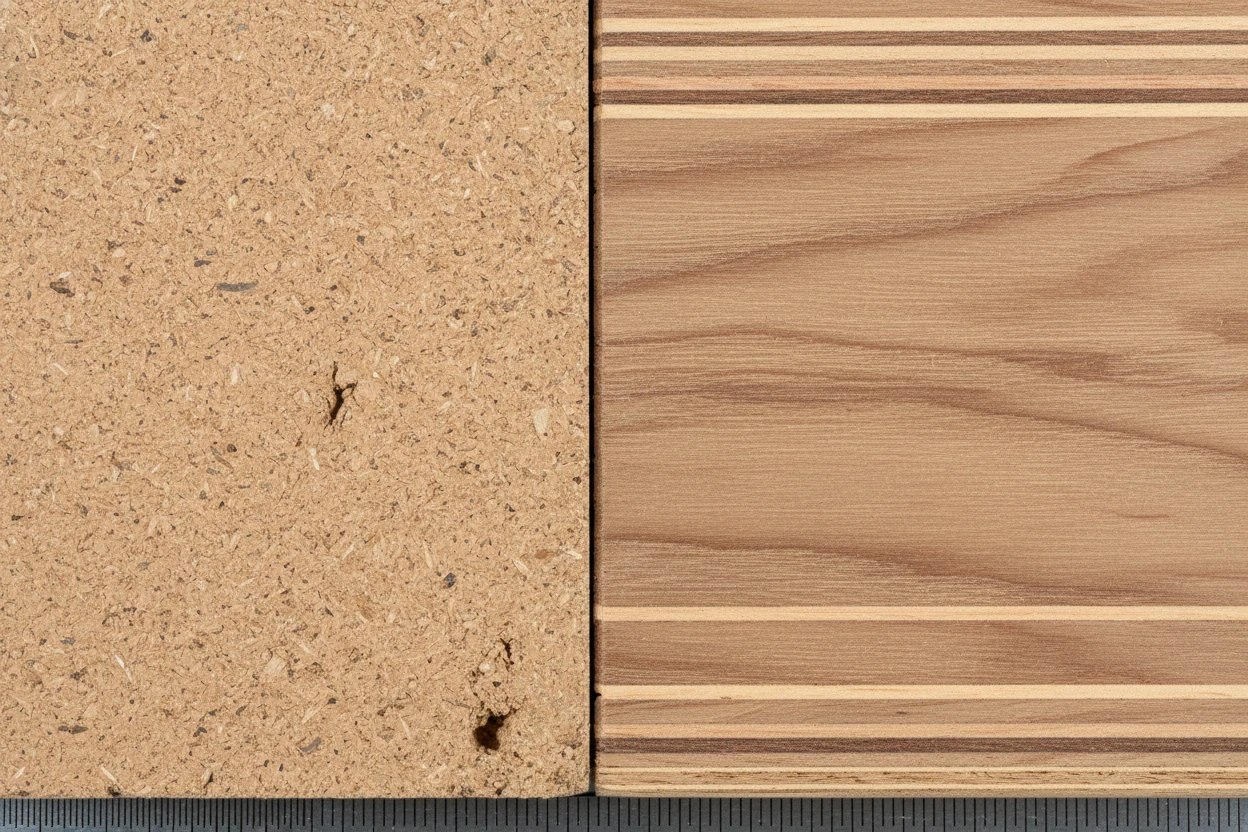
Plywood bonds multiple veneer layers with alternating grain orientation, creating balanced structural properties. This engineering approach distributes stress evenly, resulting in superior strength in all directions compared to particle board.
Strength and Durability Comparison
Plywood significantly outperforms particle board in structural strength and load-bearing capacity. Plywood handles heavy loads, supports shelving without sagging, and maintains integrity under stress. Particle board fails under sustained weight, makes poor shelving material, and easily breaks during installation.
Durability timeline differs dramatically: particle board lasts 5 to 10 years in typical use, while plywood remains functional for 30 to 50 years or longer with proper care. This durability advantage makes plywood more economical over extended ownership periods.
Moisture Resistance and Water Damage
Particle board is not waterproof and extremely vulnerable to moisture. Brief water exposure causes swelling, warping, and delamination. The synthetic resin bonding dissolves when saturated, destroying the panel’s structural integrity.
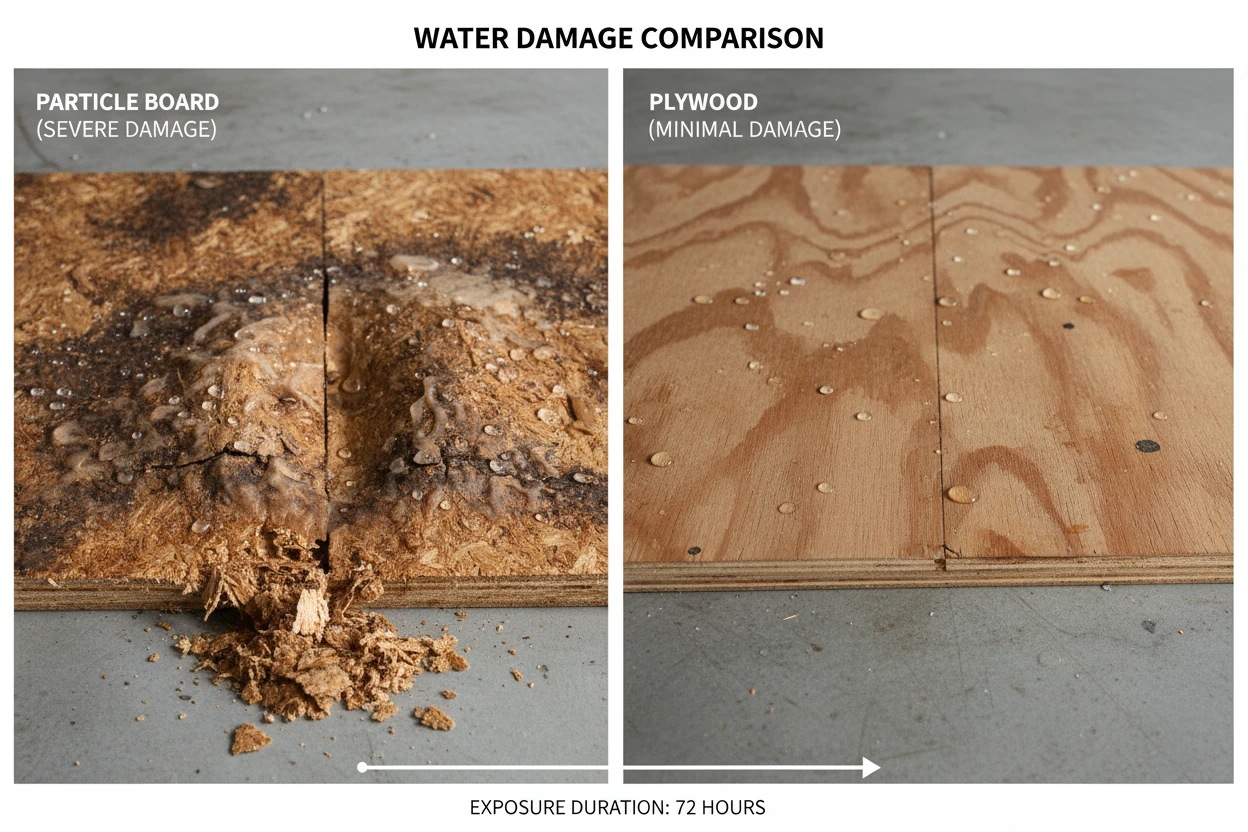
Plywood exhibits moderate moisture resistance and can withstand occasional humidity when properly sealed. Marine plywood uses waterproof adhesives providing superior water resistance for wet environments. Proper finishing and edge sealing make plywood suitable for kitchens and bathrooms where particle board fails immediately.
Weight and Structural Stability
Particle board is lighter than plywood, making it easier to handle and transport. However, this light weight correlates with weak structural performance. Particle board cannot support heavy loads or serve load-bearing applications.
Plywood is heavier due to superior density but provides structural stability preventing warping and sagging. For wall-mounted cabinetry or furniture with wheels, plywood’s stability ensures long-term performance.
Particle Board vs Plywood Comparison Table
| Property | Particle Board | Plywood |
|---|---|---|
| Composition | Wood chips plus resin | Multiple veneer layers |
| Strength | Weak | Very Strong (2 to 3 times stronger) |
| Durability | 5 to 10 years | 30 to 50 plus years |
| Water Resistance | Poor (swells easily) | Good (when sealed) |
| Weight | Light | Heavier (denser) |
| Moisture Content Tolerance | Fails quickly | Handles humidity better |
| Screw Holding | Poor (pullout risk) | Excellent |
| Cost per Sheet | $20 to 50 | $50 to 150 |
| Best For | Budget furniture | Durable cabinetry |
| Lifespan | Short-term | Long-term |
| Environmental Impact | Uses waste wood | Requires forest resources |
| Finishing Options | Laminate or paint | Stain, veneer or paint |
Particle Board vs MDF vs Plywood
Particle Board vs MDF
MDF (Medium-Density Fiberboard) is stronger than particle board but weaker than plywood. MDF uses finer wood fibers creating a smoother surface than particle board, suitable for detailed finishing and veneering.
MDF vs moisture: Like particle board, MDF is susceptible to water damage and swelling, though less dramatically than particle board. Both materials require protection from humidity. However, MDF maintains shape better than particle board when exposed to occasional moisture spikes typical in kitchens.
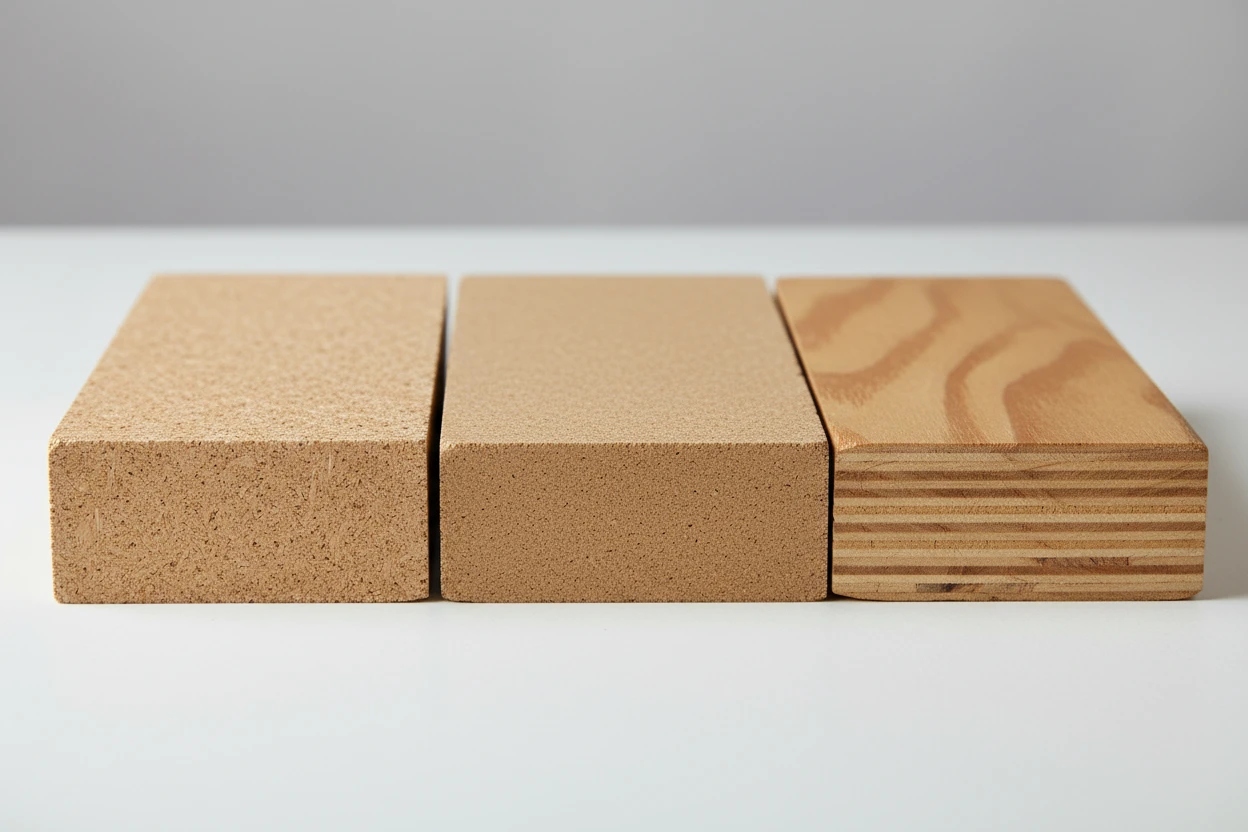
MDF vs Plywood comparison: Plywood offers superior strength and durability compared to both materials. However, MDF provides better surface smoothness than plywood or particle board when detailed finishing is required. MDF’s density allows for intricate edge detailing and router work impossible with particle board.
Cost perspective: MDF costs approximately $40 to 100 per sheet, positioned between particle board and plywood. For budget-conscious projects requiring smoother surfaces than particle board offers, MDF provides a middle ground.
Three Material Performance Summary
Particle board excels at affordability only. Weak structural properties, poor moisture resistance, and short lifespan limit it to temporary applications. MDF offers moderate improvements in strength and surface quality but shares moisture vulnerability with particle board. Plywood clearly dominates in strength, durability, and moisture resistance, justifying premium pricing through long-term value.
OSB vs Plywood vs Particle Board
OSB (Oriented Strand Board) differs from particle board by arranging wood strands in specific directions for improved directional strength. Unlike particle board’s random orientation, OSB’s engineering provides moderate structural performance suitable for construction sheathing and subflooring.
OSB vs moisture: Like particle board, OSB is vulnerable to water damage but performs better in temporary moisture exposure. OSB is primarily used in construction rather than furniture, making direct furniture application comparisons less relevant.
Structural comparison: Plywood significantly outperforms both particle board and OSB for furniture and cabinetry applications. OSB’s strength suits construction applications but lacks the refinement and durability required for quality furniture. Particle board remains the weakest option across all structural metrics.
Application distinction: OSB is engineered for construction work including subflooring, roof sheathing, and wall sheathing, while particle board and plywood compete for furniture applications. For DIY furniture and cabinetry, the particle board vs plywood choice is most relevant, with plywood superior.
Particle Board vs Plywood Cabinets: Which Is Better?
Cabinets Made from Particle Board
Particle board cabinets are budget-friendly, costing 30 to 50 percent less than plywood alternatives. Suitable for temporary installations or rental properties where durability is not critical. RTA (ready-to-assemble) furniture manufacturers rely heavily on particle board for cost-conscious consumer market penetration.
Performance reality: Particle board cabinets under kitchen sinks fail within 2 to 3 years due to water exposure. Most particle board cabinets warp noticeably after 3 to 5 years of regular use as humidity fluctuations cause swelling and shrinkage cycles. Doors misalign, shelves sag, and fasteners loosen as the material degrades.
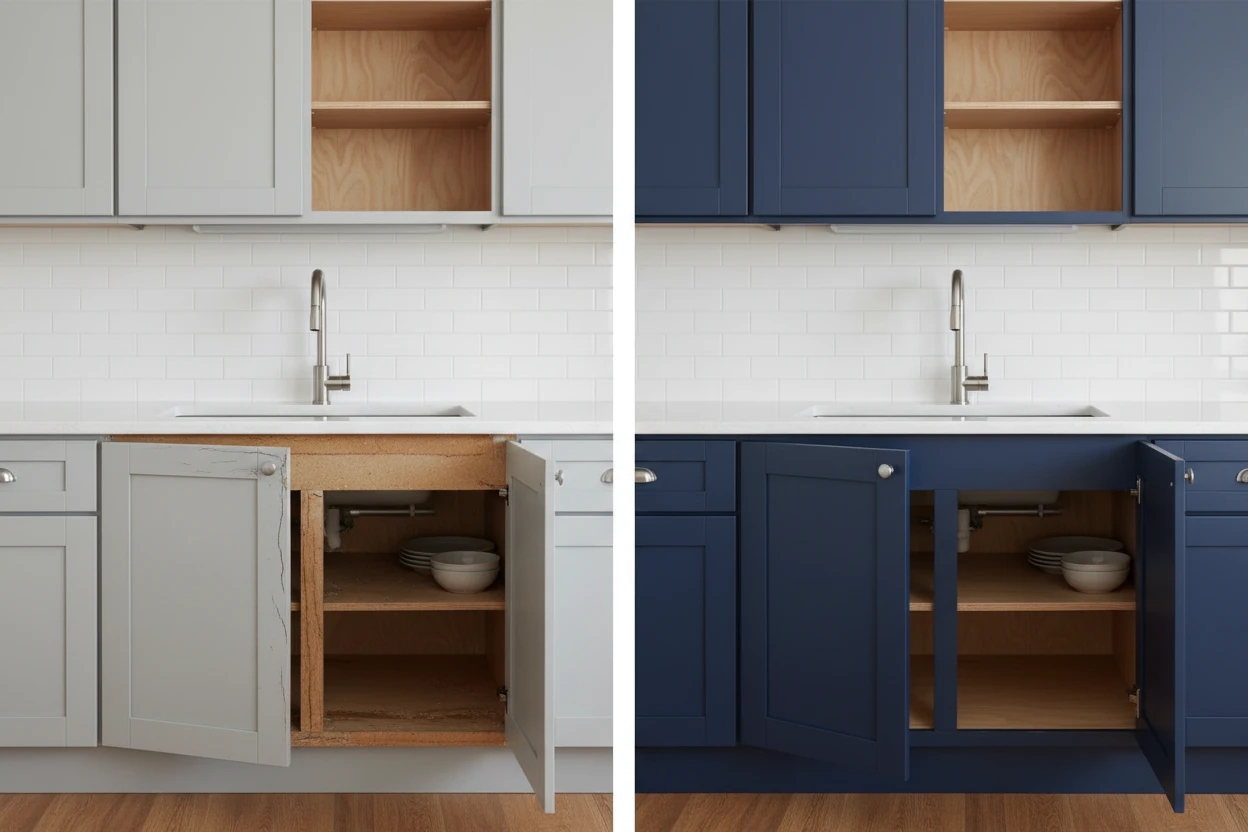
Disadvantages are significant: Particle board cabinets cannot support heavy dishware or appliances. Water exposure from kitchen sinks or bathroom humidity causes irreversible damage through swelling, delamination, and structural failure. Most particle board cabinets require replacement within 5 to 10 years of regular use, offsetting initial cost savings through premature replacement.
Cabinets Made from Plywood
Plywood cabinets offer superior durability maintaining structural integrity for decades. Kitchen and bathroom environments where moisture exposure is common require plywood’s superior moisture resistance. Professional cabinetmakers specify plywood exclusively for quality installations.
Performance advantages: Plywood cabinets hold fasteners reliably, support heavy loads without sagging, and accept finishes beautifully for professional appearance. Plywood cabinets remain functional and attractive after 20 to 30 plus years of regular use. Kitchen cabinets can withstand moisture from daily sink use, dishwasher steam, and humidity without deterioration.
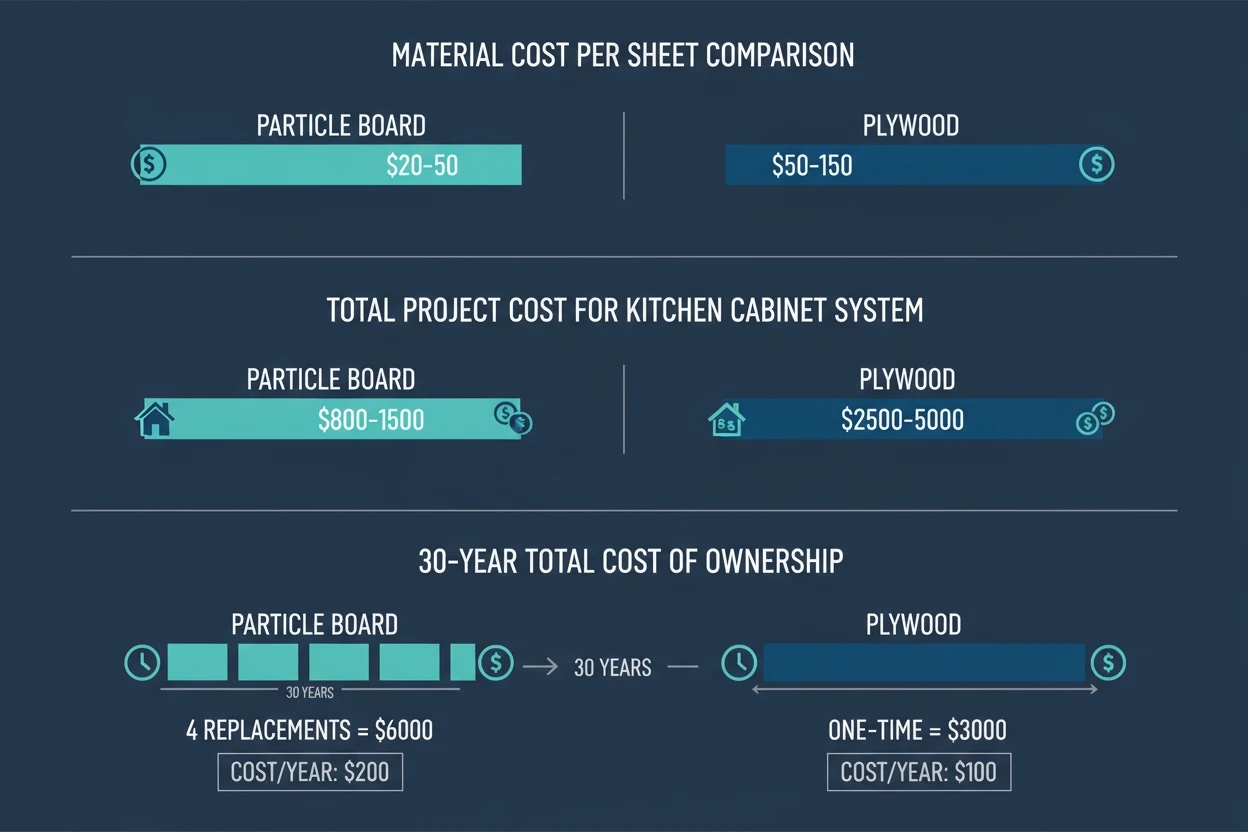
Long-term value significantly exceeds particle board, even at higher initial cost. A plywood cabinet system costing 3,000 dollars and lasting 30 years costs 100 dollars annually. A particle board system costing 1,500 dollars but lasting 8 years costs 187.50 dollars annually. Over 30 years, plywood proves more economical despite higher upfront investment.
Which is better plywood or particle board? For anything beyond temporary installations, plywood is unquestionably superior, delivering decades of reliable service versus particle board’s 5 to 10 year lifespan.
Cost Comparison: Particle Board vs Plywood
Particle board costs $20 to 50 per sheet, making it attractive for budget-conscious projects. A basic particle board cabinet system costs 800 to 1,500 dollars for a kitchen application. Plywood costs $50 to 150 plus per sheet depending on grade, thickness, and species (birch, oak, softwood). Equivalent plywood cabinetry costs 2,500 to 5,000 dollars.
Cost factors affecting price include thickness, with 3/4 inch costing more than 1/2 inch, and structural applications requiring thicker material. Grade matters significantly, as A/B grades designed for visible surfaces cost 2 to 3 times more than C/D structural grades. Veneer quality affects pricing, with premium veneers like Baltic birch exceeding standard birch pricing by 30 to 50 percent. Species also impacts cost, with hardwood veneer (birch, oak, maple) costing more than softwood plywood.
Manufacturing source affects pricing, as imported plywood carries shipping costs affecting overall price. Hidden cost factors matter significantly. Particle board requiring fastener upgrades (pocket hole joinery, reinforcement) adds expense. Lamination costs for both materials differ considerably. Quality laminate for plywood ensures longevity, while laminate on particle board merely delays inevitable failure.
However, total cost of ownership differs dramatically. Particle board requiring replacement after 8 years (1,500 dollar cabinet system times 4 replacements equals 6,000 dollars over 30 years). Plywood lasting 30 years (3,000 dollar one-time investment). Plywood costs half as much per year of use despite twice the upfront cost.
Lamination and Finishing: Plywood vs Particle Board
Can You Laminate Particle Board vs Plywood?
Particle board accepts lamination, providing decorative finishes and moisture protection. Factory-laminated particle board represents the majority of RTA furniture. However, laminated particle board remains structurally weak and vulnerable to delamination when saturated. Lamination extends aesthetic appeal but does not enhance durability.
Edge sealing is critical for particle board as exposed edges absorb moisture rapidly. Even laminated particle board fails when water reaches unsealed edges, causing catastrophic swelling. Professional lamination includes edge banding (plastic or veneer applied to edges) providing moisture protection critical for extending particle board lifespan.
Plywood accepts veneers, laminates, and paint beautifully. Veneer or laminate application on plywood creates premium furniture maintaining structural integrity. Plywood’s superior strength supports heavier finishes without warping or failure. Veneer application over plywood creates luxury furniture indistinguishable from solid wood.
Durability of Protective Finishes
Laminated particle board lasts as long as the laminate (5 to 10 years typical). Once laminate peels or moisture penetrates edges, structural failure accelerates. Delamination (separation of laminate from particle board surface) creates unusable furniture requiring replacement.
Read more: How to Finish Birch Plywood: Complete Guide to Staining, Painting, and Sealing
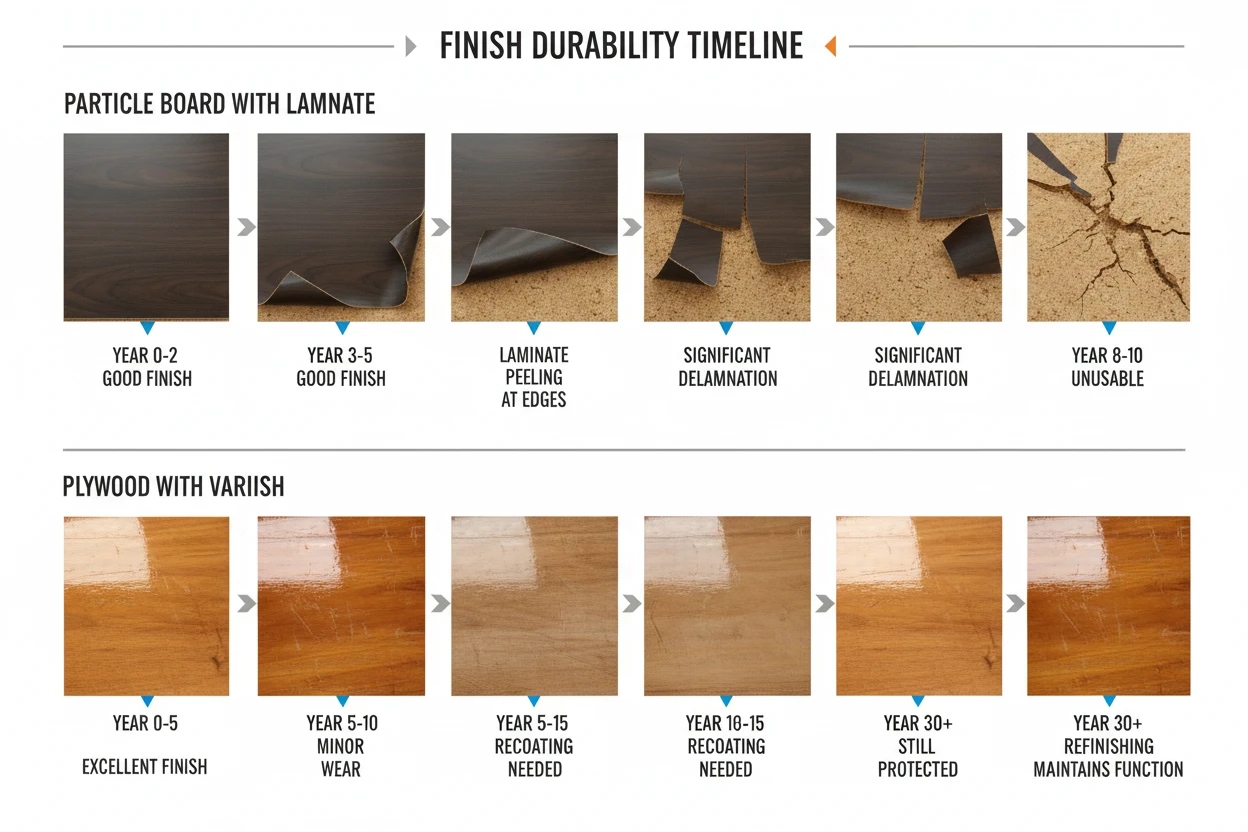
Plywood with proper finishing (varnish, lacquer, or sealed laminate) lasts decades, with the finish protecting the underlying material. Recoating or refinishing maintains protection indefinitely. Professional craftspeople refinish plywood furniture after 20 to 30 years, restoring appearance and protection while maintaining original structural integrity.
How to Identify: Is My Old Furniture Plywood or Particle Board?
Visual Inspection
Examine the cut edge: Particle board displays uniform, grainy appearance showing compressed wood particles distributed throughout. Plywood shows distinct layers of veneer with visible grain patterns in each layer. Baltic birch displays 7, 9, or more distinct layers, each clearly separated.
Look at shelf undersides or cabinet bottoms where raw edges are visible. Particle board appears granular and uniform. Plywood shows clear lamination with individual veneer sheets stacked alternately. The layer distinction is obvious on quality plywood.
Weight Test
Particle board is notably lighter than plywood of equivalent thickness. Pick up the piece. If suspiciously light, likely particle board. A 3/4 inch plywood sheet (4 feet by 8 feet) weighs approximately 45 to 50 pounds. Equivalent particle board weighs 30 to 35 pounds (distinctly lighter). Particle board’s lightweight nature becomes obvious when moving furniture.
Water Resistance Test
Apply water droplet to concealed area: Particle board absorbs water quickly causing visible darkening and slight swelling within minutes. Plywood resists water, with moisture beading up on sealed surfaces. Unsealed plywood gradually absorbs water but more slowly than particle board.
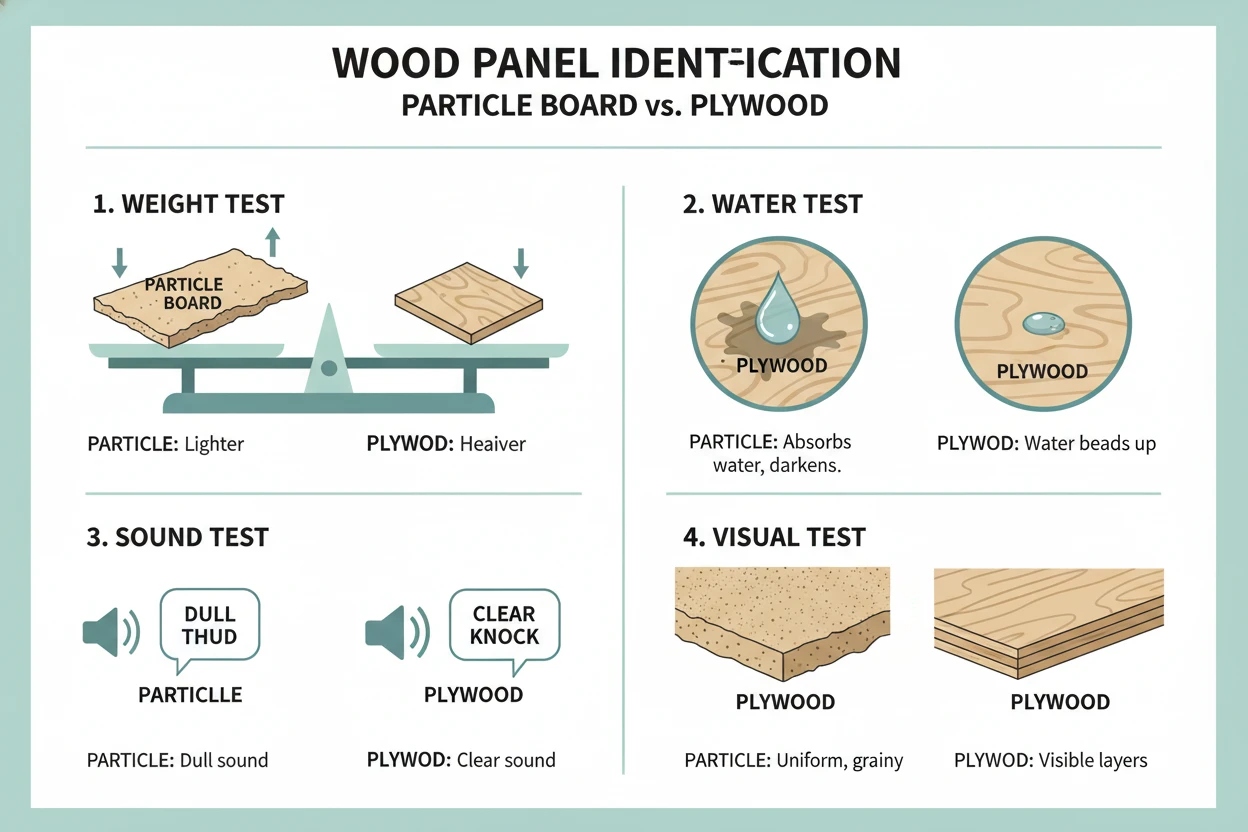
Test on a hidden location (furniture bottom or back) to avoid surface damage. Particle board water absorption is obvious within 5 to 10 minutes. Plywood shows minimal absorption and water beads on the surface.
Sound Test
Tap the surface gently: Particle board produces dull, muffled sound due to low density and poor internal cohesion. Plywood creates sharper, clearer sound due to superior density and layer structure. The acoustical difference becomes apparent through comparison. Particle board sounds dead while plywood sounds solid.
Advantages and Disadvantages of Particle Board
Pros
Particle board offers very affordable pricing, costing 30 to 50 percent less expensive than plywood and reducing upfront project costs. The material is lightweight, making it easy to handle and transport while requiring less equipment and labor. Particle board provides a smooth surface that serves as an excellent base for lamination and paint, accepting finishes evenly. The uniform appearance ensures consistent coloring and texture throughout panels without variation.
This material is recyclable, utilizing waste wood and reducing environmental landfill impact. Particle board is available everywhere through widely stocked building supply retailers. The material is easy to cut and work with, allowing standard tools to cut cleanly without splintering.
Cons
Particle board offers weak strength and cannot support significant loads, which limits applications severely. It provides poor moisture resistance, swelling and failing when wet, making it unsuitable for kitchens and bathrooms. The material features low durability with a typical 5 to 10 year lifespan, requiring frequent replacement. Particle board exhibits weak screw holding, with fasteners pulling out easily and requiring reinforcement methods. The material cannot be refinished since surface damage is permanent with no repair options available. Health concerns exist regarding formaldehyde off-gassing, especially in poorly ventilated spaces. Particle board is not suitable for permanent installations and requires regular replacement over time. The material has poor edge quality, with exposed edges absorbing moisture rapidly and causing failure. Difficult repairs are required since damage cannot be patched or repaired, necessitating replacement.
Environmental Impact and Sustainability
Particle board benefits from sustainability perspective by utilizing wood waste, sawdust, and manufacturing byproducts. The manufacturing process redirects waste from landfills into usable material. This waste diversion represents genuine environmental benefit compared to virgin resource consumption.
However, particle board’s short lifespan undermines environmental benefits. A piece lasting 8 years requires replacement five times over 40 years, consuming resources equivalent to five harvests. Total resource consumption for four decades of particle board replacements exceeds single plywood investment lasting 40 years.
Plywood requires harvesting forest resources but offers superior durability. A plywood piece lasting 40 years provides better environmental value than particle board lasting 8 years requiring replacement five times over the same period. Per-year resource consumption over extended lifespan favors plywood despite higher per-unit resource requirements.
FSC-certified plywood ensures sustainable harvesting from responsibly managed forests. Baltic Birch plywood from Scandinavian sources often carries sustainability certifications. Choosing certified plywood maximizes environmental benefit while ensuring long-term performance.
Best Use Cases: When to Choose Which Material?
Choose Particle Board When
Budget is the primary constraint where project costs must be minimized significantly. The project is temporary or short-term spanning 1 to 5 years duration. Moisture exposure is minimal in dry, climate-controlled environments. Lightweight material is essential when weight limitations exist. Decorative appearance matters more than durability for the application. Quick replacement is acceptable without significant loss if failure occurs. Rental properties exist where tenant damage risk is high. Children’s temporary furniture or seasonal use items are the focus.
Choose Plywood When
Long-term durability is important with ownership spanning 10 plus years. Moisture or humidity exposure is likely in kitchens, bathrooms, and laundries. Load-bearing capacity is required for shelving with heavy items. Professional appearance and quality matter for visible surfaces. Cost of ownership over time is a consideration for budget planning.
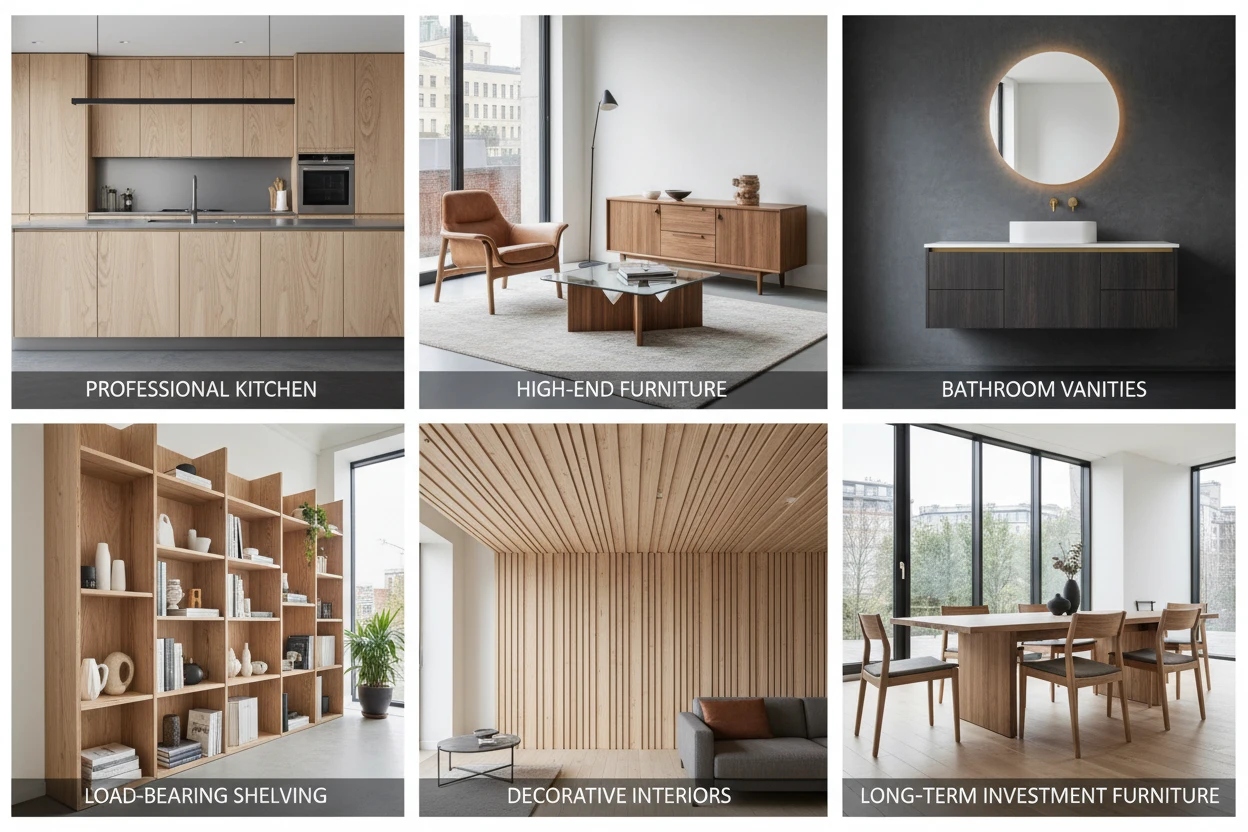
Refinishing or repairs may be needed for maintaining investment value. Structural integrity is critical for safety in cabinetry supporting appliances. Furniture is intended as heirloom or long-term investment. Rental income property benefits from durability preventing expensive replacements.
Particle Board vs Plywood FAQs
What is Particle Board vs Plywood?
Particle board is compressed wood chips and sawdust bonded with resin (lightweight, affordable, but weak and moisture vulnerable). Plywood is multiple veneer layers in alternating grain directions (strong, durable, and moisture resistant). Plywood is superior for anything beyond temporary use. Particle board serves budget projects only.
Which is Better Plywood or Particle Board?
Plywood is definitively better for anything beyond temporary use. Superior strength (2 to 3 times stronger), durability (30 to 50 plus years vs 5 to 10 years), and moisture resistance make plywood the clear choice. Particle board’s only advantage is lower cost.
Is Particle Board Waterproof?
No, particle board is not waterproof. Brief water exposure causes swelling and warping. Extended moisture exposure destroys structural integrity. Particle board is unsuitable for kitchens, bathrooms, or any moisture exposed environments.
Can You Laminate Plywood vs Particle Board?
Yes, both accept lamination. However, laminated particle board remains structurally weak and vulnerable to delamination when saturated. Plywood’s superior strength supports laminate application maintaining durability for decades.
What Are the Disadvantages of Particle Board?
Major disadvantages: weak strength, poor moisture resistance, low durability (5 to 10 years), weak screw holding, non-refinishable surfaces, health concerns from formaldehyde, and unsuitability for permanent installations. The only advantage is lower cost.
Is My Old Wood Plywood or Particle Board?
Examine cut edge: Particle board shows uniform particles; plywood shows distinct veneer layers. Weight test: Particle board is lighter. Water test: Particle board absorbs water; plywood resists. Sound test: Particle board sounds dull; plywood sounds sharper.
Conclusion: Particle Board vs Plywood Final Verdict
Particle board and plywood serve different purposes. Particle board is appropriate for temporary, budget conscious projects where durability and moisture resistance are not critical. Plywood is essential for permanent installations, durable furniture, and environments with moisture exposure.
The choice depends on your actual needs: If building temporary or rental furniture, particle board suffices. For quality cabinetry, shelving, or furniture lasting decades, plywood’s superior strength, durability, and moisture resistance justify the higher cost.
Long-term value strongly favors plywood. A piece lasting 40 years costs less per year than particle board requiring replacement five times over the same period.
For comprehensive information about plywood options and quality specifications, explore our complete birch plywood guide. For understanding premium plywood materials suitable for furniture and cabinetry projects, see our birch plywood furniture ideas.
Bình luận