


What buyers mean by 6mm, 8mm and 9mm plywood
These numbers are nominal panel thicknesses. They do not describe the species, number of plies, veneer thickness, face quality, glue system, density, sanding calibration or permitted tolerance. Two panels sold as 9mm can therefore behave differently during cutting, edge machining, lamination and installation.
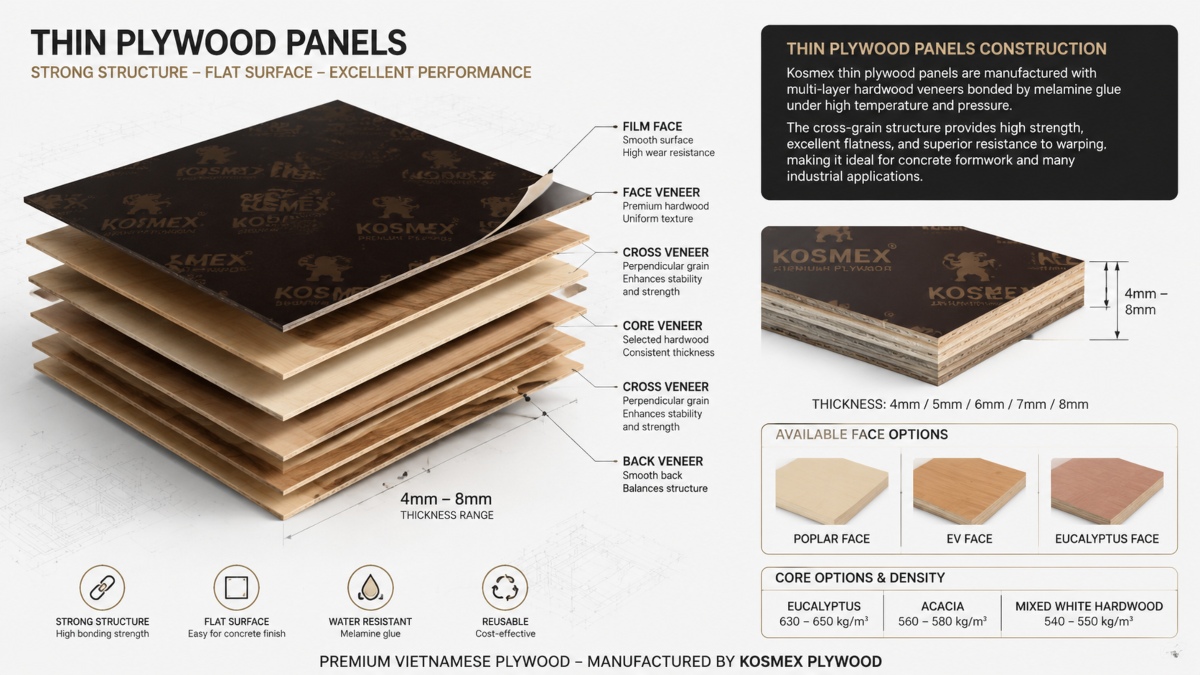
Plywood gains dimensional stability from alternating veneer grain directions. Cross lamination reduces movement compared with a single wide board, but it does not make the product immune to moisture gradients or internal stress. This is why professional buying starts with construction and end use, not with thickness alone. Buyers who need a broader reference can also review Kosmex guides to types of plywood and standard plywood sizes.
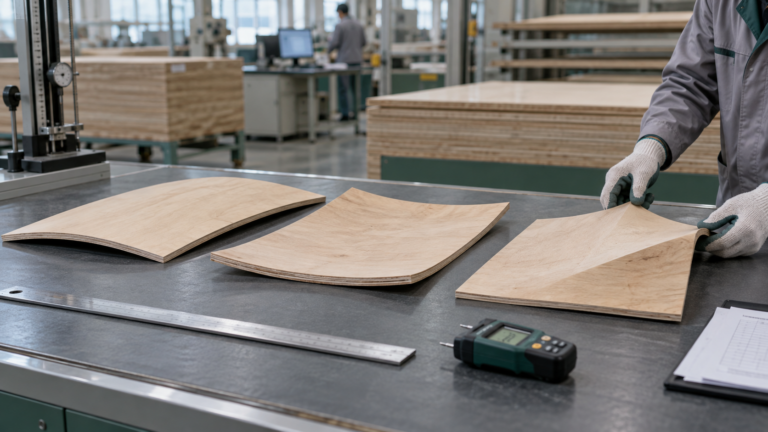
In this guide, flatness means resistance to unwanted bow, cup and twist under agreed conditioning and support. It does not mean the panel cannot deflect elastically under load. Every thin panel will bend to some degree if the span, load or support pattern demands it. The practical objective is a balanced panel that arrives within an agreed flatness limit and remains suitable when stored, machined and installed correctly.

Quick comparison: 6mm vs 8mm vs 9mm plywood
| Nominal thickness | Typical buyer uses | Why buyers choose it | Main checks |
|---|---|---|---|
| 6mm | Cabinet backs, drawer bottoms, liners, decorative inserts, partitions, lamination substrate | Low profile and lower panel weight | Support spacing, fastening, face quality, moisture, flatness after machining |
| 8mm | Furniture components, wall lining, display units, vehicle or case liners, fabricated panels | A useful midpoint between light weight and handling stiffness | Actual finished thickness, construction symmetry, edge quality, packing support |
| 9mm | Cabinet components, partitions, furniture carcass elements, light shelving with support, interior fit out | More handling stiffness and fastener engagement than thinner alternatives | Span and load, core quality, screw tests, weight, surface calibration |
The applications above are screening guidance, not structural design values. A cabinet back held in grooves behaves differently from a free standing partition. A 9mm shelf with a long unsupported span can still deflect. Confirm span, load, fixing pattern, service humidity and required safety factor before final approval.
When 6mm plywood is the right choice
6mm plywood is useful where the component is supported and the design values slim profile or reduced weight. Common examples include cabinet backs captured in a rebate, drawer bottoms supported on four sides, liners, exhibition panels, decorative layers and substrates that will receive another surface. Kosmex discusses similar thickness decisions in its kitchen cabinet plywood guide.
The buying risk is treating 6mm as a miniature version of a thick structural panel. It has less bending stiffness, edges provide limited screw purchase, and large unsupported sheets are easier to damage during handling. Face checking, core gaps and local thickness variation can also become more visible after finishing or lamination.
A useful 6mm specification therefore names the support condition and the next manufacturing step. If a decorative film will be applied, ask for a calibrated surface and confirm whether both faces will receive balanced treatments. If the sheet will be routed, test the selected construction for edge breakout. If it will form a cabinet back, prototype the groove, perimeter fixing and diagonal racking performance.
Why 8mm plywood deserves its own specification
8mm plywood is often missing from generic thickness charts, yet it can be commercially valuable. It can provide more handling stiffness than 6mm without automatically moving the project to 9mm. That can matter in furniture parts, shopfitting, displays, wall lining and manufactured cases where every millimetre affects finished dimensions or shipping weight.
Do not accept 8mm only as a label. Ask for the proposed ply construction, actual finished thickness range and sample weight. A mill may reach the same nominal thickness with different veneer schedules. Those choices influence symmetry, core quality, density and machining. If the panel will be pressed with a laminate, test the complete lay-up because an unbalanced decorative treatment can pull even a well made substrate out of flat.
When 9mm plywood adds useful stiffness
9mm plywood is a common step up for partitions, cabinet components, furniture panels and light shelves that have appropriate support. The extra thickness usually improves handling stiffness and edge area, but it is not a substitute for engineering. Long spans, concentrated loads and wet service conditions require a design check.
Core species matters. Eucalyptus core is typically selected when buyers want higher density and a firm machining feel. Poplar core can reduce weight and can be attractive for interiors. Mixed or combination cores can balance cost, weight and performance. The buyer should compare the actual proposed constructions, not species names in isolation. Kosmex provides additional context in its guides to eucalyptus vs poplar plywood and poplar core plywood.
Flatness is a system, not a marketing adjective
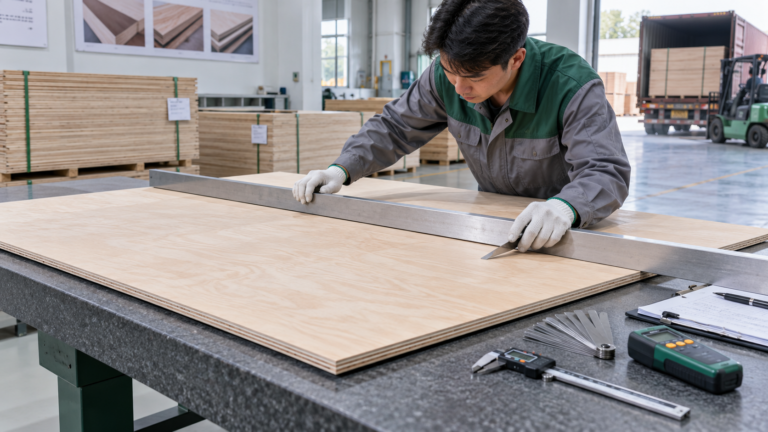
A useful flatness claim answers four questions: how was the panel conditioned, how was it supported, how was deviation measured, and what limit was accepted? Without those details, phrases such as “no bending” or “never warps” are not verifiable.
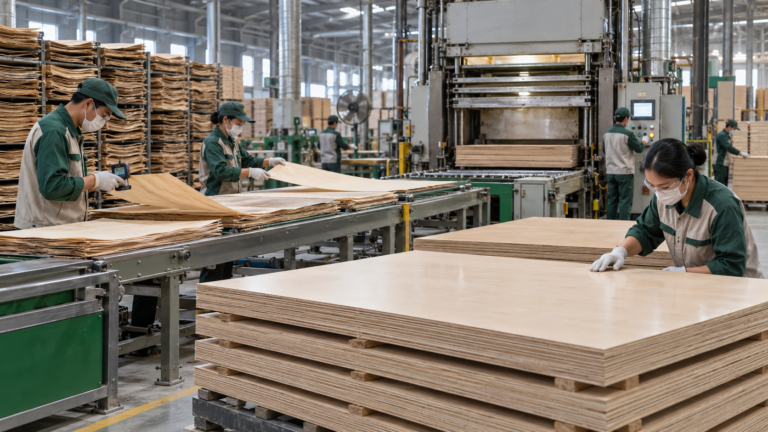
Flat panels begin with controlled veneers. Moisture should be measured and sorted so that unusually wet or dry veneers do not create an imbalance. Face and back constructions should be compatible. Glue spread, assembly time, press temperature, pressure and time must suit the construction. After pressing, panels need controlled conditioning before final sanding, grading and packing.
Core gaps and overlaps also matter. A large gap can leave a weak line or telegraph through the face. An overlap can create a local ridge and thickness variation. For a closer look, see plywood core gaps and overlaps and the comparison of machine composed and hand joined cores.
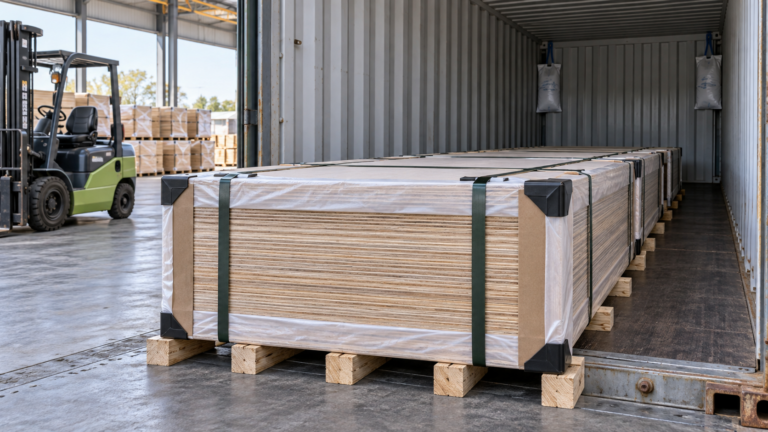
The factory is only one part of the system. A flat bundle can change if it is stored on uneven bearers, exposed to rain, heated on one face, strapped over unsupported areas or opened immediately after a large climate change. This cluster therefore links manufacturing control with pre-shipment inspection and logistics.
Core, face and bond choices
Core species and construction
The core contributes most of the panel thickness and strongly influences weight, stiffness, machining and cost. Eucalyptus is generally denser than poplar. Pine offers a different balance of availability, texture and density. Engineered veneer, often shortened to EV, normally describes the decorative face veneer rather than the structural core. Always list face and core separately in the RFQ.
Face and back balance
A decorative face paired with a very different back can create an asymmetric moisture response. That does not mean both faces must look identical, but their construction and finishing schedule should be designed as a balanced system. When one face receives UV coating, laminate or another low permeability finish, trial the reverse face and process conditions as well.
Bond and emissions
Select the adhesive system for the end use and destination requirements. Interior furniture, humid interiors and exterior exposure are different service conditions. Ask for the declared bond class or agreed test method instead of relying on a broad word such as “waterproof.” If formaldehyde emission is regulated by the market or customer, state the limit and request a report that matches the proposed construction.

A buyer specification that suppliers can actually quote
Send one controlled specification with the RFQ. At minimum, include:
- nominal thickness and permitted actual thickness range;
- sheet length, width and squareness requirement;
- end use, support condition and critical machining operations;
- face species or EV pattern, face grade and repair limits;
- back construction needed to balance the panel;
- core species, permitted composition and core defect limits;
- bond or glue requirement and any referenced test method;
- target moisture range and conditioning requirement;
- flatness definitions, test support, sample size and acceptance limits;
- sanding calibration, surface finish and coating or lamination plan;
- emission, legality and destination documents;
- bundle protection, bearer spacing, straps and container plan.
This level of detail improves price comparison. A low quote may represent a different core, looser surface standard, fewer controls or lighter packing. Kosmex also recommends reviewing the documents to request from a Vietnam plywood supplier before order approval.
Sample approval and production verification
A small sample is useful for face approval, but a full sheet is more informative for flatness, diagonal measurement and machining. Mark the approved sample with the product code, construction, date and approval status. Keep a sealed reference when the commercial risk justifies it.
Run the full production sequence on the sample: cut it, route or drill it, apply the planned finish, assemble it and expose it to the expected climate. Record the result. A panel that looks flat in a warehouse may react after one face is coated or after a wide part is cut from the sheet.
For production, define a sampling plan and report format. Record sample identity, instrument calibration, conditioning, measurement location and result. Photos should include the panel ID and measuring device. Buyers can use Kosmex guidance on evaluating a Vietnam plywood factory to connect sample approval with process evidence.
Common buying mistakes
- Choosing by thickness only. The same nominal thickness can hide different constructions.
- Using “no bending” as the requirement. Separate permanent warp from normal deflection under load.
- Approving only a small face sample. Full sheet behaviour and machining remain unknown.
- Coating one face without a balance trial. Unequal moisture exchange can cause curvature.
- Ignoring storage and packing. Good factory flatness can be lost on uneven supports or in a wet container.
- Comparing price per sheet without weight and usable yield. Rejects, rework and damaged edges can erase a small unit price advantage.
If weight affects handling or container planning, use measured sample density and the approved dimensions. Kosmex provides a starting point in how much a sheet of plywood weighs, but the production construction should determine the final calculation.
Final selection checklist
Choose 6mm when the panel is continuously supported or fixed around its perimeter and low profile matters. Consider 8mm when the project needs a practical middle thickness with more handling stiffness. Move to 9mm when extra stiffness, edge area or robustness helps, while still checking the span and load. In every case, approve the proposed construction and finish, define measurable flatness, test the real application and protect the bundle through shipment.
The strongest commercial position is not an absolute promise that plywood can never bend or warp. It is a controlled product: balanced construction, traceable factory records, agreed inspection and packing that is designed for the route to the buyer.
Frequently asked questions
Which is better, 6mm, 8mm or 9mm plywood?
There is no universal best thickness. Choose 6mm for supported liners, backs and light components, 8mm when more handling stiffness is useful, and 9mm when the design needs a firmer panel or a somewhat longer supported span. Confirm the final choice by prototype or engineering review.
Does more thickness guarantee a flatter sheet?
No. Thickness can improve handling stiffness, but flatness also depends on balanced construction, veneer moisture, glue spread, pressing, conditioning, sanding, storage and packing.
Can 6mm plywood be used for cabinet backs?
Yes, when the back is captured in grooves, fixed around the perimeter or otherwise supported. Panel size, fastener spacing, humidity and load still matter.
What should a buyer request with a sample?
Request the proposed production construction, face and back standard, core species, glue or bond class, moisture target, thickness tolerance, flatness method, packing method and any relevant test reports.
Bình luận