


Film Faced Plywood Manufacturing Process at a Glance
- Select and prepare veneer-grade logs.
- Peel, clip, dry and grade veneers.
- Repair or compose veneer sheets for a consistent core.
- Apply adhesive and cross-lay the plies.
- Pre-press and hot-press the plywood substrate.
- Trim, calibrate, sand and repair the surface.
- Apply resin-impregnated film to the faces.
- Press and cure the film onto the panel.
- Final-trim, seal the edges and mark the product.
- Inspect, test, pack and release the batch.
The first stages are shared with general plywood manufacturing. Film faced production becomes distinct in the required substrate quality, surface preparation, overlay lamination and formwork-oriented inspection.
1. Log and Veneer Preparation
Log selection and conditioning
Manufacturing begins with timber selected for peeling into veneer. Species, log age, diameter, growth defects and storage affect the resulting sheets. Logs are debarked and cut to the required block length. Depending on species and equipment, they may be conditioned with heat and moisture so the veneer peels more evenly.
Buyer relevance: A core described only as “hardwood” gives limited information. Ask which species or mix is used, whether changes are controlled and how the supplier manages seasonal raw-material variation.

Rotary peeling and clipping
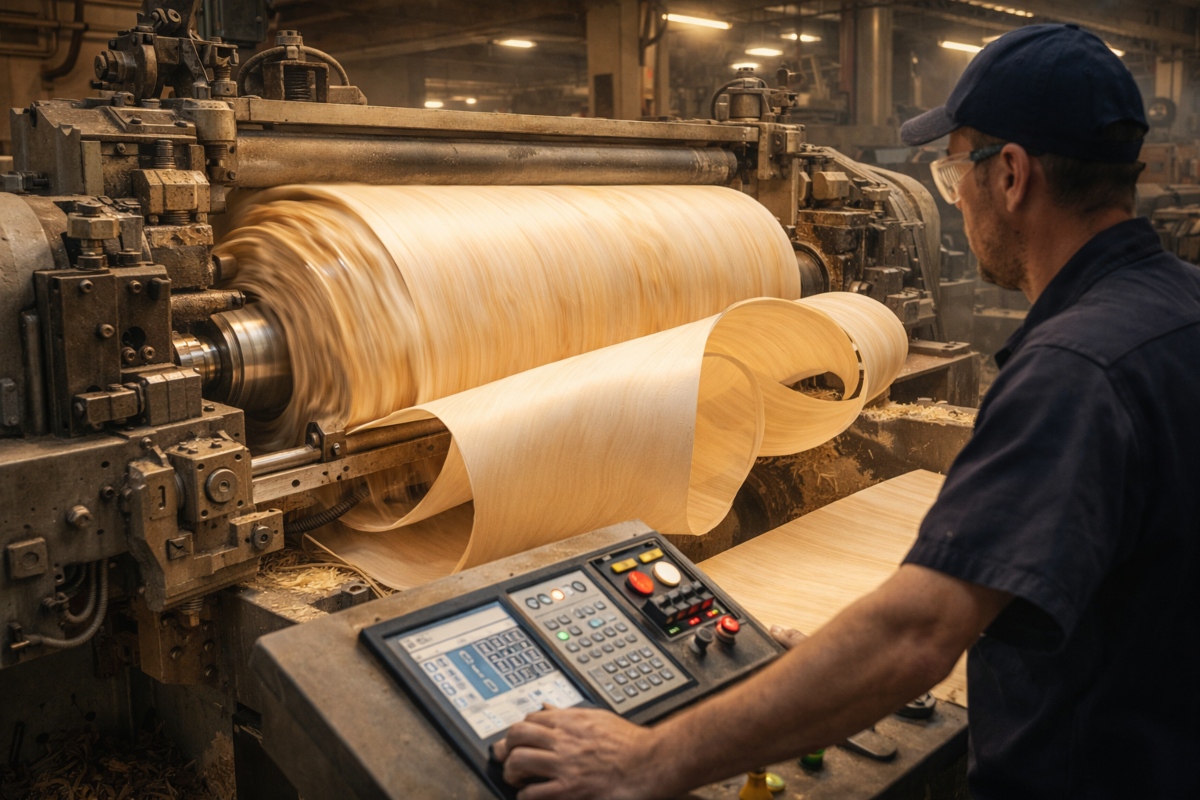
A rotary lathe peels the log into a continuous veneer ribbon. The ribbon is clipped into usable sizes, while major splits, holes and irregular sections are removed or directed to lower-grade uses. Veneer thickness and uniformity influence the number of plies, glue spread and final panel consistency.
QC gate: Check veneer thickness, large defects, grain damage and clipping accuracy. Poor peeling can create rough, weak or uneven plies that remain hidden inside the panel.
Drying and moisture sorting
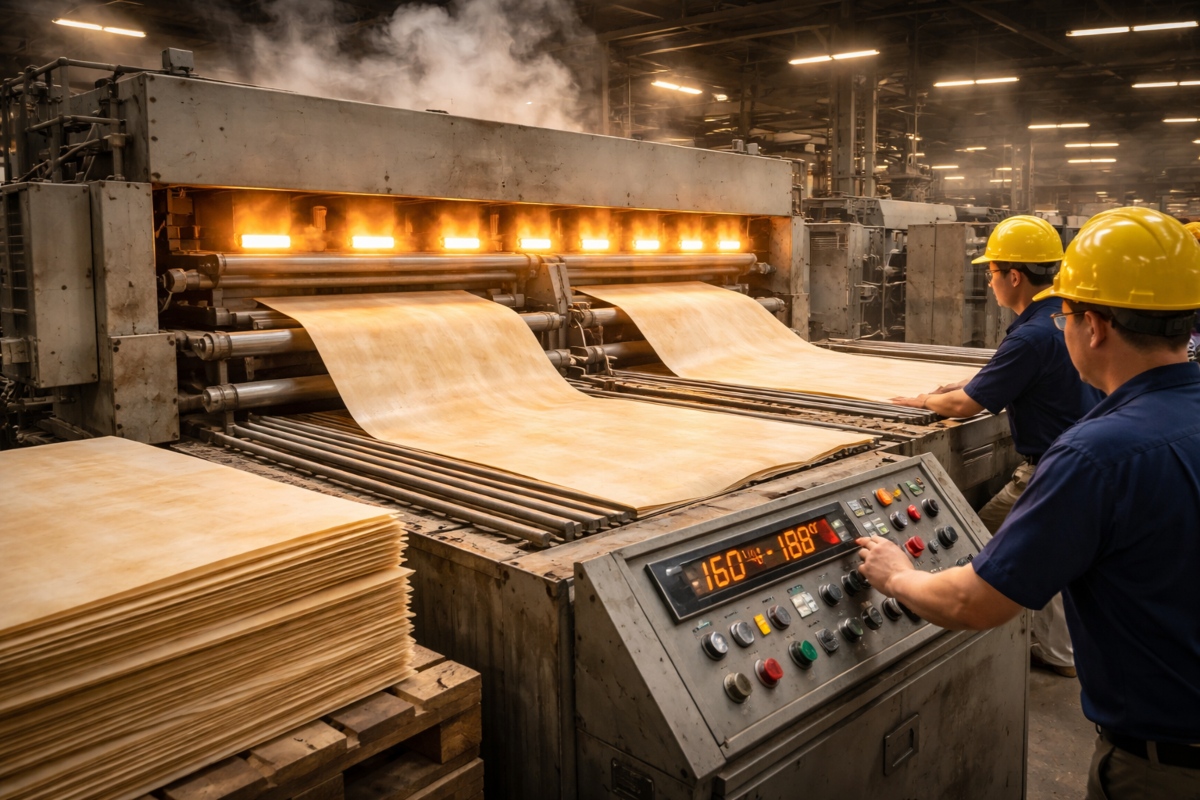
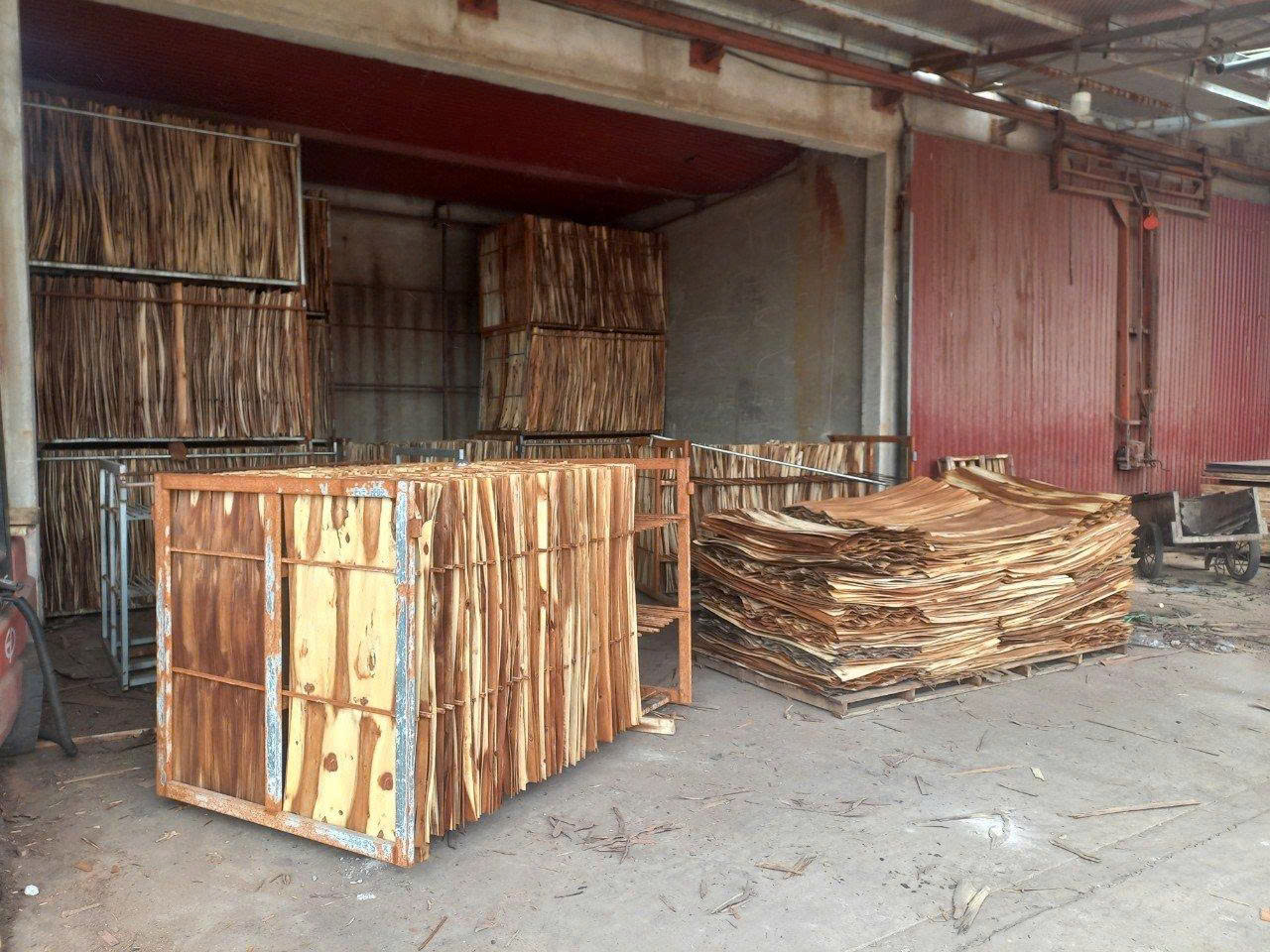
Fresh veneer contains excessive moisture that compromises adhesive bonding. While many conventional suppliers rely on outdoor sun drying, which often leaves veneers with high residual moisture that leads to warping and delamination, we utilize advanced industrial mechanical dryers to strictly control moisture content within the optimal range.
After mechanical drying, every veneer batch is systematically measured and sorted. This ensures consistent internal moisture levels across all plies, eliminating uneven curing or post-pressing movement.
QC gate: Record moisture by lot with dedicated moisture meters and reject or re-dry any material outside the production threshold. Sampling covers multiple stack depths and positions to eliminate hidden wet pockets before core assembly.
Veneer grading
Workers or automated systems classify veneers by defects and intended layer. Better continuous veneers are normally reserved for face-adjacent layers, while suitable internal pieces may be composed into full sheets. Grading should control knots, splits, holes, decay, thickness and repairs.
2. Core Joining, Repair and Lay-Up
Creating full veneer layers
Not every peeled veneer is wide and defect-free enough to cover a panel. Manufacturers join strips or repair local defects. A composer machine can align and connect veneer pieces into more uniform sheets, helping reduce random gaps and overlaps compared with uncontrolled manual placement.
Cross-laminated lay-up
Veneers are stacked so adjacent grain directions cross, usually at right angles. This arrangement improves dimensional stability and distributes strength in both panel directions. The number and thickness of plies should match the approved construction.
QC gate: Confirm ply count, orientation, repaired areas and the absence of excessive gaps, overlaps or folded veneer. Misalignment here can create soft spots, telegraphing and local weakness after pressing.
3. Adhesive Application and Plywood Pressing
Selecting the adhesive
Film faced plywood may be produced with adhesive systems designed for different moisture exposure and cost targets. Phenolic and melamine-modified systems are common trade options, but the formula, spread and cure determine actual bond performance. The purchase specification should name the required classification or test, not only the label WBP. The existing phenolic versus melamine glue guide explains the buying distinction.
Glue spreading
Rollers or other controlled equipment distribute adhesive across veneer faces. Too little glue can leave dry areas and weak bonds. Too much can cause bleed, cost waste or uneven cure. Glue viscosity, pot life, veneer moisture and time between spreading and pressing must remain within the production recipe.
QC gate: Record adhesive batch, mixing, spread rate and production time. Traceability should connect the glue batch to the pressed panels.
Pre-pressing
Pre-pressing consolidates the lay-up so veneers remain aligned and can be handled before hot pressing. It helps develop initial contact between glue and wood. Poor pre-press control can allow shifted plies or open areas.
Hot pressing
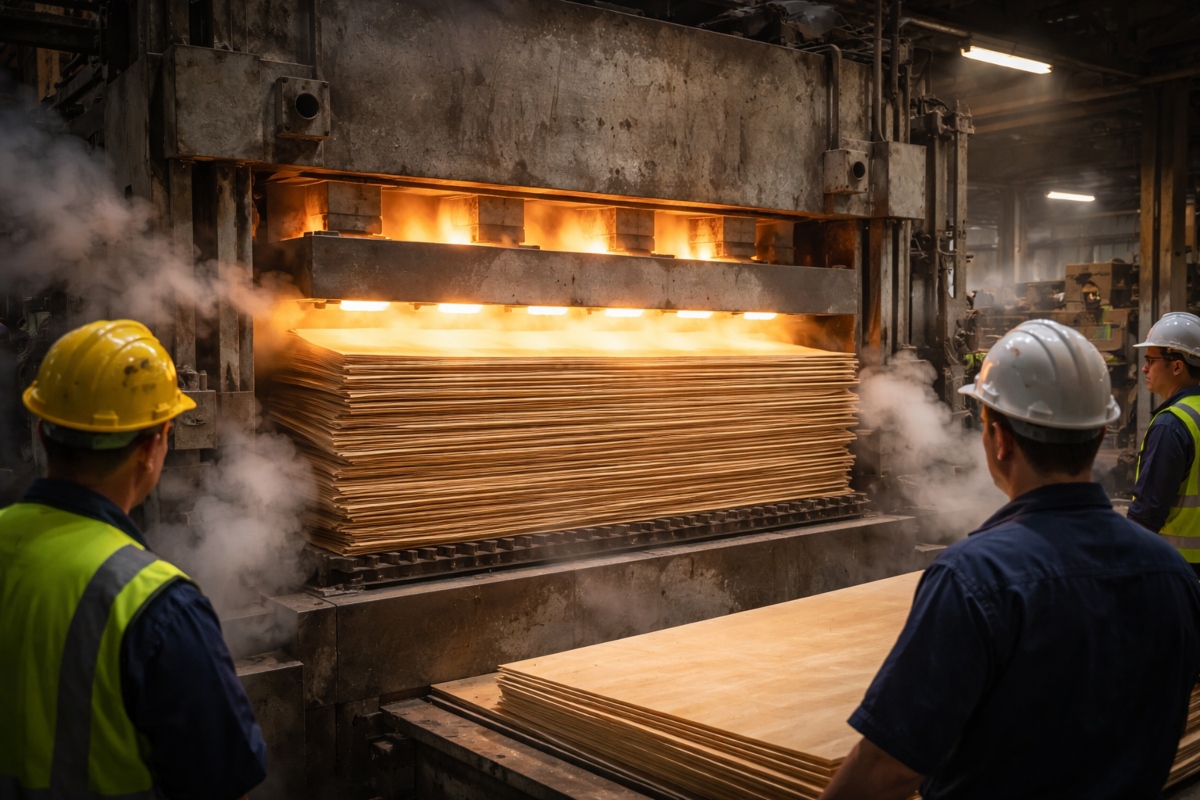
The lay-up is pressed under controlled heat, pressure and time to cure the adhesive and form the plywood substrate. The correct recipe depends on thickness, species, moisture, adhesive and equipment. Press platens, loading, temperature distribution and timing affect panel thickness, bond and flatness.
QC gate: Monitor each press cycle and maintain equipment. Panels with incomplete cure, blisters, thickness variation or other abnormalities should be isolated before surface finishing.
4. Trimming, Calibration and Surface Preparation
Initial trimming
The pressed substrate is trimmed to remove irregular edges and establish a consistent rectangle. Squareness matters because inaccurate panels create difficult joints and waste on site.
Calibration and sanding
The panel is calibrated and sanded to create a flat, uniform base for the film. High spots, glue residue and thickness variation can telegraph through the overlay. Excessive sanding can thin face veneers, while insufficient sanding can reduce film adhesion and surface quality.
Surface repair
Small face defects may be filled or patched before film lamination. Repair material must be stable under heat and compatible with the overlay. Large voids or structural core defects should not be hidden by filler.
QC gate: Measure thickness at several points, check flatness and inspect repaired areas. The substrate should be clean and dry before film application.
5. Phenolic Film Lamination
Film selection
Resin-impregnated paper is selected by type, color, surface and grammage. Brown and black are common, but color is not a quality grade. Paper strength, resin content, storage condition and supplier consistency affect lamination and wear.
Film placement
Film sheets are positioned on the prepared faces. Dust, folds, trapped particles or misalignment can create visible defects. The stack then enters a hot press or lamination press where heat and pressure cure the resin and bond the film to the plywood.
Film pressing and curing
The cycle must cure the surface without burning, blistering or under-bonding. Uneven temperature or pressure can create gloss differences, pinholes, film lifting and local weakness. The pressed panel is allowed to stabilize before final processing.
QC gate: Inspect the full face under good lighting for bubbles, overlaps, punctures, resin defects, burned areas and inconsistent texture. Where the specification requires it, verify film adhesion or other surface properties using an approved method.
6. Final Trimming and Edge Sealing
Final trimming brings the filmed panel to the ordered dimensions and creates clean edges. The operation also exposes veneer end grain, so the edges receive a compatible protective coating. Coverage should be continuous at faces, corners and any permitted repairs.
Edge sealing reduces moisture entry; it does not transform a defective panel into a sound one. Inspect the core before coating and reject open glue lines, excessive gaps or crushed edges that exceed the purchase criteria. The guide to core gaps and core overlaps provides visual examples of defects that coating must not conceal.
Every later jobsite cut or hole creates a new unsealed area. Buyers should provide crews with an approved field procedure and use the existing guide on cutting plywood without splintering to reduce film damage.
7. Final Quality Control, Testing and Traceability
A finished batch should be checked against the purchase specification rather than a vague “premium” standard.
| Control | What it can reveal |
|---|---|
| Dimensions and diagonals | Length, width and squareness deviations |
| Multi-point thickness | Pressing and calibration consistency |
| Flatness | Warp, bow, twist or storage issues |
| Film inspection | Bubbles, lifting, scratches, pinholes, burn-through and contamination |
| Edge and cross section | Seal coverage, gaps, overlaps, open glue lines and ply construction |
| Moisture measurement | Panel stability and storage control |
| Bond test | Glue-line performance under a named method |
| Mechanical tests | Declared strength or stiffness properties where required |
| Marking and documents | Product identity, batch, grade and certificate connection |
Sampling frequency and acceptance limits should come from the contract, applicable product standard and inspection plan. The existing guide to common plywood defects explains how cross-section, bond, moisture and dimensional checks support a shipment decision.
Batch traceability
Traceability should connect the finished bundle to key production information such as raw veneer lot, adhesive batch, film lot, press cycle, inspection result and test sample. This makes it possible to investigate a complaint without treating every sheet from a shipment as identical.
Packing and release
Approved panels are counted, labelled and packed to protect faces, edges and corners. Bundles should stay dry during storage and transport while avoiding conditions that trap condensation. The shipping documents should match the physical labels.
Process Defects and Their Likely Origins
| Finished-panel defect | Possible process causes |
|---|---|
| Core gap or soft spot | Poor veneer grading, incomplete composing or lay-up error |
| Overlap or local high spot | Misaligned core strips or folded veneer |
| Delamination | Moisture outside control, poor glue spread, expired mix or inadequate press cure |
| Thickness variation | Uneven veneers, press loading or calibration |
| Warp or twist | Unbalanced lay-up, moisture differences, cooling or storage |
| Film bubble or lifting | Dust, moisture, poor surface preparation or lamination cycle |
| Burned film or pinholes | Film quality, press conditions or surface contamination |
| Edge water entry | Incomplete factory coating, damage or unsealed field cut |
A defect may have more than one cause. Preserve labelled samples and production records before assigning responsibility.
How Buyers Can Audit a Film Faced Plywood Process
- Start with the product specification. The audit should verify a defined panel, not judge the factory by cleanliness alone.
- Follow one batch. Trace veneer, glue, lay-up, pressing, film, trimming, inspection and packing.
- Review records. Check moisture, adhesive, press cycles, calibration, rejected panels and instrument calibration.
- Observe change control. Ask what happens when veneer species, glue or film supplier changes.
- Sample from normal production. Do not rely only on showroom samples.
- Compare documents to equipment. Confirm that claimed tests and controls are actually performed or validly outsourced.
- Check traceability. Select a finished bundle and work backward to production records, then select a record and find the corresponding goods.
- Close non-conformities. Record responsibility, correction, reinspection and prevention before shipment release.
Original factory photos, process videos and redacted QC records make this article more credible. They should be accurately captioned and linked to the actual Kosmex process rather than used as generic decoration. Use the existing guides on evaluating a Vietnam plywood factory and supplier documents to request when planning the audit.
Frequently Asked Questions
Is film faced plywood made by coating normal plywood?
The basic concept is a plywood substrate plus resin film, but formwork performance depends on building the substrate, bond and surface specifically for the intended use. Applying film to weak plywood does not create a premium panel.
Why is plywood hot pressed more than once?
Factories may press the plywood substrate and later press the film onto the prepared surface. Production routes vary. What matters is that each cycle is controlled for the approved construction.
What causes film bubbles?
Possible causes include moisture, dust, poor surface preparation, film defects or incorrect lamination conditions. A root-cause review should examine the batch records and sample.
Does a composer machine guarantee no core gaps?
No. It can improve alignment and consistency, but veneer grading, machine settings, handling and inspection still determine the result.
Which production record should an importer request?
Request the records named in the purchase and quality plan, which may include material identity, moisture, adhesive, press, dimensional inspection, bond tests, surface checks and batch traceability.
Request Product and Process Evidence
For a current Kosmex film faced plywood offer, ask for the proposed construction, technical data, available test reports, inspection plan and factory evidence that apply to your order.


Bình luận