


How Much Does a Sheet of Plywood Weigh? [2026 Guide + 4×8 Weight Chart]
Choosing the wrong panel weight can slow down installation, increase labor costs, and even create safety risks on-site. Many buyers underestimate how critical it is to know how much does a sheet of plywood weigh before ordering.
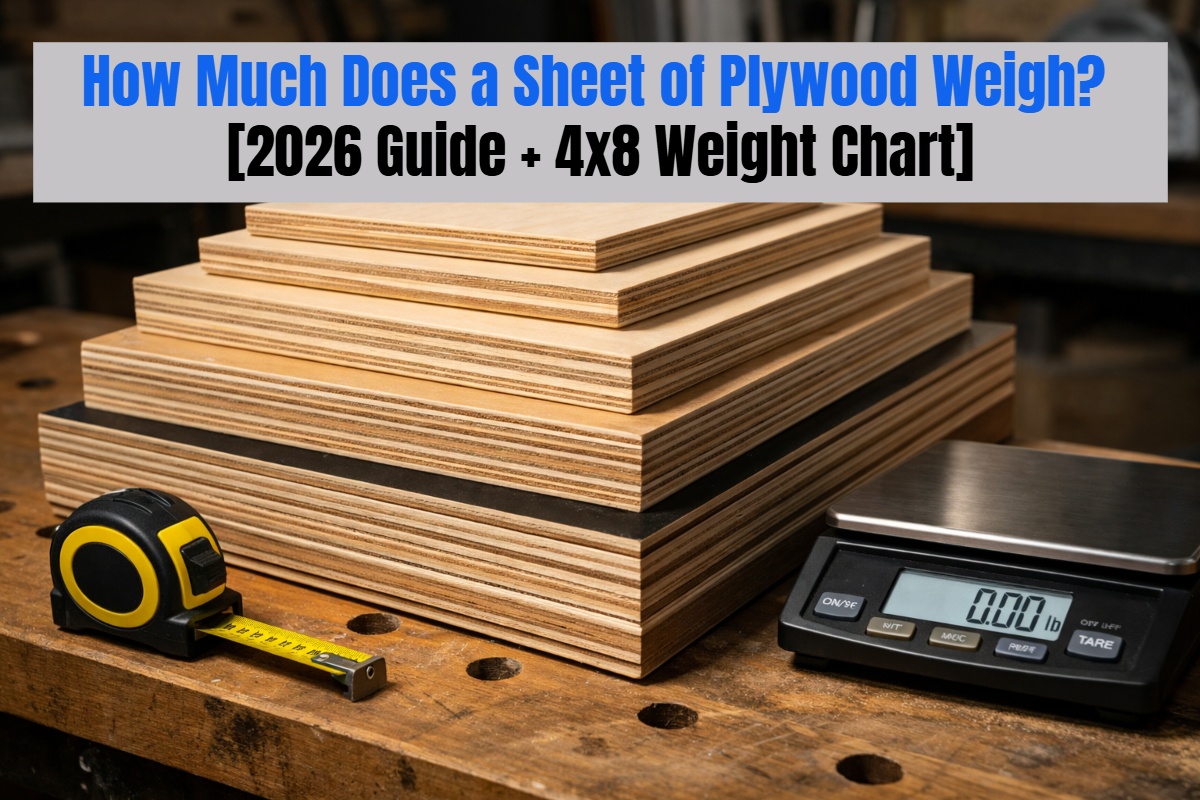
From handling a 70+ lb 3/4 inch sheet to calculating pallet loads for freight, a small miscalculation can lead to costly delays and structural issues. This guide gives you exact weights, formulas, and real-world insights to get it right the first time.
How Much Does a Sheet of Plywood Weigh? (Quick Answer)
For a standard 4×8 foot sheet (1220 x 2440 mm), the approximate weight by thickness across common plywood types is:
| Thickness | Imperial | Softwood (lbs) | Hardwood/Birch (lbs) | Eucalyptus (lbs) |
| 6 mm | 1/4″ | 20 to 22 | 23 to 26 | 24 to 27 |
| 9 mm | 3/8″ | 28 to 32 | 33 to 38 | 35 to 40 |
| 12 mm | 1/2″ | 38 to 43 | 45 to 52 | 47 to 53 |
| 15 mm | ~5/8″ | 47 to 54 | 57 to 65 | 59 to 66 |
| 18 mm | 3/4″ | 57 to 64 | 68 to 79 | 71 to 79 |
| 21 mm | ~13/16″ | 66 to 75 | 79 to 91 | 83 to 93 |
| 25 mm | 1″ | 79 to 89 | 94 to 109 | 99 to 111 |
Note: All weights are estimates based on industry standard density ranges: softwood plywood 450 to 550 kg/m3, hardwood and birch plywood 650 to 700 kg/m3, eucalyptus plywood 550 to 620 kg/m3. Actual panel weight will vary with moisture content and manufacturing variables. Always confirm with your supplier’s technical datasheet for precise specification work.
Quick rule: For a fast site estimate without a calculator, use 2.5 lbs per square foot for 3/4 inch hardwood plywood, or 1.6 lbs per square foot for 1/2 inch softwood plywood. Multiply by your panel area to get approximate sheet weight.
How Much Does a 4×8 Sheet of Plywood Weigh? (By Thickness)
The 4×8 foot format (approximately 1220 x 2440 mm) is the standard commercial sheet size in North American markets. The following sections cover the most commonly specified thicknesses in detail.
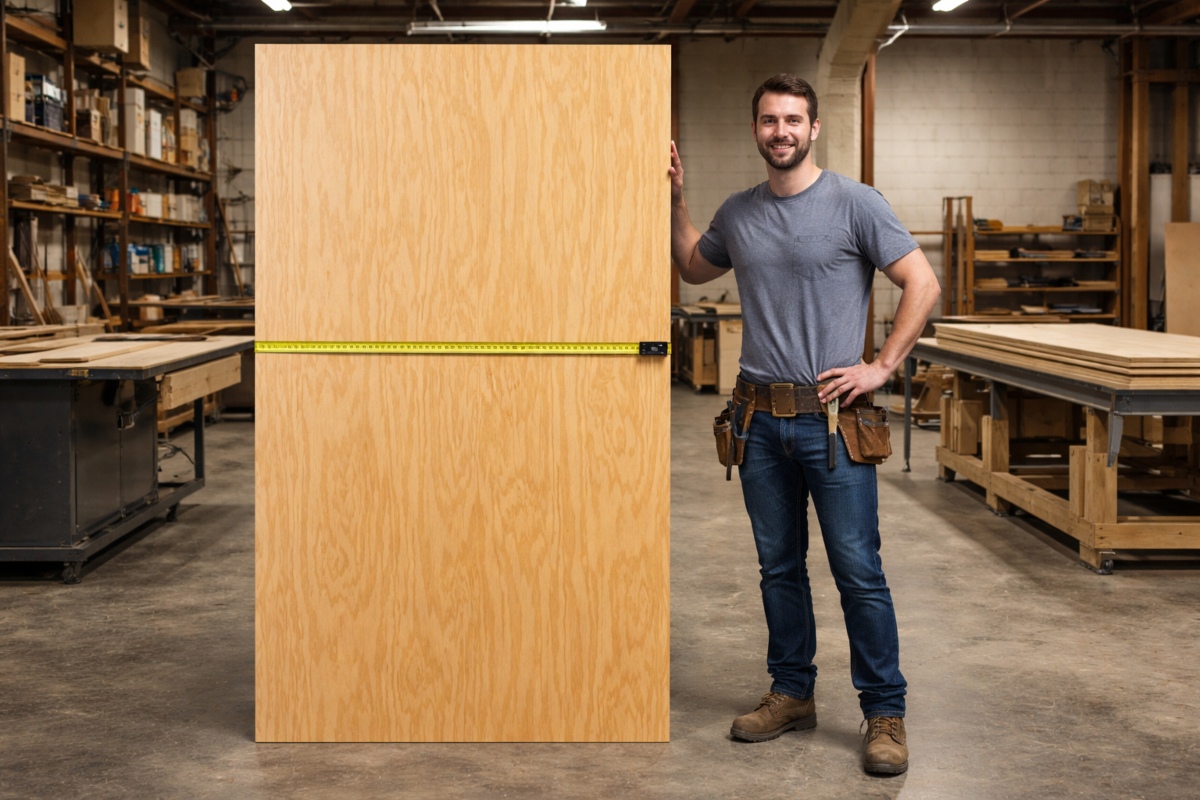
How Much Does a 4×8 Sheet of 1/4 Inch Plywood Weigh?
A 4×8 sheet of 1/4 inch (6 mm) plywood weighs approximately 20 to 27 lbs depending on species. Softwood 1/4 inch panels come in at the lower end of this range, around 20 to 22 lbs. Hardwood birch panels at this thickness typically weigh 23 to 26 lbs, and eucalyptus plywood 1/4 inch sheets sit at approximately 24 to 27 lbs due to eucalyptus’s higher density compared to most softwood species.
At this thickness, panels are primarily used for drawer bases, cabinet backing, and lightweight decorative applications. A single sheet is easily handled by one person.
How Much Does a 4×8 Sheet of 1/2 Inch Plywood Weigh?
A 4×8 sheet of 1/2 inch (12 mm) plywood weighs approximately 38 to 53 lbs depending on species. Softwood 1/2 inch plywood falls in the 38 to 43 lb range. Birch and hardwood plywood at 1/2 inch typically weighs 45 to 52 lbs, and eucalyptus at 12 mm comes in at approximately 47 to 53 lbs.
Half-inch plywood is widely used for shelving, furniture side panels, and secondary structural components. Sheets at the heavier end of this range are manageable for one person but are more comfortably handled as a two-person lift for overhead or elevated installation.
How Much Does a 4×8 Sheet of 5/8 Inch Plywood Weigh?
A 4×8 sheet of 5/8 inch (approximately 15 mm) plywood weighs approximately 47 to 66 lbs depending on species. The 5/8 inch specification is common in North American fire-rated drywall equivalents and some structural sheathing applications. For hardwood plywood at this thickness, expect weights between 57 and 65 lbs for birch and 59 to 66 lbs for eucalyptus.
How Much Does a 4×8 Sheet of 3/4 Inch Plywood Weigh?
A 4×8 sheet of 3/4 inch (18 mm) plywood is the most commonly asked-about specification, and the weight range is 57 to 79 lbs depending on species. Softwood construction plywood at 3/4 inch typically weighs 57 to 64 lbs. Hardwood birch plywood weighs approximately 68 to 79 lbs, and eucalyptus plywood at 18 mm falls in the 71 to 79 lb range.
At 3/4 inch, sheets at the upper end of the hardwood range exceed the recommended single-person lift limit of approximately 50 lbs under safe handling guidelines. Two-person handling is standard practice for 3/4 inch hardwood plywood on professional installations. This is the thickness used for most cabinet carcasses, structural furniture, and fitted joinery.
Safe handling note: A 3/4 inch birch or eucalyptus plywood sheet weighing 70 to 79 lbs should be treated as a two-person lift in all professional installation contexts. Attempting solo lifts of panels at this weight, particularly when carrying up stairs or positioning overhead, significantly increases the risk of dropped panels and personal injury.
Plywood Weight Calculator: Formula and Examples
The weight of any plywood sheet can be calculated precisely using the panel’s density and its physical dimensions. Understanding this formula allows you to calculate the weight of any panel specification, not just the standard sizes in the charts above.
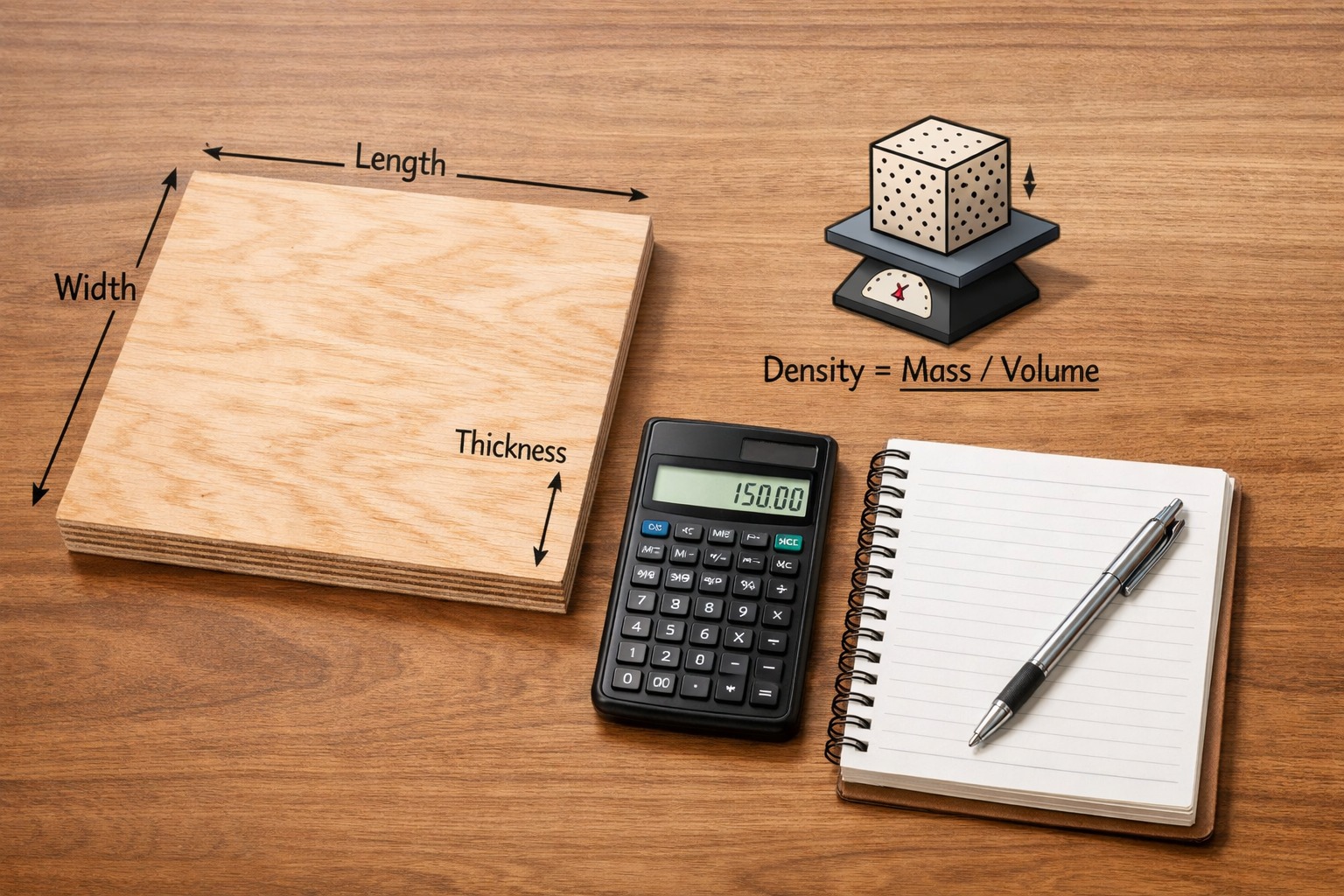
The Formula
Weight is calculated as:
Weight (kg) = Density (kg/m3) x Thickness (m) x Width (m) x Length (m)
To convert kilograms to pounds, multiply by 2.205.
Worked Example 1: 18mm Eucalyptus Plywood, 4×8 Sheet
Panel: 18 mm eucalyptus plywood, 1220 x 2440 mm, density 600 kg/m3
Calculation: 600 x 0.018 x 1.220 x 2.440 = 32.2 kg (approximately 71 lbs)
Result: A standard 4×8 sheet of 18 mm eucalyptus plywood at 600 kg/m3 weighs approximately 32 kg or 71 lbs.
Worked Example 2: 12mm Birch Plywood, 4×8 Sheet
Panel: 12 mm birch plywood, 1220 x 2440 mm, density 680 kg/m3
Calculation: 680 x 0.012 x 1.220 x 2.440 = 24.3 kg (approximately 54 lbs)
Result: A standard 4×8 sheet of 12 mm Baltic birch plywood at 680 kg/m3 weighs approximately 24 kg or 54 lbs.
Worked Example 3: 18mm Softwood CDX, 4×8 Sheet
Panel: 18 mm softwood CDX plywood, 1220 x 2440 mm, density 500 kg/m3
Calculation: 500 x 0.018 x 1.220 x 2.440 = 26.8 kg (approximately 59 lbs)
Result: A standard 4×8 sheet of 18 mm softwood CDX at 500 kg/m3 weighs approximately 27 kg or 59 lbs, meaningfully lighter than the hardwood equivalent.
For reference on how density specifications relate to panel thickness and grade selection, our plywood grades guide covers the full specification framework.
Why Does Plywood Weight Vary? 5 Key Factors
Two sheets of plywood with identical dimensions can weigh very different amounts. Understanding why helps avoid specification errors and surprises when panels arrive on site.
1. Wood Species: The Most Important Variable
Wood species is the single largest determinant of plywood weight at any given thickness. Density varies enormously across species, from lightweight softwoods to dense tropical hardwoods. Based on industry standard density specifications:
- Poplar plywood: 450 to 520 kg/m3 (lightest common panel core)
- Softwood (pine, fir, spruce) plywood: 450 to 550 kg/m3
- Eucalyptus plywood: 550 to 620 kg/m3
- Birch plywood: 650 to 700 kg/m3
- Rubber wood plywood: approximately 700 kg/m3
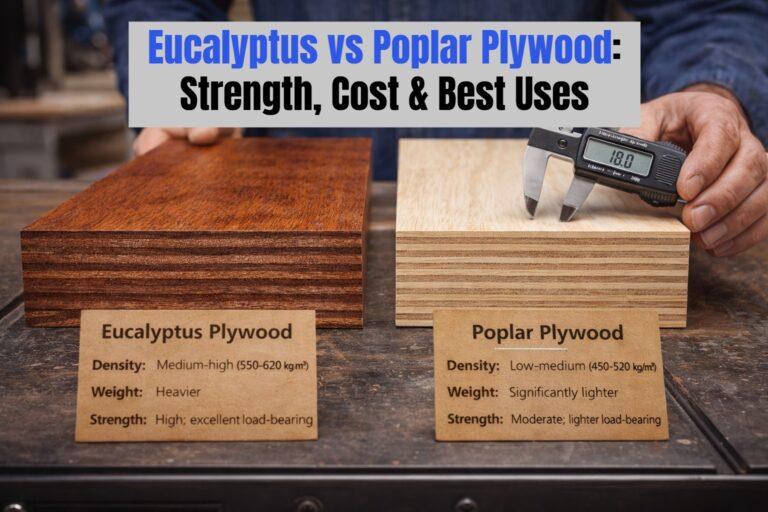
A 3/4 inch sheet of poplar plywood weighs roughly 20 to 25 percent less than a 3/4 inch sheet of birch plywood at the same dimensions, purely because of species density. This difference compounds significantly across a full project: for every 100 sheets ordered, the choice between poplar and birch plywood represents a weight difference of roughly 500 to 700 lbs per pallet. For a side-by-side comparison of how two common species affect weight and structural performance, see our eucalyptus vs poplar plywood guide.
2. Core Type: Full Species vs Mixed Core
Panels marketed under a species name do not always contain that species throughout the full panel depth. A panel labeled as birch or eucalyptus plywood may have face veneers in the named species but use poplar or pine for the core layers. This significantly reduces overall panel density and weight compared to an all-species-core panel.
Full eucalyptus core panels and full Baltic birch panels (which use the named species throughout every ply) weigh more and perform better structurally than mixed-core alternatives. A mixed eucalyptus-poplar combi core panel at 18 mm will be lighter than a full eucalyptus panel at the same thickness, and will also perform differently under load. Always confirm core composition with your supplier, not just the face veneer species.
3. Glue Type and Density
The adhesive used between veneer layers contributes a small but measurable amount to overall panel weight. WBP (Water Boiled Proof) phenolic adhesive, used in exterior-grade and film-faced plywood, is denser than MR (Moisture Resistant) melamine adhesive used in interior-grade panels. For a given panel thickness and species, WBP-bonded panels will be marginally heavier than MR-bonded panels. This difference is typically 1 to 2 percent of total panel weight and is not a primary weight factor, but it is part of why manufacturer datasheets may show slightly different weights for otherwise identical-specification panels from different production batches.
4. Moisture Content at Time of Delivery
Wood is hygroscopic: it absorbs and releases moisture from the surrounding environment, and its weight changes accordingly. Plywood panels are manufactured to a target equilibrium moisture content, typically 8 to 12 percent for standard commercial panels, but actual moisture content at the time of delivery may differ if panels have been stored in humid conditions or have absorbed moisture during transit.
A panel that has absorbed moisture during storage or shipping may weigh several percent more than its specification weight. This is a practical concern for buyers receiving large pallet quantities from international shipping: panels stored in a humid container can be measurably heavier than the technical specification suggests. Request kiln-dried certification and check panel moisture content on delivery when precise weight calculations matter for structural or logistics purposes.
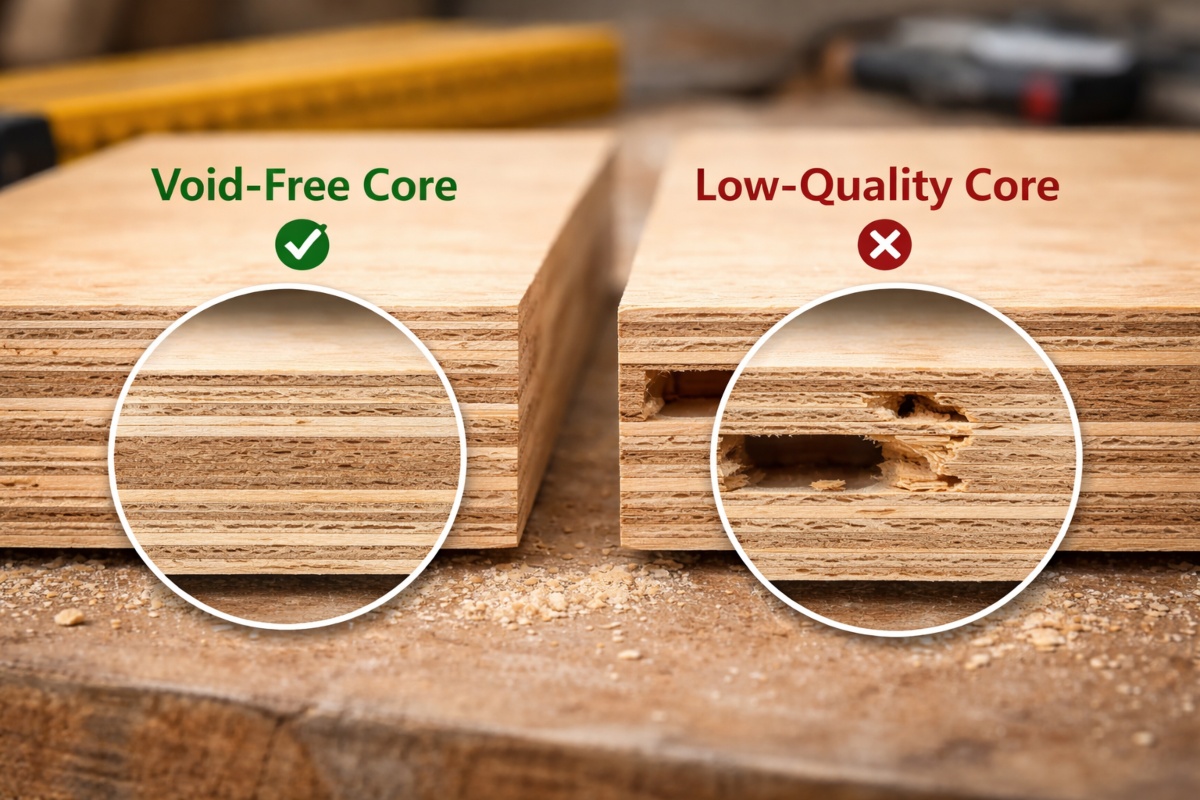
5. Manufacturing Quality and Void Content
The internal construction quality of a plywood panel affects its effective density. Panels with internal voids, gaps between veneer layers, or hollow core sections contain less actual wood fiber per unit volume than void-free panels, making them lighter but also structurally weaker. Void-free panels such as Baltic birch plywood and properly manufactured eucalyptus plywood have a higher effective density than lower-grade panels with internal defects.
This is one reason why budget panels can be lighter than specification panels of the same species and thickness: the weight saving comes not from material efficiency but from structural compromise. A panel that feels light for its size should prompt a closer look at internal quality. For guidance on how to assess panel quality before purchase, our what is eucalyptus plywood guide covers quality indicators for hardwood panels.
How Much Does 3/4 Inch Plywood Weigh? (Most Asked Question)
The 3/4 inch (18 mm) specification is the most commonly searched plywood weight question because it is the standard thickness for cabinet carcasses, structural furniture, and structural sheathing. The answer varies significantly by species:
| Species / Type | Density (kg/m3) | Weight per 4×8 sheet (kg) | Weight per 4×8 sheet (lbs) |
| Poplar core plywood | 480 | ~25.7 kg | ~57 lbs |
| Softwood CDX plywood | 500 | ~26.8 kg | ~59 lbs |
| Softwood construction plywood | 530 | ~28.4 kg | ~63 lbs |
| Eucalyptus plywood | 580 to 620 | ~31.0 to 33.2 kg | ~68 to 73 lbs |
| Baltic birch plywood | 650 to 680 | ~34.8 to 36.4 kg | ~77 to 80 lbs |
| Rubber wood plywood | ~700 | ~37.5 kg | ~83 lbs |
The range from lightest to heaviest 3/4 inch plywood is over 25 lbs per sheet, which is more than a quarter of the panel’s weight. For a kitchen fit-out using 40 panels, the choice between poplar core and Baltic birch represents a total weight difference of approximately 1,000 lbs, which is a meaningful variable for both installation labor and freight calculation.
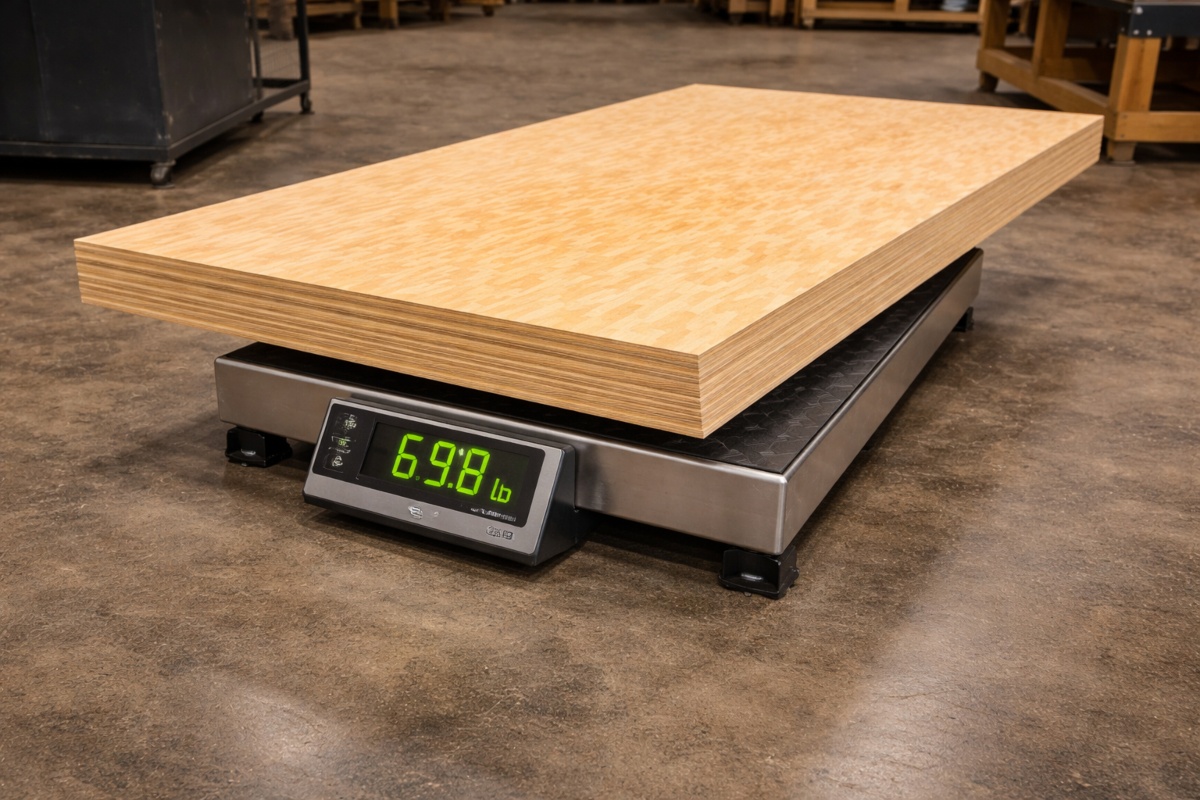
For context on how 3/4 inch plywood weight relates to structural performance in cabinet and furniture applications, see our standard plywood sizes guide for standard dimension and specification reference.
How Much Does 1/2 Inch Plywood Weigh?
Half-inch (12 mm) plywood is commonly used for shelving, furniture panels, wall paneling, and interior door panels. It is lighter and more manageable than 3/4 inch but still carries meaningful structural capability for most furniture applications.
For a standard 4×8 sheet:
- Softwood 1/2 inch plywood: approximately 38 to 43 lbs
- Poplar core 1/2 inch plywood: approximately 35 to 40 lbs
- Eucalyptus 1/2 inch plywood: approximately 47 to 53 lbs
- Birch 1/2 inch plywood: approximately 45 to 54 lbs
A single sheet of 1/2 inch softwood plywood is comfortably within one-person handling range for most adults. Hardwood 1/2 inch panels at the upper end of the weight range are manageable solo but are more safely handled as a two-person lift for overhead installation or work on ladders.
For weight per square meter rather than per sheet, use the formula: divide the sheet weight in kg by the panel area in square meters. For a 4×8 sheet (approximately 2.98 m2), a 47 kg eucalyptus 1/2 inch panel weighs approximately 15.8 kg/m2.
Weight of Other Common Plywood Thicknesses
How Much Does 1/4 Inch Plywood Weigh? (6mm)
A 4×8 sheet of 1/4 inch plywood weighs approximately 20 to 27 lbs depending on species. At this thickness, the weight difference between species is smaller in absolute terms because the overall mass of the panel is lower, but the percentage difference remains consistent with the density ratios: a birch 1/4 inch panel weighs approximately 20 to 25 percent more than a softwood panel of the same dimensions.
Quarter-inch plywood is primarily used for drawer bases, cabinet backing, and decorative facing, where its light weight is part of the design intent. It is not a structural thickness and should not be used in applications requiring load-bearing performance.
How Much Does 3/8 Inch Plywood Weigh? (9mm)
A 4×8 sheet of 3/8 inch (9 mm) plywood weighs approximately 28 to 40 lbs depending on species. Softwood panels at this thickness fall at the lower end (28 to 32 lbs), eucalyptus at 35 to 40 lbs, and birch at 33 to 38 lbs. This thickness is used for cabinet backs, light shelving, and partitions within furniture carcasses.
How Much Does 5/8 Inch Plywood Weigh? (15mm)
A 4×8 sheet of 5/8 inch (approximately 15 mm) plywood weighs approximately 47 to 66 lbs depending on species. This thickness sits between the standard 1/2 inch and 3/4 inch specifications and is less commonly stocked than either. For North American buyers, 5/8 inch is sometimes specified for fire-rated sheathing or as an intermediate furniture specification where 1/2 inch is too light but 3/4 inch is heavier than needed.
How Much Does a Bundle, Bunk, or Pallet of Plywood Weigh?
For contractors, suppliers, and buyers calculating freight costs or verifying that a floor or transport vehicle can support a delivery, the total pallet weight is often more important than the individual sheet weight.
A standard commercial pallet of plywood typically contains 50 to 75 sheets, with the exact quantity depending on thickness and panel format. Using the 3/4 inch (18 mm) specification as a reference example:
- 50 sheets of 3/4 inch softwood plywood: approximately 1,340 to 1,550 kg (2,950 to 3,420 lbs)
- 50 sheets of 3/4 inch eucalyptus plywood: approximately 1,550 to 1,660 kg (3,420 to 3,660 lbs)
- 50 sheets of 3/4 inch birch plywood: approximately 1,740 to 1,820 kg (3,840 to 4,010 lbs)
These figures do not include pallet weight (typically 20 to 25 kg for a standard wooden pallet) or any packaging and banding material. For freight cost calculation, always add pallet weight to panel weight for the gross shipment weight.
Structural note: A standard domestic floor in residential construction is typically rated at 40 to 50 lbs per square foot (approximately 195 to 244 kg/m2) live load. A pallet of plywood at 1,600 kg concentrated on a 1.2 x 1.2 m pallet footprint represents approximately 1,111 kg/m2, which exceeds standard residential floor live load ratings. Pallet deliveries should always be placed on structural floor areas such as ground level concrete slabs, not upper-level residential floors, without consulting a structural engineer.
Plywood Weight Chart: Full Comparison by Species and Thickness
The following table provides estimated 4×8 sheet weights across species and thicknesses for comprehensive reference. All figures are calculated based on industry standard density values at a sheet size of 1220 x 2440 mm.
| Thickness | Imperial | Poplar (kg / lbs) | Softwood (kg / lbs) | Eucalyptus (kg / lbs) | Birch (kg / lbs) |
| 6 mm | 1/4″ | 8.6 / 19 | 10.1 / 22 | 10.8 / 24 | 12.0 / 26 |
| 9 mm | 3/8″ | 12.9 / 28 | 15.1 / 33 | 16.2 / 36 | 18.0 / 40 |
| 12 mm | 1/2″ | 17.2 / 38 | 20.2 / 44 | 21.6 / 48 | 24.0 / 53 |
| 15 mm | ~5/8″ | 21.5 / 47 | 25.2 / 56 | 27.0 / 60 | 30.0 / 66 |
| 18 mm | 3/4″ | 25.7 / 57 | 30.2 / 67 | 32.4 / 71 | 36.1 / 80 |
| 21 mm | ~13/16″ | 30.0 / 66 | 35.3 / 78 | 37.8 / 83 | 42.1 / 93 |
| 25 mm | 1″ | 35.7 / 79 | 42.0 / 93 | 45.0 / 99 | 50.1 / 110 |
Density reference values used: Poplar 480 kg/m3; Softwood 500 kg/m3; Eucalyptus 580 kg/m3; Birch 680 kg/m3. These represent mid-range values within each species’ standard density band. Heavier panels within each species will reach the upper end of the weight ranges shown in earlier sections. For detailed density specifications by species, see our birch plywood density guide.
Why Plywood Weight Matters in Real Projects
Transportation and Delivery Planning
Freight costs for large plywood orders are calculated on gross weight or volumetric weight, whichever is greater. Knowing the sheet weight before ordering allows accurate freight cost estimation and prevents surprises when the invoice arrives. For international shipping, the weight difference between poplar and birch plywood can translate into a meaningful cost difference per container.
Site Handling: One Person or Two?
Safe manual handling guidelines generally set a single-person lift limit at approximately 23 to 25 kg (50 to 55 lbs) for occasional lifts under favorable conditions, and lower for repetitive or awkward lifts. A standard 4×8 sheet of 3/4 inch hardwood plywood at 36 to 37 kg (79 to 82 lbs) exceeds this threshold, requiring two-person handling for safe installation. Planning crew sizes and labor allocation correctly based on sheet weight prevents injuries and reduces time lost to improper handling.
Structural Floor and Rack Loading
When storing or staging panels on elevated floors, mezzanines, or racking systems, the total concentrated weight of a stack needs to be within the rated load capacity of the supporting structure. A stack of 20 sheets of 3/4 inch birch plywood weighs approximately 720 to 740 kg: a significant point load that needs to be distributed across multiple floor joists or structural bays, not concentrated on a single unsupported span.
Furniture Weight and Load Capacity
The weight of plywood panels contributes to the overall weight of finished furniture, which matters for load planning (floor capacity), delivery logistics (furniture transport weight), and end-user handling (moving furniture after installation). A kitchen fitted with 40 sheets of 18 mm eucalyptus plywood contains approximately 1,300 kg of panel material before hardware, doors, and worktops are added. For buyers comparing species for large installations, our eucalyptus plywood vs birch plywood comparison covers the weight and structural performance trade-offs in detail.
Pro Tips: How to Estimate Plywood Weight Quickly
For fast site estimates without a calculator, the following rules of thumb are reliable enough for most planning purposes:
- 3/4 inch (18 mm) hardwood plywood: approximately 2.5 lbs per square foot. For a 4×8 sheet: 32 sq ft x 2.5 = 80 lbs
- 3/4 inch (18 mm) softwood plywood: approximately 2.0 lbs per square foot. For a 4×8 sheet: 32 sq ft x 2.0 = 64 lbs
- 1/2 inch (12 mm) hardwood plywood: approximately 1.7 lbs per square foot. For a 4×8 sheet: 32 sq ft x 1.7 = 54 lbs
- 1/2 inch (12 mm) softwood plywood: approximately 1.3 lbs per square foot. For a 4×8 sheet: 32 sq ft x 1.3 = 42 lbs
- 1/4 inch (6 mm) plywood (any species): approximately 0.8 lbs per square foot. For a 4×8 sheet: 32 sq ft x 0.8 = 26 lbs
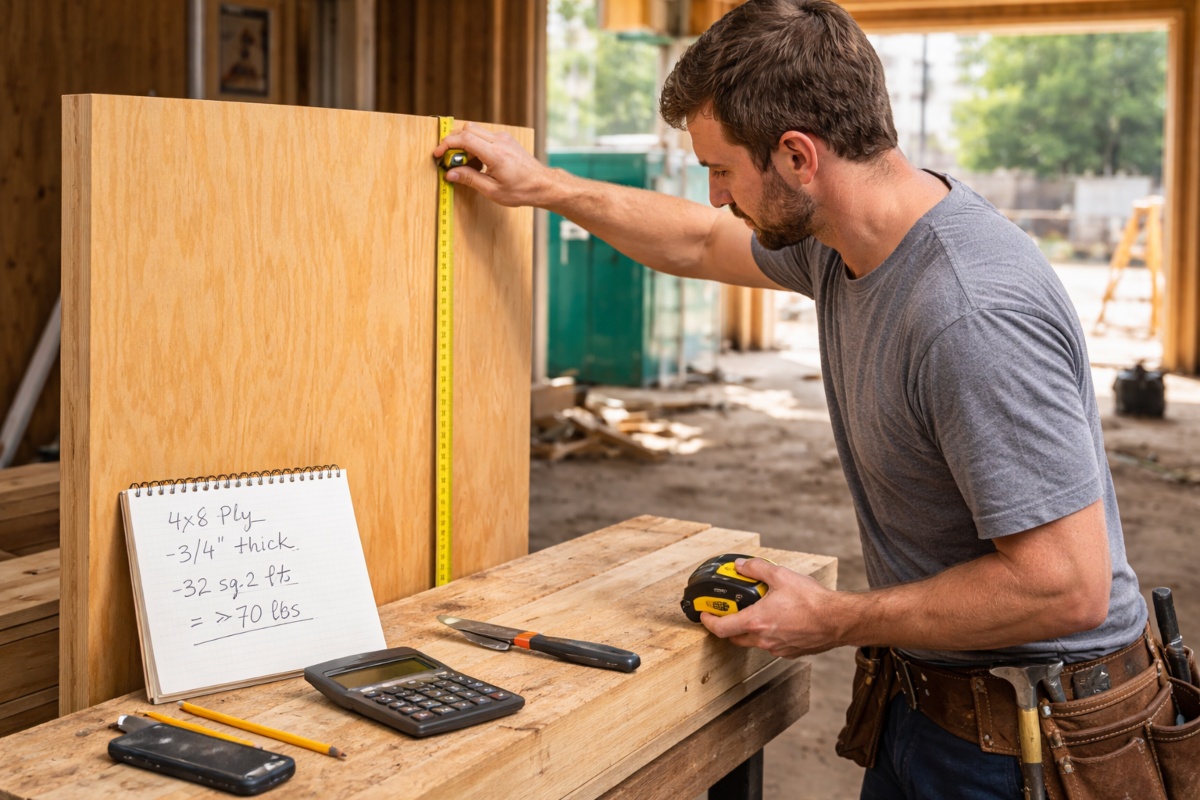
For metric estimates: multiply the panel area in square meters by the thickness in meters by the species density in kg/m3. This is the same formula as the weight calculator section above, applied in one step.
For buyers sourcing panels and needing verified weight specifications before a large order, always request the manufacturer’s technical datasheet, which will state the panel weight at the target moisture content. For Kosmex Group products, our commercial plywood and film faced plywood panels are available with documented specifications including panel weight by thickness.
Frequently Asked Questions
How much does one sheet of plywood weigh?
The weight of one sheet of plywood depends on its dimensions, thickness, and species. For the standard 4×8 foot (1220 x 2440 mm) format, weights range from approximately 19 to 26 lbs for 1/4 inch panels up to 79 to 110 lbs for 1 inch panels. Hardwood panels such as birch weigh approximately 20 to 30 percent more than softwood panels of the same thickness and dimensions.
How much does a 4×8 3/4 inch sheet of plywood weigh?
A standard 4×8 sheet of 3/4 inch plywood weighs approximately 57 to 80 lbs depending on species. Softwood construction plywood falls at the lower end (57 to 64 lbs), eucalyptus plywood in the middle (68 to 73 lbs), and Baltic birch plywood at the upper end (77 to 80 lbs). The exact weight depends on the specific density of the batch; always confirm with your supplier’s datasheet for precise specification work.
Is hardwood plywood heavier than softwood?
Yes, significantly. Hardwood plywood species such as birch and eucalyptus have densities of 550 to 700 kg/m3, compared to softwood plywood at 450 to 550 kg/m3. At the same thickness and sheet size, hardwood plywood typically weighs 15 to 30 percent more than softwood plywood. This weight difference reflects the denser grain of hardwood species and translates directly into higher structural performance at equivalent thicknesses.
How much does a unit or pallet of plywood weigh?
A standard commercial pallet of 50 sheets of 3/4 inch plywood weighs approximately 1,340 to 1,820 kg (2,950 to 4,010 lbs) depending on species, not including pallet weight. Softer species at the lower end, harder species at the upper. Always add pallet weight (20 to 25 kg) for gross freight weight calculation.
How much does plywood weigh per square foot?
As a quick reference: 3/4 inch hardwood plywood weighs approximately 2.5 lbs per square foot; 3/4 inch softwood plywood approximately 2.0 lbs per square foot; 1/2 inch hardwood plywood approximately 1.7 lbs per square foot; and 1/4 inch plywood (any species) approximately 0.8 lbs per square foot. Multiply by your panel area in square feet to get total sheet weight.
What plywood is the lightest?
Poplar core plywood is the lightest commonly available commercial plywood panel, with a density of approximately 450 to 520 kg/m3. This makes it 20 to 30 percent lighter than birch plywood at the same thickness. The trade-off is lower structural strength and reduced moisture resistance compared to denser hardwood species. For projects where panel weight is the primary constraint, our eucalyptus vs poplar plywood comparison covers how the lightest and mid-range options compare on key performance factors.
Conclusion
Plywood weight is not a fixed number: it is the product of thickness, panel dimensions, species density, core composition, and moisture content, all of which vary across the market. Getting the weight right before ordering prevents the three most common problems: crews struggling with panels that exceed safe single-person lift limits, freight costs that come in higher than budgeted, and structural floors or racking systems that are loaded beyond their rated capacity.
The key figures to carry: a 3/4 inch softwood sheet weighs approximately 60 lbs; a 3/4 inch hardwood birch or eucalyptus sheet weighs 68 to 80 lbs; and every 100 kg/m3 of additional species density adds roughly 5.4 lbs per sheet at 3/4 inch on a standard 4×8 format. Use the weight calculator formula for precise calculations, and always confirm against the manufacturer’s technical datasheet for large-volume orders.
For panel specifications that include verified weight data, Kosmex Group’s birch plywood and anti-slip film faced plywood products are available with full technical documentation. Explore our types of plywood guide to compare the full range of panel options and specifications before placing your order.





Bình luận