


Eucalyptus Plywood Review: 7 Key Facts, Pros, Cons & Real User Reviews
Woodworkers and contractors searching for an honest Eucalyptus plywood review often run into confusing feedback online. Some claim it’s a budget-friendly alternative to Baltic birch, while others warn about warping, inconsistent layers, or ultra-thin veneers. If you are trying to decide whether eucalyptus plywood is worth specifying for cabinets, furniture, or CNC work, conflicting opinions can make the decision harder than it should be.
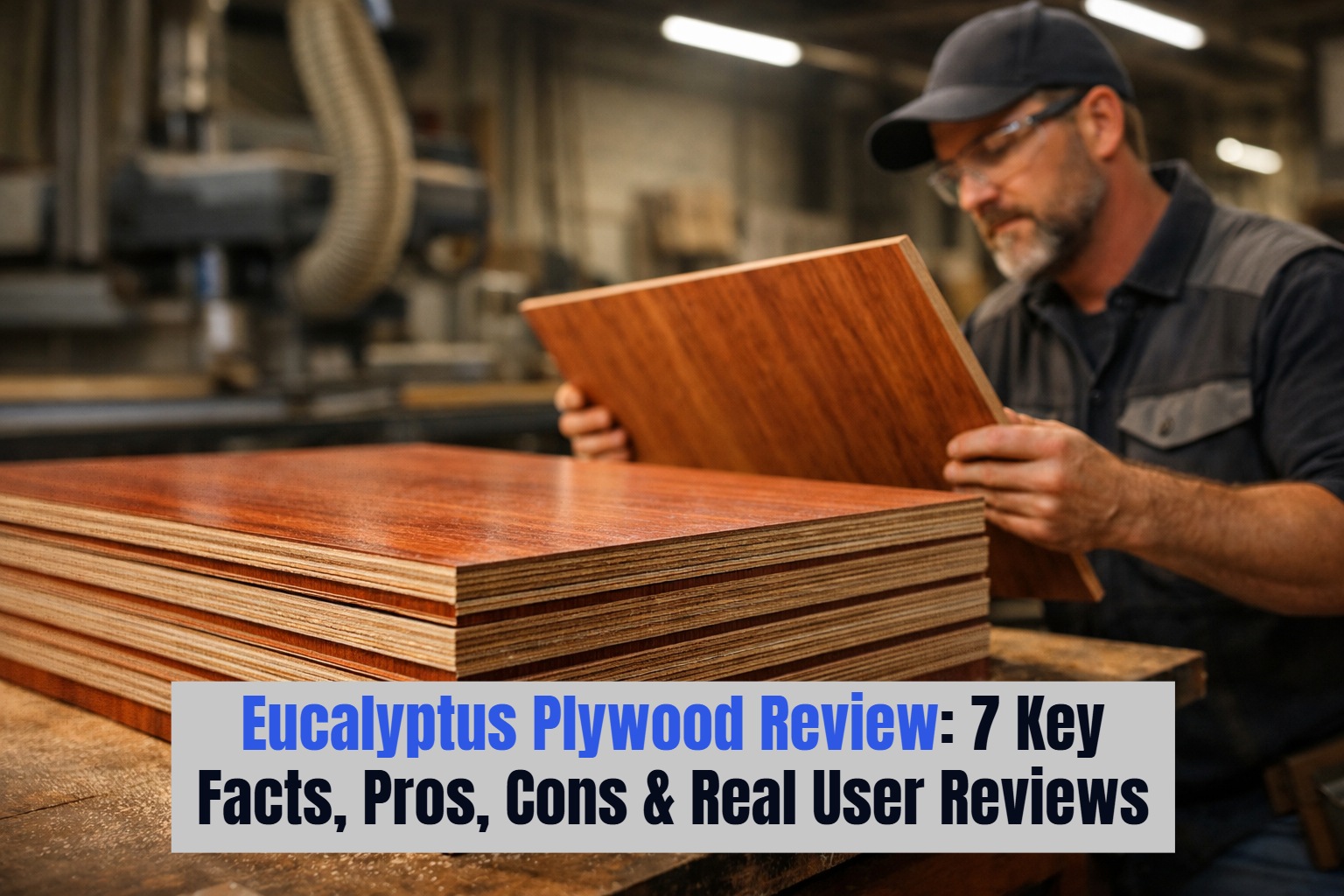
This Eucalyptus plywood review cuts through the mixed opinions with verified technical data, real user feedback, and practical buying guidance. Instead of repeating marketing claims, we break down the material’s true performance, its strengths, limitations, and the specific situations where eucalyptus plywood delivers excellent value; and where another plywood type may be the smarter choice.
7 Key Facts About Eucalyptus Plywood Performance
1. It Is a Genuine Hardwood Panel
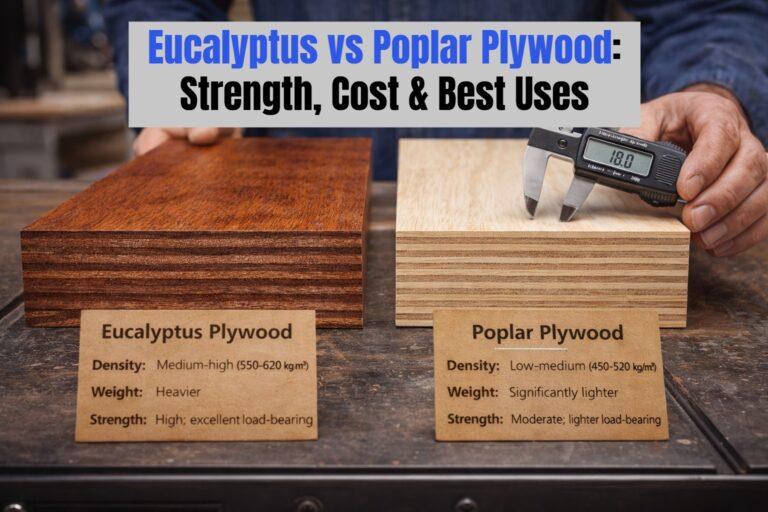
Eucalyptus is not a softwood engineered wood product. It is a fast-growing but genuinely dense hardwood, and eucalyptus plywood panels made with eucalyptus veneer throughout carry those hardwood properties into the finished panel. The density of eucalyptus plywood typically ranges from 550 to 620 kg/m3, which is well above standard softwood construction plywood and comparable to mid-range hardwood panels. This density is the basis of its structural performance.
2. Natural Oils Provide Built-In Moisture Resistance
Eucalyptus wood contains natural oils that act as an inherent moisture barrier, slowing water absorption into the panel. This is one of eucalyptus plywood’s most commercially significant properties: it resists moisture more effectively than most other plywood species without requiring additional chemical treatment. This characteristic makes it suitable for kitchen cabinetry, bathroom joinery, humid-climate furniture, and outdoor-adjacent applications where standard plywood would need sealing or upgrading to WBP adhesive.
3. High Ply Count Is a Genuine Quality Signal
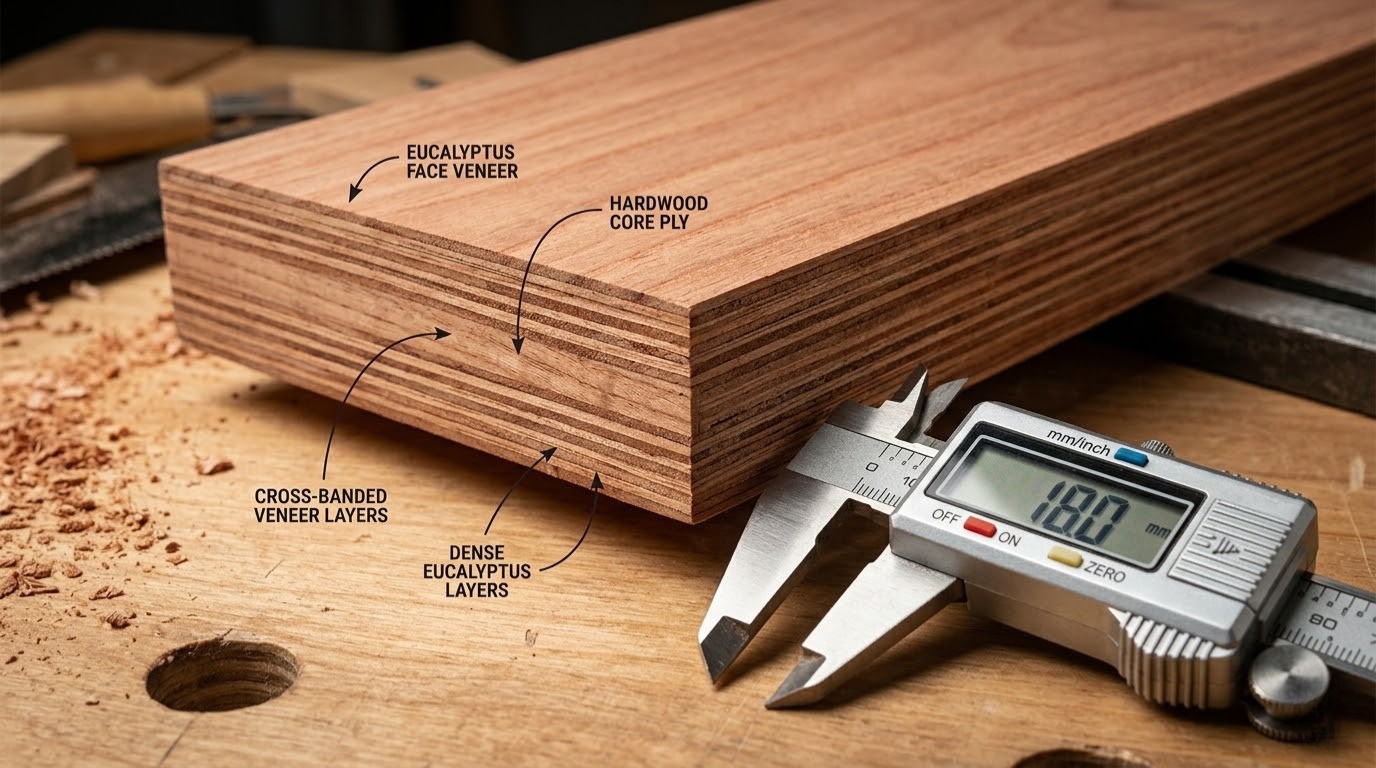
The Facebook discussion referenced in the research for this guide highlights an important specification point: an 11-ply eucalyptus panel is structurally superior to a 7-ply panel of the same thickness. More plies means thinner individual veneers, more glue lines per panel thickness, and better load distribution. When evaluating eucalyptus plywood, the ply count is one of the clearest quality indicators available to a buyer without cutting open the panel. For context on how ply count relates to panel thickness across species, see our eucalyptus plywood thickness guide.
4. Core Composition Varies and Affects Performance Significantly
Not all panels sold as eucalyptus plywood are full eucalyptus construction. Some use eucalyptus face veneers over a poplar or pine core, or a combi core that mixes eucalyptus and softwood layers. A full eucalyptus core panel performs significantly better structurally and has more consistent moisture resistance than a mixed-core panel. The negative reviews about warping, voids, and thin veneers often apply to lower-grade mixed-core products rather than well-made full eucalyptus panels. Confirm core composition with your supplier before purchasing.
5. It Is Easier to Stain Than Birch
Eucalyptus plywood accepts stain more evenly than birch plywood, which is prone to blotchy absorption without pre-conditioning. The reddish-brown base color of eucalyptus produces warm, consistent stained results with a wide range of tones, and the grain takes finish with predictable behavior. For furniture and cabinetry where a natural stained finish is the goal, eucalyptus plywood is a more forgiving material than birch from a finishing perspective.
6. Panel Flatness Depends on Sourcing Quality
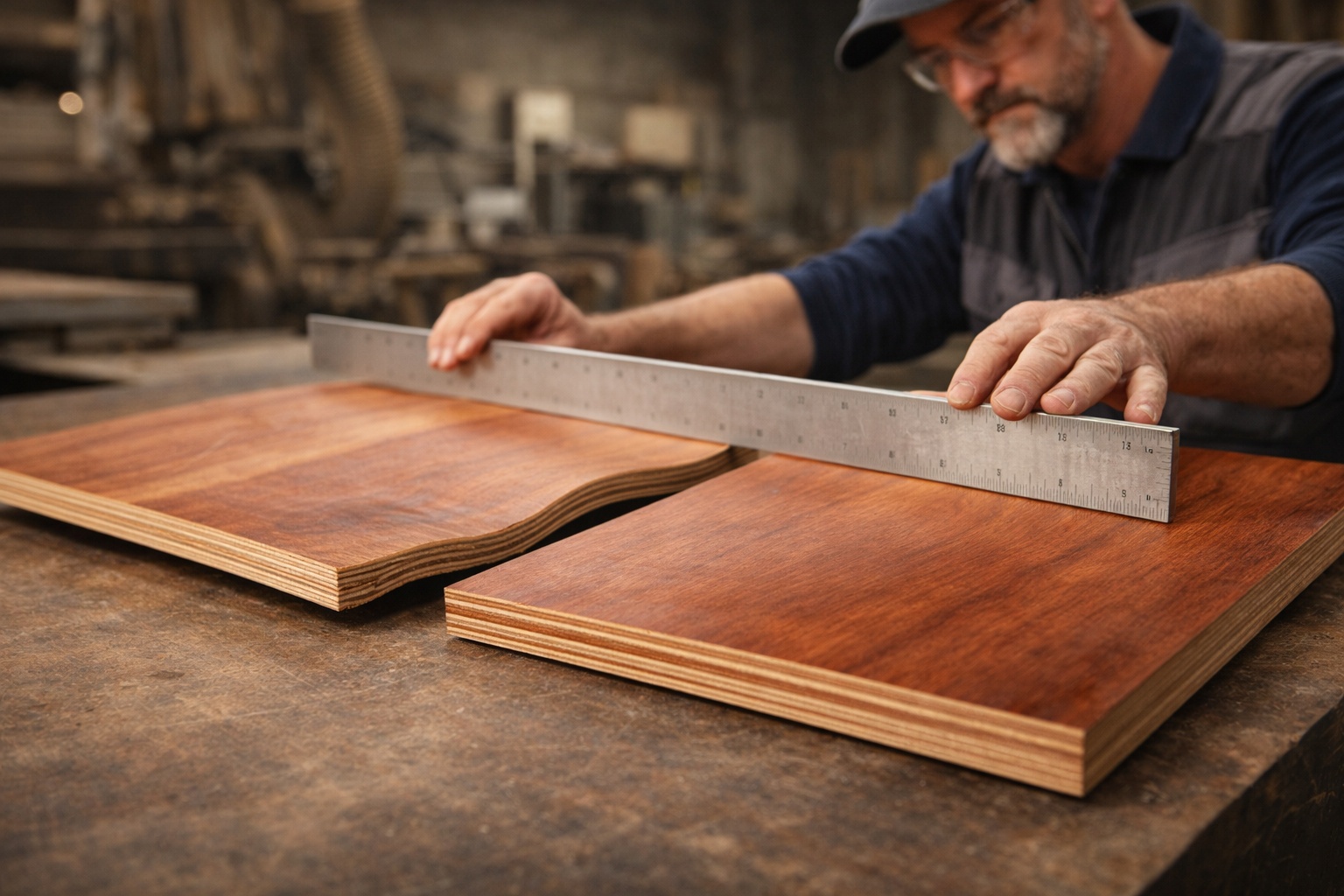
Several negative reviews of eucalyptus plywood focus on warping and lack of flatness. This is a real issue with lower-quality production, but it is not an inherent property of the species. Eucalyptus panels that are kiln-dried correctly, stored flat, and manufactured with consistent veneer moisture content will stay flat in standard indoor conditions. Panels from lower-grade suppliers that are inconsistently dried or stored poorly before shipping are more prone to movement. Buying from a reputable supplier with documented quality control is the most reliable way to avoid this problem. Our plywood suppliers guide covers what to look for when evaluating supplier quality.
7. Species Selection Within “Eucalyptus” Matters
Eucalyptus is a genus with hundreds of species, and not all of them produce equally good plywood veneer. Plantation-grown species selected specifically for plywood production, such as Eucalyptus grandis and Eucalyptus urophylla, are bred for straight grain, consistent density, and stable drying behavior. Some wild-harvested or poorly selected eucalyptus species do have a tendency toward twisted grain and instability during drying, which is the basis of some negative reviews. Plantation eucalyptus from reputable suppliers does not share these characteristics.
Pros of Eucalyptus Plywood
Strong Structural Performance
Eucalyptus plywood’s density gives it excellent load-bearing capacity, bending stiffness, and screw-holding performance. It outperforms standard softwood construction plywood structurally at the same thickness, and for furniture and cabinetry applications it delivers results comparable to more expensive hardwood panels. Heavy shelving, kitchen cabinet carcasses, workbench tops, and structural furniture components all benefit from eucalyptus plywood’s structural credentials.
Built-In Moisture Resistance
The natural oil content of eucalyptus plywood provides a moisture resistance advantage that most other panel species cannot match without additional treatment. For applications in kitchens, bathrooms, humid climates, or outdoor-adjacent spaces, this characteristic reduces the risk of swelling, delamination, and surface degradation without requiring extensive sealing. With WBP phenolic adhesive, eucalyptus plywood is suitable for applications involving direct and sustained moisture contact. This is one of the most consistent positives across eucalyptus plywood reviews from real users in woodworking communities.
Cost-Effective Hardwood Panel
Eucalyptus plywood is typically 20 to 30 percent less expensive than Baltic birch plywood of equivalent grade, and it sits comfortably below premium hardwood panels such as maple plywood in cost. For buyers who need genuine hardwood panel performance at a competitive price, eucalyptus plywood consistently delivers strong value. Multiple users in online forums describe it as a “great bang for the buck” material that outperforms its price point. See our eucalyptus plywood vs birch plywood comparison for a full cost and performance breakdown.
Clean CNC and Saw Cuts
Eucalyptus plywood’s consistent density and hardwood veneer structure produce clean, crisp cuts in CNC routing and sawing operations. Its void-free core means router bits and saw blades do not encounter the air pockets that can cause tearout and inconsistent cut quality in lower-grade panels. Several reviews specifically highlight CNC and laser cutting performance as a strength of the material.
Good Sustainability Profile
Plantation-grown eucalyptus reaches harvestable maturity in 5 to 7 years, making it one of the most rapidly renewable commercial hardwood sources available. FSC-certified eucalyptus plywood is widely available from responsible suppliers. For buyers with sustainability commitments, eucalyptus plywood’s fast growth cycle and plantation-based supply chain compare favorably to slower-growing species. Our types of eucalyptus plywood guide covers how different panel types are sourced and certified.
Distinctive, Attractive Grain
Eucalyptus plywood’s warm reddish-brown grain with straight to interlocking patterns is visually distinctive in a way that many standard panels are not. For furniture and interior design applications where the natural wood appearance is a design feature, eucalyptus plywood’s bold grain and warm color add genuine visual value. It suits rustic, tropical, and warm contemporary interior styles particularly well.
Cons of Eucalyptus Plywood
Quality Varies by Supplier and Grade
The most consistent complaint in eucalyptus plywood reviews is inconsistency: panels that warp, veneers that are thinner than expected, or inner plies that show voids and gaps. This is real, but it is a sourcing and grade quality issue rather than an inherent species problem. Lower-grade and lower-priced eucalyptus panels, particularly those marketed without clear grade specifications, are more prone to these issues. Specifying a named grade (BB/BB for furniture, BB/CC for painted work) and buying from a verified supplier substantially reduces this risk.
Heavier Than Softwood and Poplar Panels
Eucalyptus plywood’s density that makes it structurally strong also makes it heavier than lighter-core alternatives. An 18 mm eucalyptus sheet is noticeably heavier than a comparable poplar or softwood panel, which adds to handling effort during installation and increases shipping weight for large orders. For applications where panel weight is a constraint, either structurally or logistically, a lighter-core panel may be the more practical specification. Our eucalyptus vs poplar plywood comparison covers the weight difference and its practical implications in detail.
Natural Oils Can Interfere with Some Finishes
The same natural oils that provide moisture resistance can interfere with the adhesion of certain oil-based adhesives and finishes if the panel surface is not properly prepared. A light sanding before applying adhesive or primer removes the surface oil film and allows reliable bonding. Water-based finishes generally adhere without this preparation step. This is a manageable consideration rather than a major limitation, but it is worth knowing before starting a finishing process.
Less Widely Stocked Than Mainstream Alternatives
Eucalyptus plywood is not yet as widely available at standard retail hardware stores as softwood construction plywood or generic commercial panels. In some markets, it is primarily available through specialist timber merchants and plywood importers rather than general building supply chains. Lead times and minimum order quantities may differ from mainstream panel products. Buyers working with tight project timelines should confirm availability with their supplier before specifying eucalyptus plywood.
Sawdust Precautions Required
Some eucalyptus species produce sawdust that can cause skin or respiratory irritation in sensitive individuals. This is not unique to eucalyptus and is standard practice for any hardwood panel, but it is worth noting for woodworkers who work without dust extraction. Appropriate dust extraction equipment and personal protective equipment are recommended when machining eucalyptus plywood.
Eucalyptus Plywood Reviews: What Real Users Say
Online reviews and forum discussions about eucalyptus plywood reveal a consistent picture once the context of each comment is understood. The positive reviews tend to come from buyers who sourced named-grade panels from known suppliers and used them for interior furniture and cabinetry. The negative reviews tend to reflect experience with budget panels without clear grade specifications, often purchased opportunistically without confirming core composition.
Positive User Feedback
Across woodworking communities, the most common positive descriptions of eucalyptus plywood are:
A good alternative to Baltic birch. Seems like a good deal, and acacia and eucalyptus cores are as strong as walnut or a little stronger, so the core should be good.
This captures the consensus of experienced woodworkers: eucalyptus plywood is a credible hardwood panel at a price point that undercuts Baltic birch. The strength comparison to walnut reflects eucalyptus’s density rather than an exact hardness equivalence, but the underlying point is well-supported by the material’s specifications.
11-ply will be stronger than the typical 7-ply. It is a very good deal for that.
This comment highlights a critical specification point: ply count at a given thickness is a direct indicator of panel quality. Higher ply count means more, thinner veneers and more glue lines, which distributes stress more evenly and reduces the risk of delamination.
So long as it is flat, it is good.
A pragmatic and accurate assessment: panel flatness at point of purchase is the most important quality check for eucalyptus plywood. Flat panels from a reliable supplier perform well. Warped panels suggest poor drying or storage conditions before delivery.
Negative User Feedback and Context
Some users report negative experiences with eucalyptus plywood, most commonly around warping, inconsistent layer quality, and thin face veneers. These concerns are worth taking seriously, but they need context:
Expect inconsistent layers, heavy warping and delamination. Also the top layers are extremely thin.
This kind of experience typically reflects low-grade, unspecified commercial panels rather than furniture-grade eucalyptus plywood with a named grade and verified core construction. The thin face veneer concern is a grade issue: BB/BB grade panels specify minimum face veneer thickness, and panels sold without a grade designation may not meet this standard.
Another thread contributor noted that concerns about eucalyptus’s structural instability are largely based on experience with wild-harvested species in North American climates, where poorly-selected eucalyptus introduced for construction lumber did twist and crack on drying. Modern plantation eucalyptus grown specifically for plywood production uses selected species and controlled drying that does not exhibit these problems.
That was mainly for outdoor furniture from what I was reading. If it is in a temperature-controlled environment it should not be an issue.
This comment accurately reflects the practical experience of most users: eucalyptus plywood performs reliably in stable indoor conditions. The concerns about movement and instability apply primarily to sustained outdoor exposure without proper sealing, not to standard interior furniture and cabinetry applications.
Reddit and Forum Consensus
Across Reddit woodworking communities and Facebook groups, the consensus position among experienced woodworkers is that eucalyptus plywood is a good value proposition for cabinetry, jig-making, and furniture work, particularly as an alternative to Baltic birch when price is a consideration. The most repeated advice is to inspect panels for flatness before purchasing and to confirm the ply count and core composition from the supplier. Panels that pass these checks consistently receive positive reviews in use. For a full specification comparison between eucalyptus and birch, our eucalyptus vs birch plywood guide covers the key differences in detail.
Eucalyptus Plywood vs Alternatives: Quick Comparison
For buyers evaluating eucalyptus plywood against the most common alternatives:
| Factor | Eucalyptus Plywood | Baltic Birch | Poplar Plywood |
| Density | Medium-high | High | Low-medium |
| Moisture Resistance | Good (natural oils) | Moderate | Low; needs sealing |
| Structural Strength | High | Very high | Moderate |
| Staining | Even, consistent | Prone to blotching | Even |
| CNC Performance | Good | Excellent | Very easy |
| Cost | Mid-range | Premium | Budget |
| Availability | Growing; specialist suppliers | Widely available | Widely available |
| Best For | Cabinetry, humid areas, value builds | Fine furniture, CNC precision | Lightweight interior furniture |
Is Eucalyptus Plywood Good For Specific Applications?
Is Eucalyptus Plywood Good for Cabinets?
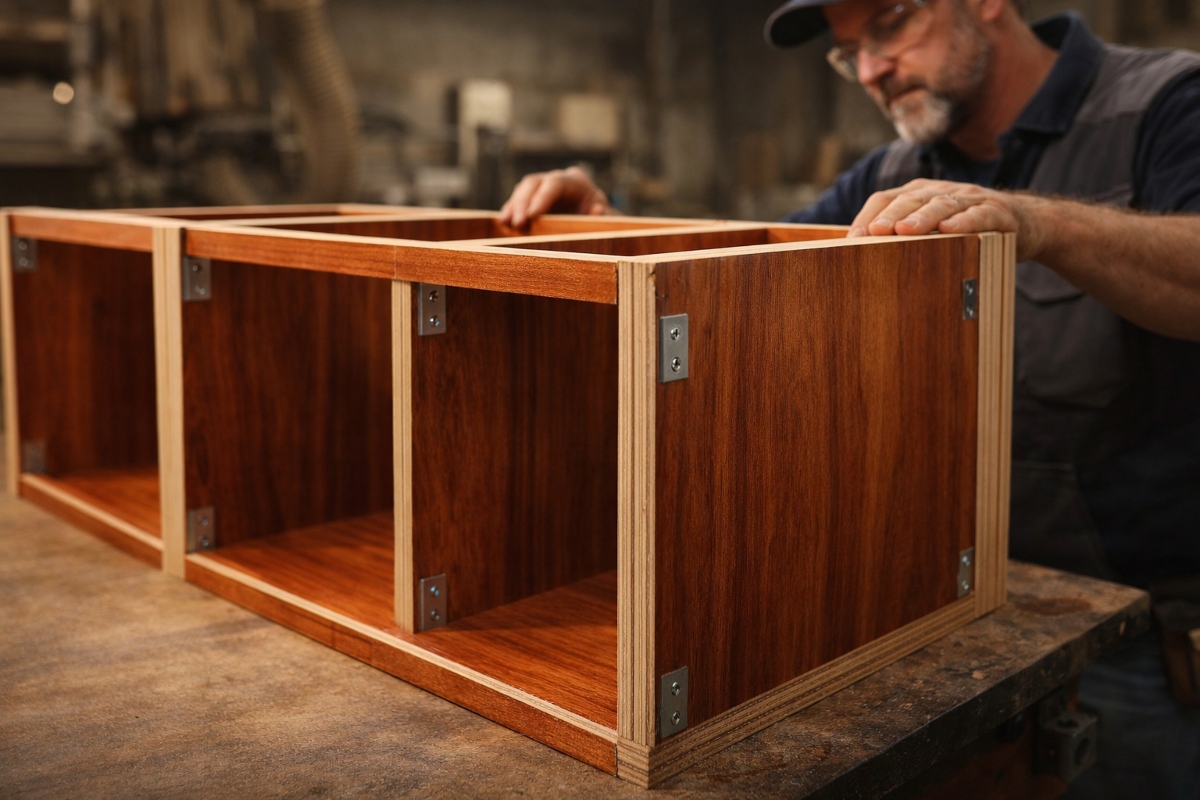
Yes. Eucalyptus plywood is a strong specification for cabinet carcasses. Its density provides good screw-holding for hinges and hardware, its moisture resistance is an advantage in kitchen and bathroom environments, and its structural stiffness keeps cabinet boxes square and stable over time. Many buyers specifically highlight cabinet work as an application where eucalyptus plywood delivers a step above generic commercial panels at a competitive price. For cabinetry-specific use cases, our commercial plywood product page covers available grades and specifications.
Is Eucalyptus Plywood Good for Furniture?
Yes, for most furniture applications. Eucalyptus plywood’s hardwood density makes it appropriate for structural furniture components, shelving, table substrates, and storage pieces. Its staining behavior is more consistent than birch, making it practical for natural-finish furniture. The reddish-brown grain is visually bold and suits warm, natural interior design aesthetics. For painted furniture, it performs well with standard surface preparation.
Is Eucalyptus Plywood Good for CNC and Laser Cutting?
Yes. The consistent density and void-free structure of quality eucalyptus plywood produce clean, precise cuts in CNC routing and laser operations. Router bits encounter consistent resistance across the full panel, which reduces tearout and produces predictable cut quality. Multiple user reviews specifically mention CNC performance as a strength. For precision-cut components, our customized CNC cutting services process eucalyptus plywood to close tolerances.
Is Eucalyptus Plywood Good for Outdoor Use?
With appropriate precautions, yes. Eucalyptus plywood’s natural moisture resistance makes it more suitable for outdoor-adjacent and semi-exposed applications than most other plywood species. However, no standard plywood panel is fully weatherproof without surface sealing. For outdoor use, eucalyptus plywood with WBP phenolic adhesive should be used, all surfaces and edges should be thoroughly sealed with an exterior-grade finish, and the panel should be protected from sustained direct water contact. Marine-grade eucalyptus plywood with void-free construction and WBP bonding throughout is the correct specification for genuinely wet or marine environments.
Is Eucalyptus Plywood Good for Structural Applications?
For structural flooring, wall sheathing, and load-bearing furniture, eucalyptus plywood’s density and stiffness make it a capable specification. Its performance at a given thickness exceeds standard softwood panels and is broadly comparable to mid-range hardwood plywood. For construction-grade structural use, eucalyptus film faced plywood with phenolic surface treatment is available and specifically designed for demanding site conditions. Our film faced plywood product page covers construction-grade eucalyptus panel specifications.
How to Identify Good Quality Eucalyptus Plywood
Given that quality varies significantly across the market, knowing what to check before purchasing is the most practical way to ensure a positive experience with eucalyptus plywood.
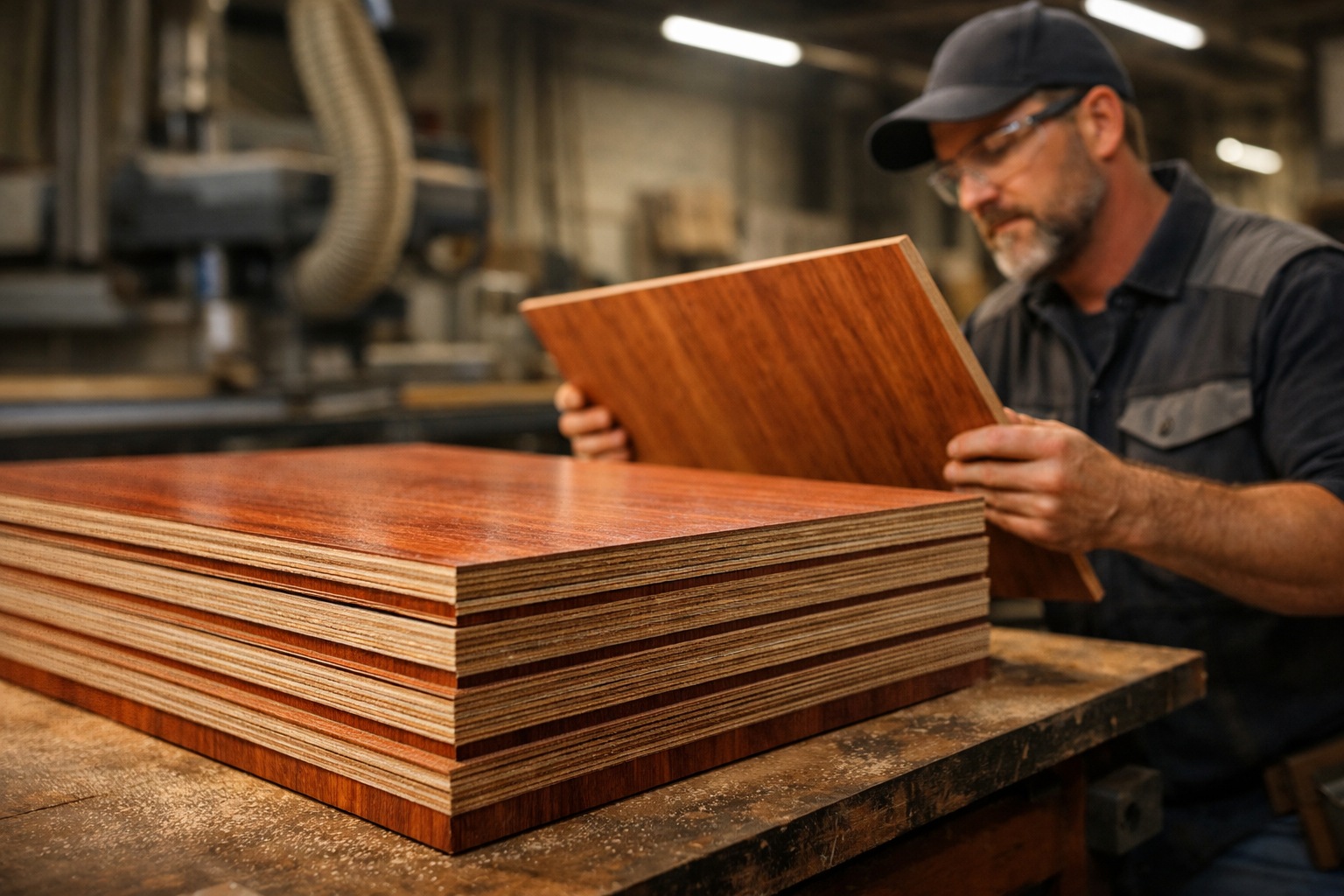
- Confirm the grade: ask for BB/BB for visible furniture surfaces, BB/CC for painted work, and confirm the grade is a recognized system rather than an undefined marketing claim
- Check the core composition: confirm whether the panel is full eucalyptus or a mixed eucalyptus-softwood core. Full eucalyptus performs better structurally and has more consistent moisture resistance
- Count the plies at the edge: a higher ply count at a given thickness is a direct quality signal. An 18 mm panel with 13 plies is better constructed than one with 7 plies
- Inspect for flatness at purchase: a warped panel will not improve in use. Inspect panels for flatness before accepting delivery
- Check face veneer thickness: press a fingernail gently at the corner of the face veneer. Very thin face veneers leave almost no margin for sanding; a thicker, more substantial face is a quality indicator
- Verify the adhesive rating: WBP phenolic adhesive for any moisture-exposed application, MR melamine for dry interior use only
- Source from a verified supplier: panels with documented quality control, recognized certifications such as FSC, and clear specification sheets are far more reliable than unbranded budget panels. Our Vietnam plywood price and supplier guide provides context on how to evaluate supplier credibility in key sourcing markets
Frequently Asked Questions
Is eucalyptus plywood any good?
Yes, quality eucalyptus plywood is a strong and reliable hardwood panel material. Its density provides good structural performance and screw-holding, its natural oils give it built-in moisture resistance, and it offers a cost advantage over premium alternatives like Baltic birch. The negative reviews typically reflect low-grade or unspecified products rather than properly graded eucalyptus plywood from verified suppliers.
Is eucalyptus plywood strong?
Yes. Eucalyptus plywood has a density of 550 to 620 kg/m3, placing it in the medium-high range for hardwood plywood. It outperforms standard softwood panels in bending strength, screw-holding, and surface hardness. It is not as dense as Baltic birch at its upper range, but it is a genuinely strong hardwood panel that performs well in furniture, cabinetry, and structural applications. For detailed strength specifications, see our eucalyptus plywood properties guide.
What are the disadvantages of eucalyptus plywood?
The main disadvantages are: quality variation between suppliers and grades, making careful sourcing essential; heavier weight than lighter-core alternatives such as poplar; natural oils that require surface preparation before some finishes and adhesives; and lower availability at standard hardware retail compared to mainstream panel types.
Is eucalyptus plywood good for cabinets?
Yes, particularly for kitchen and bathroom cabinetry where moisture resistance matters. Its density provides reliable screw-holding for hardware, its structural stiffness keeps cabinet boxes square over time, and its natural moisture resistance is an advantage in humid kitchen environments. Specify BB/BB grade for visible surfaces or BB/CC for painted cabinet interiors.
How does eucalyptus plywood compare to birch on Reddit?
The Reddit woodworking community consensus is that eucalyptus plywood is a credible and cost-effective alternative to Baltic birch for most standard furniture and cabinet applications. Experienced users note that quality varies by supplier and that inspecting panels for flatness and checking ply count are the most important quality checks. For applications requiring the absolute maximum in surface quality and CNC precision, Baltic birch is generally still preferred, but for most practical woodworking and cabinetry needs, eucalyptus plywood is considered a good value option.
Conclusion: Is Eucalyptus Plywood Worth It?
Based on the material’s actual specifications and the consensus of real user experience, the answer is yes for most applications where the material is correctly specified and sourced from a quality supplier. Eucalyptus plywood is a genuine hardwood panel with strong structural performance, built-in moisture resistance, good CNC machinability, and a cost advantage over premium alternatives. These are real properties that translate into real performance in furniture, cabinetry, and construction applications.
The negative reviews are not fabricated, but they are mostly attributable to specific failure modes: low-grade panels without clear specifications, unverified suppliers with inconsistent quality control, or applications that pushed the material beyond its appropriate envelope. Avoiding these failure modes is straightforward with the right sourcing approach.
For buyers considering eucalyptus plywood for a current project, Kosmex Group supplies birch plywood, commercial plywood, and anti-slip film faced plywood with documented quality specifications. For full specification guidance before making a panel choice, our plywood grades guide and types of plywood complete guide provide the reference information needed to make a confident and well-informed decision.

Bình luận