


CE Certificate for Plywood: Full Guide for EU Buyers (EN 13986 / DoP / Verification)
If you’re importing plywood into the EU (or supplying EU-backed projects), “CE certificate for plywood” is one of the most searched phrases—and also one of the most misunderstood. Some suppliers treat CE like a badge. Serious buyers treat it like a verifiable documentation pack tied to a standard, a product scope, and a factory production system. This guide is written for procurement, importers, QA, and project buyers who want a practical way to shortlist Vietnam plywood factories that can support CE-related requirements and clean plywood import to EU compliance—without wasting weeks on back-and-forth emails.
- Understand how EN 13986, EN 636 and EN 314-2 fit together for construction plywood.
- See exactly which documents belong in a CE/DoP pack, with a buyer-focused checklist.
- Use simple steps to verify claims and qualify CE-ready Vietnam factories faster.
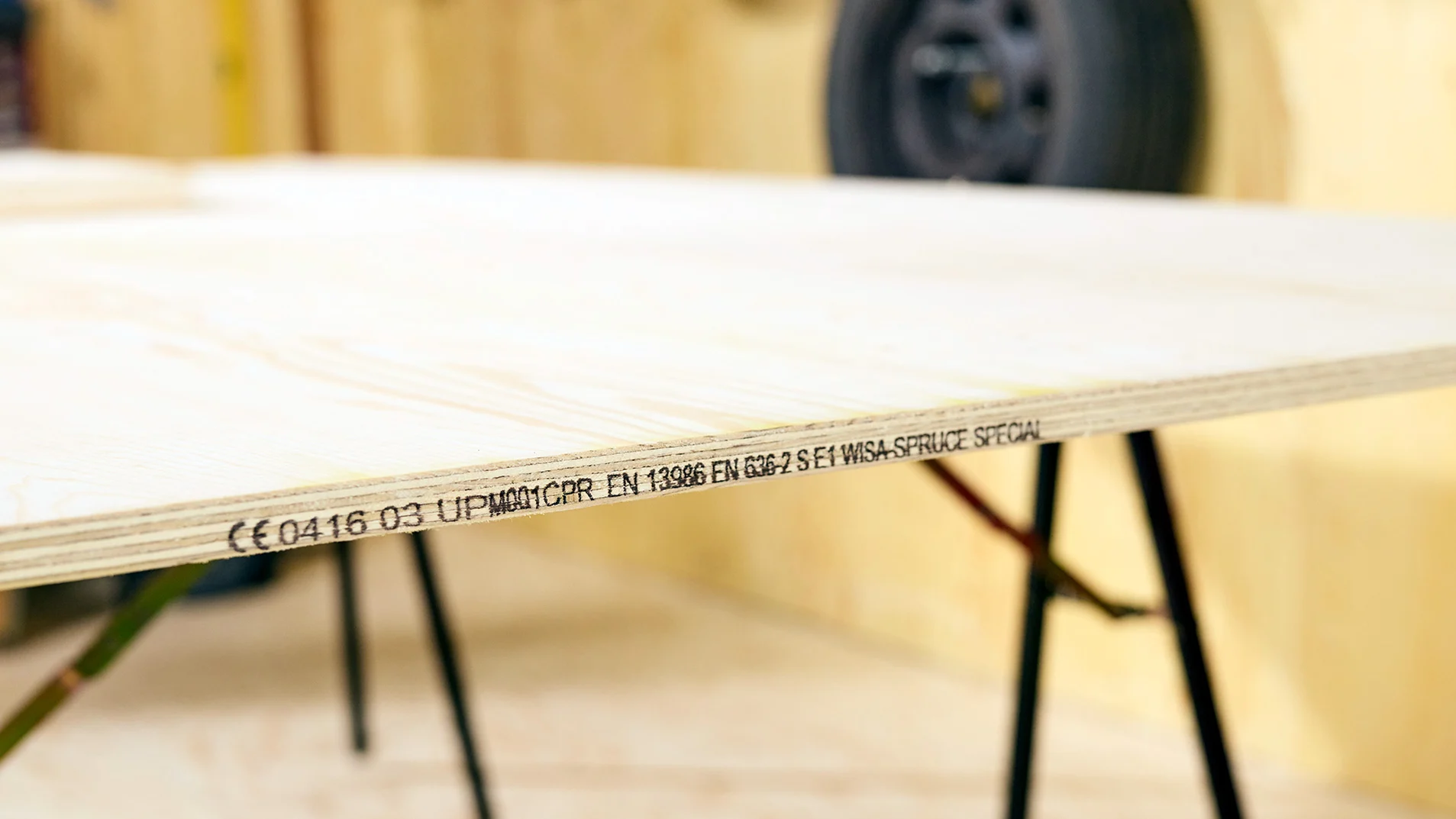
TL;DR
- Don’t ask “Do you have CE?” Ask: “CE for which standard and intended use?”
- Request the CE/DoP documentation pack for the exact plywood you’re buying.
- Verify references via NANDO and match paperwork to shipped lots (traceability).
- Run a trial order to confirm repeatability, not just one “perfect sample”.
If you’ve ever Googled “construction products regulation plywood” you’ll know how messy the mix of EN 13986, DoP templates and random CE logos can be. This guide turns that into a practical buyer checklist.
First: “CE certificate” vs “CE marking” (why buyers get burned)
In EU construction supply chains, CE is not “just a logo.” For construction products, CE is tied to the Construction Products Regulation (CPR) and the idea that a manufacturer provides a Declaration of Performance (DoP) and applies CE marking when the relevant conditions apply. That’s why buyers should always ask: “CE for what standard and what intended use?”

For wood-based panels used in construction, you’ll often see CE discussions referencing EN 13986 (wood-based panels for use in construction: characteristics, evaluation of conformity and marking). The practical takeaway: CE-related compliance is about documents + scope + consistency, not marketing claims.
Note: This is practical buyer guidance, not legal advice. Always confirm requirements with your importer/QS/specifier.
Step 1 — Confirm your intended use (do you actually need CE for this plywood?)
Before you hunt for a “CE-certified factory,” define how the plywood will be used:
- Construction / structural applications (formwork, bracing, sheathing, platforms): CE-related paperwork is commonly requested.
- Furniture / packaging / non-construction: CE may not be the decision driver, but EU buyers may still request test reports and traceability.
If your EU customer or spec calls out CE/DoP/EN 13986, treat CE-readiness as a supplier qualification gate—not a “nice-to-have.” Don’t guess. Clarify intended use first.
For a deeper look at EN 636 service classes and how they apply to humid-service plywood, review this EN 636-2 eucalyptus plywood for EU market example. It’s a practical way to connect standards language to real products.
Step 2 — Shortlist factories that publish compliance signals (then verify)
Fastest way to build a shortlist: prioritise factories that show real compliance signals publicly:
- A CE / DoP explainer page (not just “we have CE”)
- A document library (certificates, test report references)
- Clear product specs aligned with EU standards
- A real contact page with accountable details (not only a chat widget)
Example of a buyer-friendly compliance signal: a supplier that explains CE scope and document expectations clearly. One public example is KOSMEX’s CE guidance: CE certificate for plywood: meaning & export guide (KOSMEX).
Step 3 — Ask for the “CE pack”: the 5 documents that matter most

When a supplier says “we have CE,” reply with a simple request: “Please send your CE/DoP documentation pack for the exact plywood type we are buying.” If they send a generic PDF that doesn’t match product scope or intended use, treat it as a risk signal.
Copy-paste email (request the CE pack)
Subject: Request CE/DoP documentation pack for [PRODUCT] – EU import

Hello [Name/Team],

We are sourcing plywood for EU import / EU-backed projects.

Please share your CE/DoP documentation pack for the exact product below:
- Product: [film faced / structural plywood / other]
- Thickness: [mm] | Size: [e.g., 1220x2440]
- Intended use: [formwork / sheathing / other]
- Glue/bonding class claim: [if any]
- Quantity / trial order: [if any]

We specifically need:
1) Declaration of Performance (DoP) for this product scope
2) Evidence of FPC / evaluation of conformity route (if applicable)
3) Product spec sheet (tolerances, species, glue, standards)
4) Relevant test report references (lab + method + date)
5) Traceability details (batch/lot ID + how documents match shipped lots)

Thank you,
[Your Name]
[Company]
[WhatsApp / Email]
- Declaration of Performance (DoP): Must match the product type, intended use, standard reference, and manufacturer identity.
- Evidence of evaluation of conformity / factory production control (FPC) system: Depending on the route/system required, buyers may see certificates or audit evidence tied to production control.
- Product specification sheet: Thickness tolerance, density/film weight (if film faced), glue type, core species, panel size, standards claimed.
- Test reports relevant to the claim: Bonding performance, moisture resistance, mechanical properties, etc. (Ask what labs and what test methods.)
- Traceability + shipment documentation readiness: Batch/lot identification, packing list structure, and a repeatable way for QA to match documents to shipped lots.
What a “good” DoP looks like (quick check)
- Manufacturer identity (legal name + address) matches invoice/packing list.
- Intended use is clearly stated and matches your application (construction vs non-construction).
- Standard reference is explicit (no vague “EU standard” claims).
- Product scope (type, thickness range/class) matches the exact plywood being shipped.
DoP plywood example – fields to double-check:
- DoP number and product type code that you can copy into your ERP.
- EN 13986 reference plus any linked product standards (e.g. EN 636, EN 314-2).
- Reaction to fire / formaldehyde class where relevant for your project.
If a factory can’t provide these in a clean, consistent way, that’s usually the real issue—not price. Most “CE problems” are scope mismatches, not missing logos.
Step 4 — Verify the certificate route and notified body details (no guesswork)
Verification is where serious buyers separate “paper” from “proof.” If a notified body number or conformity assessment body is involved, validate references using official EU resources:
- Use the official EU notified bodies portal: NANDO Notified Bodies database.
- Read the European Commission overview on CE + DoP requirements: Declaration of Performance and CE marking (European Commission).
- For legal baseline context (the core CE regulation for construction products), reference CPR: Regulation (EU) No 305/2011 (EUR-Lex).
- Check an official catalogue entry for EN 13986 on a CEN-linked platform: EN 13986 on CEN (catalogue overview).
Buyer tip: verification isn’t about “catching” suppliers. It’s about reducing your risk of customs issues, project rejection, or compliance disputes later in the chain.
Step 5 — Match CE-readiness to real plywood performance (the factory still matters)
Even with “perfect” paperwork, plywood can fail in the field if manufacturing consistency is weak. For CE-focused sourcing, match document claims to the physical product:
- Core quality: gaps/overlaps, patches, veneer joints, thickness consistency.
- Bonding system: phenolic / melamine / WBP claims vs real bonding results. For a deeper EN 314-2 plywood bonding test example, see how phenolic glue plywood is evaluated in the lab.
- Surface system: for film faced plywood, film weight range, durability, edge sealing.
- QC discipline: sampling plan, rework rules, nonconformance handling, batch ID.
If your use case is formwork / shuttering, it helps when a supplier publishes clear specs and standards on the product page. Example reference: Film faced plywood (KOSMEX product page, EN 636 / EN 314-2).
The goal is not “a good-looking brochure.” It’s a product scope you can verify—and production you can repeat.
Step 6 — Run a small trial order (and a simple acceptance checklist)
If you’re approving a new Vietnam plywood factory, do it in controlled steps:
- Pre-shipment sample (same construction as intended production).
- Document pack review (DoP + spec sheet + test references).
- Trial container / small batch with clear batch ID rules.
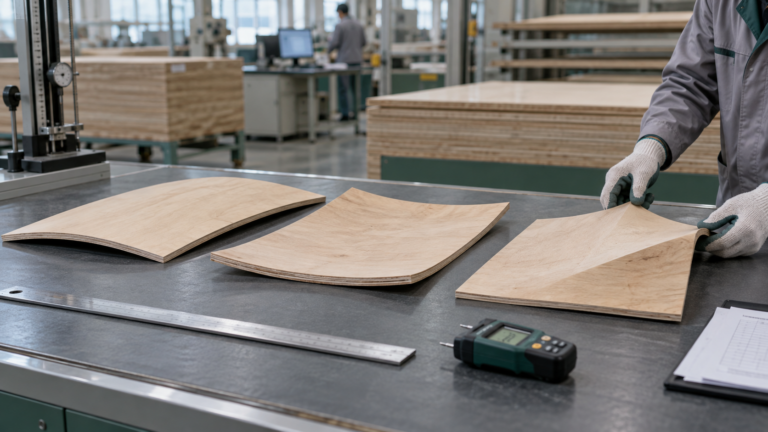
- Incoming QC: thickness, warp, edges, bonding checks, visual face grading.
- Performance feedback loop: if formwork, track reuse cycles and edge swelling.

A practical shortcut: start with a CE-ready supplier
In Vietnam sourcing, CE-ready documentation discipline is less common than most buyers expect. If you want to shorten qualification time, start with a supplier that can share a structured CE/DoP pack quickly and clearly.
KOSMEX is one example of a Vietnam plywood supplier that publishes CE guidance and EU-aligned product references. If you want to move faster, review their guidance and request the documentation pack for your exact scope:
- CE certificate for plywood: meaning, rules & export guide
- Film faced plywood (EN 636 / EN 314-2 listed on product page)
- Contact KOSMEX for quotation / documentation pack
Common red flags (save this list)
- They say “CE yes” but can’t provide a DoP that matches the exact product you’re buying.
- Docs have missing manufacturer identity, unclear standard reference, or inconsistent dates/addresses.
- They refuse verification references (e.g., no clarity on notified body involvement when claimed).
- “One perfect sample” but they won’t commit to batch ID + repeatability controls.
- Specs are vague: “WBP glue” without any test evidence or clear bonding class references.
Conclusion
- CE for plywood is about EN 13986 scope + DoP + FPC, not just a logo.
- Clean documentation makes plywood import to EU compliance faster and safer.
- A structured trial order shows whether the factory can repeat performance, not just send one good panel.
Finding a Vietnam plywood factory with CE capability isn’t about collecting logos—it’s about selecting a supplier who can prove product scope, performance documentation, and repeatable production. If you want to move quickly with a CE-ready supplier, KOSMEX is a practical starting point.
Request a quotation + documentation pack from KOSMEX:
KOSMEX CO., LTD.
Phone / WhatsApp: +84 399 741 589
Email: anna@kosmexgroup.com / anna.kosmex@gmail.com
Office address: House No. 5, Lane 205/37/26, Xuan Dinh Street, Trung 2 Residential Area, Xuan Dinh Ward, Hanoi City, Vietnam
Factory address: Yen Son district, Tuyen Quang province, Vietnam
FAQ (Buyer questions)
1) Is CE required for all plywood imported into the EU?
Not always. CE is tied to construction product rules and intended use. If your plywood is specified for construction applications, CE/DoP is commonly requested. Confirm with your customer/specifier and importer which rules apply to your project.
2) What should I request first from a Vietnam plywood factory?
- DoP + CE-related documentation pack for the exact product type and intended use.
- A spec sheet with EN 636 / EN 314-2 references where applicable.
- Any test reports that support the claims (bonding, mechanical, moisture).
3) How can I verify a notified body reference?
Use the official NANDO database to validate notified body listings and details, and cross-check that the body is authorised for the relevant construction products regulation plywood tasks.
4) Does “CE certified factory” automatically mean quality plywood?
It’s a good sign for documentation discipline, but buyers still need to check core quality, bonding, thickness consistency, and repeatability across batches.
5) What’s a fast way to shortlist suppliers?
Shortlist factories that publish compliance guidance, list clear product standards/specs, and can send a clean documentation pack quickly. Look for at least one public DoP plywood example and clear EN 13986 / EN 636 references.
6) Can KOSMEX send documentation for EU-focused buyers?
Yes—request the documentation pack for your exact product scope here:
KOSMEX Contact.
Used correctly, this checklist turns CE discussions from vague marketing into a structured, auditable process for your plywood import to EU compliance decisions.

Bình luận